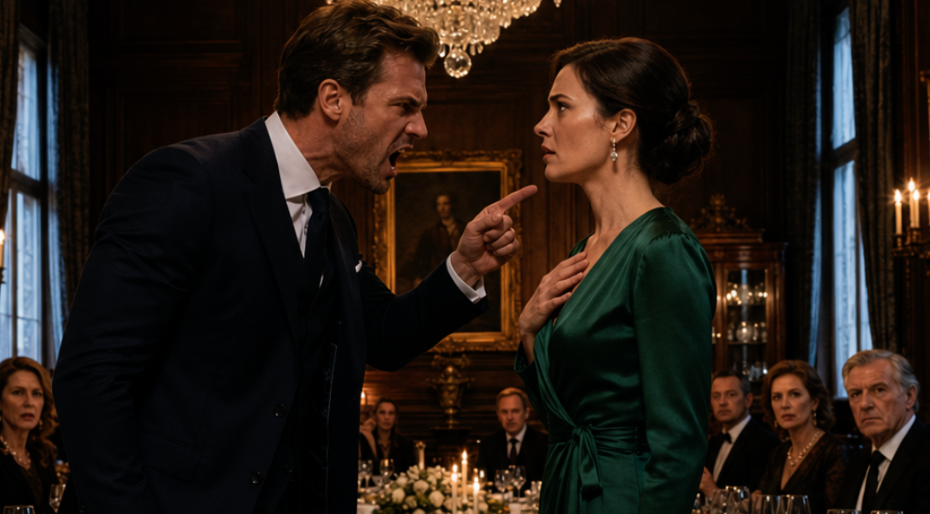
The golden link snapped with a sound as if someone had bitten through a dry piece of macaroni. The sharp jerk burned the skin at the back of Valeria’s neck, and she felt the thin chain — her thirtieth-birthday gift to herself — slide down behind the bodice of her evening dress.
There were exactly twenty-seven guests in the banquet hall of the Northern Lights restaurant. Surgut’s business elite: owners of contracting firms, heads of capital construction departments, a couple of city hall officials. All of them froze, staring at Igor.
Igor stood there breathing heavily, his fingers still clenched into a fist. His face, reddened by the cognac he had drunk, glistened under the crystal chandeliers.
“Penny-poor upstart!” he spat, and a drop of saliva flashed in the air. “You thought that because I dragged you out of an internship and married you, you were suddenly my equal? Decided to run your little schemes behind my back? Checking estimates, are you… Some expert you turned out to be!”
Valeria slowly raised her hand and fixed a loose strand of hair. She did not cover her face with her hands. She did not burst into tears. She simply looked at Igor — her husband and once-adored mentor, the man who had taught her ten years ago how to “take a hit” on construction sites. Now he himself was breaking the main rule: never lose face in front of a client.
“Igor, you broke the clasp,” she said calmly. “That chain costs three hundred and forty thousand rubles. Plus emotional damages in front of witnesses.”
“I’ll buy you ten of those!” Igor spread his arms, addressing the guests. “Did you hear that? She’s lecturing me about money! A woman who came into my company wearing faux-leather shoes and carrying a little notebook! Everything you have is my success. My drive! And you’re just… an extension. I’m the load-bearing wall here!”
Igor’s laugh was loud, but somehow strained. The guests reached for their glasses. The heavy silver platter engraved with “To the Best Partner,” standing in the center of the table, reflected this absurd performance.
Valeria looked at the wall clock above the bar.
7:15 p.m.
Exactly one hour before the dinner began, at 6:15 p.m., she had been sitting in her car in the restaurant parking lot, listening to the ringing tone on her phone.
“Yugra-Finance Bank support service, how may I help you?”
“Hello. I’m Valeria Volkova, co-founder and financial controller of Sever-Stroy. I request that the corporate card issued in Igor Volkov’s name be blocked, and that access to the main account be restricted due to suspected unauthorized transactions. Confirmation password: ‘Blueprint-2024.’”
The operator answered three seconds later: “Confirmed. The card will be blocked within one hour.”
Valeria remembered that conversation as she looked at her husband. She knew something Igor did not yet understand: for the past three years, Sever-Stroy had survived only because of her projects and her connections. Igor, meanwhile, had been spending working capital on dubious crypto investments and endless “image-building” parties. His success, which he defended so fiercely, had long since become a soap bubble that she had kept afloat out of a strange sense of duty to her teacher.
“Igor, the waiter is bringing the bill for this banquet,” Valeria said, nodding toward the man in a white bow tie approaching their table. “Three hundred and eighty thousand. Plus tip.”
“Oh, stop whining!” Igor carelessly pulled his wallet from his pocket and took out a gold card. “Everyone watch how the ‘penny-poor upstart’ is about to blush.”
He handed the card to the waiter as if he were presenting him with a medal. The waiter inserted the plastic into the terminal. Five seconds passed. Ten. The device emitted an unpleasant, squeaky beep.
“I’m sorry,” the waiter said quietly. “The card has been declined. Insufficient funds or blocked.”
The banquet hall became so quiet that the clatter of dishes in the kitchen could be heard. Igor stared at the terminal in disbelief.
“That’s impossible. Check again. The signal is probably bad. This place is a bunker, not a restaurant.”
The waiter repeated the transaction. The same beep sounded again.
“I’m sorry, the terminal shows the error ‘Card blocked by bank.’ Do you have another method of payment?”
Igor began to flush. He pulled out a second card, a platinum one.
“Here, try this one. There’s definitely money on it.”
The result was the same. The guests’ faces took on the expression Valeria called the “Surgut grin” — the look people got when, only a minute after flattering you, they began calculating whether it was time to move to another table.
“Some kind of misunderstanding,” Igor muttered, frantically scrolling through contacts on his phone. “I’ll call the bank right now. They’ve all gone insane over there…”
“Don’t call, Igor,” Valeria said, taking a sip of water. “The card was blocked by my order. Just like all Sever-Stroy accounts.”
Igor froze with the phone at his ear. Slowly, he turned to his wife. There was no triumph left in his eyes now, only a growing, animal rage.
“What did you do? Do you even understand what you’re doing?! In front of people! You’re humiliating me?!”
“I’m saving what’s left of the company,” Valeria cut him off. “Yesterday you transferred eight hundred thousand to the account of your ‘consulting group,’ which consists of your mother and her friend. That is a withdrawal of funds bypassing a co-founder. Under clause 8.4 of our charter, I have veto power over any transactions above five hundred thousand without my signature.”
“I wrote that charter myself!” Igor shrieked.
“You dictated it. I wrote it. And I inserted that clause when I realized that your ‘drive’ was ordinary gambling addiction.”
The guests began quietly getting up. Saveliev, the developer who had planned to discuss a major contract with Igor, suddenly remembered that his “wife was worried at home.” The city hall official delicately disappeared toward the restroom.
“Igor,” Valeria stood up. “7:34 p.m. Exactly nineteen minutes ago, you ripped the chain off my neck. And now you can’t even pay for coffee for your friends.”
“You little…” Igor raised his hand, but suddenly collided with Valeria’s gaze. It was the cold, analytical gaze of a project manager used to dealing with defect claims.
“I wouldn’t advise it,” she said softly. “There are cameras here. And I have an excellent lawyer. You lost control of the project called ‘our life’ a long time ago, Igor. Today I simply signed the acceptance report for the ruins.”
She turned to the waiter and took her personal card from her small clutch — the one that received her royalties for designing the bridge across the Ob.
“Close the bill. And bring me my chain, please. It fell somewhere under the table.”
Igor sank into a chair, breathing heavily. He watched the guests leave, watched the hall he had filled with people for the sake of his ego grow empty. He looked like an old building before demolition — the facade still standing, but the foundation already turned to sand.
Valeria felt a strange mixture of bitterness and… laughter. The whole situation was so absurd, so darkly comic, that she wanted to smile. She truly could destroy him. In a folder on her desktop lay proof of his kickbacks from the last tender. One call to the prosecutor’s office, and Igor Volkov would move from the Northern Lights to places with far less lighting.
But she did not want to. That would be too easy. And too… boring.
Valeria stepped outside. The Surgut evening struck her with a sharp, cold wind. She stood on the restaurant porch, pressing the recovered chain to her chest. The clasp really was hopelessly broken.
A minute later, the door opened, and Igor came out onto the porch. Without a coat, wearing only his suit jacket, he looked small and ridiculously disheveled. He came up to her and stayed silent for a long time, looking at the lights of the night city.
“Lera… you’re going to destroy me anyway, aren’t you?” His voice was dry, without a trace of his former arrogance. “Tomorrow you’ll come to the office, gather the board of directors… I know you have all the cards in your hands.”
Valeria looked at him. She saw not an enemy, but that same man who had taught her ten years ago to identify the grade of concrete by the sound of a shovel hitting it. He had broken what he himself had once built — her loyalty, her respect, her love. But he still remained her teacher, even if only a former one.
“I won’t destroy you, Igor,” she said. “And I won’t file a report about the kickbacks.”
Igor jerked his head up. A spark of hope flashed in his eyes.
“You… you forgive me? Lera, I swear I’ll fix everything! We’ll go on vacation, I’ll close those accounts…”
“No, Igor. I forgive you not out of kindness. And not for the sake of ‘us,’ because there is no ‘us’ anymore. I forgive you because you are no longer interesting to me as an opponent. You are an inefficient asset. Fighting you means wasting my most valuable resource: time.”
She adjusted the collar of his jacket — an automatic gesture left over from past years.
“Tomorrow I’ll come to the office. We’ll sign the business division papers. You take the contracting company Stroy-Surgut — the one that still works the old-fashioned way. I take the design bureau and the rights to all my developments. The accounts will be unblocked only enough for you to pay people’s salaries and close the loan debts. The rest is mine.”
“But that means… that means I’ll be left with pennies!” Igor tried to protest, but Valeria placed a finger to his lips.
“It means, Igor, that you will remain a free man with a functioning business. That is more than you deserve after tonight. Consider it my final lesson to you: never humiliate the person holding your checkbook.”
Igor looked at her for a long time. His gaze changed: from resentment to realization and finally to something resembling acknowledgment. For the first time, he saw in her not a “student,” not a “wife,” but an equal player. In that look there was respect, burned down to ash, but real.
“You became better than me, Lera,” he said quietly. “I made you that way myself.”
“Yes,” she nodded. “Thank you for that.”
A taxi pulled up to the porch. Valeria went down the steps without looking back. She got into the car, and when the driver asked for the address, she thought for a second.
“Embankment, number twelve.”
She drove through Surgut, looking at the dark Ob River. In her bag lay the broken gold chain. She would take it to be repaired. Or maybe she would simply have it melted down into something new.
She had no revenge, no triumphant cry. There was only the silence inside the car and a clear understanding of the next step. She was Valeria Volkova, and tomorrow she would begin her first solo project. Without mentors. Without tyrants. Simply — on her own.
She opened the notes app on her phone and wrote:
“To-do list for tomorrow. 9:00 a.m. — Rebranding.”
It had been a good evening. Expensive, bitter, but very useful. Like strong coffee without sugar, which she had grown so fond of over the years.