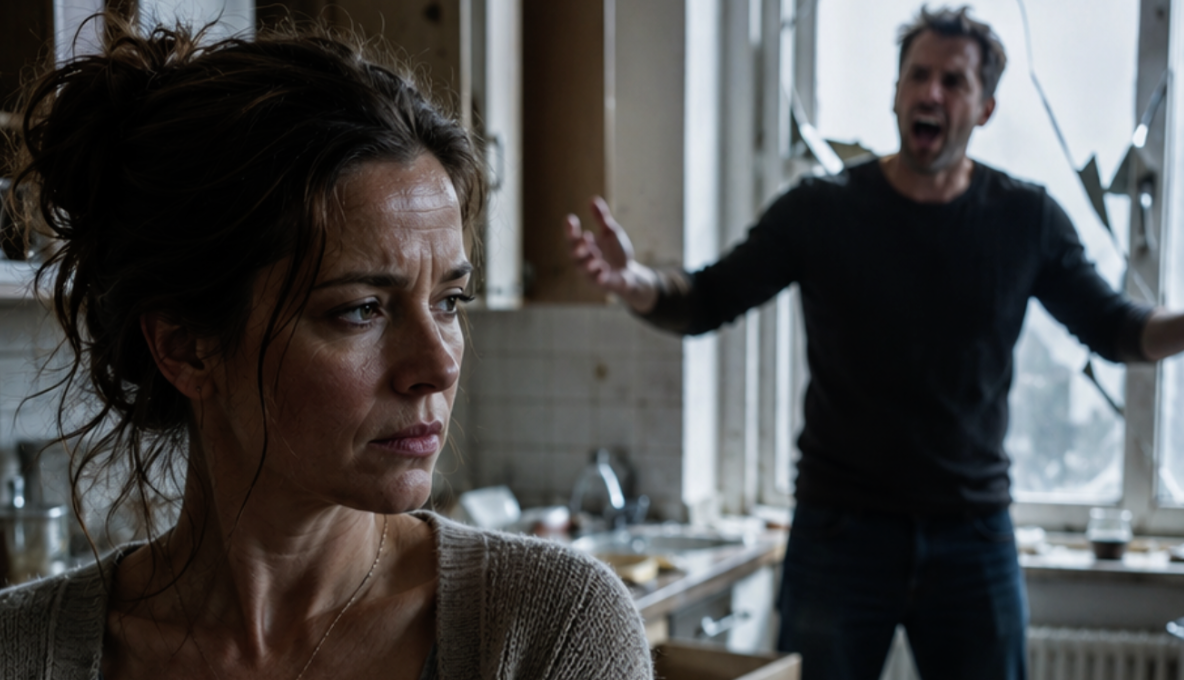
The broken cup lay by the baseboard, scattered into three uneven shards. On the floor, among flour, spilled sunflower oil, and fragments of faience, a kitchen chair lay overturned, one leg twisted out of place. The fronts of the lower cabinets were hanging open, the doors dangling from a single hinge, and a dark wet stain spread across the wallpaper above the sink: Danya had hurled a mug with the last of his tea at it, not aiming, only wanting the noise to be louder, wanting the air to tremble, wanting Olya to understand.
He stood in the doorway, breathing heavily, fists clenched, the collar of his shirt unbuttoned. His eyes darted around, searching for her reaction. He was waiting for tears. Waiting for her voice to tremble, for her to take a step back, for a submissive, “Fine, all right, I’ll give it to you.” He was waiting for what had worked before.
Olya was sitting on the only stool that had survived. In front of her stood an intact cup. She took a slow sip, set it down on the table, and looked at him without haste, without anger, without fear. She simply looked.
“Where is the money?” His voice cracked into a hoarse rasp. “The apartment has been sold. The account has been opened. You know what we discussed. These are joint funds. I won’t tolerate you hiding them from the family.”
Olya nodded, as if agreeing with a fact about the weather.
“We discussed it. But we didn’t decide it.”
“Enough games!” he snapped, stepping forward. His boot crunched on a shard. “Do you see what I’m capable of? I can smash everything. I can leave. I can make sure you regret this later. Give me the key to the safety deposit box. Right now.”
Olya slowly looked around the kitchen. Broken glass. Torn-down shelves. The smell of spilled vinegar and old dust. She remembered how her grandmother always used to say, “Fear is a poor builder. A house won’t stand on it.” She remembered how three months earlier Danya had “borrowed” her savings from her “as a friend,” promising it would only be for a week. How that week had turned into three. How debts had appeared. How excuses had followed. She remembered the first time he had raised his voice at her because she had bought the wrong wallpaper. And how she had shrunk inside then, believing it was her fault.
She would not shrink anymore.
“The money will be where it belongs,” she said quietly. “Don’t worry.”
He smirked, but the smirk came out crooked, unconvincing.
“Is that a threat? Are you threatening me now? After I…” He stopped short and glanced at the wreckage around him. “Fine. Think about it. I’m giving you twenty-four hours. Tomorrow evening, I expect confirmation of the transfer. Or we don’t speak anymore.”
He turned around and slammed the door so hard that another strip of plaster crumbled from the wall. Olya did not flinch. She stood up, stepped around the puddle of oil, carefully picked up the shards of the cup, and folded them into a piece of newspaper. Then she took out her phone and dialed a number.
“Mom,” she said when the call was answered. “Let’s make everything official. The inheritance should be in your name, not mine. Yes, today. I’ve already called the notary. No, not a word to Danya. Let him think everything is the same as before. Thank you. I’ll be there in an hour.”
The car sped along the gray avenue, and Olya looked out the window, feeling something inside her settle into place. Not joy. Not triumph. Just clarity. The kind that comes when you stop being afraid of someone else’s shadow.
The notary’s office smelled of old paper and wax. Her mother sat across from her, straight-backed and composed, wearing the formal coat she only put on for important matters. They did not hug. They did not cry. They simply signed. The notary, a gray-haired man with tired eyes, flipped through the documents, stamped them, and asked clarifying questions. Olya answered clearly. Her mother nodded. When everything was ready, the notary closed the folder and looked at her over his glasses.
“Everything is ready.”
“Thank you,” Olya said. She took the statement, slipped it into her bag, and went outside. The wind tousled her hair, but she felt warm.
She came home late. The kitchen was still in the same condition. She did not start cleaning right away. She took off her coat, hung it up, poured herself some tea, and sat down. Her phone was silent. Danya did not call. He did not write. Let him think she was confused. Let him believe time was working in his favor.
The next morning, she called a cleaning service. While men in blue overalls carried out the trash, wiped down the walls, and changed the hinges, Olya sat in the living room and reviewed reports from the realtor. The money had already been transferred into her mother’s account. And once everything was over, her mother would transfer it all to Olya’s account. Olya decided she would put part of it into a deposit and set part of it aside for renovations.
Danya appeared toward evening. The door opened slowly. He came in and looked around. The kitchen was shining. A new backsplash, even shelves, intact dishes. It smelled of lemon and fresh wood. He froze.
“You cleaned everything up?” he asked, and something strange flickered in his voice. Not anger. Uncertainty.
“Yes,” Olya replied, not looking up from her laptop.
“And the money?” He came closer. “You didn’t transfer it? I checked. The joint account is empty.”
Olya closed the laptop and looked at him.
“Danil, we never agreed on a joint account. We agreed that you would stop giving me ultimatums. And the money is with my mother. Now it is her inheritance and her money.”
He turned pale. He took a step back. His hands trembled.
“What do you mean?”
“I mean exactly what I said. Grandma’s apartment is no longer my inheritance. The paperwork is complete. Legally, financially, emotionally. It isn’t mine. You can be angry. You can smash dishes. You can leave. But the money will stay where I decide it should stay.”
He opened his mouth, then closed it. His throat moved dryly. He looked at the door, at the window, at his own hands, which only yesterday had seemed to him like instruments of power, and now had suddenly become nothing more than bone and skin. He sat down on the edge of the sofa. His back bent. His shoulders dropped.
“Olya…” His voice was quiet, almost childlike. “I… I was just scared. That you would leave. That you would abandon me. That everything would fall apart. I didn’t think… I just wanted us to be together. For everything to be like before.”
Olya said nothing. She saw the structure inside him collapsing—the one he himself had built: the belief that fear was glue, that a loud voice was authority, that a wrecked kitchen was proof of love. She saw him realizing that he had been wrong. Not in his words. In the very foundation.
“And I wasn’t afraid,” she said at last. “Not then, not now. You thought that if I trembled, I would become convenient. But convenience is not closeness. It is just the silence before a breakdown.”
He raised his eyes. There was no calculation in them. Only emptiness, where understanding was slowly beginning to grow.
“I’m sorry,” he breathed. “I… I was wrong. I’m ready to change. I’ll take a second shift. I’ll be there for you. Just… don’t throw me out. Give me a chance. I’ll come back. I want to come back.”
Olya stood up and walked to the window. Behind the glass, the sunset was fading, painting the buildings a soft amber. She remembered her grandmother’s hands. Wrinkled, strong, never clenched into fists. She remembered how her grandmother used to say, “Daughter, don’t confuse loudness with strength. Strength is when you can leave, but you stay because you want to. Not because you’re afraid.”
“You won’t come back,” she said evenly. “Not because I’m cruel. But because you have already made your choice. You chose fear instead of respect. You chose control instead of trust. Now live with that. I’m not holding on to resentment. But I’m not holding the door open either.”
He stood up. Came closer. Stopped one step away.
“Olya… please. Without you… I don’t know how…”
“You’ll learn,” she replied. “Everyone learns. Some faster. Some slower. You won’t get a third time. Not because I’m heartless. But because I no longer believe that something broken can be glued back together with the same glue.”
He nodded. Slowly. Without a word. He took his jacket from the hanger and left. The door closed quietly. It did not slam. It did not ring out. It simply clicked.
Olya was left alone. The apartment smelled of fresh paint and peace. She walked into the kitchen and ran her palm over the smooth countertop. She took out a notebook and opened it to a blank page. She wrote: “Replace the faucet. Hang the shelves. Buy flowers.” Then she closed it. Turned off the light.
She went to bed early. In the morning, she called a designer. They discussed the layout. She chose the color of the walls. Life had not ended. It had simply stopped belonging to someone else. And that was enough.