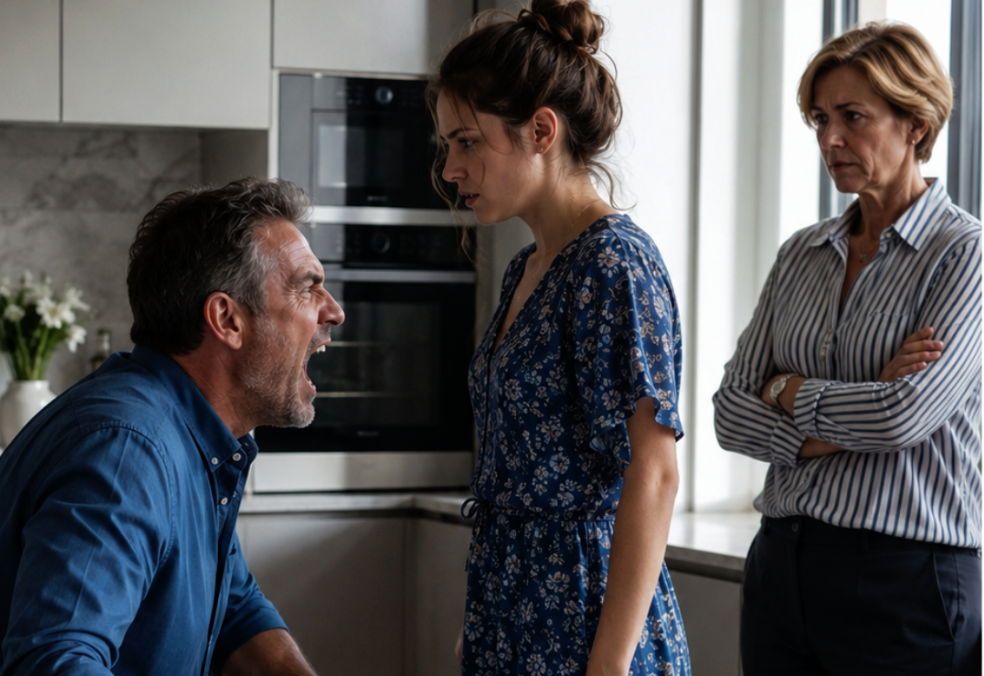
Find a part-time job at night or on weekends! Mom needs support, you have to earn money! — her husband ordered, pounding his fist on the table.
“Listen, are you stupid or what?” Igor threw over his shoulder without taking his eyes off the television. “Sitting at home like a broody hen. My mother works her fingers to the bone, and what about you? Painting your nails?”
Olya did not answer. She was standing at the sink, finishing the dishes after dinner — for the third time that day, because her mother-in-law, Nina Pavlovna, somehow managed to dirty dishes even when she was only drinking tea. The water was hot, almost burning her fingers, but Olya did not turn it down. It was the only sensation that felt real at that moment.
“Find a part-time job at night or on weekends! Mom needs support, you have to earn money!” her husband finally tore himself away from the sofa, came into the kitchen, and struck the table with his fist. Not hard. Just for emphasis. “I said so!”
Olya turned off the water. Slowly, she turned around.
Igor was thirty-seven. Once, he had been different — or had it only seemed that way to her? Now a man stood before her with a reddish face and cloudy eyes — his third can of beer since six in the evening, she counted automatically, no longer even realizing why. His shirt was wrinkled. His slippers did not match — one checked, the other striped.
“All right,” she said quietly.
Igor had clearly expected something else. He narrowed his eyes.
“What do you mean, all right?”
“I’ll think about it.”
He stood there for a moment, chewing his lips, then returned to the sofa. The conversation was over — at least for him.
Nina Pavlovna appeared the next morning without calling. She simply opened the door with her own key — she had made a duplicate a year earlier, claiming that “you never know what might happen.” Olya was just getting ready for work. She worked as an administrator at a small dental clinic, five days a week, from nine to six.
“Oh, already all made up,” her mother-in-law said instead of greeting her, looking Olya up and down. “Where are you off to so early?”
“To work, Nina Pavlovna.”
“She has work.” Her mother-in-law went into the kitchen, opened the refrigerator, and began inspecting its contents as if she were checking someone else’s warehouse. “Igorek told me you’re looking for a side job?”
“I am.”
“That’s right. I worked my whole life and never whined.” She took out a piece of cheese and sniffed it. “What is this, Rossiysky cheese? I don’t eat this kind. Why can’t you buy something decent?”
Olya picked up her bag. Put on her coat.
“Goodbye, Nina Pavlovna.”
“Wait, I haven’t finished talking!” Her mother-in-law put the cheese back but did not close the refrigerator. “I need you to be home this Saturday. My friends are coming over, and someone needs to receive them, set the table, all that.”
Olya stopped at the door. Something slowly stirred inside her — not anger yet, but something very close to it.
“I’m working on Saturday.”
“Where exactly are you working on Saturday?”
“I found a part-time job. That’s what you wanted.”
Nina Pavlovna’s eyes widened. She had definitely not expected that.
Olya had found the side job three weeks earlier — completely by chance. Her colleague Rita had casually mentioned that an acquaintance was leaving a position as an assistant at a private photo studio: helping during shoots, greeting clients, looking after props. Saturdays, Sundays, sometimes evenings. Olya called — and they hired her almost immediately.
The studio was called “Frame” and was located in an old building in the city center that had once housed some kind of research institute. Inside, everything had been renovated: high ceilings, brick walls, huge windows. The owner, Pavel, about forty-five, quiet and precise in his movements, greeted her briefly: “No being late. Phone on silent. The client comes first. We’ll explain the rest as we go.”
Olya was never late. And her phone was always on silent.
In three Saturdays, she had already understood: this place was an entirely different world. They photographed everyone there — young mothers with babies, elderly couples for anniversaries, fashionable girls for portfolios, companies for websites. Olya arranged props, served coffee, helped with changing outfits, and recorded clients’ details. It was not especially difficult, but it required attention — constant, living attention.
She told Igor she had found a part-time job at a café. At the cash register. He did not ask any follow-up questions.
That Friday, everything went wrong from the very morning.
Igor had been in a bad mood since the night before. He had argued with someone on the phone, and that mood settled over the apartment like the smell of dampness. Olya tried not to get in his way: she packed her things in advance, ate breakfast quickly, stood by the window with a mug, and looked down at the street.
In the courtyard, a neighbor was walking a red-haired dog. The dog was dragging her toward the playground, and she was laughing — throwing her head back, completely happy. Olya looked at her and thought: so this exists too. For no reason at all.
“What time are you getting off work today?” Igor shouted from the room.
“Seven.”
“Mother called. She says you were rude to her.”
Olya set down the mug.
“I wasn’t rude.”
“She says you were. So you were.”
It was always like that. Nina Pavlovna said it — so it was true. Olya said it — so it needed to be checked.
She said nothing. Took her bag and left.
The studio was unusual that Saturday. Pavel had warned her back on Wednesday: “There will be a difficult client. A major order. Everything has to be perfect.”
The client turned out to be Viktor Arkadyevich Strelnikov — the owner of a chain of jewelry stores. He was short, fit, dressed in an expensive coat, and came with two assistants and a young woman whom everyone simply called Dina. She stood slightly aside, observed everything carefully, and barely spoke to anyone.
Olya was handling the props when she heard Dina speaking on the phone — quietly, almost in a whisper, but the words were clear:
“…everything is in place. Yes. He doesn’t know. On Monday.”
Dina noticed Olya standing nearby. She put the phone away. Smiled — completely calmly, like a person who had nothing to hide. Or like someone who knew very well how to hide things.
Olya smiled back and moved toward the props table. But those words stayed with her — caught somewhere in her mind and would not leave.
He doesn’t know. On Monday.
What was supposed to happen on Monday — and who did not know?
The shoot dragged on until eight in the evening. When Olya left the building, she almost ran into one of Strelnikov’s assistants. He was standing by the entrance, talking on the phone, clearly nervous.
“…said he saw her there. Do you understand? There. That’s no coincidence,” he was saying quickly, not noticing Olya.
Olya walked past him. She got on the metro. She rode home thinking not about Igor, not about Nina Pavlovna — but about Dina and her quiet phone conversation, and about what exactly was being stored in that studio besides props and other people’s photographs.
Because that day Pavel had locked one of the inner rooms — the one Olya had previously entered freely. And he had not explained why.
At home, it was quiet — suspiciously quiet. Igor was asleep on the sofa, the television mumbling something about the news, two empty cans and a plate with dried crumbs on the table. Olya cleaned it all up silently, without clattering, on autopilot. She showered. Lay down.
But she did not sleep.
She lay there staring at the ceiling, and her thoughts spun on their own, like a stuck record. Dina. The locked room. He doesn’t know. On Monday. Pavel, who in three weeks had never once raised his voice, had suddenly become different somehow — tense, curt, avoiding eye contact.
Maybe there was nothing there. Maybe it was simply someone else’s life, someone else’s business — not her story.
But something would not let go.
Sunday passed under the sign of Nina Pavlovna. Her mother-in-law arrived at noon, again without warning, carrying a large bag with a loaf of bread and some magazine sticking out of it. She entered the apartment as one enters one’s own home — without asking, barely greeting anyone, immediately heading for the refrigerator.
“Igorek, have you had breakfast?” she shouted toward the room.
“I ate,” came the answer.
“What did you eat?”
“Fried eggs.”
“Fried eggs.” Nina Pavlovna pronounced it with such intonation that it sounded like something deeply immoral. She turned to Olya. “You made him fried eggs?”
“He made them himself.”
“Of course.” Her mother-in-law pursed her lips. “A husband cooks for himself. What a fine life you have.”
Olya did not answer. She sat at the kitchen table with her laptop, pretending to read something important. In reality, she had been staring at the same paragraph for about twenty minutes and seeing nothing.
Nina Pavlovna settled opposite her, took out the magazine, and began flipping through it — loudly, demonstratively, as if every page were someone’s verdict. Then she looked up.
“Have you found that part-time job?”
“Yes.”
“Where?”
“In a studio. I help with photo shoots.”
Her mother-in-law was silent for a moment. That was unexpected — she usually did not stay silent.
“What kind of studio?”
“A photo studio in the center. It’s called Frame.”
“Hm.” Nina Pavlovna lowered her eyes to the magazine again, but something in her face changed. Some small, almost invisible reaction. “Do they pay much?”
“Enough.”
“Enough means how much?”
“Enough.”
Her mother-in-law raised her eyes and looked at Olya for a long, studying moment. Then she smiled — unpleasantly, with one corner of her mouth.
“Fine. Your business.”
And returned to the magazine.
Olya looked at her and thought: what was that? Just curiosity — or something else?
On Monday, she worked until six. On the way home by metro, she got off two stops early — for no reason, she just wanted to walk. The street was evening-busy, full of people, shop windows glowing, music playing somewhere from the open door of a café.
She walked and almost thought of nothing — a rare state she had learned to value. Just legs, just asphalt, just air.
Her phone vibrated. An unknown number.
“Hello?”
“Olga?” The voice was male, calm, slightly official. “This is Pavel. Did you save my number?”
“No, I didn’t have time. But I realized it was you.”
A short pause.
“I need you at the studio tomorrow. Not Saturday — tomorrow. At ten in the morning. It’s important. Can you come?”
“I have work until…”
“I know. Take a day off. One day. This is necessary.”
Olya stopped in front of some shop window. The glass reflected the street, passersby, herself — a woman in a coat with a phone to her ear and an expression on her face she would have struggled to describe.
“What happened?”
“Not over the phone. Tomorrow. At ten.”
He hung up.
She took the day off — said she was feeling unwell. It was not entirely a lie: she barely slept that night, and by morning she really did feel as if she had spent hours being driven in a rattling bus.
Igor left for work early — he had some meeting. Olya drank coffee, got dressed, and went out.
The studio door opened as soon as she pressed the bell. Pavel was standing in the corridor — not behind the reception desk as usual, but precisely in the corridor, as if he had been waiting by the door.
“Come in.”
They sat down in the small room where props were usually stored. Pavel closed the door.
“You heard Dina’s conversation on Saturday,” he said. He did not ask — he stated it.
Olya did not deny it.
“Yes. By accident.”
“I know it was by accident.” He rubbed his temple. “Dina works for Strelnikov. Officially, she is his project assistant. Unofficially, she monitors what he does and passes information to other people. People who need that information very much.”
“What people?”
Pavel was silent for a moment.
“His former business partners. They’ve been in conflict for two years. Strelnikov thinks it’s all behind him. He’s mistaken.”
Olya listened. Somewhere outside, the street hummed; something clicked in the radiator. Everything was very ordinary — and everything was completely unordinary.
“Why are you telling me this?”
Pavel looked straight at her.
“Because the locked room contains materials that Strelnikov gave me for safekeeping three months ago. Documents. I didn’t know what they were. Now I do. And now Dina knows they are here.”
“How do you know she knows?”
“Because this morning a man called me. He introduced himself as a lawyer. He said someone would come for the documents in the next few days. And that I had better not interfere.”
Olya exhaled slowly.
“Are you going to the police?”
“I’m thinking about it. But first I need to check something.” He paused again. “Olga, do you know anyone in the legal field?”
“No. I mean… wait.”
She suddenly remembered Vera, a former classmate. They had not seen each other for three years, but they occasionally exchanged messages. Vera worked at a small legal consultancy — not criminal cases, more civil law, but still.
“I have one acquaintance. But I don’t know whether she can help with this specifically.”
“Call her. Today.” Pavel stood up. “And one more thing. Don’t tell anyone you were here today. No one — do you understand?”
Olya nodded. She also stood up. At the door, she turned around.
“Why do you trust me?”
Pavel narrowed his eyes slightly.
“Because Nina Pavlovna Gromova — your husband’s mother — called me on Friday evening and asked whether a certain Olga worked for me. From the description, it was you.”
The ground did not disappear beneath her feet. But something shifted — quietly, irreversibly.
Her mother-in-law. She knew about the studio. She had asked about it.
And that was no longer simple curiosity.
Olya walked down the street and noticed nothing around her. Shop windows, passersby, pigeons on cornices — everything drifted past like slow-motion film. There was one thought in her head that refused to form into anything understandable: Nina Pavlovna knew about the studio. Not just knew — had called there. Asked about her.
Why?
She went into the first café she saw. Small, quiet, with wooden tables and the scent of cardamom. She ordered an Americano, sat by the window, and took out her phone.
Vera answered after the second ring.
“Olya, hi! It’s been ages!”
“Hi. Vera, I need your help. Not as a friend — as a specialist. It’s urgent.”
A pause.
“Tell me.”
Olya spoke quietly, almost in a whisper, though the nearby tables were empty. She laid everything out — the studio, Strelnikov, Dina, the lawyer’s call, the locked room. And the part about her mother-in-law too.
Vera listened without interrupting. That was a good sign: she never interrupted when something genuinely interested her professionally.
“All right,” she said at last. “If the documents were officially handed over for safekeeping, that’s one situation. If unofficially, it’s another. Pavel urgently needs to record the fact of the threat — that call from the ‘lawyer.’ A written statement would be best. I can help draft it. And also — those documents must not be touched, moved, or given to anyone without notarial supervision. Absolutely nothing should be done before consultation.”
“Would he be willing to come to you?”
“Have him call today. Give him my number.”
Olya exhaled — for the first time that morning, truly.
“Vera, thank you.”
“Don’t thank me yet. The story with your mother-in-law isn’t simple either. If she’s somehow connected to those people, that’s a whole different level. Be careful, Olya. Seriously.”
She returned home at two. The apartment was empty — Igor had not come back yet, and thank God Nina Pavlovna was not there. Olya took off her shoes, went into the kitchen, put the kettle on, and simply stood there, holding on to the countertop with both hands.
How had this even happened? Three months ago, she had simply been a woman who washed dishes and listened to her husband pounding his fist on the table. And now she was in the middle of someone else’s story, one that involved documents, pressure, someone’s double game, and her own mother-in-law in an unclear role.
Life knows how to surprise. Not always pleasantly, but always precisely.
The kettle boiled. She made tea, sat down, and began thinking methodically — the way she could when she did not panic.
Nina Pavlovna knew about the studio. She had asked about it. But how had she learned the name in the first place? Olya had told her on Sunday. So the call must have been after Sunday — and before Friday. Pavel had said: “She called on Friday evening.” It all fit.
But why? What connection could there be between Nina Pavlovna Gromova, a pensioner with a magazine and a loaf of bread, and Strelnikov with his jewelry stores and tangled partners?
Her phone vibrated. A message from Pavel: “Spoke with Vera. I’m on my way to her. Thank you.”
Good.
Then another message. From Igor: “I’ll be late. Mother called, said she’ll stop by this evening.”
Olya put the phone aside. So Nina Pavlovna would come in the evening. Well then. Let her come.
Her mother-in-law appeared at eight. Without a bag this time — empty-handed, which was strange in itself. She went into the room, looked around, and sat in the armchair — the very one Olya considered hers.
“Will Igor be back soon?” she asked.
“He said he’d be delayed.”
“I see.” Nina Pavlovna folded her hands on her knees. “Well, fine. Then you and I will talk for now.”
Olya sat opposite her. Calmly. She had made her decision that afternoon: not to attack, not to defend herself — simply to listen and observe.
“Have you been working at that studio long?” her mother-in-law began.
“A few weeks.”
“And how is it? Do you like it?”
“I do.”
Nina Pavlovna was silent for a moment. Then, unexpectedly directly:
“Did you see Strelnikov?”
There it was.
Olya did not blink.
“A client by that name came in, yes. A large order.”
“Large.” Her mother-in-law smirked. “Vitya always knew how to throw dust in people’s eyes. I’ve known him for a long time. A very long time. Since back when he was nobody.”
“You never told us.”
“There are many things I never told.” She looked toward the window. “He owes me, Olya. Seriously owes me. Not money — that no longer matters. But he owes me. And I know that in that studio, there is something I need to see.”
Olya looked at her — at this woman she had thought was simply unpleasant, simply difficult, simply a mother-in-law. But it turned out she had her own story, her own pain, her own score to settle with someone else’s prosperity.
“Nina Pavlovna. Those documents are no longer in the studio.”
Her mother-in-law turned sharply.
“What?”
“They were taken this morning. The owner transferred them to a safe place — with legal supervision. Everything is official.”
It was a half-truth. The documents had not been moved anywhere — but Vera was already working to protect them. Olya took the risk. Sometimes you have to say slightly more than you know in order to see the reaction.
And there was a reaction.
Nina Pavlovna went pale. Not dramatically, but noticeably.
“Who gave permission?”
“The owner of the studio made the decision himself. After he started receiving threats.”
“Threats…” Her mother-in-law repeated the word quietly, almost to herself. Then she stood up. “So Dina managed after all.”
“Dina has nothing to do with this.”
Nina Pavlovna looked at her for a long moment. There was something in that look — not anger, not confusion. Something like exhaustion. Real, deep exhaustion that had been accumulating for years.
“You don’t understand what you’ve gotten yourself into, girl.”
“I haven’t gotten myself into anything. I was just working.”
“No one ever just works. There is always a place, a time, and people — and none of it is coincidence. Never.”
She took her bag. Went to the door. In the hallway, she turned back.
“Tell Pavel I want to talk. Personally. Without lawyers and without Strelnikov. Just talk.”
“I’ll pass it on.”
The door closed. Quietly — without a slam.
Igor arrived around half past nine. He smelled of beer — astonishingly consistent. He threw his jacket onto a chair and went into the kitchen.
“Was Mother here?”
“She was. We talked.”
“About what?”
“Life.”
He snorted and opened the refrigerator.
“You’ve actually become normal lately. You don’t make scenes.”
Olya looked at him and thought: he knows nothing. Not about the studio, not about the documents, not about the fact that his mother is a completely different person from what she seems. He lives in his own small picture of the world, where the main thing is dinner on the table and beer in the fridge.
“Igor,” she said suddenly. “We need to have a serious talk. Not now — but soon.”
He looked at her over the refrigerator door.
“About what?”
“About us. About the way we live.”
He was silent for a moment. Closed the refrigerator. Sat down on the stool.
“All right,” he said, unexpectedly quietly. “Let’s talk.”
Olya looked at him — and for the first time in a long while, she saw not an unpleasant, cloudy-eyed man with a can in his hand, but simply a tired man who also did not quite understand how his life had come to this.
That changed nothing. But it made everything slightly more complicated.
Outside the window, the city murmured — alive, indifferent, immense. Everyone in it had their own account to settle. And sooner or later, the time came to present it.
The conversation with Igor happened that same night.
Not a scandal — precisely a conversation. Quiet, exhausted, the kind that happens between people who have understood everything for a long time but kept pretending they had not.
Olya spoke calmly. About how things could not continue this way. That she was not a servant and not a wallet. That Nina Pavlovna was his mother, and he loved her, but that did not mean Olya had to put up with everything. That pounding a fist on the table was not an argument. That beer every evening was not rest, it was escape. And that she was tired of waiting for him to come back — the real him, not this version.
Igor listened. Did not interrupt. Looked at the table.
Then he said:
“I know.”
Two words. But there was so much in them that Olya simply fell silent.
A week later, Pavel met with Nina Pavlovna. Olya was not present — it was not her story, not her account to settle. But afterward Pavel said briefly: “She got what she wanted. Not the documents — the truth. Sometimes that matters more.”
What truth it was, Olya did not ask. Some other people’s stories should remain other people’s stories.
Dina disappeared — simply stopped appearing. Strelnikov resolved the issue with his partners somehow quietly, without publicity. The city swallowed the story and did not even grimace — it knew how to do that.
Olya stayed at the studio. Pavel offered her a permanent position — not as an assistant, but as an administrator. With a proper salary, a schedule, and prospects.
She accepted.
On her first working day, she arrived a little early, made coffee, and opened the window. The city below hummed, hurried, lived. And she looked at it and thought: this is how something new begins. Not loudly, not beautifully — just morning, just coffee, just you yourself.