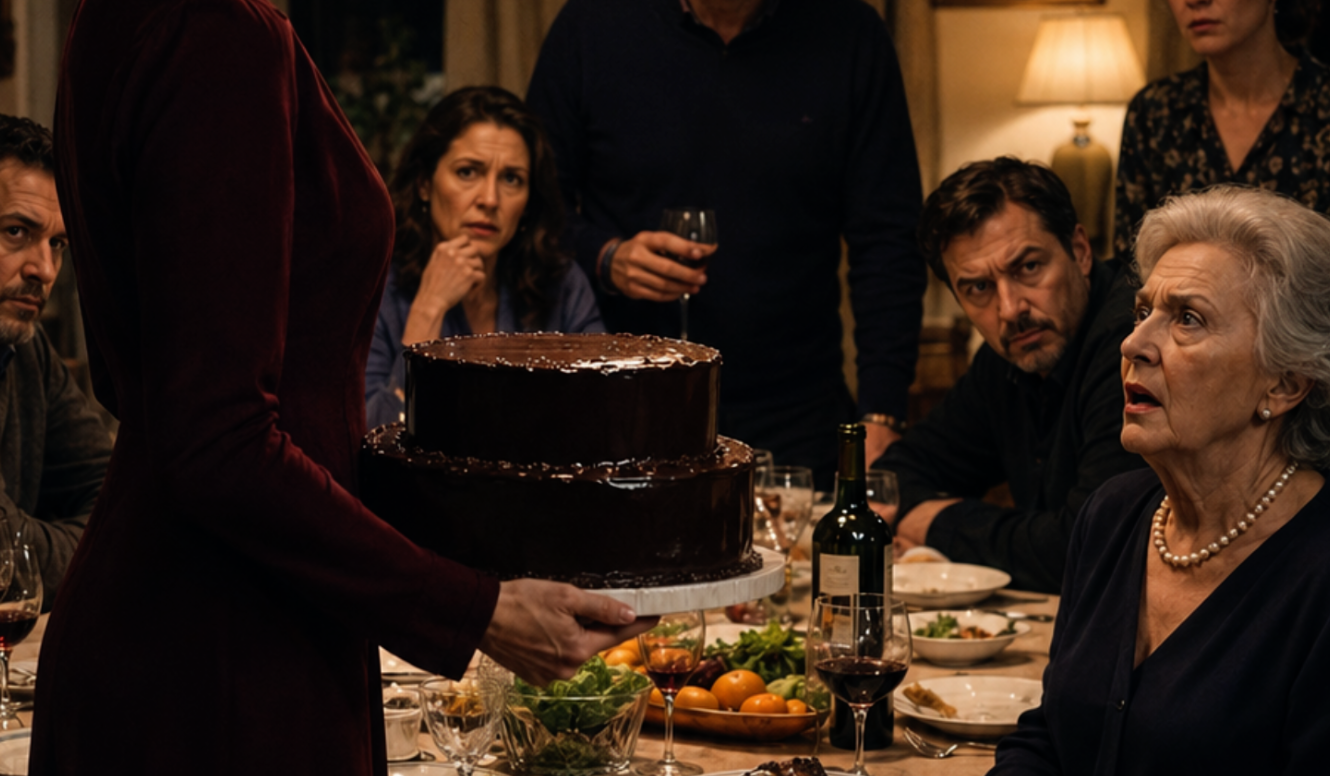
My Mother-in-Law Mocked My Cake at My Husband’s 50th Birthday in Front of 23 Guests: I Silently Removed It from the Table — and the Celebration Ended Differently
Yana wiped her hands on her apron, crumpled it up, and threw it into the sink. The cream on the fabric had hardened into a crust. Her hands still remembered the weight of the pastry bag filled with cream, the vibration of the planetary mixer on speed three, the cold smoothness of the spatula she had used to level the sides.
The cake stood on a rotating cake stand — perfectly even, covered with a mirror glaze the color of dark chocolate. Yana was already dressed: a dark blue dress with three-quarter sleeves, her hair gathered into a low bun, earrings in place. In the hallway, bags rustled as her husband Oleg carried boxes of fruit and drinks in from the car.
A milestone birthday. Fifty years old. They were gathering at home, twenty-three people in all. Oleg had wanted a restaurant, but Yana insisted on doing it at home — they would set the table themselves, everything homemade. Three days earlier she had finished her shift and gone straight to the stove: blackcurrant confit, mousse made with two kinds of chocolate, a brownie base, mirror glaze.
The cake required resting time at every stage. The sponge had to sit for six hours, the mousse had to set in the refrigerator for three, and the glaze had to be exactly thirty-two degrees before being poured. Yana worked as a pastry decorator in the bakery department of a supermarket, standing on her feet for twelve hours per shift. At home, she rarely baked for family — she simply had no energy left. But for Oleg, yes.
Oleg’s mother, Maria Vasilyevna, arrived an hour before the guests. She had volunteered to help, although Yana knew that her “help” would look more like an inspection. Maria Vasilyevna taught Russian language and literature at the school where she had once worked as a deputy principal. The habit of correcting and judging others was deeply rooted in her. She came in, took off her shoes, hung her coat on the hook by the door so neatly that the hem did not touch the wall, and went straight into the kitchen.
“Oh, so you made the cake yourself,” Maria Vasilyevna said, peering into the refrigerator. She looked over the cake. “Beautiful, of course. Just like store-bought.”
“Thank you, Maria Vasilyevna,” Yana replied, and did not bother explaining about the confit and mousse. It was pointless. Her mother-in-law had never been interested in her profession. To Maria Vasilyevna, her daughter-in-law’s work was simply “baking little pies in a supermarket.” Yana did not argue. In seven years of marriage, she had learned that with a person who is waiting for your mistake, it is better not to start a conversation where they can give you a grade.
Oleg came out of the shower and was changing in the bedroom. From there he shouted:
“Mom, why are you so early? We haven’t even finished setting the table yet!”
“That’s why I came early — to help,” Maria Vasilyevna called back, and began taking plates out of the sideboard. She arranged them in the order she considered correct: dessert plates on the left, appetizer plates on the right, forks with the tines facing down. Yana had planned it differently, knowing that the cake would be needed closer to the end and that the dessert plates would make more sense kept in reserve in the kitchen. But she stayed silent about that too. Seven years.
The guests began arriving at six. First came Oleg’s sister Katya with her husband Dima. Katya worked as an accountant at a transport company and had come straight from the office, changing into the house shoes she had brought with her in a bag.
Her husband Dima worked there too, as a mechanic on the dispatch line. He was a strong, quiet man who said maybe ten sentences all evening. Then Oleg’s colleagues from the bus depot arrived — Oleg worked as the head of a vehicle column at a municipal transport company and knew half the city through its routes. They came with their wives and gift bags. Then the neighbors from the landing came by, as did Oleg’s old friend from technical school, Kostya, and two more couples.
The apartment filled with voices. Yana carried out salads, Oleg opened mineral water and juice, someone turned on soft music through a speaker on their phone. Maria Vasilyevna sat at the head of the table, to the left of her son, and made polite conversation the only way she knew how — by asking every guest where they worked and how much they earned, then immediately commenting on it.
Yana paid no attention to it. She was used to it. She thought only about the cake. Thirty-two degrees — that was the glaze temperature when applied. Refrigerator temperature — plus four.
Before serving, the cake had to stand at room temperature for fifteen to twenty minutes so the flavor could open up. She remembered this the whole time she sliced bread, arranged butter, and topped up drinks. In a pastry chef’s mind, this kind of thing sits there the way checking mirrors on an empty road lives in a driver’s mind.
When the main course had been eaten and they began brewing tea, Yana quietly went into the kitchen, opened the refrigerator, and took out the cake. She placed it on the counter and removed the protective foil cover.
She switched on the electric kettle, took out the teapot — a round porcelain one, a wedding gift from her mother — and a package of tea leaves. Her mother lived far away in Krasnoyarsk and had visited Yana and Oleg only once, when their son was born. Their son was five now, and her mother saw him only through video calls. For a second, Yana held the teapot in her hand, but the kettle had already clicked off, and she went to set out dessert.
She carried the cake into the room and placed it in the center of the table.
The guests hummed with approval. Honestly hummed. Yana had heard that sound many times at weddings when the final dessert was brought out — three tiers, mirror glaze, each side leveled so smoothly it reflected the light. Yana noticed Katya leaning toward her husband and whispering something with a smile. Dima nodded. Oleg stood up, about to make a toast, but Maria Vasilyevna beat him to it.
“Sonny, let me cut it. You’ve only just turned fifty — your hand might shake,” she said, and laughed.
Then she reached for the knife. She did not take the special pastry knife Yana had placed nearby, but an ordinary table knife with a serrated blade, the same one that had been used earlier to cut cold meats. Yana jerked forward to say, “Maria Vasilyevna, there’s a cake knife,” but she was too late. Her mother-in-law, confident as a teacher at the blackboard, cut straight across the cake. The glaze cracked along the line, the mousse began to slide, and the edges of the slice came out ragged.
The room fell silent.
Maria Vasilyevna put a piece on her plate, scooped some with a spoon, and tasted it. She chewed. Put the spoon down on the table, turned to the guests, and said:
“Our daughter-in-law is economical. She didn’t buy a store-bought cake for her husband’s birthday. She made one herself. Well, what can you do — everyone is in a crisis.”
And she smiled.
The smile was not evil. More condescending. The way a teacher smiles while forgiving a student for a spelling mistake in a dictation. Someone among the guests coughed awkwardly. Katya’s husband Dima lowered his eyes to his plate. The neighbor reached for a napkin. The wife of one of Oleg’s colleagues, a woman with a short haircut, started to say something and stopped mid-sentence. Oleg stood there with his glass, never having made his toast, his face confused in a quick, twitch-like way.
Yana stood at the end of the table.
There were numbers in her head. Recipe calculations. Ingredient costs. Belgian chocolate, special order, delivered from a wholesale warehouse by post — she had waited five days for it. Cocoa butter for the glaze — ordered separately, because regular supermarkets did not carry the fat content she needed.
Blackcurrant confit: she had sorted through the berries for two hours, removing stems, then cooked them down with sugar to the exact temperature of one hundred and four degrees. Mousse: she had tempered the chocolate on a marble slab, mixing it until it turned silky before folding in the whipped cream.
Two days. Two shifts on her feet, then a sleepless night. And all of it became “our daughter-in-law is economical; she didn’t buy a store cake.”
She looked at the cut in the cake. At the torn edge of the mousse. At the piece her mother-in-law had bitten and then abandoned at the edge of the plate.
And she did not say a word.
She simply walked around the table, picked up the cake dish carefully with both hands, the way one picks up a heavy pan with a finished sponge cake, and carried it into the kitchen. Behind her, everyone went quiet. Not like before a storm, but in a muffled way, like in a teachers’ lounge when the deputy principal leaves without finishing her sentence.
Yana went into the kitchen and placed the cake back in the refrigerator. Top shelf, left corner — where it belonged, next to the closed container of confit. She shut the refrigerator; the seal made a soft smack. She took off the apron she had worn when she came out to the guests, threw it into the sink, wiped her hands on the kitchen towel, and hung it back on the hook. In the hallway, she put on her shoes and took the car keys from the shelf.
And she left.
She did not slam the door. She did not burst into tears. She simply left, leaving the guests sitting at the table.
The car smelled of an air freshener — Oleg hung one from the rearview mirror, coffee-scented, a simple one from an auto shop. Yana sat behind the wheel, turned on the ignition, but did not move.
She sat for a minute. Her fingers rested on the steering wheel, and she looked at her hands — the same hands that had held the spatula, the pastry bag, the thermometer for tempering for two days. On her wrist was a red mark from the cuff of her compression sleeve. It would not fade until morning.
Her phone vibrated. Oleg. She did not answer. It vibrated again — Katya, her husband’s sister. She did not answer. Then a message came from Oleg: “Yana, where did you go? What happened?”
She did not reply. Because there was nothing to say. If a person had not understood in seven years what it looked like when your labor was devalued, one message would not fix anything.
She started the engine and drove out of the courtyard. She drove through the city — the streets were already empty, a Saturday evening, everyone at home. She passed her supermarket, where the bakery lights were on — the night shift was shaping croissants. Yana knew the girls there, knew their hands, knew the smell of yeast dough that seeped into clothes.
She wanted to go inside, just like that — to take a spare coat, stand by the dough mixer, knead, shape, pipe choux pastry from a bag. There, everything was clear: there was a technical sheet, a production norm, a head pastry chef who saw your work and said directly whether it was good or bad. There were no metaphors or hidden meanings there. There was no need to wait seven years for someone to understand the difference between a store-bought cake and something made by hand.
She stopped by the embankment. Got out of the car, stood there, and looked at the water. The water was dark, autumnal, cold. Tugboats rumbled in the harbor. Yana thought of her son — he was at the neighbor’s for the night. They had arranged in advance that on the day of the birthday celebration he would sleep there so he would not interfere with the adult gathering. Good. That meant he had not seen it. Had not heard his mother being called economical for a cake she had mixed while he slept.
She stood there for about twenty minutes. Then the phone rang again in the car. Maria Vasilyevna. Yana looked at the screen, saw her mother-in-law’s name — and suddenly understood with perfect clarity that she could not hear her voice right now. Not because of hurt, but because that voice would ask a question, and the question would require an answer, and there was no answer.
Because Yana did not know how to explain to Maria Vasilyevna that pastry work was not a hobby and not “mixing cream from a packet.” That there was a difference between mousse and buttercream, between mirror glaze and a melted chocolate bar, between “made it herself” and “a professional dessert worth a quarter of her salary.” That a store-bought cake for five thousand rubles was a compromise, not an achievement.
The phone went silent. Then Oleg called again. Yana answered.
“Yana, where are you?” His voice was confused, almost childlike. “I don’t understand what happened. Mom made a bad joke, it happens. You put the cake in the refrigerator, the guests are confused. Come back.”
“Did you understand what she said?” Yana asked quietly.
“Well, she said it and she said it. She didn’t mean any harm. You know she’s always like that.”
“Oleg, I spent two days at the stove. I didn’t sleep at night while the mousse was setting. I sorted the berries one by one. I ordered the glaze ingredients separately with my own money. Your mother called me stingy in front of the guests.”
“She didn’t call you that, she joked,” irritation appeared in his voice. “Why have you become so sensitive? If you’re offended, tell her. Why leave?”
“I’m not offended,” Yana said, and it was true. “I just don’t want to anymore.”
“Don’t want what?”
“To be the daughter-in-law who saves money. If she needs a store-bought cake, let her buy one herself. My cake will stay in the refrigerator. That’s where it belongs.”
Oleg fell silent. Yana listened to his silence, and there was everything in it: the understanding that his wife was right, the unwillingness to admit it, the fear of his mother, who was now sitting at the table looking like an insulted queen, and confusion — how to gather the guests back into the evening, how to end it, what to say. He was a good husband, Oleg.
He did not cheat, he worked honestly, he loved his son. But between his wife and his mother, he did not choose his wife — he chose silence. Because it was easier that way. Because a mother is forever, and a wife — well, a wife is forever too, but you can negotiate with a wife. You cannot negotiate with a mother.
“All right,” he said at last. “Come home, we’ll talk. The guests will leave, and we’ll sit down calmly, the three of us, and discuss it.”
“I won’t stay with the guests,” Yana answered. “And there’s nothing to discuss. I’ll come back when she leaves.”
And she hung up.
She returned home close to midnight. She opened the door with her own key — the hallway was dark, only the kitchen light was on. The guests had gone. Oleg was sitting in the kitchen, loading dirty plates into the dishwasher. When he saw his wife, he straightened up.
“She left,” he said shortly. “Offended. Said you were hysterical.”
“I know,” Yana nodded.
“Your cake is in the refrigerator. Almost whole. Just one piece missing. Katya tried it and said it was the best cake of her life.”
“Katya is a smart woman,” Yana smiled for the first time that evening.
Oleg froze with a plate in his hands, then placed it on the counter and sat on a stool. He looked exhausted: the birthday had failed, the guests had left in confusion, his mother had gone home angry, and his wife was looking at him calmly and distantly.
“What do you want?” he asked directly. “For me to quarrel with my mother?”
“No,” Yana answered. “I want you to hear me. Not just now. In general. In seven years, you have never once told her that I am a pastry chef, not ‘a girl from the bakery.’ That I am a professional. That I earn no less than you, by the way. That a cake I bake costs money, time, and skill. You have never once stopped her when she took little digs at me. Not once. Today was the first time she did it in front of people. In front of your colleagues, Oleg. In front of the people you work with. Tomorrow the whole bus depot will know that the head of the column has a stingy wife.”
Oleg said nothing. He rubbed his face with his palms. When he lowered his hands, his face was red, as if from frost.
“She’s my mother, Yana.”
“Yes. And I am your wife. And I’m not asking you to choose. I’m asking you to be on my side at least when I’m right.”
A pause hung between them. Yana walked to the refrigerator, opened the door, and took out the cake. She placed it on the table. The cake looked almost untouched — only one crookedly cut piece was missing from the edge. She took the proper cake knife, clean, with a long thin blade, the one that should have been used from the very beginning. She made an even cut, placed a slice on a plate, and pushed it toward her husband.
“Try it. Calmly. Not in a hurry, not after salads. Just try it.”
Oleg took a spoon. Broke off a small piece — the mousse was light and airy, the sponge evenly soaked with berry confit, the glaze gave a slight crack under the spoon. He chewed, and something changed in his face — maybe only now did he understand what exactly his mother had called “saving money.”
“It’s… delicious,” he said. “Very. Yana, I didn’t know you could do this.”
“I can,” she answered. “I know how. I was trained. I get paid for this. Your mother ate a piece and said, ‘A store-bought one would have been better.’ That isn’t true, Oleg. It is not true. And you know it just as well as I do.”
He nodded. Put the spoon down.
“What should I do?”
“Call her tomorrow and say: ‘Mom, Yana is a pastry chef. Her cake was professional work. You hurt her in front of the guests. I’m asking you to apologize.’”
“She won’t apologize.”
“Then at least you will say it. And after that, we’ll see.”
Oleg nodded again. Yana could see it was hard for him. Forty-six years of his mother’s upbringing could not be thrown away in one evening. Maria Vasilyevna had raised him alone; his father left when Oleg was ten. His mother supported two children on a teacher’s salary, never asked anyone for help, did everything herself — repairs, the vegetable garden at the dacha, lessons late into the night. Oleg had grown up with the feeling that his mother was untouchable. And now his wife was saying: the untouchable one is wrong, the untouchable one caused pain. And someone has to decide whose truth matters more. He did not know how to do that. But at least he was listening.
Yana sat down across from him. She took a small piece of cake for herself, just to taste. The mousse had turned out exactly the density she had planned. The confit had not run, the brownie base had not become soggy. The work had been done perfectly. She ate and thought: the world is strange.
If she had been an accountant, like Katya, and had prepared an annual report without a single mistake, no one would have said: “Our accountant is economical; she didn’t hire an auditor.” If she had been a doctor and made a diagnosis, no one would have said: “She didn’t invite a paid specialist, she handled it herself.” But if you are a woman who bakes, your labor is always treated not as work, but as a household duty. Not as a service, but as something you “should” do.
She finished her piece and pushed the plate away.
“Oleg,” she said. “You need to understand. I’m not demanding anything. I’m not taking anything away. I simply won’t keep giving what isn’t valued. Cake is my work. Three days at the stove is my resource. If your mother thinks store-bought is better, fine. Let her buy it. I won’t bake for family holidays anymore.”
“At all?”
“Until she understands that I’m not saving money — I’m giving a gift. A cake worth six and a half thousand rubles is not economic. It is a gift. A gift paid for by me, made with my hands.”
Oleg stood up and poured himself some tea — already cold, though he did not notice. He took a sip and grimaced.
“Thousands?” he asked. “That expensive?”
“Belgian chocolate. Cocoa butter. Frozen berries. Thirty-percent cream. Plus packaging, plus delivery. Plus electricity: the refrigerator ran nonstop for two days, the stove for four hours a day. Add it up.”
Oleg set down the mug. He looked at the cake as if seeing it for the first time.
“I honestly didn’t know.”
“Now you do.”
At night, they lay in bed. Oleg turned toward the wall, but from his breathing Yana could tell he was not asleep. She was not asleep either. She thought about tomorrow. About needing to pick up their son from the neighbor’s in the morning. About Monday — a shift starting at seven, twelve hours on her feet.
About the almost whole cake in the refrigerator and what she should do with it. Maybe take it to the girls at the bakery and let them try it, let them evaluate the mousse with double stabilization. Maybe simply cut it into pieces and freeze it — mousse holds up well in the freezer.
She also thought about Maria Vasilyevna. About the fact that the elderly woman had not acted out of malice — that was the whole thing. She genuinely considered homemade baking a sign of poverty.
In her world, where thirty years had been lived on a teacher’s salary, where every kopeck counted, a store-bought cake was a celebration, a luxury, a gesture. If someone baked it themselves, it meant they had spared the money. The logic of survival, not the logic of cruelty. Maria Vasilyevna did not know how to accept gifts — she only knew how to evaluate. And any gift that did not fit into her coordinate system looked suspicious to her.
It was possible to understand. Difficult to accept. Whether forgiveness would come — time would tell.
In the morning, Yana got up before everyone else. She made coffee and drank it standing by the window, looking out into the yard where the groundskeeper was raking leaves into orange bags. Behind her, the bedroom door opened. Oleg came out — sleepy, disheveled, in a wrinkled T-shirt. He walked over and hugged her from behind.
“I’ll call my mother,” he said quietly. “I don’t know what I’ll say. But I’ll call. And if she says again that you’re hysterical?”
“What will you say?”
Oleg was silent for a moment.
“I’ll say that you are my wife.”
“That’s good.”
Yana remembered how, in childhood, her mother would brew tea in a teapot and wait for the water to boil on the gas stove, and the kitchen smelled not of coffee or glaze, but of simple black tea with bergamot. She still kept that porcelain teapot.
It was half past seven in the morning. Sunday. Their son would wake up in an hour — the neighbor would bring him home after breakfast. Yana decided she would make syrniki. And she would cut the cake and put a slice on a plate. Her son loved his mother’s baking. It did not matter to him whether it was store-bought or not. What mattered to him was that it existed.
And her mother-in-law? Her mother-in-law could wait.