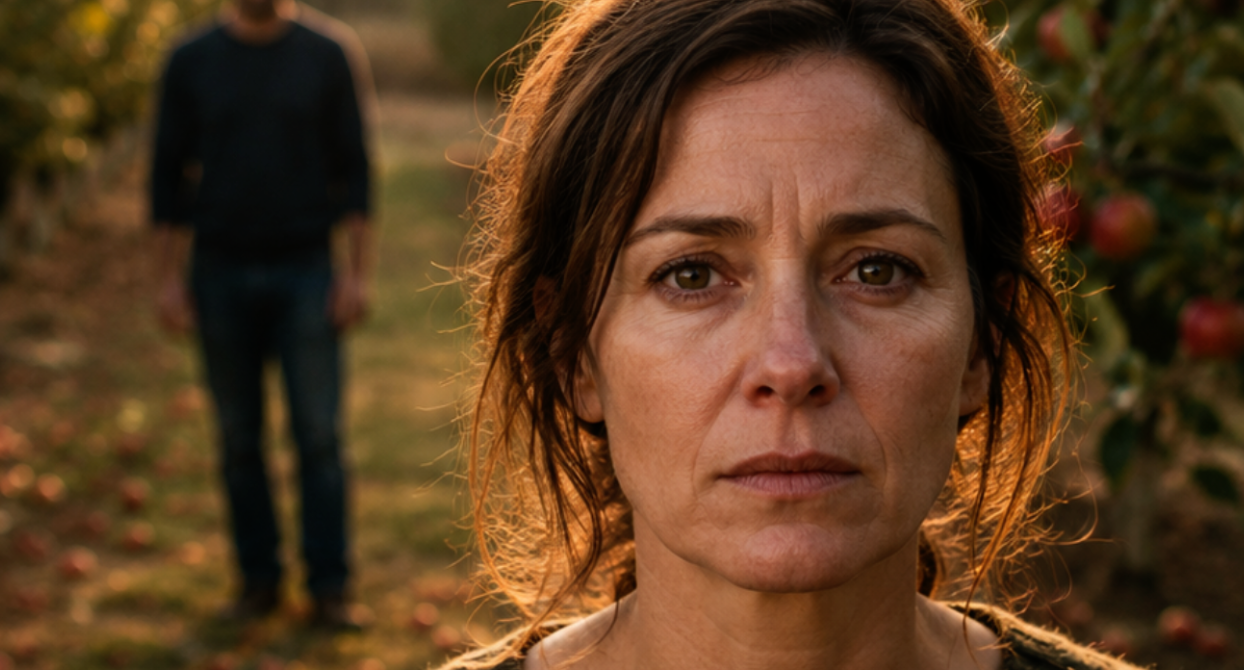
My Dacha Neighbor Cut Down My Apple Trees: “The Shade Was Bothering Me.” Over the Summer, I Turned His “Sunny” Plot into a Swamp
“Are you aware, Alevtina Petrovna, that your fence isn’t in the right place?”
I lifted my head from the garden bed and immediately understood that this conversation was not going to be pleasant. Ignat was standing by the gate — hands on his hips, his T-shirt stained with barbecue smoke, his red bull-like neck glistening with sweat. His voice was always commanding, like that of a man used to people not arguing with him.
“What do you mean, not in the right place?” I set the watering can down on the ground.
“Here,” he jabbed a finger at the chain-link fence between our plots. “It’s crooked. It’s coming onto my side.”
I looked at the fence. That same fence that had stood there for exactly twenty years, ever since I bought this plot in 2006. Six hundred square meters, a falling-apart little house, and three apple saplings that I planted two years after buying the place. Antonovka, White Transparent, and Streyfling. The saplings had been thin as pencils, and I immediately tied each one with a strip of cloth so the wind wouldn’t break them. I was afraid they wouldn’t take root. But they did. That was eighteen years ago.
“Ignat, the fence is standing according to the boundary stakes. It’s been standing there for twenty years.”
“Well, who knows. The stakes could have shifted,” he shrugged and went back to his place without even listening to the end.
I stood there with the watering can and watched him walk away. Four years. Four years since he bought the neighboring plot. Before him, Nina Sergeyevna lived there — a quiet woman with dahlias and a cat named Barsik. She and I used to drink tea together on Saturdays, and she was truly the only person at the dacha I could talk to heart to heart. Then she moved to Kaluga to live with her daughter and sold the plot. And Ignat appeared. With his wife Svetlana, his pickup truck, his barbecue grill, and a speaker that blasted Russian chanson every Friday until midnight.
A week later I came to the dacha and immediately understood that something was wrong. The fence between our plots had moved. Not much, so you wouldn’t notice it by eye. But the posts were standing a little farther to the left than usual, and the mesh had been stretched again — neatly, with fresh clamps. Someone had tried very hard to make it look natural.
I always keep a measuring tape in the shed. A habit left over from the thirty-two years I worked as a nurse at the district clinic — measure everything, double-check everything, every milliliter counts. I took out the measuring tape and stretched it from the corner of the house to the fence. Four meters seventy. But it had been exactly five. Thirty centimeters of my land.
My strawberry bed ran exactly along that fence! Two bushes had already ended up on his side. Remontant strawberries, the ones I brought from a nursery three years earlier. Four hundred rubles per seedling. And now they were behind someone else’s fence.
I went over to him. Ignat was sitting on the terrace, drinking beer, his feet up on the railing. Master of life.
“Did you move the fence?” I asked.
“What fence?” He didn’t even turn around.
“Ours. Between your plot and mine. It’s been moved thirty centimeters onto my side.”
“Alevtina Petrovna, what are you inventing now? It was always like that. Maybe the ground settled.”
“The ground settled exactly thirty centimeters? Along the entire length? All nine posts moved evenly by themselves?” I showed him the measuring tape. “I can measure it in front of you if you want.”
He took a sip of beer and looked past me. That’s how people look when they consider someone an empty space.
“So what, thirty centimeters. You have six hundred square meters, and I only have four. It’s cramped enough for me as it is.”
“If it’s cramped for you, buy a bigger plot. But don’t touch what’s mine.”
“Oh, stop making a scandal. A woman your age, and you’re making noise like a girl.”
I went back to my place. I clenched my jaw so hard my tooth started to ache. Was I really supposed to tolerate this? I called Lyosha — my son is a civil engineer and lives in Tver. He immediately said, “Mom, photograph all the measurements with the tape. If he doesn’t move it back, write to the chairwoman. And don’t touch the posts yourself, so he can’t turn it against you later.” I photographed everything. Every post. Every measurement. With the date on the phone screen — just in case.
I wrote to the chairwoman, Tatyana Ivanovna. She came three days later, looked, and shook her head. She took out her own measuring tape and measured too. The same thirty centimeters. She spoke with Ignat behind closed doors.
He moved the fence back. Silently. Without apologizing. The clamps on the posts shone brand-new. But apparently apologizing was something he did not know how to do. Or did not consider it necessary.
Back then I thought, well, that’s it, the man understood. He won’t interfere again.
How wrong I was.
The next season began with the car.
The road in our gardening community is narrow — two cars can barely pass each other. There’s no asphalt, just gravel, and after rain it becomes one continuous rut. Then Ignat bought himself a pickup truck. Huge, white, with a chrome bumper and a bull bar. Why anyone would need such a monster at a dacha, I never understood. But he was very proud of it, washed it every Sunday, polished it with a cloth.
And he started parking it directly opposite my gate.
The first time I thought it was an accident. It happens, maybe a person misjudged. The second time, well, a coincidence. But the third time, I came out on Saturday morning and there were forty centimeters between my gate and his bumper. You couldn’t get through with a cart. You couldn’t squeeze through with a bag of fertilizer. And I immediately understood that this was a system.
Every Friday evening he would arrive and park the car in such a way that I could neither drive up to my plot properly nor leave. In June, they delivered sixty-eight kilograms of compost to me — the truck with the soil couldn’t get close, and I had to carry the bags myself from the bend in the road. Forty meters. Twelve bags, five or six kilos each. And my back is already bad — thirty-two years on my feet at the clinic with patients. After that I couldn’t straighten up for a week. Patches, ointment, pills.
I went up to him and asked him to move it. Politely. Every time — only politely. How else can you behave when you live fence to fence?
“Yeah, yeah, in a minute,” he would say, without moving. “I’ll move it later.”
“Later” came five or six hours afterward. Or didn’t come at all. And his wife Svetlana sometimes came out onto the porch and silently watched as I squeezed past the bumper with a bucket and rake. Not once did she say a word to her husband. Not once did she offer to help. Not once.
Every weekend. Two years in a row! I counted — a habit from the clinic, counting everything. About thirty times a season. Sixty times over two years I went up to him and asked. Sixty times I heard that “yeah, yeah, in a minute.”
Once I couldn’t take it anymore and called the local police officer. A young man arrived, polite, in an unbuttoned uniform. He looked and said to Ignat, “Sir, park properly. Don’t create obstacles for your neighbors.” Ignat nodded, smiled, even shook his hand. The officer left. And what happened? Ignat moved the car for a week. Exactly one week. Then the chrome bumper was shining by my gate again.
Back then I stayed silent. I watered the beds, dug in the soil, tied up the tomatoes. And I accumulated things. At the time I didn’t even understand what exactly I was accumulating. But something inside me tightened every Friday — quietly, evenly, like a spring.
Is it normal to ask for the same thing sixty times? In April of 2025, Tatyana Ivanovna called me on a Wednesday evening. I was ironing laundry. Her voice sounded strange — guilty, cautious.
“Alevtina, something has happened. A complaint has been filed against you. An official one, to the board.”
I turned off the iron, placed it on its stand, and carefully wound up the cord. Only then did I ask:
“A complaint? From whom?”
“From Ignat. He wrote that you have an illegal structure. That your shed supposedly stands less than a meter from the fence. And that your greenhouse doesn’t comply with regulations. And that your compost pile is too close to his plot.”
I sat down on a chair. I already understood that this would not be simple. I built that shed in 2010 — with my own hands, with Lyosha helping. He was fourteen then. We had specifically measured it — one and a half meters from the fence, as required by the building regulations. I remember how Lyosha held the measuring tape while I hammered in the stakes, and he laughed that I was stricter than any construction foreman.
“Tatyana Ivanovna, it’s one and a half meters there. I measured it when I built it.”
“I believe you. But there is a complaint, so it has to be reviewed at the meeting. May thirteenth, in two weeks.”
Fourteen days. For fourteen days I fell asleep and woke up with a heaviness in my chest. Not because I was afraid! In fact, I knew the shed was standing correctly. It was the insult that hurt. For four years I had done nothing bad to that man. Not once. Not the barbecue smoke that drifted onto my beds every weekend — and I am allergic, my eyes water from charcoal smoke. Not his music until midnight. Not his dog barking from six in the morning. I tolerated it! I stayed silent!
And he filed a complaint. An official one. Against me!
About fifteen people came to the meeting. The assembly hall of the board was stuffy, with peeling wallpaper and a portrait of some agronomist above the door. Ignat sat in the front row, one leg crossed over the other, wearing a fresh shirt. He had prepared. He confidently explained that my shed violated the norms, that its shadow fell on his tomatoes, that he had personally measured it and that there were only eighty centimeters to the fence.
Eighty centimeters! He had turned one and a half meters into eighty centimeters — just like that, on paper.
I stood up. My hands were not trembling — and I thought it was strange, they should have been. I took out my phone and opened the photographs, the very ones Lyosha had taught me to keep in a separate folder: “Neighbor. Evidence.”
“Here are the measurements of my shed,” I said, turning the screen toward the hall. “One and a half meters from the fence. A photograph with a measuring tape. Date — April tenth. Twenty days ago.” I waited until everyone had looked. “And here is another photograph. Ignat’s fence, which in 2023 stood thirty centimeters on my territory. Also with measurements. Also with a date. And with confirmation from Tatyana Ivanovna — she came herself back then to measure.”
Silence hung in the hall. Someone coughed in the back row. The neighbor from Third Street leaned toward her friend and began whispering.
I looked at Ignat. His neck was burgundy, his veins swollen, blotches appearing on his cheekbones. Thirty-two years in a clinic — I know very well what a person looks like when he has nothing to say.
“Perhaps we should move on to other matters?” Tatyana Ivanovna said.
“Perhaps,” I agreed. “But let Ignat first tell everyone why he moved the fence.”
He stood up. The chair scraped across the floor. He left silently, slamming the door so hard that the agronomist’s portrait tilted. Svetlana sat for another minute, then also got up and left without raising her eyes to anyone.
I walked home along the path beside the ditch, and the sunset was pink and warm. The apple trees stood in bloom — white clouds on their branches, and the bees buzzed so loudly the air seemed to vibrate. The Antonovka had bloomed first, as always. The White Transparent was catching up. And the Streyfling — later, it was always later.
I stopped under the Streyfling and placed my palm on the trunk. The bark was warm from the sunset, rough beneath my fingers.
For eighteen years I had cared for them. Pruning every spring — thin branches with pruning shears, thicker ones with a saw. Whitewashing the trunks up to the first fork. Feeding them — ash, humus, superphosphate. Copper sulfate against scab. Every autumn — one hundred and twenty kilograms of apples from three trees. Compotes, jam, apple butter, dried slices for winter, Charlotte for my grandchildren. Two grandchildren — Misha and Dasha. Misha is seven, Dasha is five. Misha loves Antonovka, sour and crunchy. Dasha loves White Transparent, soft and sweet.
It’s all right, I thought. Let it be. The important thing is that the apple trees are still standing.
On May twenty-third, I came to the dacha. Train, then bus, then fifteen minutes on foot — the usual route. I could walk it with my eyes closed.
I opened the gate. I walked along the path past the currants, past the gooseberries, past the garlic bed. And stopped.
Three stumps.
Three smooth, fresh stumps on the spot where my trees had stood just a week earlier. The cuts were white and damp — done with a chainsaw, evenly and neatly. Piles of sawdust lay on the ground. And the branches were stacked by the fence in a neat pile — as if he had done me a favor, as if he had tidied things up.
I stood there and couldn’t breathe. My throat tightened. My fingers turned icy — in May, in twenty-six-degree heat.
Eighteen years! I had planted them when Lyosha was twelve. He held the saplings straight while I covered the roots with soil and pressed it down with my foot. We watered them from a hose, and he laughed because I accidentally sprayed water on his sneakers. New sneakers — he was offended for about five minutes, then forgave me and demanded ice cream.
The Streyfling was the thickest — about forty centimeters around. The Antonovka was thinner but tall, its branches reached up to the second floor. And the White Transparent was spreading, its branches stretching all the way to the fence. That was where the shade came from, the shade that bothered him so much.
I went up to the fence. Ignat was weeding his beds. On his knees, in gloves. A peaceful dacha owner.
“Did you do this?” My voice was very even, and I myself was surprised by that calm.
He raised his head. Not a trace of shame on his face — quite the opposite, he looked pleased.
“What’s the big deal? The shade from your apple trees covered my whole plot. My tomatoes didn’t ripen for three seasons. The peppers didn’t grow. I need sun.”
“You cut down my apple trees. On my land. Without my permission.”
“Well, what else was I supposed to do? I asked you to trim the branches. You didn’t.”
He had not asked. Not once in four years — not a single word about branches, shade, or tomatoes. I would have remembered. My memory is such that I can still name patients’ blood pressure readings from twenty years ago.
“You never asked, Ignat. Not once.”
“I did. You forgot. Age, you know.”
Age! I am fifty-eight, not ninety. Is that an age where someone can be written off?
I turned around and went back to my house. I entered, closed the door, and leaned my back against it. My shoulder blades pressed into the wood.
My hands were shaking. Not from fear — from rage. Quiet, white, even rage. When everything inside is burning, but outside there is ice. And you already understand clearly that shouting is useless, but thinking is exactly what needs to be done.
I called Lyosha.
“Mom, are you serious?” He fell silent for a long time, ten seconds or so. “File a police report. This is destruction of someone else’s property, Article 167.”
“I’ll file it, of course. But that won’t bring the apple trees back, Lyosha. They were eighteen years old. New ones will take just as long to grow.”
“Mom, I’ll come on Saturday. Definitely.”
Lyosha came. He brought a pie from his wife and silence. We stood by the stumps, and he photographed them — methodically, from every side. Then he walked around the plot, crouched down near the boundary, and ran his palm over the ground.
“Mom, your plot is higher than his. There’s a twenty- or thirty-centimeter difference.”
“Yes, it’s always been like that. A slight slope toward his side.”
“And does the water run toward him when it rains?”
“Before, no. The apple trees held it back, their roots were deep, the crowns wide. The soil beneath them was loose and absorbed everything. But now there are stumps.”
He stood up, brushed off his knees, and looked at my house, at the garden beds, at the stumps, at the fence. I could see a plan forming in his head, and I actually became interested in what he would say.
“Mom, didn’t you want to level the plot? Remember, you complained that the foundation by the house floods in spring?”
“I did. Last year the water stood there for three days, and the wallpaper in the basement got damp.”
“Well then. You can call a landscaping crew. Site grading, leveling the soil. They’ll make the proper slope — away from the house, so the water drains.”
“Drains where?”
He looked at me. I looked at him. Nothing more needed to be said.
On Monday I was already calling a company — found them on Avito: “Site grading, leveling, drainage.” A surveyor came, a polite young man with a leveling instrument and a notebook. He walked around the plot, set stakes, wrote down numbers.
“So, the slope away from the house?” he clarified.
“Yes, away from the house and away from the beds. So water doesn’t stand near the foundation.”
“Understood. We’ll do it. Natural relief, drainage slope of two to three degrees, all according to regulations.”
Eighty-five thousand rubles. I had been saving that money from my pension for two years for a good greenhouse — polycarbonate, automatic vents, a dream. But the greenhouse could wait.
The crew worked for two days. Mini tractor, soil, compaction — everything was neat, everything documented. There was a contract. There was a certificate of completed work. The slope was two and a half degrees. Within regulations. Formally, it was simply landscaping the plot. And the fact that the water would now go in a certain direction — well, that was physics. As simple as the multiplication table.
Ignat watched from behind the fence. He stood there for a long time, squinting at the tractor and the workers.
“What are you doing?” he finally asked.
“Leveling the plot,” I said, then paused. “I need sun.”
He opened his mouth. I closed it. I could see in his eyes that the phrase sounded familiar to him. But he said nothing and went back to his place.
The crew left. I planted grass where the apple trees had grown. Water it with the hose. Stood up, wiped my hands on my apron, and looked at the smooth, neat ground. It seemed to me that the plot had become empty and foreign. Just lawn — and nothing else.
That evening I sat alone on the veranda. Tea in a travel mug, silence. Outside the window — a level plot, without apple trees, without shade. The sun beat down on the bare ground until sunset, and I thought that before, at this time, the Streyfling had given cool shade, and now there was only emptiness.
I didn’t regret the eighty-five thousand. I regretted only the apple trees. But those are different things. The summer passed quietly. Ignat did not speak to me, and neither did Svetlana — they would pass by my gate and immediately turn away. I was not upset. In fact, I even felt lighter without those forced “hellos.”
In August, I filed a police report about the cutting down of the trees. The local officer came, wrote everything down, photographed the stumps. He measured the trunk diameters, counted the rings on the cuts — eighteen. He said a case could be opened.
When Ignat found out, he immediately ran to the fence and shouted, “Have you completely lost your mind? Calling the police over three trees?!”
Over three trees! They had grown for eighteen years — and he said “over three trees,” as if they were weeds. I did not answer. I just watered the lawn.
And then September came. And the rains began.
The first serious one was on the ninth. It poured for two days, a normal autumn rain, nothing unusual. At my place, the water was gone within half a day — the lawn absorbed it, the soil was dense after compaction, the slope worked. The paths were dry, the beds clean.
And at Ignat’s place — a lake.
I sat on the veranda with tea and watched. All the water — mine, his, from the road — all of it flowed down to him. He ran out in rubber boots, walked around the plot, waved his arms, shouted something to Svetlana. She stood on the porch in a robe and silently looked at the water. The tomatoes were knee-deep in muddy slush. The peppers, which had needed sun so badly, were in the mud.
A week later — rain again. Then more. September turned out wet. Every downpour — and Ignat had a new puddle. The beds washed out, the paving-stone paths shifted, the wooden borders swelled and went crooked. And at my place — dry, clean, level. I had invested those eighty-five thousand correctly after all.
In October he came to me. For the first time in four months. He stood by the gate — boots wet, jacket open, burgundy neck.
“Alevtina Petrovna, my plot is flooding.”
“You have my sympathy,” I said.
“It’s because of your leveling! You deliberately made the slope toward my side!”
“I made the slope away from my house. According to regulations. I have a contract with the company, a certificate of completed work, measurements before and after. Everything is official. Do you want to look?”
“I’ll take you to court!”
“Go ahead, Ignat. Definitely do that. And while we’re there, we’ll talk about my apple trees too. I have a police report filed. The trees were eighteen years old. Three of them. One hundred and twenty kilos of apples every year — compote, jam, dried slices, charlotte for the grandchildren. Count it over all the years — more than two tons. They weren’t just ‘three trees,’ Ignat. They were my life.”
He stood there silently. His neck turned blotchy — red, white, red again. He opened his mouth, closed it, turned around, and left. The gate slammed behind him.
I stood alone. The rain rustled over the lawn — over the smooth, green, tidy lawn in the place where my apple trees had grown for eighteen years.
In November, his cellar flooded. Potatoes, carrots, beets, jars of pickles — everything was in water. I saw Svetlana bailing it out with buckets. One hour, then another. Her back bent, her hands red from the cold water.
I felt ashamed. A tiny bit. For about three seconds. Then I looked at the stumps — they were still sticking out; I had deliberately not uprooted them, so I would remember — and the shame passed. Was I the one who started it? Was I the one who went onto someone else’s plot with a chainsaw?
Four months have already passed. Winter is coming soon. Snow will fall, and in spring it will melt — and all the meltwater will also go to Ignat. He has already understood that; I can see it in his eyes when we happen to meet on the road. He only turns away.
He no longer greets me. Svetlana turns away too. They say he goes around the whole gardening community telling everyone what a “snake” I am and what a “vindictive old woman.”
And I sleep peacefully. For the first time in four years. The stumps stick out beyond the window. The lawn is green. The slope works.
Did I go too far with that leveling? Or did he ask for it himself when he cut down my apple trees?