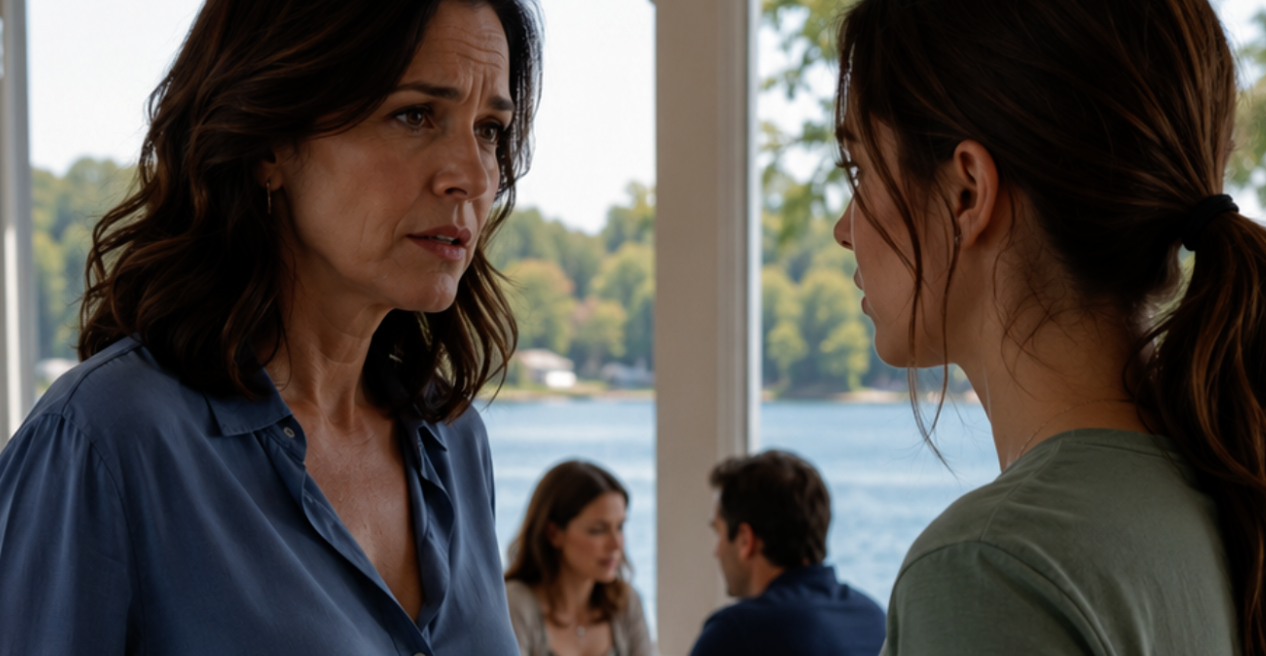
My Former Friend Stole My Fiancé Eighteen Years Ago. We Ran Into Each Other at a Health Resort
The suitcase refused to close.
I sat on it with my knees, pressed down, and fastened the lock. Twelve days at a health resort—Eduard had said, “Take everything you need, have a proper rest.” The voucher was from the factory, free of charge. It would have been a sin not to go. So I went.
The bus from the station took forty minutes. Pine trees stood along the road, straight as soldiers on a parade ground, and the air smelled as though someone had wiped it with pine oil. I got out, breathed in, and felt something in my chest unclench. The last three months at work had been nothing but tenders, suppliers, invoices. My head was buzzing. And here—silence, birds, and a wooden veranda overlooking the lake.
They gave me a room on the second floor, with a window facing the pines. I set down my suitcase, opened the window, and stood there listening to the wind rustle through the treetops. It was good here. Peaceful. For the first time in a long while—no tenders, no calls from suppliers, no Ulyana’s homework.
My daughter wrote in the messenger: “Mom, did you get there?” I replied with a heart and went to dinner.
The dining hall was large and bright, with panoramic windows and the smell of cutlets. I took a tray, got in line—and saw Karina.
I didn’t recognize her right away. She was standing by the window with a bowl of soup, thin, with sharp cheekbones and her hair tied back in a ponytail. She used to wear it loose—thick and dark. I remembered it very well. Because eighteen years ago, that same hair had been lying on my fiancé’s shoulder in a photo sent to me by a mutual acquaintance.
Karina.
The tray in my hands tilted, and the cutlet slid toward the edge of the plate. I caught it at once and turned away.
It can’t be. Not here. Not now.
But it was her. I would have recognized that tilt of her head among thousands—slightly to one side, as if she were always listening for something. We had been friends for nine years. Since our third year at the institute, since the dormitory, since the shared room for four where she slept on the top bunk and whispered to me at night about her dates. Nine years—and it all ended two months before my wedding.
I sat at a far table. With my back to her. I ate without tasting anything. The soup was mushroom—I only realized that from the smell when I brought the spoon to my mouth. My hands were trembling. With my left hand, I automatically clenched my fingers—a habit that appeared after that summer. Back then, there should have been a ring on my ring finger. Igor had already bought it. I had seen the little box in his jacket, in the right pocket, when I was looking for the car keys.
Karina got the ring.
I stood up, carried away my tray, and went outside. The air had cooled and smelled damp from the lake. I walked past the building, past the benches, past the flowerbed with marigolds—and stopped by the fence.
Twelve days. And she was here, at the same health resort.
Was it possible not to notice someone for twelve days?
The next morning I went to my treatments early—at seven thirty. I thought it would be empty at that time. In the corridor outside the physiotherapy room stood two chairs. Karina was sitting on one of them.
She raised her head and looked at me. And I saw what I hadn’t noticed yesterday in the dining hall: dark circles under her eyes, dry skin, thin wrists. In truth, she wasn’t simply older—she was tired, deeply tired, from the inside.
“Renata,” she said quietly.
I sat on the second chair, not beside her, but across the passage, and by habit stared at the wall. A poster about therapeutic exercise hung there—a drawn little person bending from side to side.
“Hello,” I answered. My voice came out dry as paper.
We were silent for a minute. Maybe two. A nurse came out of the room and called a surname—mine. I got up and went in without looking back.
When I came out twenty minutes later, Karina was no longer on the chair.
At lunch, I saw her again. She was sitting alone, picking at fish with her fork. Her plate was full—she had barely eaten. I passed by with my tray, sat three tables away, and stared out the window.
Why is she here? Resting or getting treatment?
None of my business. Truly—none of my business.
For eighteen years I hadn’t spoken her name. Not out of weakness, but because of a decision. When it all happened—in June of 2008, two months before the wedding—I came home, sat down in the kitchen, and crossed Karina out of my life. Literally. I deleted her number from my phone. Blocked her on every platform that existed back then. The photos—and there were many, nine years of friendship—I put in a bag and gave to my mother. I said, “Put these away somewhere.”
I didn’t explain anything to mutual acquaintances. Whenever her name came up, I simply changed the subject. After six months, they stopped mentioning her.
I crossed Igor out too. But him—it was easier. A man can be replaced. I understood that even then, at thirty-two, sitting in the kitchen in front of cold tea. A man is pain in the chest, sleepless nights, a month of tears, and then—slowly, millimeter by millimeter—life goes on.
But a friend? A friend cannot be replaced. It isn’t even about love—it is about trust. I trusted her as I trusted myself—and she threw it away for a man. For my man.
That was what hurt all these years. Not Igor. Karina.
I finished my compote and stood up.
She was standing near the exit of the dining hall—waiting, or maybe just vaping. A white electronic cigarette gleamed in her hand, small and thin. Karina had never even touched tobacco before.
“Renata.”
I stopped—not because I wanted to, but because my legs stopped on their own.
“I know you hate me,” Karina said. Then added, “Well, or something like that.”
“I don’t hate you,” I answered. “I don’t care.”
That was a lie. And she knew it was a lie. And I knew that she knew.
Karina took a drag and exhaled vapor. It smelled of something berry-like—not tobacco, but chemical sweetness.
“I need to tell you something,” she said. “You don’t have to listen. But if you ever want to—I’ll be here for another ten days.”
I looked at her. At the sharp cheekbones, the thin fingers with protruding joints, that stupid electronic cigarette.
“I won’t want to,” I said, and went back into the building.
In my room, I lay on the bed and stared at the ceiling. The pines rustled outside the window. The wind had grown stronger, and branches scraped against the cornice—quietly, monotonously, as though someone were dragging a fingernail over wood.
Ten days. She would be here for another ten days.
And what could she possibly tell me? What could be new? I saw everything with my own eyes. I found text messages on his phone. Three of them. “I miss you.” “When will we see each other?” “You are the best thing that happened to me this past year.” And they were from my friend. To my fiancé. Two months before the wedding.
I turned onto my side. The pillow smelled of starch, the linen was fresh, the mattress hard, the curtains institutional. A normal health resort. I had come here to rest.
And I would rest. On the third day, Karina sat down beside me on a bench by the lake.
I didn’t leave. Maybe I was tired of running. Or maybe three days of silence and pine air had softened something inside me, and my anger was no longer as sharp. It hadn’t disappeared—it had simply dulled a little, like a toothache that aches but no longer shoots with pain.
Karina was silent. She looked at the water. The lake was smooth and gray, with a strip of reeds along the far shore. Someone was swimming in the middle—a head flickered in the water, arms rowing evenly. The sun sat behind the clouds, and the light was even, without shadows.
“I’m here for recovery,” Karina said. Not to me exactly—more to the lake. “After the hospital. I spent six months there.”
I said nothing—not out of cruelty, but out of confusion, because I honestly didn’t know what to say to that. Offer sympathy? To her? To the woman who had…
“You don’t have to feel sorry for me,” Karina said, as if she had read my thoughts. “I’m just explaining why I’m here. So you don’t think I’m stalking you.”
I gave a short involuntary snort.
“Renata,” she turned to me. Her eyes were gray, tired. The same Karina—and a completely different one. “Do you remember that birthday? At Lyoshka Markov’s?”
Of course I remembered—April 2008, the birthday of a mutual acquaintance. Igor went without me—I was on a business trip in Nizhny, purchasing supplies for the factory. I came back four days later, and everything seemed normal. Or so I thought.
“He came up to me himself,” Karina said. “In the kitchen. Everyone else was in the room, and I was washing glasses. He came in, stood beside me, and started talking. I didn’t think anything of it. Well, Igor. Your Igor. I introduced you two, remember?”
As if I could forget. That hurt too—she had introduced us.
“And then he wrote to me. A week later. A normal message—how are you, haven’t seen you in a while. I answered. Why wouldn’t I? It was normal communication.”
She fell silent. Took out the cigarette, twisted it between her fingers, but didn’t light it. Dampness drifted from the lake, and I felt the cold rising from the water, from the ground to the bench, seeping through the fabric of my jacket.
“Then he started writing every day,” Karina continued. “And at some point he told me that you and he had broken up.”
I turned to her.
“What?”
“He said you had broken up,” Karina repeated. “That you had left him. That the wedding was canceled.”
“In April?” I couldn’t believe it. “In April we were placing the order at the restaurant. Choosing the menu. I was picking napkins from the catalog, white ones with a silver border.”
“And he told me it was over. That you had already been separated for a month. That you had moved out.”
Silence. Only the wind and that swimmer on the lake—steady strokes, splashes.
“I believed him,” Karina said. “Because why would he lie? He was a grown man. Not a boy. And I thought… I thought maybe there could be something.”
“What could there be?” I asked. And I heard my own voice—thin as a stretched string.
“Us. Him and me.”
I stood up. My legs had gone numb from sitting, and my knee cramped—I stepped crookedly and grabbed the back of the bench. The lake swayed before my eyes, then steadied.
“A convenient version,” I said. “Very convenient. Eighteen years later.”
Karina didn’t stand. She sat there, looking up at me from below. And there was neither resentment nor self-defense in her eyes. Only fatigue.
“I’m not asking you to believe me,” she said. “I’m just telling you how it was. You can decide for yourself.”
I turned around at once and left.
In my room, I brewed tea from a bag and drank it, burning my lips. My hands were trembling slightly—not from cold, but because everything inside me had begun mixing too quickly.
She’s lying. Of course she’s lying. After so many years—another story. Convenient. She comes and tells a beautiful version where she isn’t guilty. So who is guilty? Igor?
I set the mug on the nightstand and looked at my hands—my left one was clenched in a fist. The ring finger, the very one where the wedding ring should have been. Later, another ring appeared on it—from Eduard, three years after everything. Thin, gold, without a stone. I still wear it.
But Igor really did check my phone.
The thought came on its own—I hadn’t invited it. I simply remembered. How he would take my mobile “to check the time,” and then I would notice the call log was open. How once he asked who Vitya was in my contacts—and it was Vitaly Petrovich, head of the transport department, sixty-two years old, with three grandchildren.
Back then I thought it was jealousy. And jealousy seemed like a form of love.
No. Don’t think about this. She’s lying.
I finished the tea and lay down. I didn’t sleep until three in the morning. Outside the window, the wind drove branches along the cornice—creak, pause, creak.
The morning was cold. I put on my jacket and went out onto the veranda.
Karina was already sitting there. In a warm sweater, with a mug—steam rising from the rim. She looked at me and said nothing. Simply moved over on the bench, leaving space.
I stood for a minute. Looked at the pines—they were wet with dew, dark, with droplets on the needles. The air smelled of pine and earth. The lake lay below, motionless as glass.
And I sat down.
For a minute we were silent. Then I said:
“He checked my phone.”
Karina nodded. She wasn’t surprised.
“Mine too,” she answered. “Only he didn’t check it. He demanded to see it. Every evening. Who called, whom I wrote to, why I didn’t answer right away. If I was in the shower and didn’t hear the call—it was a scandal until morning.”
I said nothing. The coffee in the thermos was hot—I poured some into the lid and warmed my fingers around it.
“How long?” I asked.
“Seven years,” Karina said. “Exactly seven. Then Savely started school, and I filed for divorce. Because my son started copying him. He began shouting at the dog the way Igor shouted at me. And I understood—it was either now or never.”
Savely. She has a son.
“The divorce took a year and a half. He wouldn’t agree. Court, lawyers, certificates. We divided the property through bailiffs—he took the apartment, and I moved into a rental with the child. I lived seven years with a man who checked my every step. And you left him after two months.”
She fell silent. Took a sip from her mug.
“Well, what can you do,” she said quietly. “Life doesn’t ask whether you’re ready or not.”
I sat and looked at the lake. My hands warmed around the thermos lid, the coffee had cooled slightly, but inside I felt hot—not from the coffee.
I left after two months. She’s right. I left Igor two months before the wedding—I found the messages, caused a scene, put the dress back in the closet, canceled the restaurant. And that was it. And I survived. But what if I hadn’t found them? What if the wedding had happened?
A picture rose before my eyes: me in a white dress, Igor beside me, the registry office, rings, guests. And then—evenings with phone checks, scandals over contacts in the address book, whispers of “Who is this Vitya?” in my ear. And not for two months—for years.
“Did he lie to you too?” I asked. Quietly, almost in a whisper.
Karina immediately gave a bitter smile, without amusement.
“From the first day,” she said. “He said the apartment was his. It turned out it was mortgaged, with guarantors. He said he was valued at work. A year later he was fired for a conflict with management. He said he wanted a child. When Savely was born, he didn’t hold him for the first three days. He sat in the kitchen, drank beer, and complained that the baby screamed.”
Each of her words settled over my memory like a pattern. And it was true—Igor had exaggerated back then too, even before that story. He said he was valued at the company. That the car was bought outright, not on credit. That his ex had left because she “wasn’t good enough.” I didn’t check. I didn’t want to. I was thirty-two, and I was waiting for that wedding so much that I was ready not to notice.
“I wanted to call you,” Karina said. “Back then, in 2008. I dialed your number a hundred times.”
“Why didn’t you call?”
“And what would I have said? Renata, your fiancé came to me himself, wrote to me himself, told me himself that you had broken up? Would you have believed me?”
I opened my mouth—and closed it. Because no. I wouldn’t have believed her. Back then, at thirty-two, with a dress in the closet and a paid restaurant—I would have decided Karina was making excuses. That she had taken my man and now wanted to look innocent. I would have become even angrier.
“That’s what I thought too,” Karina said. “So I stayed silent. And then it was already too late.”
The wind changed. Warmth came from the lake—the sun broke through the clouds, and the water sparkled so brightly that I had to squint. The veranda smelled of heated wood and resin.
“I hated you,” I said. “All these years.”
“I know.”
“Not Igor. You.”
“I know,” Karina repeated. Then added, “That makes sense. He was a man; he could be replaced. But I was a friend. That’s different.”
I looked at her. And suddenly I saw—not that Karina from 2008, bright, with long hair and laughter that filled the whole room. But this one. Fifty years old, thin, with dark circles and a cigarette in her pocket. The one who had lived seven years with the man I had escaped after only a couple of months.
“You paid more for him than I did,” I said. I hadn’t expected those words from myself. They came out on their own, without preparation, without a plan.
Karina blinked. Quickly, several times.
“Well, what can you—” she began her favorite phrase, but didn’t finish. She turned toward the lake and gripped the mug with both hands.
We were silent for a long time. Maybe five minutes. Maybe fifteen. The sun rose higher, shadows from the pines crept across the veranda, and my feet, which had been freezing ten minutes earlier, began to warm.
I remembered my wedding dress. White, simple, without lace—I didn’t like anything too ornate. It hung in the closet for two months. I could neither put it on nor throw it away. In September, I gave it to my mother. She hid it on the mezzanine and never once asked what happened to it. Three years later, when I married Eduard, we registered our marriage quietly, just the two of us, and I wore a gray dress—new, bought the day before. No veil, no restaurant, no napkins with a silver border. And I was happy.
If not for that June—there would have been no Eduard. No Ulyana. No my life—this one, real and calm. With a husband who never checks my phone. Who makes coffee in the morning and places my mug closer to the edge of the table because he knows I grab it on the go. Who, in fourteen years, has never shouted once. Not at me. Not at our daughter. Not at the dog.
“Karina,” I said.
She turned.
“You took my dream from me. And the dream turned out to be rotten. I didn’t see that.”
Karina looked at me without blinking. Her lips tightened, and her chin trembled.
“I didn’t want it to happen that way,” she said. “Truly. But I don’t regret that you left him.”
“I don’t regret it either.”
I unclenched my left hand—the fingers that had tightened into a fist for eighteen years whenever I remembered that summer finally straightened. A ring gleamed on my ring finger. Thin, gold, without a stone. Eduard’s.
“Thank you,” I said.
And Karina—for the first time in four days—smiled. Not broadly. Not cheerfully. But she smiled. The very same smile I remembered from the dormitory, from nighttime conversations between the top and bottom bunks, from nine years of friendship that I had tried to cross out and couldn’t.
We sat on the veranda. Drank cooled coffee. The pines rustled, the lake shone in the sun, and the wind smelled of resin. We didn’t hug—it was far too soon for that. Maybe we would never be friends again. Maybe after the health resort, we would go our separate ways and never call each other. But right then, that morning, something that had pressed on me for eighteen years finally stopped pressing.
I took out my phone. Dialed Eduard.
“How are you?” he asked.
“I’m good,” I answered. And my voice sounded different. Softer. Lighter.
“Rest,” he said. “Ulyanka sends her hello.”
I hung up and looked at the pines, at the lake, at my hands—open palms, relaxed fingers.
Eight days later, I left the health resort. The suitcase closed on the first try. The same suitcase, the same things—but it was easier to carry. I stepped out onto the veranda, breathed in the pine air, and stood there for a minute. Down below, the lake glittered. The wind stirred the branches. Everything was the same as on the first day.
Only I was different.
I had brought eighteen years of resentment here.
And I was leaving with an empty suitcase.