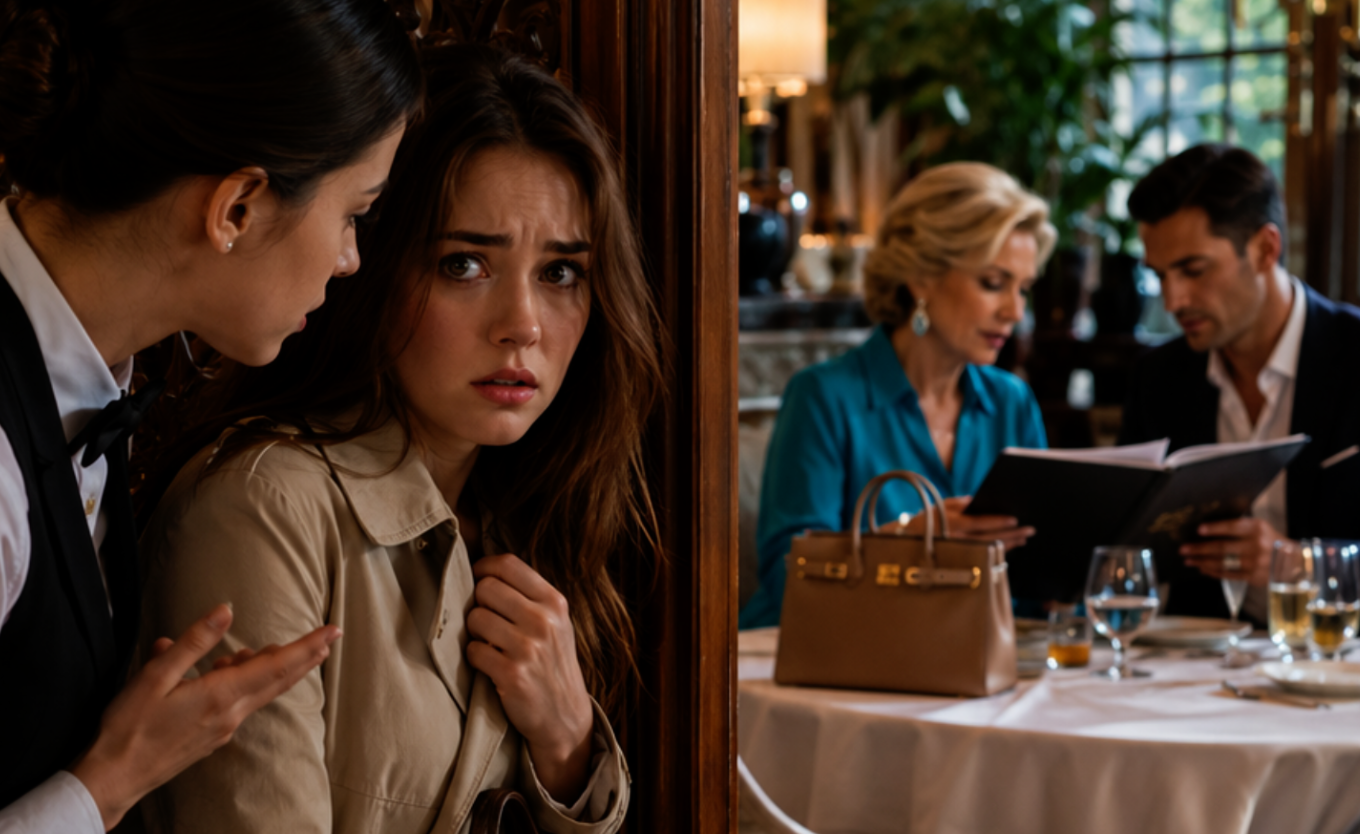
“Hide behind the screen,” the waitress said. Five minutes later, the bride heard about the apartment being pledged as collateral
Yana arrived at the restaurant earlier than scheduled because she wanted to look over the hall without rushing. In nine days, long tables were supposed to be set up here, candles lit in glass holders, and a cake brought out with a delicate lilac branch made of fondant — exactly the one Yana had chosen from a picture, though she herself only loved real lilacs: spring lilacs, with wet leaves after rain.
Near the entrance, it smelled of bread from the oven and coffee. The administrator was speaking on the phone, the waiters were arranging cutlery, and in the far corner there was already a screen — tall, walnut-colored, with worn carving. Yana noticed it only because a young waitress in a black apron was peeking out from behind it.
The girl came over quickly, almost running.
“Are you Yana Tikhonova?”
“Yes. We have a banquet on Saturday. I’m here to see Alla Sergeyevna.”
The waitress did not answer. She took Yana by the elbow, and her fingers were icy.
“Hide behind the screen. Now. I’ll explain later.”
Yana tried to pull her arm free.
“Miss, what are you talking about? I came to discuss the menu.”
“I know. Please don’t argue. You can’t let them see you at the entrance.”
There was no rudeness in her voice, no strange curiosity. Only such urgency that Yana suddenly remembered she had not turned off the towel warmer in the bathroom that morning — even though she definitely had. Thoughts sometimes cling to nonsense when something incomprehensible is happening nearby.
She glanced toward the glass doors.
A dark sedan pulled up to the restaurant. Valentina Pavlovna — Lev’s mother — got out of it. In her hands was a familiar cream-colored handbag with a heavy gold clasp. Lev got out after her, zipped up his jacket, and for some reason did not look at his phone, although he usually scrolled through messages at every spare moment.
He had told Yana he would be at the office all evening.
“Faster,” the waitress breathed.
Behind the screen there was a narrow alcove with a small sofa. Yana sat down, pressed her bag to her knees, and saw a strip of the hall between the sections of the screen. From there she could see the window, two tables, and part of the bar, but no one would notice her unless she stood up.
Valentina Pavlovna and her son sat down at a table by the window. The waitress who had led Yana there placed water in front of them and went toward the kitchen. Yana expected to hear a conversation about the wedding, the host, the flowers. But Valentina Pavlovna took a thick folder out of her bag and placed it on the table with a sound as if she had covered something alive with her palm.
“Everything we need is here,” she said. “After the registry office, all that will be left is to go to the notary.”
Lev did not open the folder.
“Mom, maybe we shouldn’t rush?”
“Oh, don’t start pretending you have a conscience. There are less than two weeks until the wedding, and you’re still circling around it.”
“Yana isn’t stupid. She’s an HR officer; she’s used to reading documents.”
“Then you’ll hurry her along. Tell her it’s paperwork for a share in the company. She won’t be the first woman to sign papers in her husband’s family.”
Yana did not immediately understand what they were talking about. A ridiculous thought flashed through her mind: maybe Valentina Pavlovna had decided to give her and Lev some kind of share in her furniture salon. She sometimes talked about that salon as if it were not a store on the outskirts of town, but a small state held together by her character and her ability “not to show weakness.”
Then Valentina Pavlovna opened the folder.
“Here is the surety agreement. Here is the consent to pledge the apartment as collateral. Here is the credit line for the company. Formally, the money will go toward purchasing inventory, and then I’ll handle the rest myself.”
Lev squeezed the napkin.
“What does her apartment have to do with it?”
“It has to do with the fact that the bank won’t give us a kopeck without proper security. And Yana has a clean credit history, an official salary, and a two-room apartment with no mortgage. Banks like clients like that.”
The pen slowly slipped out of Yana’s hand. She did not bend down to pick it up. It lay on the floor beside her shoe, and suddenly that small object became more important than everything else: the rustle of a skirt, the ticking of the clock above the bar, someone’s laughter outside.
“She won’t agree,” Lev said.
Valentina Pavlovna smirked.
“She will. You’ll explain it beautifully. You’ll say that without her signature, we won’t be able to open the family business she herself dreamed of. Then you’ll fly to Kaliningrad, walk along the embankment, drink mulled wine. In a week, the money will go where it needs to go.”
“And if she finds out?”
“She’ll find out when it’s too late. The apartment will already be collateral. You’ll file for divorce. Say that after the wedding she became suspicious and impossible to live with. The debts will stay with her. We’ll get breathing room.”
Lev raised his eyes.
“You say that as if you’ve done this before.”
His mother did not answer right away. She straightened a knife on the table that was lying slightly crooked, then set the glass down evenly.
“I did what had to be done for the family.”
“With Darya?”
“Quiet. Don’t say names in a restaurant.”
Lev looked at the folder without touching it.
“She lost her apartment afterward.”
“Darya signed everything herself. A grown woman. Not a child.”
“She lived in a dormitory with her daughter.”
Valentina Pavlovna turned to her son. For a second, something tired, almost human, appeared in her face.
“When your father died, he didn’t leave me a business. He left me a hole. I spent ten years filling it with my own hands. I took orders, slept in the warehouse, sold the car so that you and your brother wouldn’t have to drop out of university. You only saw me scolding and demanding. But I simply didn’t want you to live the way I did at twenty-two — with a child in my arms and an empty refrigerator.”
Yana caught herself listening. Not sympathizing — no. But understanding where this woman’s habit had grown from: grabbing what belonged to others whenever her own slipped away. Valentina Pavlovna was not a fairy-tale villain. She was a person who had once decided that someone else’s life was a convenient expendable resource.
“But Yana isn’t Darya,” Lev said quietly.
“All the better. She has an apartment.”
After that, he nodded.
Not sharply. Not with relief. He simply nodded, and Yana understood that she would hear nothing more important.
When they left, the waitress did not come to the screen immediately. First she brought someone a bill, wiped the table by the window, and placed a fresh eucalyptus branch in a vase. Only then did she crouch beside Yana.
“You heard everything?”
Yana looked at the empty spot by the window.
“Yes.”
“My name is Vika. I don’t know what you should do now. But you must not sign any papers.”
Yana stood up so quickly that her shoulder hit the screen. It creaked softly.
“Why did you decide I had to hide?”
Vika was silent for a moment, then said:
“Because three years ago I worked as an assistant at a notary’s office. Valentina Pavlovna came to us with a girl. The girl’s hands were shaking, and her fiancé kept repeating, ‘Sign it, it’s just a formality.’ I didn’t understand anything back then. Later I found out that the girl had lost her apartment.”
“Do you know her?”
“No. I remembered her last name. I accidentally saw it in the court database when I was helping a friend with her divorce. There was a case about debt collection. The fiancé was Valentina Pavlovna’s older son.”
Yana wanted to ask something else, but instead she took out her phone and called Lev. He answered after the third ring.
“Yan, hi. I’m in a meeting, I can’t talk long.”
“Where are you?”
The pause was short, but Yana had time to hear dishes clinking in the restaurant.
“At the office. I told you.”
She looked at the window. The sedan was already leaving the parking lot.
“Of course you did,” Yana replied. “I won’t distract you.”
She did not go home. She got into her car, placed her hands on the steering wheel, and stared at the windshield wipers for a long time. Then she opened the laptop that always stayed in the trunk after work and began searching.
She knew the name of Valentina Pavlovna’s company: Vector-Mebel. In twenty minutes she found an old arbitration case record; in an hour, a district court decision that mentioned a surety agreement, a loan, and a woman named Darya Sokolova. Her marriage to the older son had lasted five months. Six months after the divorce, Darya’s apartment had been sold at auction.
Yana closed the laptop.
Her first thought was to cancel the wedding and disappear. Pick up the dress from the atelier, write to her parents, switch off her phone. She even opened the chat with the wedding host and typed: “The celebration is canceled.” Her fingers hovered over the screen.
Then she imagined Valentina Pavlovna adjusting Lev’s collar in the morning and saying, “Never mind, we’ll find another one. This one turned out to be hysterical.”
Yana erased the message.
That evening, Lev met her at home with a pizza box. On the kitchen table stood two glasses, and beside them lay a printed itinerary for Kaliningrad. He hugged her from behind, and Yana forced herself not to pull away.
“You’re quiet,” he said. “Tired?”
“I spent a long time at the restaurant.”
“Mom called. She was worried whether you managed to discuss everything.”
Yana took a slice of pizza, though she did not want to eat.
“She really worries about us.”
“She already considers you a daughter.”
The bite went cold in Yana’s mouth. She put it down on the plate.
“Lev, what if after the wedding your mother offers me a role in her business?”
He held his breath for the slightest moment.
“Why are you asking?”
“Just because. She likes saying that family should be a shared enterprise.”
Lev smiled too quickly.
“Well, if she offers, we’ll discuss it. You’re smart. You won’t sign anything you don’t like.”
That night, Yana lay beside him and looked at his back. He slept peacefully, sometimes quietly snoring, while the blue light of a charger blinked on the bedside table. She thought this must be how people sleep when they do not need to remember that tomorrow they will smile at the person whose apartment they plan to pledge as collateral.
In the morning, Yana called Darya Sokolova.
Darya was silent for a long time. Then she said she could meet only after her shift, in a small café near the market. Yana arrived early and chose a table by the window. At the next table, a woman in a down jacket was feeding a child a bun, breaking off small pieces. Yana watched her hands and thought that she had never noticed before how much in life is decided by signatures.
Darya turned out to be older than Yana had expected. Not in age — she was a little over thirty — but in her face. There were shadows under her eyes, her hair was tied back with an elastic band, and a dried white streak of paint marked the sleeve of her jacket.
“I work as a painter,” she said, noticing Yana’s glance. “After everything, I had to learn.”
She did not want to remember. It was visible in the way she held the spoon over her cup and did not stir the sugar.
“I already lost in court,” Darya said. “Everything was clean on their side. I signed, the notary certified it, my husband said it was for the business. Then he left. I was left with debts, a child, and a room at my aunt’s.”
“They’re planning to do the same to me.”
Darya looked at Yana carefully.
“Then leave.”
“If I leave, they’ll find another woman.”
“And if you stay, they may get ahead of you.”
Yana lowered her eyes. There it was — the thought she had feared. Maybe she was simply overestimating herself. Maybe she needed to save herself, not play avenger. She had no experience, no money for lawyers, and no habit of looking people in the eye when preparing to expose them.
Darya took an old transparent folder out of her bag.
“Here are copies. I kept them, even though my aunt told me to throw them away. Take my lawyer’s number. Back then he honestly told me that one case was their word against mine. But if there’s a pattern, it may be different.”
The lawyer’s name was Stepan Olegovich. He listened to Yana the next day and did not promise an easy victory.
“You cannot simply record a conversation and expect everyone to be sent to prison,” he said. “But you have a possible attempted deception, a previous civil case, and a victim ready to give a statement. That is no longer nothing. The most important thing: do not sign anything and do not show that you know.”
“And if I cancel everything?”
“Then you save yourself. That is also the right thing to do. But the scheme will be harder to prove.”
Yana left his office, walked two blocks, and sat on a bench at a bus stop. Buses pulled up, opened their doors, released people carrying bags, and drove away again. Nearby, a boy in a red hat kicked the metal trash bin with his boot until his mother said, “Stop it, people are watching.”
Yana suddenly thought that she wanted to go home to her mother. Not to Lev, not to their future “family life,” but home — where violets stood on the windowsill and her father always put the kettle on when he heard her opening the door.
She did not go. Not yet.
Two days later, Valentina Pavlovna came to their place in the evening without warning. She brought a jar of homemade jam and a folder.
“Well then, my dear daughter-in-law, it’s time to settle the formalities,” she said, taking off her coat. “After the wedding you won’t have time for this.”
Lev was sitting beside her on the sofa, scrolling through sports news. When his mother placed the folder on the coffee table, he switched off the screen.
“Yana, it’s all simple,” he said. “Mom wants to register a share in your name. It’s a good start for us.”
Yana opened the folder. On the first page lay consent to act as a surety. On the second was a draft pledge agreement. She felt a cold trickle crawl down her back, but leaned lower, as if carefully reading the small print.
“There are too many pages here,” she said. “I want a notary to explain them to me.”
Valentina Pavlovna smiled.
“A notary only certifies signatures. Why waste your time?”
“I’ll feel calmer that way.”
“You don’t trust me?”
There it was, the pressure Darya had spoken about. Not shouting. Not a threat. Just the ordinary hurt of an older woman who had supposedly spent her whole life trying for the family.
Yana raised her eyes.
“I do trust you. That’s why I want all of us to hear the explanation together.”
Lev frowned.
“Yan, what’s gotten into you? Mom said they’re just formalities.”
“Then nothing terrible will happen if the notary reads them aloud.”
Valentina Pavlovna slowly closed the folder.
“Fine. Tomorrow at eleven. I’ll arrange it.”
After she left, Lev paced around the room for a long time. He did not shout, but kept moving things from place to place: he removed a mug from the windowsill, then put it back; folded a blanket, then threw it onto an armchair.
“You made me look like an idiot in front of my mother.”
“Because I want to read what I’m supposed to sign?”
“Because you suddenly decided everyone around you is an enemy.”
Yana watched him buckle and unbuckle the strap of his watch.
“And if I don’t sign?”
He sat down across from her.
“Then Mom will lose the salon. People work there. It’s her life. Are you really ready to destroy all that because of some papers you don’t even understand?”
“And are you ready to leave me with debts?”
Lev lowered his head.
“I don’t want that. But sometimes people help family.”
He said it quietly, almost plaintively. And it was at that exact moment that Yana finally stopped waiting for him to come to his senses on his own.
That night, she wrote to Stepan Olegovich: “Tomorrow at eleven. They’ll bring the folder.” Then she called her parents and said the wedding had to be canceled, but she did not yet explain why. Her mother was silent at first, and her father asked only one question:
“Are you alone?”
“No. I’m at Lev’s.”
“Then come to us in the morning. Not at eleven. Now.”
Yana went. Her father met her in a house sweater, took her bag, and did not ask questions in the hallway. In the kitchen, her mother placed a plate of syrniki in front of her. Yana watched butter melting on them, and only then began to cry — not loudly, without sobbing, just tears falling onto her sleeve.
In the morning she put on a gray dress, tied up her hair, and went to the notary. Stepan Olegovich was sitting in the next office with Darya and a bank employee who had come in response to a statement about a possible attempt to arrange collateral without informed consent. Yana herself had insisted that they not enter too early.
“First I need to hear them out completely,” she said. “Otherwise Valentina Pavlovna will say again that she was misunderstood.”
At the notary’s office, Valentina Pavlovna was already waiting. She was wearing the light-colored suit Yana had seen at a family dinner and a large brooch shaped like a golden leaf. Lev stood by the window, holding the folder.
“Yana,” he said, “let’s not make a scene.”
“That depends not on me.”
The notary, a thin man with a neat beard, began reading the documents. At first Valentina Pavlovna interrupted him, saying that everything was obvious. Then she fell silent.
“Consent to pledge the apartment as collateral,” the notary said. “Suretyship for the obligations of the company. A credit line in the amount of three million eight hundred thousand rubles.”
Lev took a step toward Yana.
“You knew?”
“Since that evening at the restaurant.”
Valentina Pavlovna turned to her sharply.
“So this was your doing? You were eavesdropping?”
“No. I was sitting behind the screen because your waitress asked me to hide. After that, you told everything yourselves.”
“What waitress?”
Yana placed a printed copy of the court decision in Darya Sokolova’s case on the table.
“Here is the woman who signed the same kind of papers. Her apartment was taken from her. You told Lev it had been a necessary step for the family.”
Valentina Pavlovna turned pale, but immediately straightened up.
“Darya signed everything herself.”
“Yes,” Yana said. “Just as you wanted me to sign.”
Lev said quietly:
“Mom, enough.”
She turned to him.
“Are you going to betray me now? After everything I’ve done for you?”
“No. I just… I didn’t think she would find out.”
Those words sounded worse than any confession.
Yana looked at him.
“You didn’t think I would find out. Don’t confuse the two.”
The door opened. Stepan Olegovich entered, followed by Darya and the bank security officer. Valentina Pavlovna stepped back from the table, hit a vase with her elbow, and it swayed. The notary managed to catch it before water spilled onto the documents.
“We are recording the refusal to proceed and transferring the materials connected with the statement,” Stepan Olegovich said calmly. “The bank has already suspended consideration of the credit line.”
Valentina Pavlovna flared up.
“You all think you’ve won? The salon will close. People will be left without work. Will that make you happy?”
Yana did not answer immediately. Then she took the ring Lev had given her by the lake off her finger and placed it on the folder.
“What will make me unhappy is that for so many years you knew how to live at other people’s expense and called it saving the family.”
The ring softly clinked against the plastic.
Lev looked at it, then at Yana.
“I wanted to fix everything.”
“No,” she said. “You wanted me to pay so that you wouldn’t have to feel guilty.”
Valentina Pavlovna left the office first. She did not slam the door, did not shout. She simply took her cream-colored handbag and walked quickly down the corridor. But a week later, suppliers came to the salon — suppliers to whom she had promised money from the future loan. When they found out there would be no loan and that the bank had begun an investigation, they stopped deliveries. Two saleswomen, whose bonuses Valentina Pavlovna had delayed for months, submitted their resignations and left. Her older son refused to answer his mother’s calls: he was afraid he would once again end up involved in someone else’s case.
In the family chat, where seating arrangements and tablecloth colors had once been discussed, Yana sent one message: “There will be no wedding. Please do not write to me with questions.” A minute later, Valentina Pavlovna wrote: “She made it all up.” But Lev’s sister was the first to answer her: “Mom, enough.”
Yana saw that message already at home.
In the kitchen, her mother was slicing apples for a pie, and her father was washing cups. No one asked when she would start smiling again or whether she would find another man. Her father simply pushed the kettle toward her.
Outside the window, a fine rain was falling. Violets stood on the windowsill, and one of them had put out a new leaf — small, pale, still folded in half.