“Since You Gave the Apartment to My Brother, Let Him Support You in Your Old Age,” Lyolya Finally Told Her Parents
Lyolya walked down the street, feeling the handles of the heavy plastic bags mercilessly cutting into her palms. The autumn wind pierced her to the bone, forcing her to tuck her chin deeper into the collar of her old wool coat. Inside the bags were carefully selected groceries from the market: fresh beef without a single tendon, farm cottage cheese, expensive cheeses, and seasonal fruit. Lyolya had chosen only the best, carefully checking expiration dates and the appearance of every apple. She herself ate much more modestly, preferring simple porridge and inexpensive vegetables, but for her parents she always bought premium products. That was how it had been for years. That was what she considered right.
Valentina Ivanovna and Nikolai Petrovich, Lyolya’s parents, lived in a solid two-room apartment in a good neighborhood. They had retired long ago, but their demands had only grown with age. Lyolya, who worked as a dispatcher at a tram depot, gave a large part of her salary to make sure they lived comfortably. Her job was stressful and required constant concentration: route schedules, breakdowns on the lines, replacement of tram cars — all of it passed through her hands and her head. Her shifts were often long, and her salary was very average. But Lyolya did not complain. She was used to carrying this burden, believing it to be her unquestionable duty as a daughter.
When she reached the familiar entrance, she placed the bags on the wet asphalt to catch her breath. The muscles in her back ached from constant strain. Lyolya looked up at the windows of her parents’ apartment on the third floor. A warm, cozy light was glowing there. She sighed heavily, picked up her load, and began climbing the stairs. The elevator in that building often did not work, and today was one of those days. On every floor she had to stop briefly to rest.
The door opened almost immediately, just as she managed to press the doorbell. Valentina Ivanovna stood on the threshold, her eyebrows drawn together sternly. Her eyes immediately dropped to the bags.
“Why did it take you so long?” her mother said instead of greeting her, displeased as she inspected what had been brought. “I asked you to buy the cheese we had last time. I don’t like this one. It’s too salty.”
“Mom, they didn’t have that cheese. I bought another one. It’s even more expensive and better quality, farm-made,” Lyolya replied quietly, taking off her boots and stepping into the hallway.
“More expensive doesn’t mean better, Olga,” Nikolai Petrovich’s voice came from the room. “You’re always wasting money on who knows what, and then you complain that you don’t have enough. You’d be better off helping Vadik. The boy gets so tired at work.”
The mention of her brother’s name caused the usual dull pain somewhere deep inside her. Vadim. Her younger brother. The pride of the family, the light in the window, the person who always received the very best simply by right of birth. Vadim worked as a manager at a furniture warehouse, earned excellent money, drove an expensive foreign car, but in his parents’ eyes he forever remained a poor, exhausted boy who constantly needed support.
Lyolya silently carried the bags into the kitchen and began unpacking the groceries. She carefully placed everything into the refrigerator, trying not to pay attention to her mother’s continuing grumbling. Valentina Ivanovna followed her around, controlling every movement her daughter made.
“Did you buy beef on the bone? I asked for tenderloin! How is your father supposed to chew this? His gums are weak!” her mother protested, pointing at the piece of meat.
“Mom, this is excellent brisket for broth. I’ll make soup for you for several days,” Lyolya patiently explained.
“We don’t need soup for several days. We want fresh food every day. Vadik always brought us fresh meat from the restaurant when he worked there as a supply manager. A golden child. He simply has no time now, he works himself to exhaustion, everything for the family, everything for his Marinochka.”
Lyolya lowered her eyes and focused on wiping the countertop. The story with Vadim was an old, deep, and very painful wound. Twenty years earlier, when their paternal grandmother had passed away, leaving behind a large, luxurious three-room apartment in the very center of the city, the family council had made a unanimous decision. The apartment went to Vadim.
“He needs it more,” Valentina Ivanovna had declared categorically back then, cutting off any questions. “He is a man, the future head of a family. He needs to bring his wife into a decent home. And you, Lyolya, are a capable girl. You’ll earn your own place. You don’t need much.”
And Lyolya had earned it. For years she had lived in a tiny room in a communal apartment, saving on food and clothes, taking extra shifts at the depot, and working as a cleaner in the evenings. At the cost of incredible effort and ruined health, she managed to buy a modest one-room apartment on the very outskirts of the city. Far from the metro, in an old panel building. But it was her own home. Meanwhile, Vadim comfortably moved into their grandfather’s spacious apartment, married the spoiled Marina, and began living lavishly.
In all those years, Vadim had never once offered his parents financial help. On the contrary, he regularly borrowed money from them “temporarily,” and never returned it. Meanwhile, the responsibility of supporting the old people’s household fell entirely on Lyolya’s shoulders.
The next day at work, Lyolya could not concentrate at all. The dissatisfied faces of her parents and their constant reproaches stood before her eyes. The dispatcher’s office was noisy: radios hissed, tram drivers reported traffic jams on the tracks, and the phones rang nonstop with calls from unhappy passengers. Lyolya mechanically answered calls and switched toggles on the control panel, but her thoughts were far away.
Her shift partner, Zinaida, sat nearby. Zinaida was a straightforward, experienced woman who had seen a lot in life. For a long time, she had been watching how Lyolya exhausted herself for ungrateful relatives.
“Lyolka, you’re completely pale today,” Zinaida noticed, putting aside a route sheet. “Were you at your parents’ again? Dragging heavy bags again?”
Lyolya nodded without taking her eyes off the monitor with the route schedule.
“You should take care of yourself, my friend. You’re not made of iron. You should have your own life. But you keep tearing yourself apart. For whom? For people who don’t value you at all?”
“Zina, they’re my parents. They’re elderly. Who else will help them? Vadim is always busy. He has a difficult job, a family, huge expenses.”
Zinaida snorted loudly, expressing the highest degree of skepticism.
“Huge expenses, sure! Of course they’re huge when you go to new resorts every year and keep changing cars. I saw your Vadik last week near the shopping center. Strutting around like a peacock, and his wife was all wrapped in furs. And you’re here counting pennies so you can buy delicacies for your parents. Wake up, Lyolya. They’re simply using you.”
Zinaida’s words struck a painful place, but out of habit, Lyolya began defending her family. It was unbearable for her to admit that all her sacrifice, all her care, was perceived as something natural and worthless. She believed that if she tried even harder, if she became even more obedient and caring, her parents would finally appreciate her.
That evening, the phone rang. Her mother’s number appeared on the screen. Lyolya answered with her heart sinking — evening calls usually meant nothing good.
“Olga, listen carefully,” Valentina Ivanovna said. Her voice was tense, with hysterical notes breaking through. “We urgently need to talk. Come immediately tomorrow after your shift. This cannot be postponed.”
“What happened, Mom? Is Father all right? Is it his health?” Lyolya asked anxiously.
“His health is bearable. The problem is of another kind. Come. Such things are not discussed over the phone.”
The call ended. Lyolya could not sleep half the night, turning possible scenarios over and over in her mind. Anxiety tightened around her chest and would not let her breathe normally. She knew her mother’s intonations: if Valentina Ivanovna spoke in that tone, then serious expenses were ahead.
In the morning, Lyolya asked to leave work an hour early. The road to her parents’ home seemed endlessly long. The city was sunk in gray autumn gloom, and a fine rain tapped against the bus windows, filling her with sadness. Lyolya looked at the passersby hurrying about their business and felt infinitely alone in that enormous world.
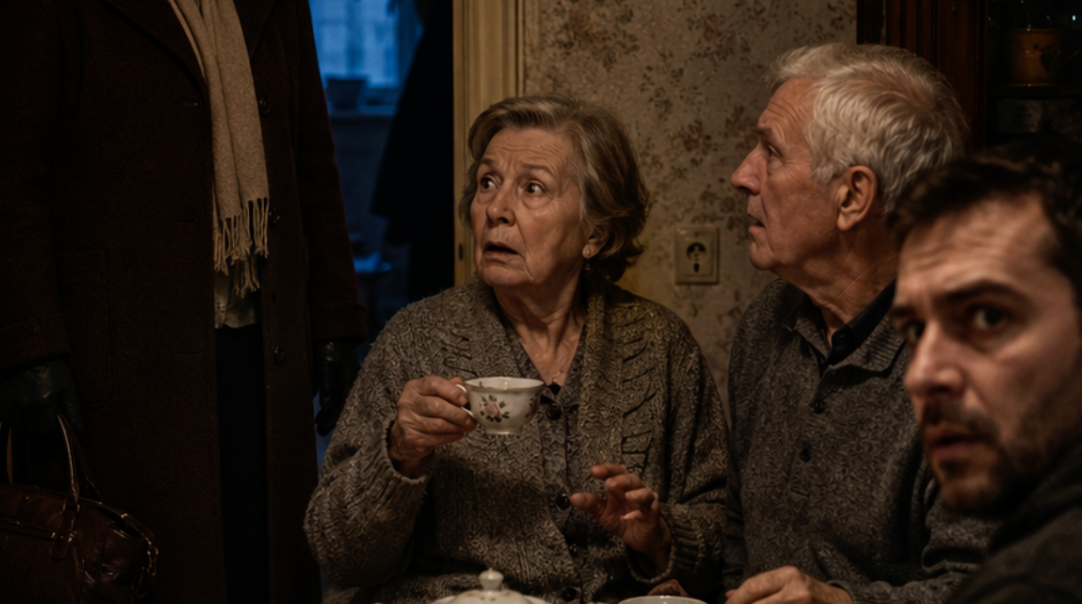
When she entered the apartment, she immediately understood that something extraordinary had happened. In the living room, at the large table, sat not only her parents, but Vadim as well. Her brother’s presence at their parents’ home on a weekday was an exceptional event. Vadim looked displeased. He kept checking messages on his expensive smartphone and nervously tapping his fingers on the tabletop. Valentina Ivanovna sat pale-faced, while Nikolai Petrovich stared grimly out the window.
“Come in, sit down,” her father commanded without turning his head.
Lyolya sat down on the edge of a chair. The atmosphere in the room was heavy and thick. The silence was broken only by the ticking of the large wall clock.
“So, the situation is critical,” Valentina Ivanovna began, clasping her hands together. “Our Vadik has run into enormous trouble. Unforeseen circumstances.”
Lyolya looked at her brother. He did not even raise his eyes from his phone screen.
“What circumstances?” she asked cautiously.
“You don’t need to know all the details of running a business,” Vadim cut her off, waving his hand carelessly. “The point is, I urgently need a large sum of money. A very large sum.”
“And what does that have to do with me?” Lyolya genuinely did not understand. “I don’t have that kind of money and never have. You know perfectly well what my dispatcher’s salary is.”
Valentina Ivanovna sighed heavily and looked at her daughter as though she had said something incredibly stupid.
“Olga, don’t pretend not to understand. Your father and I acted as guarantors for Vadik’s very large loan a year ago. He needed funds for development, to buy country real estate, to invest in the future. And now he is having temporary difficulties with payments. The bank is demanding repayment of the debt, otherwise they will seize our apartment. Our apartment, mine and your father’s, do you understand? We may end up on the street!”
Lyolya felt as though the floor had disappeared beneath her feet. Her ears began ringing. She looked at her parents, then at her brother, unable to process what she had heard.
“You… you pledged your only apartment for the sake of his latest fantasy?” Lyolya’s voice trembled. “What about the three-room apartment in the center that you gave him? Why doesn’t he sell it? Why doesn’t he pledge it?”
Vadim finally tore his eyes away from his phone and looked at his sister indignantly.
“Are you out of your mind? That is my base! That apartment is for my future children! How can I risk such an asset? It’s the foundation of our family. Our parents’ place is simple, in a residential district. The risks were minimal, circumstances just turned out this way. The economy is unstable.”
“So risking elderly people’s home is normal?” Lyolya felt anger begin to boil inside her, anger she had suppressed for decades.
“Don’t you dare speak to your brother like that!” Nikolai Petrovich barked, slamming his palm on the table. “He is a man. He is trying to build an empire, to provide for the family line. Mistakes happen, failures happen. The family must unite at such a moment.”
“And how exactly is the family supposed to unite?” Lyolya asked quietly, although she already suspected the answer.
Her mother leaned forward, her eyes shining feverishly.
“You must take out a loan, Olga. A large consumer loan. Secured by your apartment. You are officially employed, you have work experience, a good credit history. They will not refuse you. We will pay off Vadik’s debt, save our apartment, and then Vadik will gradually repay your loan. This is the only way out.”
A deafening silence hung in the room. Lyolya looked at these people, whom she called her family, and clearly understood: they did not care about her future at all. To them, her tiny apartment, bought with sweat and blood, years of deprivation and ruined health, was just a bargaining chip for solving the problems of the “golden boy.”
She remembered how she had worn the same winter boots for years, gluing the soles back on. She remembered how she had denied herself rare trips to the sea because her father needed a new television and her mother needed a sanatorium voucher. She remembered every kopeck spent on quality groceries for them while Vadim built his “empire,” buying expensive cars and dining in restaurants.
“You are asking me to pledge my only home?” Lyolya said slowly, emphasizing every word. “The very home I earned myself, without a single kopeck from you?”
“Olya, don’t dramatize!” Vadim interfered, lounging back in his chair. “Nobody is taking away your shack. It’s a mere formality. I’ll pay your loan. It’s just that banks won’t give me money now because of delays, but they’ll give it to you. It’s a matter of a couple of days to arrange the paperwork.”
“And if you can’t pay? If your ‘empire’ cracks again? What then? I’ll end up on the street?” Lyolya kept her gaze fixed on her brother.
“Vadik gave his word! How can you not trust your own brother?” Valentina Ivanovna exclaimed. “We are one blood! We must help each other. We raised you, fed you, clothed you, gave you an education. It is time to repay your debt to your parents. If we lose the apartment, we will move in with you. Is that what you want? For the three of us to live in your one-room apartment?”
It was open blackmail. A cruel, cold calculation. They knew that more than anything in the world, Lyolya valued her small, quiet corner, her only shelter from this cruel world. And they struck her in the most vulnerable place.
Lyolya stood up. She felt surprisingly calm. The anger that had raged inside her a minute before transformed into icy, crystal clarity. All illusions collapsed in an instant. The veil she had carefully placed over her own eyes all these years, justifying their indifference and consumer attitude, finally fell away.
She looked at the molding on the ceiling, at the expensive carpets bought with her money, at the large television screen for which she had paid for half a year. Then she shifted her gaze to Vadim, glowing with self-satisfaction, confident in his impunity and in the belief that his sister, as always, would obediently bend her neck.
“No,” Lyolya said firmly and loudly.
The word sounded like thunder in a clear sky. Nikolai Petrovich even choked on air.
“What do you mean, no?” her father hissed. “Did you not understand the situation? We may become homeless because you are pitying your little panel-box apartment on the outskirts!”
“I understood everything perfectly, Dad,” Lyolya took a deep breath. Her voice did not tremble. “You gave Vadim an enormous luxurious apartment in the city center. You gave him a wonderful start, a powerful foundation. You always solved his problems, paid for his whims, closed your eyes to his selfishness. You yourselves got into debt for the sake of his latest whim — a country house he could not afford.”
She took a step toward the table, resting her hands on its smooth polished surface.
“For years you drained money from me for your sanatoriums, delicacies, and repairs, complaining about your small pensions while your son changed cars. I carried that burden because I considered you my family. But you are not family. You are simply consumers.”
“How dare you speak to your mother like that!” Valentina Ivanovna turned red with rage, her chest rising and falling heavily. “We gave you life! Ungrateful girl!”
“You gave me life, but you never let me live,” Lyolya replied. “You threw me into a communal apartment, saying I was strong and would manage on my own. And you gave him everything. So, my dear parents… since you gave the apartment to my brother, let him support you in your old age!”
Lyolya turned and walked toward the exit. Behind her, an unimaginable uproar rose. Her father shouted about betrayal, her mother howled about shame and an ungrateful daughter, and Vadim muttered indignantly that “women have completely lost their minds.”
She put on her shoes, methodically fastening the zippers on her boots. Every movement was precise and calm. She felt neither fear nor guilt. Only enormous, all-consuming relief. As though a heavy sack of stones she had been carrying on her shoulders for the past thirty years had suddenly fallen to the floor.
“If you leave now, you can forget the way to this house! You are no longer our daughter!” Nikolai Petrovich shouted into the hallway, breathing heavily.
Lyolya took hold of the door handle, turned around, and looked at them one last time.
“I never was. You only have a son. Let him solve your problems now. Goodbye.”
The door closed behind her with a dull thud, cutting her off from the past.
When she stepped outside, Lyolya drew a full breath. The rain had stopped. The city seemed washed clean; the air was fresh and transparent, as if after a long, suffocating storm. Streetlights illuminated the wet asphalt, reflecting in the puddles as golden spots. She walked toward the bus stop, and her step was light and springy.
She took her phone out of her pocket. There were already ten missed calls from her mother and five from her brother on the screen. Lyolya opened the settings, selected the necessary contacts, and without hesitation sent them to the blacklist. Then she opened her banking app and canceled all automatic transfers to her parents’ accounts for utilities and internet. It was her money. From now on, it was only her money.
The next day at the tram depot, Lyolya fluttered like a bird. Zinaida, noticing the change in her friend, raised her eyebrows in surprise.
“Lyolka, did you win the lottery or something? You’re glowing all over. Even your wrinkles have smoothed out.”
“I did win, Zina. I won freedom,” Lyolya smiled, skillfully switching communication channels on the control panel.
During the lunch break, she told Zinaida everything: about her brother’s debts, the demand to pledge her apartment, and her final answer. Zinaida listened silently, only shaking her head from time to time.
“Well, look at you, girl,” she finally said, putting down her sandwich. “You did the right thing. Harsh, of course, but those bloodsuckers don’t understand any other way. Let their precious son unpack his famous empire now.”
The first few weeks were difficult. Her parents tried to get in touch through other relatives and called Lyolya’s work phone at the depot. Vadim even came to the entrance gate once, trying to threaten her and pressure her with pity, accusing her of causing their mother’s blood pressure to rise.
Lyolya came out to him with her uniform jacket thrown over her shoulders, looked at his puffy, displeased face, and said calmly:
“If you come to my workplace one more time and cause a scene, I will file a complaint with the authorities for extortion. I have plenty of witnesses. The entire team heard how you demanded money. Go, Vadik, work. Develop your business. And don’t forget to buy our parents farm cheese. They don’t eat cheap cheese.”
Vadim spat angrily at his feet and left. He never appeared again.
Time passed. For the first time in her life, Lyolya began spending money on herself. She bought new, expensive, comfortable winter boots made of genuine leather, which she had dreamed of for several years. She signed up for a swimming pool to help her tired back. She started buying herself tasty food, good fruit, and theater tickets. She made cosmetic repairs in her small but very cozy apartment, put up light wallpaper, and hung new curtains. The apartment began to breathe; it filled with light and peace.
In the evenings, she returned from work, brewed fragrant herbal tea, sat in a comfortable armchair by the window, and looked at the lights of the evening city. Her life no longer contained fuss, scandals, reproaches, or an eternal feeling of guilt. She no longer had to carry extremely heavy bags, listen to complaints, or give away her last kopecks.
From distant relatives, Lyolya occasionally learned news about her family. Things there developed predictably. Vadim, cornered by the bank’s demands and the lack of financial feeding from his sister, was forced to sell his country house at a large loss in order to cover the debts. The illusion of a “successful businessman” collapsed. His wife Marina, unaccustomed to saving money, caused a huge scandal and left him.
Her parents did not lose the apartment, but their life changed drastically. Vadim, embittered by failure, almost stopped visiting them. He blamed them for not being able to “put pressure on Lyolka,” and now he was suffering hardship. They had to forget forever about expensive groceries, new appliances, and sanatorium vouchers. They had to learn to live on their real pensions, count every kopeck from one pension payment to the next, reshape their budget, and buy cheap pasta on sale.
Lyolya listened to these stories without gloating, but also without pity. She accepted the situation as the natural result of many years of injustice. Everyone got exactly what they deserved. They had placed their bet on the “golden boy,” giving him everything. They had received their result.
A year passed. Autumn came again, coloring the trees outside Lyolya’s apartment windows in gold and crimson shades. Her life had acquired a measured, peaceful rhythm. At work, she was promoted to senior shift dispatcher and received a raise. She became close with her colleagues and often went on weekend excursions with them to nearby cities. It turned out that the world was enormous and full of interesting things when you were not tied to other people’s whims and endless obligations.
One Saturday morning, the doorbell rang. Lyolya was not expecting anyone. She went to the peephole and froze in surprise. Nikolai Petrovich stood on the landing. He had aged greatly and looked gaunt. He was wearing an old jacket that Lyolya had bought him about five years earlier.
Lyolya hesitated for several seconds, but then she turned the lock and opened the door slightly without removing the chain.
“What do you want, Dad?” she asked calmly.
Her father shifted from one foot to the other, hiding his eyes.
“Hello, Olya. Will you let me in? We need to talk.”
“Talk from there. I have things to do,” Lyolya had no intention of letting the past into her safe space.
Nikolai Petrovich sighed heavily. His voice sounded dull and broken.
“We’re living badly, Olya. It’s hard. Prices are rising, the pension is not enough for anything. Your mother is constantly sick, her nerves are shot. Vadim… Vadim has completely gone off the rails. He drinks. He was fired from the warehouse and now gets by on odd jobs. That grandfather’s apartment in the center… he sold it. Can you imagine? He sold it, invested the money in some shady pyramid scheme, and went bankrupt. Lost everything. Now he lives with us. The three of us in a two-room apartment. We argue every day. It’s pure hell.”
Lyolya listened to this confession completely evenly. Her heart did not tremble; the familiar pity that had once forced her to give away her last bit of money did not stir inside her.
“I’m sorry things turned out that way for you. But how can I help?” Her voice contained no emotion.
“Olya, daughter… We were wrong. Very wrong. Forgive us. We gave everything to Vadik, everything to him, and look how he turned out… We are family. Your mother cries every day and remembers you. She says, how can we live without Olya, she would never have acted like that. Let’s forget old grievances. Come back to us. Or at least start helping. We are practically starving. Vadim doesn’t work. He’s sitting on our necks.”
Lyolya looked at her father and saw not a close person before her, but a stranger, a weak man reaping the fruits of his own decisions.
“There is nowhere for me to come back to, Dad. I have my own home,” Lyolya gestured around her bright hallway. “And I will not help. You made your choice many years ago when you deprived me of housing in favor of my brother. You made your choice a year ago when you tried to hang his enormous debts on me. You still support a grown man. That is your life and your responsibility.”
“But you are our daughter!” Nikolai Petrovich tried to raise his voice, but the former authority was no longer in it, only despair. “This is inhuman! To abandon your parents in trouble!”
Lyolya closed her eyes for a second, gathering her thoughts.
“What would have been human was dividing the inheritance fairly. What would have been human was not draining the life out of me all these years. You destroyed our family yourselves, with your own hands, by placing Vadim on a pedestal. You fed his ego, you sponsored his foolishness. You gave him the apartment, the money, your love and care. And now, when he has devoured you, you have come to me for a new portion of resources?”
Her father was silent, his head lowered. He had nothing to say.
“Go home, Dad,” Lyolya said softly but firmly. “Go to Vadim. Demand care from him. You invested all your assets in him. Let that asset work now. I am no longer your lifeboat. I am a person who simply wants to live her life peacefully.”
She gently but decisively closed the door. The lock clicked. Lyolya leaned her back against the cool surface of the door and exhaled deeply. No tears, no hysteria. Only a final, reinforced-concrete understanding of her own rightness.
She went to the kitchen and poured herself hot green tea. She looked out the window. Life went on. The city lived its busy life, and somewhere in the distance, a tram rattled along the rails, reminding her of the job she loved. Lyolya took a sip, enjoying the tart taste and the silence of her apartment. The silence she had earned. The silence that no one would ever again dare to violate with demands, reproaches, and manipulation. She was free, self-sufficient, and absolutely happy in her simple, clear, human existence. And the past… the past remained behind a tightly closed door.