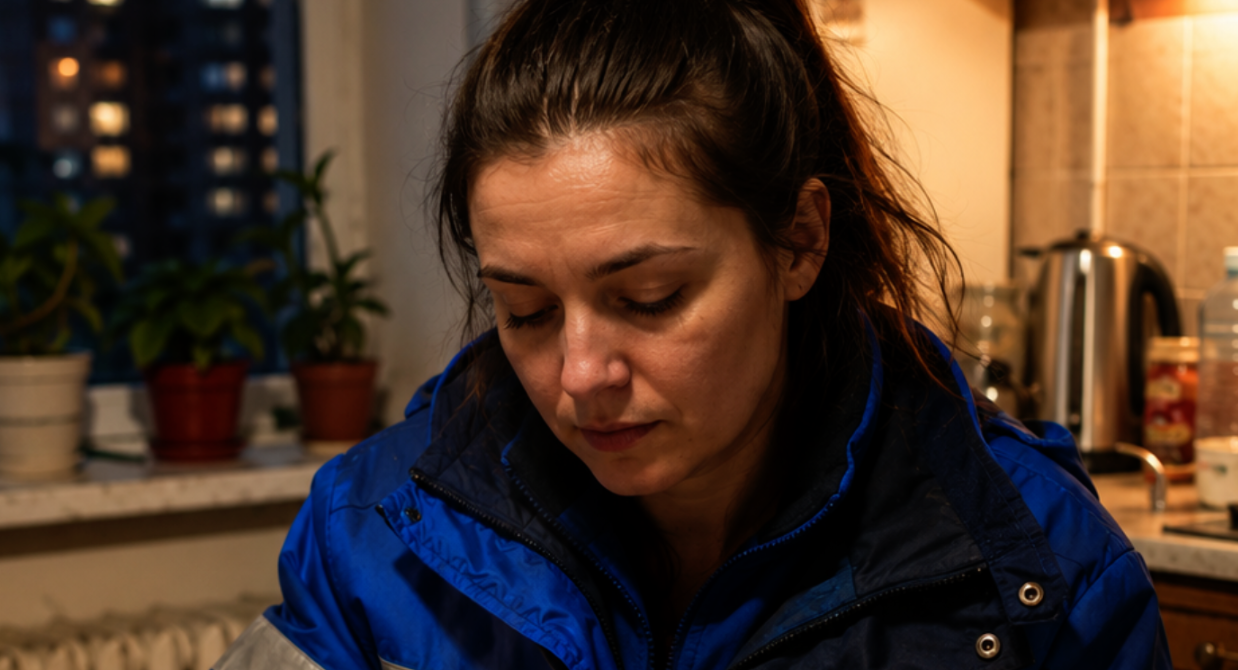
“My Daughter-in-Law Deliberately Eats Separately from the Family,” the Mother-in-Law Complained, Unaware of Her Shift Schedule
“She deliberately eats separately from us. As though we aren’t her family,” Zinaida Pavlovna complained, pressing the phone to her ear and lowering her voice even though there was no one else in the apartment. “Come over, Larisa. You’ll see for yourself.”
Larisa Melnikova, thirty-six, a senior auditor at the Accounts Chamber of the Samara Region, listened to her mother while absentmindedly straightening a stack of reports on her desk.
Thursday. Four o’clock in the afternoon.
A damp February fog hung outside her office window, and the streetlights along the Volga embankment had already come on.
“Mom, what do you mean by ‘deliberately’?”
“Exactly what I said. We sit down at the table, and she isn’t there. We eat, and she’s off somewhere else. Then she sneaks into the kitchen afterward, takes out her containers, and eats alone. Like a stranger. Andrei says nothing. The children have gotten used to it. But I’m a mother, and it hurts me.”
Larisa knew that tone.
Her mother was not merely complaining. She was passing judgment—and waiting for her daughter to carry out the sentence.
“I’ll come on Saturday,” Larisa said. “I’ll sort it out.”
She hung up and leaned back in her chair.
Marina, her brother’s wife. Twenty-nine years old. She worked as a paramedic at an ambulance station in Tolyatti. She had two children: five-year-old Kiryusha and three-year-old Polina.
They all lived together with Zinaida Pavlovna in a three-room apartment on Voroshilov Street. After Larisa’s father died, they had never moved into separate homes.
Larisa had not seen Marina in six months. The last time had been at Polina’s birthday party. Marina had seemed tired then. Her face was pale, there were dark circles beneath her eyes, and her hands were constantly moving—clearing dishes, arranging things, serving food.
But she had sat at the table with everyone.
She had even smiled.
What had changed in six months?
Zinaida Pavlovna Melnikova, sixty-one, was a former deputy principal at School No. 17. She had retired three years earlier. Her husband, Viktor Sergeyevich, had died of a stroke at fifty-eight.
He had left the apartment to his son. That had been decided verbally while he was still alive, without a will. Larisa had not argued. She had long been living in Samara, with her own one-room apartment and her own life.
Andrei worked as a foreman at the Tolyattikauchuk rubber plant. His schedule rotated: two days on, two days off, then two night shifts. His salary was forty-seven thousand rubles. Marina earned thirty-nine thousand working for the ambulance service.
Together, they brought in eighty-six thousand rubles for a household of five.
Zinaida Pavlovna’s pension was twenty-one thousand three hundred rubles. She contributed fifteen thousand to the household budget and kept the rest for medicine and small personal expenses.
There was no mortgage, but the apartment had not been renovated since the 1990s. The wallpaper was yellow, the linoleum was patterned, and the cast-iron radiators heated the rooms so intensely in winter that the windows fogged up.
The bathroom faucet leaked, and Andrei had been promising to repair it for two months.
In the children’s room stood a bunk bed Marina had bought on Avito for four thousand rubles. She had painted it white herself one Saturday evening while the children were asleep.
Zinaida Pavlovna believed that her responsibility was to hold the family together.
Lunch was served strictly at one o’clock. Dinner was at seven.
She cooked every day: borscht, meat patties, porridge, compote. Everything was organized like a cafeteria. She planned the menu a week in advance, wrote it in a blue-covered notebook, and attached it to the refrigerator with a sunflower-shaped magnet.
Marina did not fit into that system.
Not because she did not want to.
Her shifts simply began at different times—sometimes at six in the morning, sometimes at two in the afternoon, sometimes at ten at night.
Working as a paramedic at an ambulance station was not an office job. She spent twelve hours on her feet, sometimes sixteen if a colleague became ill and someone had to cover the shift.
The emergency calls ranged from heart attacks to drunken fights.
There was no time for scheduled lunches inside an ambulance.
When Marina returned home after a night shift, the family was already eating breakfast. She changed her clothes, checked on the children, kissed Kiryusha before kindergarten, and put Polina down for her daytime nap if Zinaida Pavlovna had not taken her for a walk.
Only then did Marina eat.
Quietly.
In the kitchen.
Alone.
Not deliberately.
Simply because that was how the timing worked out.
But Zinaida Pavlovna saw something else.
She saw rejection. Disrespect. A challenge.
On Saturday, Larisa took the morning commuter train from Samara.
She arrived at ten twenty.
Her mother met her at the door wearing a housecoat and slippers, with the expression Larisa privately called “deputy-principal mode”: pursed lips, raised chin, arms crossed over her chest.
“Come in. I’m just getting lunch started.”
The apartment smelled of boiled potatoes and fried onions. Soup simmered in the kitchen. The bright, cheerful voices of cartoon characters drifted from the room.
Andrei was at work and would return around six.
The children were in their room. Polina, wearing tights and a T-shirt with the cartoon character Luntik, was building a tower from blocks. Kiryusha was shaping something from modeling clay that looked vaguely like a tank.
Larisa walked down the hallway.
She glanced into the bathroom. Children’s clothes were drying neatly on a line. Three toothbrushes stood in a cup on the shelf. On top of the washing machine was a note:
“Andrei, Polina’s trousers are in the laundry basket. Wash them if you run a load.”
The handwriting was small and neat.
Marina’s.
“Where’s Marina?” Larisa asked.
“At work. Since six this morning. She’ll be back at eight tonight. Or nine. As usual.”
Larisa took off her coat, hung it on a hook, and went into the kitchen.
She sat on a stool.
“Mom, tell me in more detail. What exactly is bothering you?”
Zinaida Pavlovna placed a cup of tea in front of her daughter and sat opposite her.
Then she began.
“I try, Larisa. I try every day. I cook for everyone. I clean. I take care of the children. And she comes home and won’t even sit at the table. I tell her, ‘Marina, sit down, everything is ready.’ And she says, ‘Thank you, Zinaida Pavlovna, I’ll eat later.’ Then later, she takes out her containers. Like she’s in a hospital. She eats separately. In silence. As though she doesn’t need my food. As though she doesn’t need me.”
Zinaida Pavlovna’s voice trembled.
She turned toward the window.
Larisa said nothing.
She waited.
“I’m not a stranger,” her mother continued. “I’ve lived in this apartment for twenty years. I put her children to bed. I rocked Polina at night when her ears hurt. And she eats separately. Like we live in a communal apartment. Andrei says, ‘Mom, stop imagining things.’ But I can see it. I can feel it.”
“What do you feel, Mom?”
“That she thinks she’s better than us.”
Larisa took a sip of tea.
It was far too sweet. Her mother always added three spoonfuls of sugar.
“All right. I’ll wait for Marina and speak to her.”
Marina returned at eight forty that evening.
Larisa heard the lock click, boots being removed in the hallway, and a jacket rustling against the coat rack.
Then came footsteps—quiet, like those of someone accustomed to not waking others.
Marina entered the kitchen.
She saw Larisa and stopped.
“Hello. I didn’t know you were coming.”
“Hello. Mom asked me to come.”
Marina nodded.
She looked exactly like someone who had just spent fourteen hours working in an ambulance: gray-faced, red-eyed, her hair tied into a ponytail with loose strands falling out.
There were marks from a stethoscope on her neck.
“Have you eaten?” Larisa asked.
“I had a snack at the station. A sandwich.”
“At one o’clock?”
“At three. Between calls.”
Marina opened the refrigerator and took out two containers, one pink and one green. She placed them in the microwave.
“What’s in them?” Larisa asked.
“Chicken with rice and vegetables. I cook everything for the week on Sundays and divide it into portions. It’s easier that way. And cheaper. One container costs me about one hundred twenty rubles. If I buy lunch from the vending machine at the station, it costs three hundred fifty rubles per meal.”
She closed the microwave door.
“Multiply that by twenty-two working days, and you get seven thousand seven hundred rubles. My containers cost two thousand six hundred a month. The difference is five thousand rubles. That’s a winter snowsuit for Polina.”
“Is it easier than eating Mom’s soup?”
Marina turned and looked at Larisa.
She did not look offended.
She did not look angry.
She looked tired.
“Larisa, may I sit down?”
“Of course.”
Marina sat.
The microwave hummed.
The clock on the wall showed eight fifty-three.
“I work a twenty-four-hours-on, forty-eight-hours-off schedule,” Marina said. “But because we’ve been short-staffed for the last four months, I’ve been working a position and a half. Sometimes I work twenty-four hours on, twenty-four hours off. My workday is twelve hours. Sometimes sixteen. Last month, I worked twenty-two days.”
She paused.
“Zinaida Pavlovna eats lunch at one and dinner at seven. When I work a day shift, I come home at eight or nine in the evening. When I work nights, I leave at ten at night and return at eight in the morning. When I work the early shift, I leave at five thirty. Not one of my schedules coincides with her mealtimes. Not one.”
The microwave beeped.
Marina did not get up.
“But that isn’t the only reason. I prepare containers because I need to control what I eat. After night shifts, my body craves carbohydrates. If I sit down and eat borscht with bread and potatoes, I’ll be trembling an hour later. I need protein and vegetables. It isn’t a whim. It’s physiology.”
“Mom thinks you’re trying to make some kind of statement.”
“I know what she thinks. I tried to explain it to her three times. In October, November, and December. Every time she said the same thing: ‘I cook for the whole family, and you turn up your nose at it.’”
“So what did you do?”
“I stopped explaining. I simply continued preparing my containers.”
Larisa looked at Marina.
At her hands, dry and cracked from antiseptic.
At the badge she had forgotten to remove:
“Melnikova M. A., Paramedic, Station No. 4.”
“Marina, I need to ask you something.”
“Go ahead.”
“Do you cook only for yourself?”
Marina stood, opened the refrigerator, and pointed to the lowest and largest shelf.
“Here. Three containers for Kiryusha. There’s porridge with fruit for breakfast because he doesn’t eat well at kindergarten, so I feed him before he leaves. Two containers for Polina—puréed soup and meatballs, because she’s allergic to carrots, and Zinaida Pavlovna puts carrots in everything.”
She pointed to another container.
“This broth is for Andrei. He takes it to work because lunch in the factory cafeteria costs two hundred eighty rubles, while broth from home is free.”
Then she pointed to a glass jar with a lid.
“And this is chokeberry jam. I made it in September. Zinaida Pavlovna eats it with tea every evening. Though she probably thinks it appears by itself.”
Larisa felt something tighten in her chest.
Not anger.
Shame.
Shame for her mother.
“Marina, wait. When do you do all of this?”
“On Sunday. My only full day off. In the morning, I do the laundry, clean the children’s room, and prepare the containers for the week. I make the shopping list on Friday evening and order the groceries online for delivery at nine on Sunday morning. It saves time.”
“How long does the cooking take?”
“Four or five hours. It depends on the menu. Polina doesn’t tolerate gluten well, so I cook separately for her. Kiryusha eats everything, but I have to control his portions. He gained weight over the winter, and the pediatrician recommended keeping an eye on it.”
Marina removed the container from the microwave and took off the lid.
Rice, chicken breast, roasted broccoli.
Everything was evenly cut and neatly arranged.
“Larisa, I don’t eat separately out of spite. I eat separately because I come home after everyone else has already eaten. And I eat my own food because that is what my body needs after twelve hours on my feet.”
She picked up a fork and began to eat.
Silently.
Neatly.
Like someone who valued every minute of peace because she knew there would be very little of it.
Larisa went into the room where her mother was sitting on the sofa knitting a scarf. The needles moved quickly and evenly.
Zinaida Pavlovna did not look up.
“Well? Did you speak to her?”
“I did.”
“And what did she say? That I cook badly?”
Larisa sat beside her.
Not opposite her.
Beside her.
That was important.
“Mom, do you know what time Marina leaves for an early shift?”
“Early.”
“At five thirty. That means she wakes up at four forty-five. She showers, puts on her uniform, packs her bag, and leaves at five fifteen so she can catch the minibus.”
“I know she wakes up early. So what?”
“Do you know that Polina is allergic to carrots?”
Zinaida Pavlovna stopped moving the knitting needles.
She did not put them down.
She simply froze.
“Polina? What allergy?”
“She’s allergic to carrots. Marina cooks separate food for her without carrots. Puréed soup. Meatballs. Every week.”
“I didn’t know,” her mother said quietly.
“You put carrots in everything. Soup, borscht, stewed vegetables. Didn’t Marina tell you?”
Zinaida Pavlovna remained silent.
Then she said:
“Maybe she did. I don’t remember. But she could have simply asked. I would have cooked without carrots.”
“She asked three times. In October, November, and December.”
Silence.
The knitting needles rested on Zinaida Pavlovna’s lap.
The scarf hung down to the floor.
“Mom, do you know who prepares Andrei’s broth for work?”
“He takes it himself. From the pot.”
“No. Marina makes a separate broth on Sundays and pours it into containers. Andrei doesn’t take broth from the main pot because he wants chicken broth, not beef. You make beef broth. Marina knows what he prefers because she asked him. You don’t.”
“I’m his mother. I know what he likes.”
“Mom, he likes chicken broth. He always has, even when he was little.”
Zinaida Pavlovna opened her mouth.
Then closed it.
She turned her head toward the window.
“And there’s something else,” Larisa continued.
Zinaida Pavlovna looked up.
Her eyes were wet, but she did not cry.
Deputy principals did not cry.
They analyzed.
“Larisa, I didn’t know about the containers. I didn’t know she cooked for everyone.”
“Exactly. You saw Marina eating separately. But you didn’t see that she was feeding the entire family. Including you. The chokeberry jam you eat every evening—she made it.”
Zinaida Pavlovna looked at the bedside table.
A jar of dark jam stood there.
A spoon lay beside it.
There were cookie crumbs nearby.
“I thought Andrei bought it,” she whispered.
“No. Marina made it in September. She picked the berries at her friend’s country house. On her only day off.”
Sunday.
Nine in the morning.
The grocery courier delivered three bags.
Marina spread the food across the table: rice, chicken, broccoli, zucchini, apples, cottage cheese, eggs.
Kiryusha hovered nearby, trying to steal an apple.
“Kir, wait. I’ll wash it.”
“Mom, can I have the red one?”
“You can. Here you go.”
Larisa stood in the kitchen doorway and watched.
Marina moved around the kitchen like a surgeon in an operating room: efficiently, precisely, without unnecessary movements.
Every container was labeled with a marker.
“K—breakfast.”
“P—lunch.”
“A—shift.”
“M—night shift.”
The letters were small and even.
The handwriting of a paramedic accustomed to filling out emergency reports inside a moving ambulance.
Zinaida Pavlovna entered the kitchen at ten.
Silently, she stood beside the stove.
She looked at the containers.
At the labels.
At the shopping list pinned to the board.
“Marina.”
“Yes, Zinaida Pavlovna?”
“What can’t Polina eat? Only carrots?”
Marina turned around.
She looked at her mother-in-law.
Then at Larisa.
Then back at her mother-in-law.
“Carrots and pumpkin. It’s a cross-allergy. The pediatrician confirmed it in November. I have the medical report.”
“Show me.”
Marina dried her hands on a towel, went into the room, and returned with a folder.
It was an ordinary blue office folder with a snap button.
Inside were Polina’s medical records. Allergy test results. The pediatrician’s recommendations. A list of allergens.
Everything was neatly arranged by date.
Zinaida Pavlovna put on her glasses.
She read in silence.
Page after page.
“Why didn’t you show me this before?”
“I told you. You said, ‘In our day, nobody had allergies. We ate everything and didn’t complain.’”
Zinaida Pavlovna took off her glasses and placed them on the table.
She rubbed the bridge of her nose.
“Did I really say that?”
“Yes. On November fourteenth. After Polina developed a rash from pumpkin porridge.”
Silence.
The clock ticked.
Kiryusha laughed at a cartoon in the other room.
Polina slept in her bed.
Zinaida Pavlovna picked up a pen from the table and opened her notebook containing the weekly menu.
She ran her finger along the lines.
Then she began crossing things out.
Carrots in the borscht—crossed out.
Pumpkin in the porridge—crossed out.
Carrot juice, which she had been giving Polina in the mornings—crossed out.
Stewed vegetables with carrots on Wednesday—crossed out.
Her hand moved slowly, as though every line she crossed out cost her something.
Larisa watched.
She did not help.
She did not prompt her.
She waited.
“What else can’t she have?” Zinaida Pavlovna asked.
Her voice was steady.
Teacher-like.
Businesslike.
Marina sat beside her and opened the folder to the page with the recommendations.
“Here’s the list. Carrots, pumpkin, celery, and parsley root—not the leaves. Birch pollen in spring, but that isn’t food.”
“I don’t use celery. But I put parsley in soup.”
“Parsley root. The leaves are fine.”
Zinaida Pavlovna wrote it down.
Slowly, in large letters.
Like a teacher writing a new lesson on the blackboard.
“Marina.”
“Yes?”
“I didn’t ask you. I decided for you. That was wrong.”
She did not say, “I’m sorry.”
Deputy principals did not apologize with words.
They changed the schedule.
Larisa left at four in the afternoon.
In the hallway, she zipped up her coat and wrapped her scarf around her neck.
Her mother stood nearby.
“Mom, I’m going.”
“Go. Thank you for coming.”
Larisa glanced toward the kitchen.
Zinaida Pavlovna had hung up a new weekly menu.
Beside it was a list of Polina’s allergens, rewritten in large handwriting on a separate sheet of paper.
The sheet was attached with the sunflower-shaped magnet, next to the old menu.
Marina’s containers stood on the bottom shelf of the refrigerator.
Labeled with a marker.
As always.
But beside them was a new container.
It had no label.
It contained borscht.
Without carrots.
Larisa noticed it when she took a bottle of water before leaving. She opened the lid.
The borscht was deep red, thick, with sour cream on top.
And there were no carrots.
Not a single orange circle.
She closed the container and put it back.
She said nothing.
On the commuter train, Larisa looked out the window.
February fields drifted past—gray, empty, dotted with occasional birch trees. A dark patch of forest stretched across the horizon, and crows circled above it.
The carriage was half empty.
An elderly man across the aisle slept with his head resting on a folded newspaper.
Somewhere behind Larisa, a woman was reading a fairy tale aloud to a child, and fragments of sentences floated through the carriage:
“…and then she realized that…”
Larisa thought about Marina.
About the way she stood in the kitchen on Sundays—on her only day off, when other women her age slept until ten, drank coffee, and scrolled through their phones.
Marina chopped vegetables, boiled broth, and labeled containers with the marker she carried in her jacket pocket beside the pen she used for ambulance reports.
Larisa took out her phone and opened her chat with her brother.
“Andrei, do you know that Marina makes broth for you every Sunday?”
His answer came a minute later.
“Of course I know. She’s been doing it for four years. Why?”
“Nothing. I was just checking.”
Larisa put away her phone and closed her eyes.
Sometimes the quietest people in a family do more than anyone else.
And they are often the first to be accused because they do not announce everything they do.
They simply label the containers.
With a marker.
In small handwriting.
And place them on the bottom shelf.
Where no one looks.