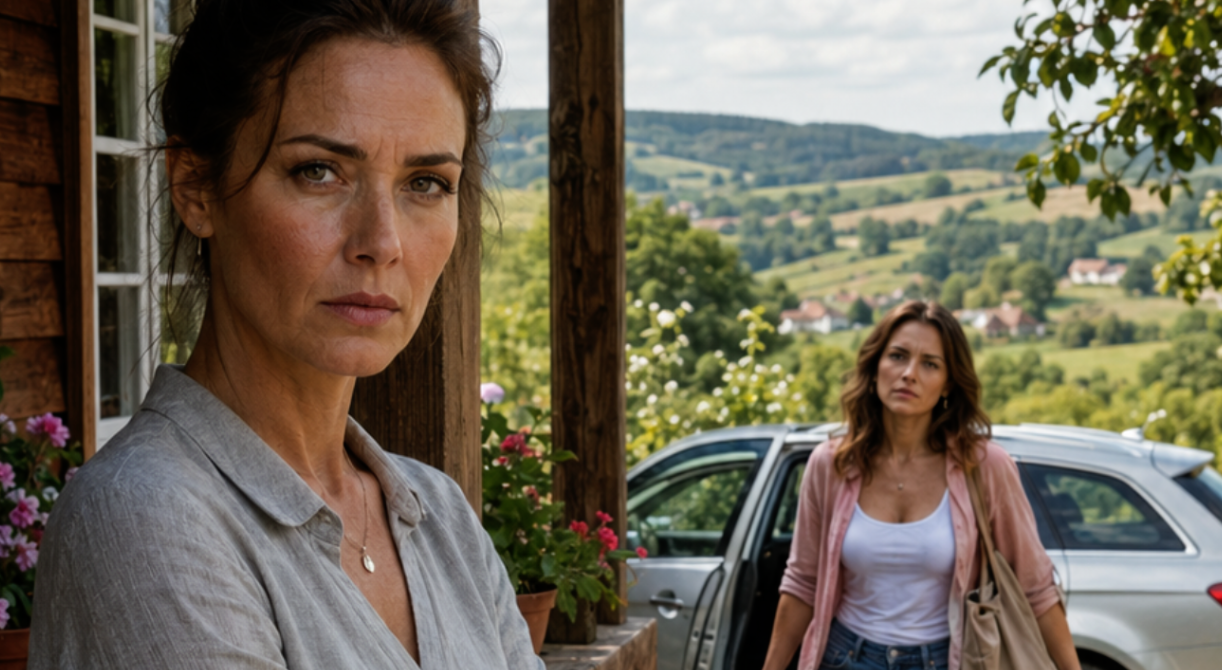
My Sister-in-Law Planned Her Vacations at My Country House for the Entire Summer. A Week Later, She Arrived—and Found a Surprise Waiting for Her
“Dina, I’ve been thinking—we should come stay with you for a week in June. At the country house, I mean. The children need fresh air.”
Larisa spoke as though she were announcing the weather forecast. She wasn’t asking. She was informing me.
I held the phone to my ear and stared at the strawberry bed I had planted the previous weekend. The soil still smelled of peat. My hands were sore from gripping the shovel. Meanwhile, Larisa was already explaining how many bags they would bring and saying that I should probably buy another folding bed.
Eleven years.
For eleven years, I had been hearing some version of, “We should come stay with you.”
It had started the day my mother gave me the country house—a small six-hundred-square-meter plot with a wooden cottage, a well, and three old apple trees.
My mother’s cottage. My mother’s garden. My mother’s roses are growing along the fence.
The deed was in my name.
Mine.
But try explaining that to a sister-in-law who believes that because her brother is my husband, everything belonging to us is shared.
Including my country house, my kitchen, and my patience.
Larisa first appeared at the cottage during the summer after my mother gave it to me. It was 2015. I was forty-one, and she was thirty-seven.
At the time, I had only just begun restoring the property. I replaced the rotten front steps, painted the fence, and planted new blackcurrant bushes. That year alone, I spent about forty thousand rubles of my own money.
I work as a technical writer. My salary is nothing extraordinary, and every ruble matters.
Larisa came to “help with the garden.”
Her help looked like this: she sat on the veranda drinking coffee while I weeded the carrots. Then she walked around the property and delivered her verdict.
“Why do you need all these roses? You’ll exhaust yourself weeding around them. You should plant potatoes instead. Potatoes are useful. Roses are just pointless decoration.”
My mother’s roses.
The same roses my mother had tended every spring. Pale pink, with heavy blossoms that smelled so wonderful you wanted to stop by the gate and simply stand there.
I said nothing.
Later, Gleb told me, “She didn’t mean anything bad. She’s just practical.”
Gleb always said that.
When it came to his sister, there was always an excuse.
Larisa disliked and loved the cottage at the same time. She disliked my sense of order, my flower beds, and my teapot with a little rooster on the lid.
What she loved was the free vacation spot forty minutes outside the city.
That first year, she came “just for the day.”
She stayed for nine.
For nine days, I fed her, her husband Sergei, and their two children. I cooked for five people—breakfast, lunch, and dinner.
Sergei ate enormous portions without speaking, scraping his fork against the plate. Maxim was seven then, and Anya was five. They raced around the property, trampled the garden beds, and pulled green onions out by the roots.
Larisa didn’t notice.
She sat on the veranda with her feet resting on the railing, talking on the phone.
For nine days, I listened to her complain that my fence was crooked, the gate squeaked, and the mattress upstairs needed to be thrown away. She said the paint on the steps was peeling—even though I had painted them that spring. She said the apple trees should be cut down because they were old and useless.
“They aren’t useless,” I said. “My mother planted them.”
Larisa looked at me as though I had said something foolish.
“So what? Trees aren’t people, Dina. You can plant new ones.”
For nine days, I washed other people’s towels and swept dirt from other people’s shoes off the porch.
When they finally left, the kitchen smelled of fried onions and someone else’s perfume. I washed the floor twice before the odor disappeared.
I spent approximately nine thousand rubles on food during those nine days.
Not one person offered to contribute a single ruble.
I told Gleb, “Next time, she should at least let us know in advance.”
He nodded.
Then he forgot.
The following year, Larisa did warn me.
One day in advance.
I had planned to paint the veranda, but I had to postpone it. What was the point of painting when five people would arrive twenty-four hours later and walk across the fresh paint?
That became the routine.
Every summer, there were six to eight visits. Each visit lasted at least a weekend, but more often five to seven days.
Over eleven years, I invested almost half a million rubles in the cottage: roof repairs, new windows, insulation, tools, fertilizer, seedlings.
Yet it felt as though I personally used the property for only one-third of each season.
The rest of the time, Larisa treated my land as though she were the owner.
Why did I tolerate it?
Because in 2016, Gleb was laid off. He was unemployed for four months. Larisa lent us one hundred and twenty thousand rubles.
We repaid every kopeck six months later.
But Larisa remembered.
And I remembered too.
Every time I wanted to say, “Enough,” a voice inside me reminded me that she had helped us when things were difficult.
And then there was Gleb.
Whenever I tried to discuss Larisa, he looked at me as though I were taking something precious away from him.
Larisa was his younger sister. He had practically raised her after their father left the family.
To Gleb, refusing Larisa felt like betrayal.
I tried speaking to her directly once.
I called her in April and politely asked that if she wanted to visit the cottage, she arrange it with me at least a week in advance so I could prepare.
Larisa reacted as though I had slapped her.
An hour later, Gleb called.
“Why did you upset Larisa? She’s crying. She says you don’t want to let her come to the cottage. She only wanted to help you with the seedlings!”
I stood in the kitchen holding the phone and thought, When did my cottage become a place where I have to ‘allow’ people to enter?
I wasn’t a prison guard.
I was the owner.
But apparently, even an owner wasn’t permitted to ask guests to announce their visits.
I never asked again.
In 2023, something happened that I later referred to simply as “the greenhouse incident.”
Larisa brought an entire group with her: Sergei, the children—Maxim, who was fourteen, and Anya, who was twelve—and one of her friends with her husband.
Six people.
They arrived without warning on a Friday evening.
I was outside wearing work gloves, tying up the tomato plants. The sun was setting, and the air was warm and heavy, scented with sun-heated earth and dill from the neighboring bed.
I heard the gate creak, turned around, and saw a crowd walking down my garden path carrying shopping bags, a barbecue grill, and a speaker blasting Russian pop-folk music.
“Dina, we’re here with some friends! Don’t worry, we’ll take care of everything ourselves!” Larisa shouted.
Without waiting for a response, she carried the bags onto the veranda.
When Larisa said they would “take care of everything,” it meant the men grilled meat, the women chopped salads in my kitchen using my knives, and the teenagers raced around the property as though it were a stadium.
Her friend Oksana opened my refrigerator, took out my mineral water, and poured herself a glass without asking.
I stood in the doorway and watched in silence.
The speaker blasted music until midnight.
The bass pounded inside my skull.
I lay upstairs and counted the songs.
Fourteen.
Fourteen songs about gangsters, brotherhood, and hard lives.
The next morning, my neighbor Antonina Pavlovna looked at me over the fence as though I had organized the party myself.
“Dina, your music was blasting until one in the morning. I had to catch the eight o’clock train. I didn’t sleep at all.”
I apologized.
For Larisa.
As usual.
Then I saw the greenhouse.
Maxim, Larisa’s fourteen-year-old son, had been throwing a ball against the wall of the house. The ball bounced into the greenhouse.
The polycarbonate had cracked.
Two entire panels.
Long fractures ran from edge to edge like lightning across the yellow plastic.
Inside, the cucumber plants had been crushed. Their stems were broken, and soil was scattered across the path.
I had spent two years building that greenhouse—the frame, the polycarbonate, the soil, the irrigation system.
It had cost twenty-eight thousand rubles.
It had also cost me three months of weekends, during which I hauled buckets of compost and dug through the earth instead of resting.
I crouched down and touched a broken cucumber stem.
It was soft and wet. It smelled fresh and green.
The day before, it had been healthy, reaching toward the light along the string I had installed the previous week.
The greenhouse smelled of damp soil and crushed leaves.
Warm and rich.
Over it lingered the sickly-sweet odor of meat from the previous night’s barbecue, which they had not even bothered to clean.
The grill rack was lying on the grass, dripping grease onto my lawn.
I showed Larisa the damage.
“Oh, Dina, they’re children. What do you expect?” She waved her hand dismissively. “It’s only polycarbonate. You can glue it.”
You cannot glue broken greenhouse panels.
You replace them.
For twelve thousand rubles.
I told Gleb, “Twelve thousand. Either Larisa reimburses me, or you do.”
Gleb remained silent for a moment.
Then he transferred twelve thousand rubles from his bank account and said, “Just don’t tell Larisa I paid for it. She’ll be upset.”
She would be upset.
Not me, whose greenhouse had been destroyed.
Not me, who had spent three months building it.
Larisa would be upset—the woman who had brought six people to my house without an invitation.
I silently accepted the money.
Then I silently went to order replacement polycarbonate.
After that, a small miracle occurred.
Larisa disappeared.
For an entire month, there were no visits. No calls beginning with, “We should come stay with you.”
Silence.
I became more confident.
I repaired the greenhouse, planted new seedlings, and finally painted the veranda pale blue, the color my mother had wanted.
I installed a new swing because Maxim had also damaged the old one by rocking it until the frame began to creak.
I spent another fifteen thousand rubles.
I thought Larisa had finally understood.
Sometimes, I told myself, one clear message is enough.
It isn’t.
At the end of April 2026, Larisa sent a message to the family group chat.
It was long.
It included a schedule.
I opened it during my lunch break at work.
“Hello, everyone! I’ve created a summer vacation schedule for the country house so it will be convenient for everybody. Take a look:
June 1–14: Larisa and family
June 15–22: Larisa’s friend Oksana and her husband
June 28–July 6: Larisa and family
July 10–20: The parents—Gleb and Larisa’s mother and father
August 1–14: Dina and Gleb
August 18–31: Larisa and family—closing the season
Dina, you get August, the warmest month! I deliberately saved the best time for you 😊”
I read it three times.
A schedule.
With dates.
For my cottage.
Six hundred square meters of land on which I had spent almost half a million rubles and eleven years of my life.
And according to Larisa’s schedule, I was allowed two weeks.
In August.
She had “saved the best time” for me.
I counted.
Larisa and her family had claimed six weeks of the summer.
Her friend Oksana had been assigned one week.
My in-laws had ten days.
I, the owner, had fourteen days.
Out of a four-month summer season, I received less time than Larisa’s friend, whom I had seen only once in my life at a birthday party.
Oksana was going to live in my cottage, sleep on my bedding, use my stove, and perhaps water my garden—or perhaps not.
And I was learning about it from a schedule posted in a family group chat.
My hands went cold.
Literally cold.
I sat at my desk surrounded by technical manuals and instruction documents, with a mug of coffee growing cold beside me.
My fingers felt icy, even though the office was warm.
Behind the wall, my colleague Natasha was typing. Someone was laughing in the hallway.
I stared at my phone and could not believe Larisa was serious.
I sent Gleb a private message.
“Have you seen this?”
He replied an hour later.
“Yes. She’s only making a suggestion. We don’t have to agree.”
Only making a suggestion.
She hadn’t asked whether it was acceptable.
She hadn’t called me, the owner.
She had created a schedule and posted it in the group chat like a train timetable.
I wrote a short message in the family chat.
“Just a reminder: the cottage and land are legally registered in my name. It was a gift from my mother. All visits must be arranged directly with me. I am the person who makes schedules for the property.”
Silence.
One minute.
Two.
Five.
Then Gleb called.
“Why did you have to write it like that? Larisa is upset. She says you humiliated her in front of everyone.”
“In front of whom? The group contains you, me, Larisa, and your mother.”
“Mom read it too. She feels uncomfortable.”
“I also feel uncomfortable when someone schedules the use of my property without consulting me.”
Gleb was silent.
Then he said the inevitable words.
“Larisa is crying.”
Larisa was always crying.
It was her most effective weapon.
The moment someone told her no, the tears began. Then came the calls to Gleb and the accusations.
Dina was cruel.
Dina didn’t care about family.
Dina was selfish.
Over eleven years, I had learned every part of this mechanism.
And every time, it worked.
Because Gleb couldn’t bear to see Larisa cry.
But that evening, I didn’t give in.
“Let her cry,” I said. “The cottage is mine.”
Gleb ended the call.
We didn’t speak for two days.
Then I discovered the key.
It was early May.
I went to the cottage alone to air out the rooms, light the stove, and inspect the roof after winter.
The commuter train swayed gently while birch trees with their first green leaves flashed past the window.
I love that journey in spring. The air is still cool, but everything smells of wet bark and something sweet—perhaps bird cherry blossoms or melting snow.
I opened the gate and walked down the path.
The porch steps were dry and clean. It had not been a snowy winter.
I took out my key, unlocked the cottage, and immediately sensed that someone had been there.
It wasn’t the smell.
Not at first, although I noticed that later.
The objects were in the wrong places.
The mugs on the shelf had been rearranged.
My blue mug, the one printed with the words “Best Tech Expert,” had been pushed into the corner. A plain white mug that did not belong to me had been placed at the front.
The blanket on the sofa had been folded differently, with the corners tucked inward.
I never folded it that way.
On the kitchen table stood an empty jar of instant coffee.
I never drink instant coffee.
It leaves a sour taste in my mouth and gives me heartburn.
I walked through the cottage.
There was sand near the entrance, dried onto the wooden floorboards. Someone had walked inside wearing wet shoes and had not swept afterward.
In the veranda closet, I found a pair of rubber boots.
Pink.
Size forty-one.
I wear size thirty-eight.
I picked up one of the boots.
It was heavy, and there was dried clay on the sole.
Clay from my property.
Someone had been walking through my garden beds.
I called Gleb.
“Someone has been at the cottage.”
“Maybe you forgot,” he said cautiously.
“Gleb, there are pink size-forty-one boots here and a jar of instant coffee. Do you think my feet suddenly grew three sizes and I developed a taste for instant coffee?”
He fell silent.
Then he confessed.
“Larisa asked me for the spare key. In March. She said she wanted to check the pipes after winter. I gave it to her. She probably made a copy.”
I stood in the middle of my kitchen.
My kitchen.
It smelled of dampness and someone else’s coffee.
Outside the window, the branch of an apple tree my mother had planted twenty years earlier moved in the wind.
My legs ached. I had spent two hours on the commuter train and then walked from the station along a muddy road.
Meanwhile, Larisa had apparently been coming here whenever she wanted.
Using her own key.
Without calling me.
As though it were her home.
For eleven years, I had opened this door to everyone.
I had fed them, cleaned after them, washed their laundry, and tolerated their behavior.
Once, I had asked them to give me advance notice, and I had been accused of cruelty.
Once, I demanded payment for something they had broken, and my husband paid for it himself so his sister would not “get upset.”
Once, I wrote in the group chat that the cottage belonged to me, and I was accused of “humiliating” Larisa.
Now she had copied a key.
Without my permission.
To my house.
I sat down on a stool.
The floor was cold because the boards had not yet warmed after winter.
Behind the wall, my mother’s old cuckoo clock ticked. I had never been able to bring myself to remove it.
Tick-tock.
Tick-tock.
Then I stood up and went to the hardware store.
It was three kilometers from the cottage near the bus stop. A small store with a low ceiling that smelled of metal, rubber, and linseed oil.
The shelves were filled with locks, hinges, handles, and cans of paint.
I walked along the aisles for twenty minutes.
A four-digit combination lock.
Heavy-duty.
Designed for exterior doors.
Resistant to frost and moisture.
Two thousand three hundred rubles.
I turned it over in my hands and pressed the buttons.
It was heavy and silver, with a black casing.
A young salesman wearing a blue apron approached me.
“For a country house?”
“For a country house.”
“Good choice. You can’t lose a key, and nobody can steal the code.”
I smiled bitterly.
You cannot lose a key.
And you cannot copy one.
Exactly what I needed.
It took me an hour and a half to install the lock.
A screwdriver, screws, and an old pine door softened by age and slightly dried around the edges.
I removed the old lock and placed it in the toolbox.
I entered a four-digit code.
The year my mother had given me the cottage.
I told no one the code.
Not Gleb.
Not Larisa.
No one.
I tested it.
Locked.
Unlocked.
The mechanism closed with a deep metallic sound.
Heavy.
Secure.
I ran my finger across the cold steel and, for the first time in eleven years, felt that the door truly belonged to me.
Larisa arrived one week later.
Gleb later told me everything in detail.
She called him on Saturday morning, sounding cheerful and businesslike.
“Gleb, Sergei, the children, and I are heading to the cottage. It’s already warm there, isn’t it? I’ve packed the bedding and bought meat. The barbecue grill is in the trunk.”
Gleb said he had mumbled something vague.
He already knew about the lock. I had told him the previous evening.
Briefly, without explanation.
“There is a new lock at the cottage. I’m the only person who knows the code.”
He looked at me, opened his mouth, and stood there for several seconds without speaking.
Then he went onto the balcony to smoke, even though he had quit three years earlier.
Larisa arrived at eleven in the morning.
With suitcases.
Two bags of food, a folding bed in the trunk, and a rolled-up sunshade.
Sergei parked the car beside the gate.
Maxim jumped out first and ran along the path. Anya followed him, staring at her phone.
They opened the gate. It wasn’t locked, as usual.
They walked past my roses, which were already covered in tight, pale-pink buds.
Past the marigold beds.
Past the greenhouse with the new polycarbonate for which Gleb had paid twelve thousand rubles.
They climbed the porch steps.
The wood creaked beneath their feet.
Then they encountered the combination lock.
Larisa tried Gleb’s birth year.
It didn’t work.
She tried her own birth year.
It didn’t work.
She entered the date of Gleb’s and my wedding.
It didn’t work.
She tried her mother’s birth year.
That didn’t work either.
She called Gleb.
Gleb said, “Dina changed the lock.”
“What lock? Give me the code!”
“I don’t have the code.”
Silence.
Then Larisa called me.
I was standing in my kitchen at home.
It was Saturday morning, and I was making tea.
Outside the window were apartment buildings and a children’s playground.
An ordinary day.
My phone rang.
Larisa’s name appeared on the screen.
I answered.
“Dina, what kind of circus is this? We’re standing outside, and the lock won’t open! Give me the code!”
Her voice was loud and commanding.
In the background, Sergei was muttering something, and Maxim was shouting.
“Larisa,” I said, “the cottage belongs to me. It is legally registered in my name. I installed the lock because you copied the key without my permission.”
“What copy? Gleb gave me the key!”
“Gleb gave you the key once so you could check the pipes during winter. You made a duplicate. You have also been coming here without my knowledge. I found your boots in the closet.”
There was a brief pause.
Then she said, “So what? We’re standing here, the children are tired, and we drove for two hours! Give me the code. We came for the weekend!”
“No.”
“What do you mean, no?”
“I’m not giving you the code. If you want to come to the cottage, call me a week in advance, ask for permission, and I will consider it. But you will not create schedules for my property, and you will not copy keys without permission.”
Larisa was silent for about five seconds.
I could hear the wind through the phone. It is always windy at the cottage.
I could also hear birds. There is a forest nearby, and golden orioles sing there in the mornings.
“Have you completely lost your mind?” she finally said. “I’ve been coming to your cottage for eleven years! It’s the family cottage!”
“No, Larisa. It’s my cottage. It was a gift from my mother. I paid for it, repaired it, and worked on it with my own hands. In eleven years, you haven’t contributed a single ruble.”
“I gave you one hundred and twenty thousand rubles when Gleb was unemployed!”
“Yes, you did. And we repaid you six months later. Every kopeck. Didn’t we?”
She hung up.
Ten minutes later, Gleb called.
His voice was quiet and tense.
“Dina, maybe you should give them the code. They’re standing outside with the children.”
“No, Gleb.”
“Larisa is crying.”
“I know. Larisa always cries when someone tells her no. It has been eleven years, and this is the first time I have truly said no. She’ll survive.”
“You could at least speak to her properly.”
“I did. Three times over the years. You always took her side. Perhaps she’ll finally listen to the lock.”
Gleb was silent.
Then he said, “What you’re doing is ugly.”
“What’s ugly is when someone else creates a schedule for your property. What’s ugly is copying a key without permission. For eleven years, I was pleasant, accommodating, and convenient. That is over.”
He ended the call.
Larisa left.
She took the suitcases, the meat, and the folding bed with her.
Later, I saw that Sergei had written one message in the family group chat.
“We made it home.”
No other comment.
Larisa wrote nothing.
Judging by his social media page, Maxim posted a photograph of the locked door with the caption, “Aunt Dina wouldn’t let us inside.”
It received seventeen likes.
I looked at the post and closed the app.
I finished my tea.
I washed my blue “Best Tech Expert” mug and placed it on the shelf.
At the front.
Where it always belonged.
Then I realized that, for the first time in eleven years, my Saturday belonged to me.
Three weeks passed.
Larisa didn’t call.
She didn’t write.
The family group chat remained silent.
My mother-in-law called once.
“Dina, Larisa is very upset. Perhaps you two should make peace.”
“I haven’t argued with anyone,” I replied. “I simply put a lock on my own door.”
My mother-in-law sighed and ended the call.
Gleb walked around looking miserable for a week.
Then he adjusted.
We went to the cottage together one weekend.
I opened the lock, let him inside, and showed him the newly painted veranda.
“It looks nice,” he said.
Then he went to mow the grass.
I still didn’t give him the code.
He didn’t ask.
The property was peaceful.
The roses along the fence were covered in buds. They were especially large that year—heavy, pale-pink blossoms.
My mother’s roses.
I cut three and placed them in a glass jar on the veranda.
Then I sat on the porch, drank tea, and listened to the golden oriole singing beyond the fence.
No one was blasting music from a speaker.
No one was breaking the greenhouse.
No one was rearranging my mugs.
But Larisa still doesn’t call.
Gleb says she has told the entire family that I “threw her out of the country house.”
My mother-in-law sighs sympathetically every time we speak.
At a family dinner celebrating my father-in-law’s birthday, Larisa arrived and deliberately sat at the opposite end of the table.
That evening, Gleb said, “You destroyed my relationship with my sister.”
I looked at him and replied, “I put a lock on my own door. Everything else was destroyed by her. Over eleven years.”
He turned toward the window and said nothing.