A Mother Donated a Kidney to Her Daughter, but the Daughter Stopped Calling. Three Years Later, the Mother Learned That She Had Sold Her Apartment and Moved Abroad
She was fifty-eight when her daughter called.
Her voice was weak and distant, as though it were coming from underground.
“Mom… Mom, please come. I’m in the hospital. My kidneys are failing. The doctors say I need a transplant. Mom… you’re the only person I have.”
Then she began to cry.
Anna Petrovna stood in the middle of the kitchen. In one hand, she held the telephone. In the other, a towel she had been using to dry the dishes. The towel fell to the floor. She did not notice.
“Lenochka… Dear God… I’m coming. I’ll be there as soon as I can. Just hold on.”
She bought a ticket for the next train. She used the money she had been saving for three years to repair the chimney. She packed within an hour, throwing a robe, slippers, and her documents into a bag.
Then she left.
She had not been to the city for five years.
Lena had moved there after finishing school. She had entered university, earned a degree in economics, found a job, built a career, and bought her own apartment.
Her mother rarely visited. Lena always discouraged her.
“Don’t come, Mom. I’m fine on my own. I have work to do. I have meetings. I don’t have time.”
Anna Petrovna was never offended. She understood. Her daughter was young. She had her own life and her own responsibilities.
She had raised her, and thank God, the girl had made something of herself. She did not drink. She did not waste her life partying. She worked and earned money.
What more could a mother want?
Sometimes, in the evenings, Anna Petrovna would sit by the window and watch the road.
She would imagine the bus stopping and Lena stepping out with a small suitcase, just as she had when she came home for school holidays.
“Mom!” she would shout.
But the buses always drove past.
They did not allow Anna Petrovna into the hospital immediately.
There was a quarantine. Masks. Shoe covers. Long corridors. The smell of medicine. White walls.
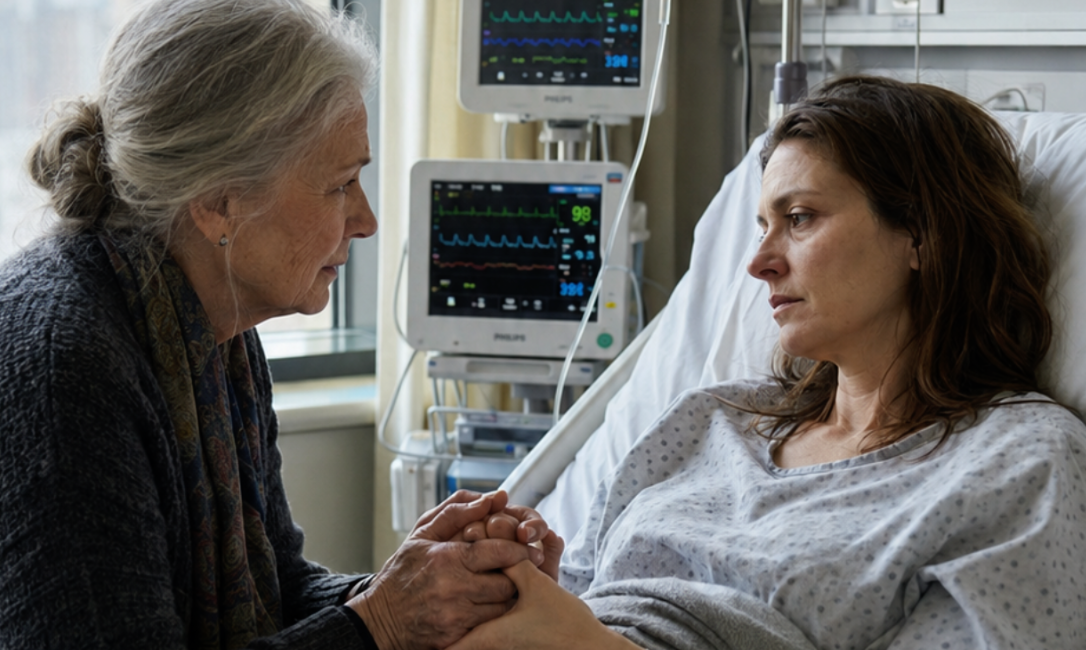
And Lena, lying in a hospital bed, pale and gaunt, with tubes attached to her arms.
“Mom…”
“My dear girl…”
They embraced and cried.
The doctor was young, around thirty. He looked exhausted and spoke quickly and without emotion.
“The situation is serious. Her kidneys are failing. She needs a donor, preferably a relative. You are her mother? Then you need to undergo testing.”
Anna Petrovna took the tests.
She waited for three days, sleeping on a chair in the corridor. She ate whatever she could find, mostly surviving on tea from a vending machine.
On the fourth day, the doctor called her into his office.
“You are a match. But you must understand that the operation is difficult. There are risks, especially for you at your age.”
“What kind of risks?”
“Various ones. Anesthesia. Complications. The recovery will be long. Are you prepared for that?”
She looked at the doctor and said:
“Doctor, she is my daughter. My only daughter. What risks are you talking about?”
Then she signed the consent forms.
The operation lasted six hours.
Anna Petrovna woke up in intensive care. Her body felt as though it belonged to someone else. The pain was deep and dull, buried somewhere inside her.
But she had only one thought.
“Lena. How is Lena?”
Lena survived.
Her body accepted the kidney. Everything went well.
During the first few days, Lena lay in the neighboring ward. Even though Anna Petrovna could barely walk herself, she visited her every day. She sat beside her, held her hand, and said:
“It’s all right, my dear. Everything will be fine. The important thing is that you’re alive.”
Lena cried.
“Mom… I will never forget this. Do you hear me? Never. I owe you my life.”
“Nonsense. What debts can there be between family members? You are my blood. You are a part of me. I would give you everything I have.”
Lena embraced her and cried even harder.
Anna Petrovna was discharged two weeks later.
She returned to the village and spent a long time recovering. Her incision hurt. She slept poorly and walked slowly. Her neighbor, Aunt Nina, brought her milk and bread.
“So, how is your daughter doing?” she asked.
“She’s doing well. She’s recovering.”
“And how are you?”
“I’m all right. I’m alive.”
“Does she call?”
“She does. Every day.”
And that was true.
At first, Lena called often. Every day. Then every other day. Then once a week.
Her voice was lively and cheerful.
“Everything is fine, Mom. I’m working. I’m busy. Thank you. You’re my savior.”
Anna Petrovna listened, nodded, and smiled.
She did not ask for anything more.
Then the calls became monthly.
After that, Lena called only on holidays.
Then there was silence.
A year passed.
Anna Petrovna waited.
Every evening, she sat beside the telephone. She checked whether it had been disconnected, whether the battery was dead, or whether there was no signal.
No.
The telephone worked. The signal was fine.
Lena simply did not call.
Anna Petrovna tried calling her herself, but she would hear:
“The subscriber is temporarily unavailable.”
Or:
“The telephone is switched off.”
Sometimes the phone would ring for a long time, but no one answered.
“She’s busy,” Anna Petrovna told herself. “She’s young. She has work and responsibilities. She’ll call when she has time.”
And she waited.
Two years passed.
Anna Petrovna grew older. Her back became stooped. She began forgetting things.
Sometimes she walked out to the road and stood there, staring into the distance.
The neighbors would ask:
“What are you doing out here, Petrovna?”
“Nothing. Just taking a walk.”
But Aunt Nina knew.
She was waiting.
Waiting for the bus.
Waiting for her daughter.
“Stop waiting, Petrovna,” Aunt Nina told her one day. “She isn’t coming.”
“Why not?”
“Because people are different. You gave her your kidney, and she…”
Aunt Nina fell silent.
She could not finish the sentence.
Anna Petrovna did not believe her.
She could not believe her.
Then, in the third year, she learned the truth.
It happened by accident.
A distant relative came from the city and stopped by for tea. They sat and talked, and suddenly, almost casually, the woman said:
“Your Lena doesn’t live in the city anymore.”
“What do you mean, she doesn’t live there? Where is she?”
“You don’t know? She sold her apartment six months ago and left.”
“Where did she go?”
“Abroad. Spain, I think. Or Italy. I’m not certain. Her husband lives there. He’s a foreigner.”
Anna Petrovna sat perfectly still and upright, her hands resting on the table.
Only her fingers moved, slowly, very slowly, curling into fists.
“Her husband?”
“Yes. She got married. Didn’t you know?”
“No.”
“Oh…”
The relative hesitated.
“I’m sorry. I thought you knew. She said she had written to her mother. Or called.”
“She didn’t call,” Anna Petrovna said.
Her voice was as taut as a string.
“And she didn’t write.”
The relative left.
Anna Petrovna remained sitting at the table.
One hour.
Two.
Three.
It grew dark, but she did not turn on the light.
She sat in the darkness, staring at the telephone. It was an old rotary phone, the same one through which her daughter had said three years earlier:
“Mom, you’re the only person I have.”
The only one.
Now those words had a different meaning.
She did not sleep that night.
She walked around the house from one corner to another. Then she approached the mirror and switched on the light. She lifted her blouse and looked at the surgical scar.
It had healed long ago, but it was still there.
Pink.
Uneven.
Like a snake.
She touched it with her fingers and thought:
“This is where my kidney used to be. Now it is inside her. Somewhere in Spain or Italy. Walking. Breathing. Living. And I am here. Alone. With a scar and a telephone that never rings.”
Then, for the first time in three years, she began to cry.
Not because she was offended.
Not because she was angry.
She cried because she finally understood.
She understood that her daughter had never loved her.
Never.
Not even as a child, when she ran toward her with open arms. Not when she said:
“Mommy, you’re the best.”
Not when she swore she would never forget what her mother had done.
They had only been words.
Just words.
Love was something else.
Love meant calling and asking:
“Mom, how are you?”
It meant visiting.
Embracing someone.
Sitting beside them.
Remaining silent together.
None of that had ever happened.
And Anna Petrovna realized that she had not merely given away a kidney.
She had given everything.
She had given her whole self.
And in return, she had received nothing.
In the morning, she got up, washed her face, combed her hair, looked into the mirror, and said to herself:
“Live.”
And she began to live.
Not for her daughter.
For herself.
She stopped waiting for the telephone to ring. She put it away in a drawer. She began planting vegetables. She bought chickens. She visited her neighbors more often. She went to the village community center and the library.
She found friends, elderly women like herself whose children lived far away and whose grandchildren lived even farther.
Little by little, life became normal again.
But the scar remained.
Sometimes at night, when the incision ached, she would wake up, lie in bed, stare at the ceiling, and think:
“My kidney is working somewhere far away, in a foreign land, inside a stranger who was once my daughter.”
Then she would fall asleep.
And in the morning, she would get up and live again.
Because life was not in the kidney.
It was in the soul.
And she had not given her soul away to anyone.
She had kept it for herself.
Two more years passed.
Then one rainy autumn day, someone knocked on the door.
Anna Petrovna opened it.
Lena stood on the doorstep.
She looked older and thinner. A suitcase stood beside her. There was a strange, unfamiliar expression on her face.
“Mom…”
Anna Petrovna looked at her for a long time.
“I… I came back. May I come in?”
Her mother stepped aside.
“Come in. The tea is hot.”
She said nothing more.
Lena entered, sat at the table, and lowered her head.
“Mom… forgive me. I… I don’t know how to say this. I betrayed you. I sold everything. The apartment. Everything I owned. Then I left. I thought I had found happiness. I thought it was love. But he… he abandoned me after a year. I was left alone. Without money. Without a home. Without anything.”
Anna Petrovna poured the tea in silence.
“I know I have no right to ask you for anything. But I came because I had nowhere else to go. Mom… you are the only person I have. You’re all I have.”
Anna Petrovna raised her eyes.
“The only one,” she said. “Now you truly have only one person. That is correct.”
Lena began to cry.
“I’ll live with you. I’ll help you. I’ll fix everything. I swear, Mom…”
Anna Petrovna sat across from her and looked at her daughter for a long time.
Then she said:
“You may live here. The house is large. There is enough room. But you should know that I have forgiven you. The kidney, however, cannot be taken back. It is inside you. It will live as long as you do.
“Every time you look in the mirror, remember that beneath your skin, beneath your ribs, there is a part of me. I gave it to you. Not for gratitude. Not to be thanked. I gave it because you are my daughter. And nothing can ever change that.”
Lena listened as tears fell onto the table.
Then her mother added:
“There is only one thing. When I die, do not sell that kidney. Because it is the only thing you have left. The only thing that cannot be sold.”
Then she went outside.
To the chickens.
To the vegetable garden.
To her life.