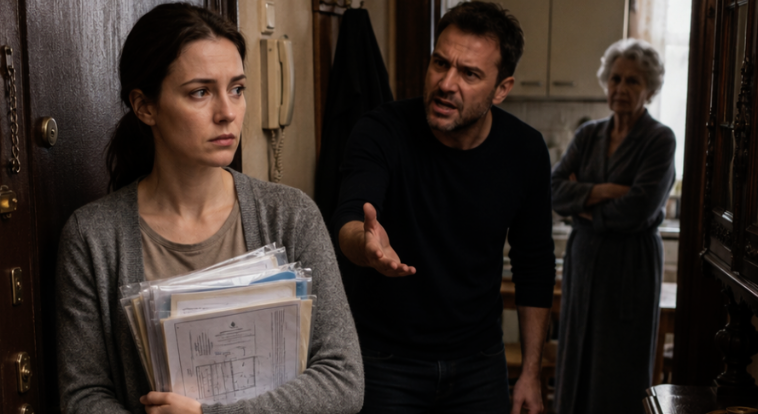
The entryway of the two-room apartment near the old confectionery factory smelled of November dampness, unwashed tiles, and unfamiliar lavender detergent. Natalia remained standing on the threshold, a heavy plastic bag of milk and fresh bread still clutched tightly in her hand.
Along the hallway wall, unfamiliar items had already crowded together: heavy checkered bags, soft slippers with pink pom-poms, and Raisa Lvovna’s worn plaid suitcase.
At first, Natalia could not even hear the sound of her own breathing. She registered only the small, jarring details that shattered the familiar topography of her home.
A foreign bathrobe hung from the brass hook behind the bathroom door. It was bright blue, covered in large, garish flowers. An unfamiliar plastic hairbrush lay on the glass shelf beside the mirror. The clay pots containing her favorite pink petunias had completely disappeared from the living room windowsill.
And her own comfortable armchair beside the television—the one where Natalia sat in the quiet evenings with a mug of tea, staring out into the dark courtyard—had already been fully occupied.
Raisa Lvovna sat deeply and comfortably in it, her legs tucked beneath her skirt, watching a television series as though she had lived there for decades.
Ilya stood beside the kitchen door, leaning one shoulder against the frame. He spoke in that calm, lazy tone that had always made the palms of Natalia’s hands grow cold.
“If you don’t like my mother, leave. Why are you making such a dramatic scene? She gets lonely living by herself. She’ll stay with us.”
With us.
That was a linguistic construction he particularly favored. Spoken with soft masculine confidence, it rapidly transformed something belonging to another person into something shared. Our home. Our kitchen. Our wardrobe.
Even though Natalia had personally chosen the wallpaper in this apartment. Natalia had bought the handles for the kitchen cabinets. The renovation had been paid for with money from the confectionery factory where she worked—or, more precisely, with her salary as a senior food technologist. For two years, she had set aside part of every paycheck to replace the windows, level the walls, and insulate the balcony.
The apartment had been inherited from her aunt before Natalia married.
It was a compact two-room flat in an old brick building, featuring a narrow kitchen, creaking parquet flooring, and a warm enclosed balcony where Natalia grew flowers and kept a shelf for homemade preserves.
When Ilya moved in after their wedding, he settled in easily. He arrived with two bags, a tool box, and the casual confidence of someone immediately feeling like the owner of someone else’s space.
At first, Natalia had found it endearing. He brought a microwave, put up a shelf, attached hooks, and joked with neighbors. Her mistake was not letting him in, but failing to realize how quickly a person could mistake her willingness to compromise for an entitlement.
“No one told me that your mother was moving in,” Natalia said, feeling the back of her neck go numb.
Raisa Lvovna looked away from the television without the slightest embarrassment.
“Oh, what was there to discuss? I’m not a stranger. I’ll stay for a little while until I recover. It’s depressing being alone.”
A little while. Other people’s invasions always began with those words. A few bags. A strange robe. A pair of slippers. Your flowers moved out of the way. Then, suddenly, you were standing in your own entryway, listening to your husband tell you to leave.
Natalia removed her coat slowly. “Why are my flowers on the balcony?”
Raisa Lvovna sighed as though Natalia’s pettiness exhausted her.
“They give me a headache. Besides, the windowsill looks much more spacious without them. I’m going to put my jars there.”
“Your jars?”
“Yes,” Ilya interrupted. “Mom brought some homemade preserves. You’re always saying homemade food is better.”
Natalia looked at her husband and understood everything. He hadn’t misspoken. Everything had been decided before she came home. The bags, the robe, the jars, the flowers, the armchair, and most importantly, his tone—the tone of someone already certain of compliance.
Natalia walked into the living room. Raisa Lvovna’s blanket lay on the sofa. Her pills and valerian drops stood on Natalia’s personal bedside cabinet. The kitchen order had shifted; cups were moved, the sugar bowl sat by the stove, and apples were replaced by pickles and biscuits.
For six years, Natalia had believed a quiet marriage could be preserved by becoming a quieter wife. During Raisa Lvovna’s first week, she inspected the refrigerator, criticized dinners, refolded laundry, and rearranged cupboards. Ilya’s response to everything was always the same: “Mom is older. You can put up with it.”
That sentence became his universal key. Mom was older, so Natalia had to move aside. Her habits and loneliness mattered more than the apartment owner feeling like a tenant.
Soon, Raisa Lvovna expanded her territory. “The small room will be more comfortable for me,” she announced one morning, referring to Natalia’s private sanctuary where she kept her documents, ironing board, and desk.
“My things are in there,” Natalia replied.
Raisa Lvovna waved dismissively. “You can sort them out. I need a room whose windows don’t face the courtyard.”
Ilya called over his shoulder, “Natasha, just move your junk. No one is going to die over a room.”
The word junk hurt deeply. Her private space had lost all value in her husband’s eyes. Raisa Lvovna took over the room gradually, filling it with her suitcase, robes, and a large back pillow, while Natalia’s floor lamp ended up discarded on the balcony beneath a blanket.
Natalia’s sister Kristina arrived on Sunday. Seeing unfamiliar slippers and sensing the tension, Kristina and Natalia stepped onto the balcony. For the first time, Natalia told her everything—the bags, the flowers, the room, Ilya’s tone.
“Why should you leave an apartment where every cabinet handle was paid for by you?” Kristina asked.
That question contained naked truth. It was her apartment, her walls, her renovation, her inheritance. Why was Natalia expected to leave?
That evening, Natalia took out the folder of documents: the deed of gift, the registry extract, and the renovation receipts. Every page brought clarity. They were forcing her out gently, through tiny invasions dismissed as trivial, until her husband finally said aloud: If you don’t like it, leave.
The night was difficult. Ilya slept peacefully, while Natalia thought about how quietly a person could become unnecessary in their own life. At dawn, she went to the kitchen and called German Petrovich, a man who repaired locks and had previously installed a security lock for her.
“Good afternoon, German Petrovich. I need to replace my locks. Could you come today?”
“I can come after lunch. Should I remove the entire old set?”
“All of it,” Natalia said.
She went to work, completed her shift, and returned home. Everything followed the usual routine, except an empty suitcase waited in the wardrobe. That night, she packed Ilya’s belongings: shirts, trousers, chargers, documents, and tools. She worked without tears, realizing that if the owner of a home was told to leave, she had two choices: abandon herself or remove the people who said it.
In the morning, Ilya emerged from the bathroom and froze in the entryway. The suitcase stood beside the door.
“What is this?”
Raisa Lvovna looked out from the kitchen. “Natasha, what kind of performance is this?”
Natalia stepped out holding the document folder, her face calm. “This isn’t a performance. It’s an answer.”
“An answer to what?” Ilya asked.
“To what you said. You suggested that I leave the apartment my aunt gave me, the apartment I pay for. The two of you will be leaving.”
Raisa Lvovna threw up her hands. “Son, do you hear her? She’s completely lost her mind.”
Natalia placed the folder on the cabinet. “The deed, the register extract, the renovation receipts. They’re mine. Everything here is mine. You’ve behaved as though I were only here temporarily. That ends today.”
Ilya stepped toward her angrily. “You can’t just throw me out.”
“I can ask you to go to the same place you told me to go,” Natalia replied. “To your mother’s apartment.”
Raisa Lvovna shifted to a soft, insinuating tone. “Everything can be discussed. Why are you creating such a disaster over a few inconveniences?”
For the first time, Natalia smiled without warmth. “The family wasn’t destroyed today. It was destroyed the moment the owner of this home was told to leave.”
Ilya flipped through the pages, hoping to find a mistake, but the documents proved ownership. “What happens now? You’re going to change the locks?”
“Yes.”
Just then, the doorbell rang. German Petrovich entered, assessed the suitcase, the expressions, and the documents. “Shall we begin?”
“Let’s begin,” Natalia replied.
Raisa Lvovna flushed. “And who exactly are you?”
“A locksmith. I was called here,” he answered calmly.
Ilya stood with his jaw clenched, wanting a scandal, a scene, anything to claim Natalia was hysterical. But there was no scene—only an entryway containing his suitcase, a locksmith, and a wife speaking steadily.
Raisa Lvovna made one final attempt at wounded pride. “You’ll regret this. A woman can’t manage on her own for long.”
Natalia looked at her carefully. “I was carrying all three of us. I think I’ll manage with just myself.”
Ilya jerked the suitcase toward himself. Raisa Lvovna grabbed her jars and robes, muttering about ingratitude. When the door closed behind them, German Petrovich began laying out his tools.
“We’ll install good locks,” he said.
“Good ones,” Natalia nodded.
While he worked, she walked through the apartment, returning her neglected petunias to the windowsill. Kristina arrived an hour later, noticed the new lock, and whistled. Natalia sat on a stool and laughed quietly, feeling the immense weight lift off her shoulders.
Ilya called twice and then sent angry text messages that turned wounded, but Natalia did not respond. Certain words permanently change the geography of a marriage, and “If you don’t like my mother, leave” were precisely those words.
Late that evening, Natalia returned the document folder to its shelf and closed the cabinet. She realized she hadn’t left at all—the people who had mistaken her patience for a property right were the ones who had left her life. And that was justice.