“My Son Needs a Wealthy Wife, Not You!” My Mother-in-Law Sneered in Front of the Guests. By the End of the Evening, They Were Laughing at Her
“Take this glass away. It has a crack in it,” Galina Arkadyevna said with disgust, pushing the crystal glass toward the center of the table.
“I’ll ask the waiter to replace it,” Timofey said, hurriedly starting to rise from his chair.
“Don’t fuss, Timosha. It’s beneath someone of your status to run after waiters,” his mother said imperiously, placing a hand on his shoulder.
The light from the restaurant chandelier swept across her wrist. A massive gold bracelet gleamed on Galina Arkadyevna’s arm. It was wide and heavy, with a fine diamond-cut pattern. She adjusted it so the cuff of her blouse would not conceal the jewelry.
“Veronika, call the young man over,” my mother-in-law said, turning to me. “You’re sitting closest to the aisle.”
“All right.”
I raised my hand to attract the attention of a waiter in a white shirt.
We were seated at a long table in a banquet hall. About thirty people had gathered to celebrate the anniversary of my mother-in-law’s cousin. There were relatives from the surrounding region, neighbors, and former colleagues. The table was overflowing with cold cuts, eggplant rolls, and tartlets topped with caviar.
“Timosha, put some salad on my plate. The one with the tongue,” Galina Arkadyevna said, handing her plate to her son.
“Here you go, Mom.”
Timofey carefully served her a portion.
“Thank you, my darling. You’ve always been so caring,” she sighed loudly enough for everyone around us to hear. “And look how beautifully the bracelet shines, Timosha. Everyone is admiring it.”
Timofey lowered his eyes to his plate.
“It’s a beautiful piece, Galya,” Aunt Nina said from across the table. “It must have been expensive.”
“It was an appropriate price,” my mother-in-law replied with a smug smile. “Timosha gave it to me for the last holiday. He said, ‘Mom, you deserve to look like a queen.’ A successful man can afford to make his mother happy.”
I silently chewed a slice of cucumber.
The “successful man” Timofey had asked me for five thousand rubles for gasoline the previous week because he had run out of money before payday.
“Veronika, why do you look so pale and gray today?” my mother-in-law asked, shifting her gaze to my dress. “You could have dressed more elegantly for an anniversary. Or is boredom part of the dress code for auditors?”
“It’s a perfectly normal dress,” Timofey said quietly without raising his eyes.
“Your opinion, Timosha, is dictated by love,” Galina Arkadyevna snorted indulgently. “Mine is based on life experience. A woman should enhance a man’s image. A man in a director’s position should have a sophisticated woman sitting beside him.”
“Timofey isn’t a director yet, Galina Arkadyevna. He’s the deputy warehouse manager,” I replied evenly.
“That’s only temporary!” my mother-in-law exclaimed, striking her fork against her plate. “He has prospects. He has business instincts! It’s just that certain people don’t believe in him and drag him down with their constant penny-pinching.”
She adjusted the gold bracelet again. It was at least the fifth time she had made that gesture that evening.
“Could someone pour me some fruit drink?” Aunt Nina asked, trying to ease the tension.
“I’ll do it.”
I picked up the heavy glass pitcher.
“Careful, Veronika. Don’t spill any on the tablecloth. They’ll charge a penalty,” my mother-in-law immediately warned me. “Of course, Timosha would pay it, but money must be handled responsibly. He doesn’t print it himself.”
I put the pitcher back down.
Timofey continued staring at his plate, carefully cutting a slice of roast pork into tiny squares. He always did that when his mother began one of her performances. He looked away and pretended her words were merely background noise.
“Have you finished the renovations?” a distant relative asked from the other end of the table.
“Finished? Not even close,” Galina Arkadyevna said, waving her hand. “Timosha hired a crew for me and ordered the finest materials. We’re waiting for everything to arrive from Italy. My son said, ‘Mom, your home is going to look like a palace.’”
Timofey coughed.
I looked at him.
“From Italy?” I asked, slightly raising an eyebrow.
“Well, perhaps Spain. I don’t understand all those names,” my mother-in-law said dismissively. “The important thing is that it’s expensive. Timofey doesn’t cut corners.”
“That’s the right way,” several female relatives agreed. “A son should be his mother’s support.”
I looked at the bracelet sparkling on my mother-in-law’s wrist and then at Timofey.
He did not say a single word in my defense. He simply allowed her to create an image in which he was a generous millionaire and I was the dull little mouse sitting beside him.
The funniest part was that I had once handed him the brushes with which to paint that picture.
“Give me two hundred thousand,” Timofey had said three weeks earlier while standing in the hallway of our apartment.
“What for?” I asked as I zipped up my boots before leaving for work.
“For a business opportunity.”
He tossed the car keys from one hand to the other.
“Some guys are bringing in a shipment of goods. We can invest in it. We’ll turn the money around within a month, and I’ll return it with interest.”
“The money in our savings account is for our vacation,” I said, straightening up and looking at him.
“We’re not flying anywhere until August. I’ll put everything back by July.”
Timofey gave me his soft, almost childlike smile.
“Come on, Veronika. Support me. You’re always saying I sit around without showing any initiative.”
“All right,” I said. “I’ll transfer it to your card.”
I did not ask any further questions. I did not demand to see a business plan.
As an auditor, I could have torn his “investment” apart in five minutes by asking three simple questions about the suppliers and the risks.
As his wife, I remained silent.
I had chosen this arrangement myself.
I earned three times more than he did. The apartment belonged to me. We had bought the car with my annual bonus, but registered it in his name so he would feel more comfortable.
For years, I had played along with the illusion.
“Thank you, Ver,” he said, kissing my cheek. “You’re the best.”
A couple of days after the transfer, Galina Arkadyevna came to visit us.
“Your kettle is old,” she said, running a finger along its metal surface. “There’s limescale inside.”
“I cleaned it over the weekend,” I replied, taking cups from the drying rack.
“You did a poor job. Timosha likes to drink clean water.”
My mother-in-law sat at the table and moved my work notebook aside as though she owned the place.
“Are you still messing around with all those papers?”
“I’m working, Galina Arkadyevna. I’m finishing a report.”
“Working,” she scoffed. “A woman should keep her home warm and comfortable. The man is supposed to be the provider. My Timofey is expanding his business. He’s making investments.”
“Is he?” I asked, placing a cup of tea in front of her. “What is he investing in?”
“Supplies!” she declared proudly. “He tells me everything. He thinks on a grand scale. Unlike certain people who sit with a calculator and count every penny from one payday to the next.”
She took a sip of tea.
The same bracelet jingled on her wrist.
“It’s a beautiful piece,” I said, looking at the gold.
“Of course it is.”
She stroked the links.
“My son bought it. He said his mother deserved it. When I was his age, I boiled potatoes in water and denied myself everything. I want him to live like a true master of his life now. I want people to respect him. It’s important for a man to be the head of the family.”
“Being the head of the family means accepting responsibility,” I observed.
“Being the head means making decisions!” Galina Arkadyevna snapped. “You clip his wings. You were the one who wanted him to feel like a man. I’m simply playing along with your little story, Veronika. You pretend he makes all the decisions, and I pretend to believe it.”
I did not answer her then.
I simply removed the sugar bowl from the table.
There was truth in her words.
For years, I had concealed how much I earned. I had avoided buying expensive things for myself because I did not want Timofey to feel inferior beside me.
I had given him that role myself.
“Transfer another fifty thousand to me,” Timofey asked a week later while we were eating dinner.
“For the same shipment?” I stopped cutting my chicken.
“Yes. The customs fees went up. We urgently need to add more money.”
He stared at his phone without looking at me.
“There’s only a hundred thousand left in the account.”
“Ver, we’re a family. I’ll return everything. Then we’ll finally start living well.”
He looked at me at last. His expression was pleading.
“I’ll transfer it,” I said evenly, opening the banking application.
I could see that he was lying.
I saw the way he hid his phone screen from me.
I chose not to look any further.
That was my mistake.
It was easier for me to hand over the money than to begin a difficult conversation that might destroy our quiet, comfortable marriage.
Let us return to the anniversary banquet.
The waiters began clearing the dirty appetizer plates and bringing out the main course. The smell of roasted meat and garlic filled the room.
Loud music started playing, and relatives headed to the dance floor. Only a handful of people remained seated.
Galina Arkadyevna had gone to “powder her nose.” Timofey had gone outside to smoke.
I sat there, absently moving the remains of my salad around with a fork.
“Veronika, pass me a napkin,” Aunt Nina said, leaning across the empty chair between us.
“Here you are.”
I handed her a paper napkin from the holder.
“Are you tired?” she asked sympathetically.
“It’s just a little noisy,” I replied, attempting a smile.
“Well, our Galya has always been loud.”
Aunt Nina dabbed her lips.
“But you and Timosha are wonderful. I truly admire you.”
“For what exactly?” I asked, taking a sip of mineral water.
“Oh, you know.”
She lowered her voice and glanced around to make sure no one could hear us.
“For paying off Galina’s debt. One and a half million rubles is no joke.”
The glass of mineral water stopped an inch from my lips.
“What debt?”
I placed the glass on the table. The sound it made was too loud.
“Don’t be embarrassed. We’re all family here.”
Aunt Nina patted my hand confidentially.
“She was bragging to us about it back in the winter. She kept saying what a wonderful son she had and that he was expanding his business. But in reality, she had taken out a pile of microloans.”
“Galina Arkadyevna took out microloans?”
My voice became completely dry and professional—the voice of an auditor who had just discovered a hole in a balance sheet.
“She started those renovations,” Aunt Nina whispered. “She hired a construction crew. She thought her pension would cover the installment payments, but the interest kept piling up. Then she redeemed that gold bracelet from a pawnshop and told everyone her son had given it to her. The debt collectors started calling her. Eventually she fell at Timosha’s feet, and he paid everything off.”
“When did this happen?” I asked.
“About three weeks ago. She called me to brag about it. She said Timosha paid the full amount and brought her a certificate from the bank proving she didn’t owe them anything anymore. He’s a good son.”
Three weeks ago.
Two hundred thousand rubles.
Then another fifty thousand.
Then I remembered how, six months earlier, Timofey had withdrawn almost a million rubles from our joint account, supposedly to buy a car and resell it.
I had never seen the car.
He had told me the deal had fallen through and that the money was “still in circulation.”
The numbers added up.
Every last ruble.
My bonus. My vacation money. My savings.
“Yes,” I said slowly. “Timosha is a very good son.”
“And you’re wonderful for not nagging him about it,” Aunt Nina said with a nod. “Another wife would have caused a scandal because the money left the household. But you’re wise. Family is what matters most.”
The music stopped.
Guests began returning to the banquet hall.
Galina Arkadyevna appeared in the doorway, adjusting her hair. Timofey entered behind her.
He sat down beside me, smelling of cold air and cigarettes.
“Is everything all right?” he asked, noticing the way I was looking at him.
“Yes. Absolutely.”
I looked at his hands.
They were the ordinary hands of a man who had never accepted genuine responsibility for anything.
I did not shout.
I did not cry.
A cold, ringing clarity settled inside me.
It was the clarity that comes when the balance sheet finally reconciles.
There were no more errors.
Everything had been calculated correctly.
They were not merely living at my expense. They were using my money to purchase status in front of their relatives while humiliating me for failing to match that fake status.
“Timosha, pour me some more fruit drink,” my mother-in-law ordered after returning to the table.
“Of course, Mom.”
She sat down and once again flashed the gold bracelet on her wrist.
The bracelet from the pawnshop.
The bracelet purchased with my money.
The waiters brought out the main course.
Conversations around the table resumed with renewed energy. One of Timofey’s distant uncles raised his glass to the woman celebrating her anniversary.
Everyone drank and ate.
“And now, let’s drink to the man hosting this evening,” Galina Arkadyevna suddenly announced, rising with a glass of wine. “To my son!”
The table fell silent.
The woman whose anniversary everyone had actually gathered to celebrate looked at my mother-in-law in surprise.
“Timosha paid for everything tonight,” Galina Arkadyevna declared, sweeping her hand over the table. “The entire banquet. Because he is a real man. A provider.”
The guests nodded.
Timofey blushed and attempted to pull his head down between his shoulders.
“And I want to say,” my mother-in-law continued, her voice growing louder as she became carried away by her own performance, “that behind every successful man, there must be the right kind of woman. A woman who inspires him.”
She looked pointedly at me.
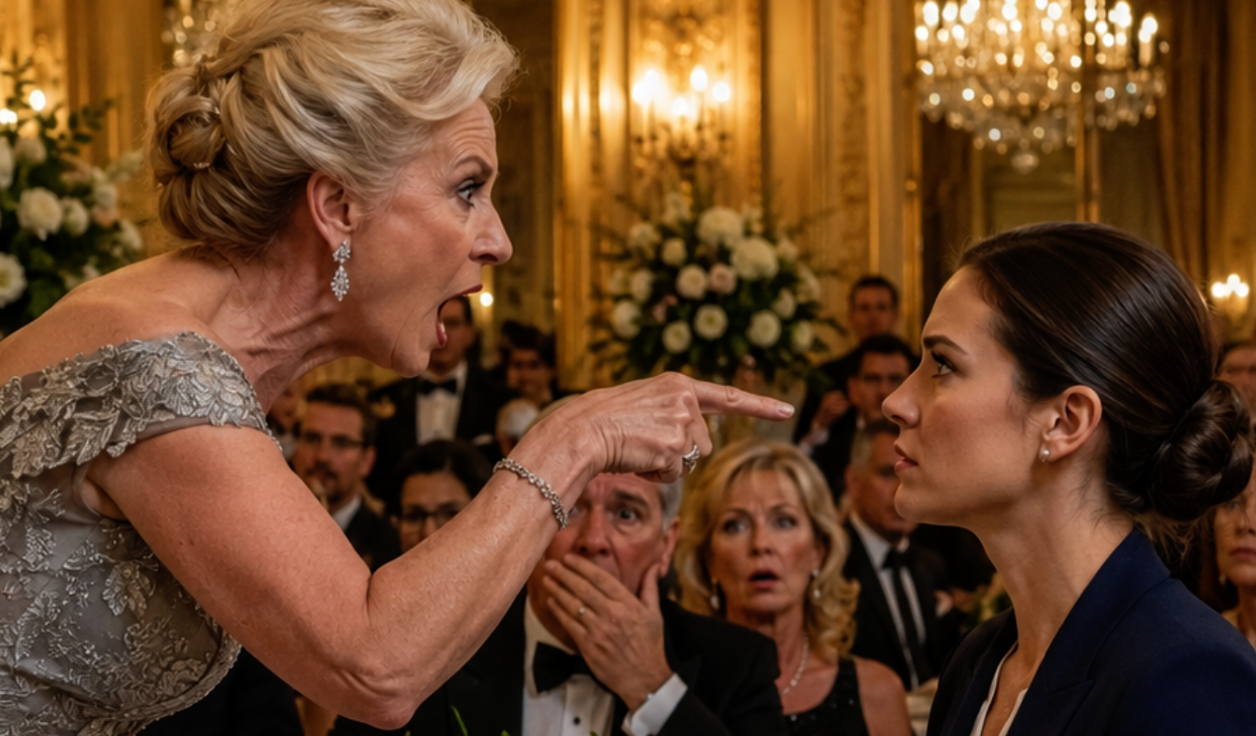
“My son needs a wealthy wife, not you!” she sneered in front of the guests, staring directly into my face. “An auditor! You sit around with your papers, counting pennies. But our Timosha is a man who thinks on a grand scale. He needs a woman with ambition and style.”
An uncomfortable silence descended over the table.
Several people lowered their eyes. Someone smiled nervously.
It was a public humiliation—open, brazen, and deliberate.
I placed my cloth napkin on the table.
Carefully. Perfectly straight.
“On a grand scale?” I repeated.
My voice was quiet, but in the silence, everyone heard it.
“Yes!” Galina Arkadyevna raised her chin. “He gets things done!”
“Does he think on such a grand scale that he used my money to pay off your microloan debts of one and a half million rubles?”
I looked directly into her eyes.
My mother-in-law froze.
Her mouth fell slightly open.
“What nonsense are you talking about?” she asked, trying to laugh, although the sound came out flat and artificial.
“I’m asking you, Galina Arkadyevna,” I continued without raising my voice. “Which debt did you pay off with my money? The debt from those imaginary luxury renovations? Or the debt from that gold bracelet you redeemed from a pawnshop and have been waving in front of your relatives all evening?”
“My dear girl, you’ve had too much to drink,” my mother-in-law said, adopting a patronizing tone.
She glanced around at the guests.
“You’ve completely lost your mind from staring at numbers all day.”
She was waiting for support from the room.
But the room remained silent.
Aunt Nina stared tensely at her plate.
“Timofey,” I said, turning toward my husband. “The shipment at customs? The investment in merchandise?”
He turned white.
“Ver, let’s talk about this at home,” he muttered, staring at the tablecloth.
“We’re going to talk about it now.”
I did not take my eyes off him.
“You took my money. You transferred it to microfinance companies to save your mother from debt collectors. And today, in front of everyone, she says that you need a wealthy wife.”
“It was our shared money!” Timofey suddenly shouted. “We’re a family!”
A murmur swept through the room.
The guests understood everything.
The illusion burst with a deafening crack.
“Why are you humiliating me in front of everyone?” Galina Arkadyevna cried, immediately adopting the role of victim.
Her eyes instantly filled with tears.
“I’m an elderly woman! I have high blood pressure!”
She clutched her chest.
“You were the one who began this speech, Galina Arkadyevna,” I stated calmly.
“You’ve always been jealous of me!” she shouted, losing control. “Jealous because my son loves me! This is your own fault! You gave him the money yourself! You wanted him to make decisions!”
In that, she was right.
I had handed him the money myself.
That was the most bitter part of the entire scene.
Someone at the other end of the table snorted.
Then someone else did the same.
The relatives who had been nodding along with her words five minutes earlier were now exchanging glances and openly laughing.
“He needs a wealthy wife,” Uncle Vitya drawled under his breath, “so she can pay off his mommy’s loans.”
Laughter rippled around the table.
Red blotches spread across Galina Arkadyevna’s face.
She looked down at her hands.
The bracelet that had been intended to inspire envy now looked like a cheap piece of evidence.
“I will not allow people to laugh at me!” my mother-in-law shouted.
She threw her cloth napkin into her plate and shoved her chair back sharply.
She expected Timofey to run after her.
She expected him to silence me.
“Mom, just sit down,” Timofey said wearily.
There was no strength in his voice.
There was no grandeur.
There was only a frightened man who had been caught stealing from his own wife.
Galina Arkadyevna froze in shock.
Her own son had failed to defend her.
She looked around the table, saw the mocking expressions on the relatives’ faces, turned around, and hurried toward the exit.
“Ver, why are you doing this?” Timofey asked, trying to take my hand. “I was going to pay you back. I’ll get a second job and return everything.”
I pulled my hand away.
“The banquet was paid for with my card,” I said. “So eat, dear guests. Everything has been paid for.”
I stood and picked up my handbag from the back of the chair.
“Where are you going?” Timofey asked, jumping to his feet.
“Home. To pack your things.”
I did not stay to listen to his excuses.
I turned around and walked toward the doors.
Behind me, the hall remained silent except for the clinking of silverware.
PART 5: AFTERWARD
“Would you like a bag?” the sales assistant in the home appliance department asked.
“Yes, please,” I replied.
It was Tuesday morning.
Three days had passed since the anniversary banquet.
Timofey had collected his belongings on Sunday. He remained silent while placing his sweaters into a sports bag.
I sat in the kitchen and drank tea.
We did not argue.
There was no point.
The sales assistant carefully placed the heavy box into a large branded shopping bag.
I had wanted that coffee machine for a long time.
It was the kind that ground the beans itself, frothed milk, and made the kitchen smell like a real coffee shop.
But it cost forty thousand rubles.
I had always found reasons not to buy it.
“We’re saving for Timofey’s car.”
“The money is needed for his business.”
“I can manage with a cezve.”
Now there was no cezve.
I had thrown it away that morning, along with my husband’s old cup.
I left the store.
The street was flooded with cold spring sunlight. The city continued living its ordinary life. Buses passed by, and people hurried about their business.
I carried the box home and placed it on the kitchen table.
Slowly and without rushing, I removed the protective film and unpacked all the parts. I rinsed the water reservoir and poured in fresh coffee beans.
The machine buzzed and hummed.
A minute later, the kitchen filled with the rich, intense aroma of expensive coffee.
I poured it into my white cup.
The apartment was empty.
No one was asking me for money.
No one was telling stories about ambitious business projects.
No one was using my money to pretend to be more important than he truly was.
I took a sip.
The coffee was perfect.
Would you be able to spend years pretending to be weak so that the person beside you could feel strong?