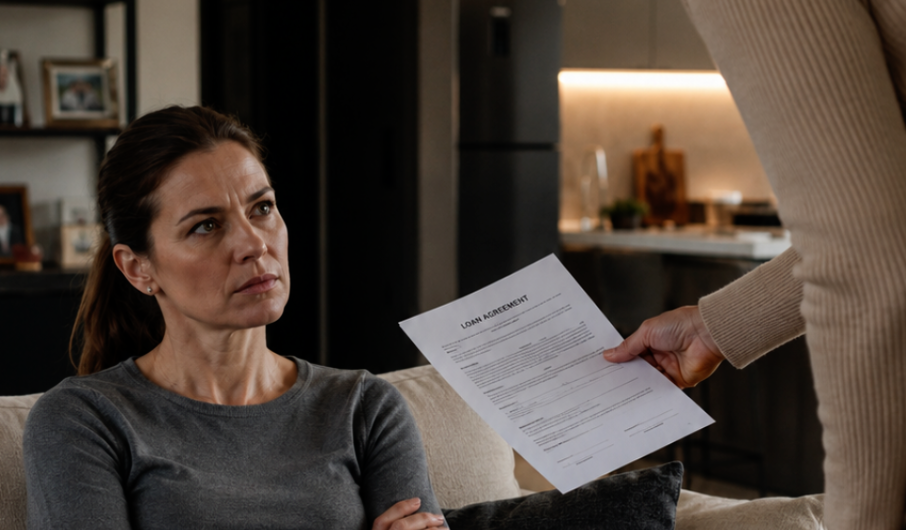
“We’ve Already Taken Out the Loan. We Thought You’d Help Us Pay It Off,” Her Sister-in-Law Admitted, Holding Out the Agreement
“We’ve already taken out the loan. We thought you’d help us pay it off,” Tatyana admitted, stretching the agreement across the table.
Olesya did not reach for the papers.
She first looked at her sister-in-law, then at her husband, Kirill. He was sitting beside her with an open bottle of mineral water, intently studying the label as though a reasonable explanation for what was happening might be printed there.
Beyond the wide-open balcony door, the summer city hummed. Children shrieked in the courtyard, car doors slammed near the entrance, and the sound of drilling came from the neighboring building. The apartment was hot, even though Olesya had turned on the air conditioner that morning.
Tatyana continued holding the agreement at arm’s length. Her husband, Anton, sat beside her. He looked composed and even slightly irritated, as though the discussion about the loan had dragged on because of Olesya.
“Whose idea was this, exactly?” she asked.
“What idea?” Tatyana lowered the documents onto the table.
“The idea that I would make payments on a loan you took out without involving me.”
Kirill finally looked away from the bottle.
“Olesya, don’t start by attacking everyone. Listen first.”
“I’m listening.”
“We found an excellent place,” Tatyana said quickly. “It’s on the highway, not far from the lake. There used to be a café there, but the owner closed it and put the property up for sale. The land is legally registered, there’s electricity, and the kitchen is almost ready. We just need to fix the place up and get started.”
“Which of you knows how to run a café?”
Anton leaned back in his chair.
“You don’t need to graduate from an academy for that. People stop, eat, and continue driving. There’s plenty of traffic.”
“So neither of you.”
“A friend of mine worked as an administrator,” Tatyana objected. “She explained everything to me.”
Olesya nodded briefly.
“Then let your friend repay the loan.”
Tatyana frowned.
“Why do you immediately turn a normal conversation into mockery?”
“A normal conversation takes place before a loan is taken out. You took out the loan, brought me someone else’s payment schedule, and informed me that you had already counted me among the people responsible for paying it.”
Kirill reached for the agreement, opened it to the last page, and pushed it toward his wife.
“Look at the monthly payment. If we divide it among three families, it’s completely manageable.”
“What three families?”
“You and me, Tanya and Anton, and Mom.”
Olesya turned her gaze toward her husband.
“Did your mother also sign the loan agreement?”
“No,” Tatyana answered. “Mom will help from her savings.”
“Then there are two borrowers. You and Anton.”
“Formally, yes.”
“Not formally. Legally.”
Olesya picked up the agreement and began reading. It was an unsecured consumer loan. Tatyana was listed as the primary borrower, while Anton was the co-borrower. They had received the money five days earlier. Part of it had already been transferred to the property’s seller as a deposit, and they planned to pay the remainder once the sale was registered.
Neither Olesya’s nor Kirill’s name appeared anywhere in the documents.
However, between the pages was a sheet torn from an ordinary notebook. On it, Tatyana had carefully written down who was expected to contribute and how much each person would pay every month. The largest share was written next to Olesya’s name.
“Why is my share larger than yours?” she asked.
Tatyana did not hesitate.
“You won’t be working at the café every day. Anton and I will take on most of the workload. I’ll manage the dining area, and he’ll handle purchasing and maintenance. Kirill will come on weekends. We only need investment from you and help with the paperwork.”
Olesya worked in equipment procurement for private medical centers. She knew how to read agreements, compare suppliers’ offers, and notice conditions hidden in the fine print. Apparently, her relatives had decided that these skills automatically made her the unpaid manager of their venture.
“Have you already purchased the property?” she asked.
“We paid the deposit,” Anton answered.
“Before doing that, did you verify the seller, the ownership rights, restrictions on the land, the land’s designated purpose, outstanding debts, and the permitted use of the building?”
Tatyana’s husband ran a hand over his chin.
“The seller showed us an official extract.”
“How old was it?”
“I don’t remember. It was a normal extract.”
“Who reviewed the deposit agreement?”
“It was a standard agreement,” Kirill interrupted. “Stop pretending that everyone around us is a criminal.”
Olesya closed the loan documents.
“And who decided the café would begin generating income immediately after opening?”
“We calculated everything,” Tatyana said.
She took another folder out of her bag. Inside were photographs of the property, printed advertisements for used equipment, several pages of calculations, and a colorful image of a sign reading: The Pier.
Olesya reviewed the calculations. They did not include waste removal, a security system, ventilation repairs, equipment maintenance, taxes, mandatory insurance contributions, or a seasonal decline in highway traffic. Tatyana had taken the food prices from a supermarket advertising brochure. She had estimated the number of customers by watching the highway for a while on a Sunday.
“You counted the passing cars?” Olesya asked.
“We sat there for two hours,” her sister-in-law replied proudly.
“And how many of them stopped near the former café?”
Tatyana looked away.
“It’s closed. Why would anyone stop there?”
“So you have no idea how many people would actually leave the highway at that particular location.”
Anton took the papers away from her.
“If you wait for a complete guarantee, you’ll never start anything.”
“I agree. That’s why an entrepreneur risks their own money instead of appointing a relative who wasn’t even warned as the person responsible.”
Kirill tapped his fingers against the table in irritation.
“We were going to tell you.”
“When?”
“Today.”
“After receiving the loan and paying the deposit.”
“We were afraid someone else would buy the property.”
Olesya held her husband’s gaze. Kirill spoke confidently, but too quickly. It seemed he had prepared that sentence in advance.
“Why was Tatyana so certain that I would agree?”
No one answered.
Tatyana adjusted the edge of her linen blouse. Anton turned toward the balcony. Kirill picked up the bottle but did not drink.
“I’ll repeat the question,” Olesya said. “Who promised you my money?”
“Not your money personally,” Kirill finally said. “Our shared money.”
“We don’t have a joint account.”
After several disagreements over spending, the spouses had agreed to keep their finances separate. They divided the cost of the apartment and groceries, while each paid for everything else independently. Kirill had been perfectly satisfied with that arrangement until he wanted to control his wife’s money.
“But we’re married,” he said. “We can’t live as though everyone is only responsible for themselves.”
“We can. That’s exactly how we’ve lived for the past four years. You were the one who insisted that you didn’t have to consult me before buying a motorcycle or taking trips with your friends.”
“What does the motorcycle have to do with this?”
“It has to do with your convenient understanding of the family budget. When you spend money, it’s personal. When your sister takes out a loan, the money suddenly becomes shared.”
Kirill straightened in his chair.
“I told Tanya that we would discuss helping them.”
“No,” Tatyana objected. “You said Olesya would agree.”
The kitchen fell silent.
Anton turned toward his wife.
“Tanya.”
“What?” She spread her hands. “Am I supposed to take all the blame now? Kirill was the one who told us Olesya had money from selling her father’s garage. He said she still hadn’t decided what to invest it in.”
Olesya’s expression did not change. She merely folded the agreement precisely along its existing crease and placed it in front of her sister-in-law.
The garage had belonged to her father before his second marriage. After his death, Olesya inherited it. Six months later, she registered her ownership, and in the spring she sold the garage to a neighbor from the same cooperative. The money was kept in a separate savings account. Kirill knew about it, but he had no access to the account.
“Now I understand,” Olesya said.
“What do you understand?” her husband asked.
“Why my share in your scheme was the largest. You weren’t expecting help. You had already spent my inheritance in your plans.”
“No one has spent anything,” Kirill protested. “You still have the money.”
“For now.”
Those last two words made him visibly uneasy.
Olesya stood up, took her phone from the countertop, and opened her banking app. The savings account was untouched. Then she went to the bedroom and checked the folder containing her documents. The garage sale agreement was where she had left it. Her passport was also still in the drawer.
When she returned, she saw her relatives speaking quietly. Kirill stopped as soon as she entered.
“Have you decided something?” she asked.
“We’ve decided that today isn’t the best day for this,” he answered. “Everyone is nervous. Tanya and Anton will go home, and you and I will talk calmly.”
“No. First, I’m getting answers.”
Anton frowned.
“We didn’t come here to be interrogated.”
“You came here for my money. Therefore, this conversation will end when I understand the entire scheme.”
She turned toward Tatyana.
“Who suggested taking out the loan before speaking to me?”
Her sister-in-law looked at her brother.
“Kirill said it would be faster that way.”
“Who determined the size of my share?”
“We calculated it together.”
“Did Kirill participate?”
“Yes.”
“Who decided I would review the documents and deal with the suppliers?”
“He did.”
Olesya picked up Kirill’s notebook from the table. Several pages contained refrigerator models, equipment sellers’ phone numbers, and an approximate opening date. Her husband had been involved in the project for at least several weeks.
“Did you go to inspect the property?” she asked.
Kirill rubbed the bridge of his nose.
“Twice.”
“You told me you were going to help Anton repair his car.”
“What difference does it make where I went?”
“To you, none anymore. To me, it makes a considerable difference.”
Tatyana stood abruptly.
“Stop treating us like criminals. We offered you a share in a perfectly legitimate business.”
“Where is my right to that share documented?”
Her sister-in-law fell silent.
“Which document states that after the loan is paid, part of the property will be transferred to me?”
“We would have arranged that later,” Anton said.
“What percentage?”
He looked at Kirill.
“We would have discussed it.”
“When? After I had paid most of your loan?”
“Olesya, you’re deliberately making the whole thing sound absurd,” her husband interrupted. “No one intended to deceive you.”
“Then show me the draft agreement between the participants. It should specify ownership shares, investment procedures, liability, distribution of expenses, and the procedure for leaving the business.”
No such document existed.
There was not even a draft.
Olesya gathered the papers into a single stack and returned them to Tatyana.
“My answer is no.”
“You don’t even want to think about it?” her sister-in-law raised her voice.
“I already have. You took out a large loan in your own names, paid a deposit on a questionable property, and brought me calculations that omit half the mandatory expenses. At the same time, you had already decided how much I would pay without offering me any legally documented ownership. This isn’t a business. It’s an attempt to share your risk with someone you never intended to give decision-making power.”
Anton stood up beside his wife.
“We’ll find another partner.”
“Go ahead. Just tell that person everything before taking their money.”
Kirill walked his sister to the door. In the hallway, Tatyana continued speaking to him quietly for several minutes. Then the front door slammed.
When he returned to the kitchen, Kirill stopped across from Olesya.
“Are you satisfied?”
“With what?”
“You humiliated my sister in front of her husband.”
“Your sister brought me a loan agreement and demanded that I pay for her decision.”
“She didn’t demand anything.”
“Then why had she already written out my payments?”
Kirill brushed crumbs from the table with his palm.
“You could have refused more gently.”
“And you could have refrained from promising my money.”
“I wanted to create an additional source of income for us.”
“Not for us. The loan was in Tatyana and Anton’s names, and the property was going to be registered in their names. They were going to work there. I was being left with the payments and the responsibility of handling the paperwork.”
“We would have registered your share later.”
“What share?”
Kirill did not answer.
Olesya opened the refrigerator, took out a bottle of water, and poured herself a glass. Her hands were not trembling. She had noticed long ago that the more brazen a person was, the more calmly one should speak to them. Raising one’s voice only helped someone who wanted to shift an argument away from facts and toward emotions.
“When did you tell Tatyana about the money from the garage?” she asked.
“I don’t remember.”
“Try.”
“A few weeks ago.”
“Why?”
“It came up in conversation.”
“My inheritance doesn’t accidentally come up in conversation, especially not together with calculations for monthly payments.”
Kirill gave a nervous laugh.
“Fine. I made a mistake. I should have spoken to you first. But there’s no reason to turn this into a family catastrophe.”
“There is no catastrophe. There are consequences.”
“What consequences?”
“Starting today, you will receive no information about my accounts, savings, or financial plans. I will keep my documents somewhere else. We will confirm shared expenses through bank transfers rather than verbal agreements. And you will return the money you took from the envelope in the safe.”
Kirill stopped smiling.
Olesya had noticed that some of the money was missing before the guests arrived. That morning, the envelope had contained cash she had set aside to repair the apartment’s heating system. After returning from the notary’s office, she had planned to call a technician and arrange for the work to be completed before autumn. Now part of the money was gone.
She had not asked about it immediately. She wanted to know whether her husband would admit it himself.
“I didn’t take anything,” Kirill said.
“Then we’ll open the safe right now and count it.”
“Why do you keep cash in there if you’re going to accuse everyone around you?”
“Because until today, only two people had access to this apartment: me and my husband.”
Kirill looked toward the kitchen door as though considering whether he could escape the conversation.
“I lent the money to Tanya for the deposit. She’ll return it.”
“When?”
“After the café opens.”
“So you took my money without permission and handed it to someone who already owes money to a bank.”
“I was going to put it back.”
“From what funds?”
“I would have figured something out.”
Olesya placed the glass on the table.
“You are going to write to Tatyana now and tell her that the money was taken without my consent and must be returned by the end of the week.”
“I’m not writing that to her.”
“Then I’ll do it. And I’ll attach a photograph of the written acknowledgment you are about to sign.”
“What acknowledgment?”
“A statement confirming that you took money from my safe and gave it to your sister.”
Kirill laughed loudly, but the laugh was brief.
“You seriously think I’m going to write an acknowledgment of debt to my own wife?”
“Refuse, and you’ll pack your belongings and leave today. The apartment belonged to me before our marriage. You are not registered here, and you have no ownership rights.”
“You’re throwing me out because of money?”
“I’m throwing you out because you stole it, lied to me, and appointed me as your sister’s sponsor.”
“Don’t call it stealing!”
“What would you call it when someone opens another person’s safe and takes cash without the owner’s permission?”
Blood rushed to Kirill’s face. He walked over to the balcony, stood there for several seconds, and then turned around sharply.
“Did you decide all of this in advance?”
“No. Until today, I believed I was living with someone I could trust.”
“And now you’re going to erase our marriage in a single day?”
“Not in a single day. For several weeks, you planned how to use my money, visited the property, lied about where you were going, discussed my financial contribution with your relatives, and took cash from my safe. Today, I merely received the complete list.”
Kirill took out his phone.
“Fine. I’ll call Tanya.”
“Send a message. That way, we’ll have a record.”
“Are you already preparing to sue me?”
“I’m preparing not to be told next week that the money never existed.”
He typed several lines to his sister and showed Olesya the screen. She read:
“The money I gave you for the deposit belonged to Olesya. She is demanding that it be returned by Sunday.”
“Add that it was taken without her permission.”
“I won’t.”
“Then delete the message and start packing.”
Kirill stared at her for more than a minute. Then he added the sentence and sent it.
Tatyana replied almost immediately:
“You said she had agreed. We’ve already given it to the seller. Where am I supposed to get it now?”
Olesya photographed the conversation with her own phone.
“Now the written acknowledgment.”
“Isn’t that enough for you?”
“No.”
Kirill wrote it by hand, specifying the amount, the date, and the circumstances under which the money had been transferred. He signed so forcefully that the pen tore the paper near the final letter.
“Are you satisfied?”
“You’ve already used that word today. It doesn’t apply here.”
“What happens now?”
“You will stay with Anton until Sunday. If the money is returned in full, we’ll decide whether there is any point in continuing a conversation about our marriage. If it isn’t, I’ll file for divorce and take legal action to recover the money.”
“We don’t have children, and there’s nothing to divide. We can divorce through the civil registry office.”
“We can, if we both agree. Do you agree right now?”
Kirill looked away.
“That’s why, if you refuse, the divorce will go through the court.”
He wanted to say something, but Olesya raised her hand.
“There’s no need to invent the right words now. Pack the essentials. You can collect the rest of your belongings later, by prior arrangement.”
Kirill did not believe she was serious until he saw the travel bag in the entryway. Olesya took it down from the top shelf and placed it on the bench.
“Have you been preparing to throw me out for a long time?” he asked.
“The bag has been there since our last trip. Don’t attribute your own planning methods to me.”
He left forty minutes later. He took clothes, documents, his laptop, and his chargers. Before leaving, he paused at the door.
“You’re going to regret doing this.”
“Possibly. But not today.”
After he left, Olesya locked the door and immediately checked the safe. She deposited the remaining cash in the bank, removed her documents from the bedroom, and placed them in a rented safe-deposit box. Then she changed the passwords to her email, banking apps, and mobile provider account. Kirill did not know her access codes, but after what had happened with the safe, she no longer intended to rely on assumptions.
The next day, Olesya ordered a new property extract for the building Tatyana and Anton intended to purchase. She had photographed the address from their folder.
The investigation produced results more quickly than she had expected.
The land beneath the café was subject to restrictions, and part of the building extended beyond the property boundaries. In addition, the seller had owned the property for less than a year and was pressuring the buyers to sign the main purchase agreement before the end of the week.
Olesya sent the extract to Tatyana with a short message:
“Show the documents to a lawyer before transferring the remaining money. There are problems with the property. This does not cancel your obligation to return my money.”
Her sister-in-law called a minute later.
“Have you decided to ruin the deal for us?”
“I’ve decided to warn you about what you’re buying.”
“The seller said it was a technical error.”
“Then he should correct it before the sale.”
“Because of your demand, we could lose the deposit!”
“You paid the deposit before conducting proper checks. I wasn’t present when you did that.”
“Kirill promised that the two of you would join the business together!”
“Kirill had no authority to speak on my behalf.”
“You left your brother without a home because of one mistake.”
“He lost access to my apartment after making several deliberate decisions. Those are different things.”
Tatyana fell silent and then changed her tone.
“Olesya, let’s not turn this into a war. We’ll return the money, just not within a week. We need time.”
“How much time?”
“Until the end of summer.”
“No.”
“Then we’ll lose the property.”
“Perhaps that would be the best outcome.”
Her sister-in-law hung up.
The money had not been returned by Sunday.
However, they discovered that the café’s seller refused to postpone the transaction and demanded the remaining payment. Anton insisted on having the documents reviewed. A lawyer confirmed the problems and advised them to withdraw from the purchase. After several tense negotiations, the seller returned most of the deposit, withholding the amount specified in the agreement.
Tatyana transferred all the recovered money to Olesya, but it was less than Kirill had taken from the safe.
Kirill returned the remaining amount himself. To do so, he had to sell the motorcycle he had valued more highly than his family relationships.
That evening, he came to collect the rest of his belongings. Olesya let him in together with Anton, whom Kirill had asked to help carry the boxes.
“You’ve received all the money,” her husband said. “Can we stop pretending to be strangers now?”
“We became strangers before I noticed it.”
“I corrected my mistake.”
“You compensated me for the damage. That isn’t the same thing.”
Anton silently carried out the first box. He clearly had no intention of interfering.
“What do you want?” Kirill asked.
“I want you to sign a statement confirming your consent to divorce through the civil registry office.”
“And if I refuse?”
“Then I’ll go to court. Only the timing will change, not the outcome.”
Kirill looked around the apartment. At the bookcase, the bright kitchen, and the photographs displayed on the wall in the hallway. The apartment had belonged to Olesya before the marriage, so he had no claim to it. The spouses had not purchased any property together, and they had no children.
Kirill had once considered this arrangement convenient. They did not need to take out a mortgage or bind themselves to long-term financial obligations. Now that same certainty deprived him of anything he could use as leverage.
“You really calculated everything,” he said.
“No. Had I calculated everything, I would have understood much earlier who I was living with.”
He signed the statement several days later. They went to the civil registry office together and submitted the documents. After the legally required waiting period, their marriage was dissolved.
Tatyana and Anton abandoned the café purchase. The loan remained, but they repaid most of it to the bank ahead of schedule. They paid off the remainder themselves. After the failed transaction, Tatyana did not speak to Olesya for several months, even though it was Olesya’s examination of the documents that had saved her from much more serious problems.
Kirill moved in with his mother. His sister no longer invited him to participate in her financial plans. Losing one deposit had been enough for her to understand the cost of his confident promises.
At the end of August, Olesya encountered Tatyana outside a medical center. Her sister-in-law was waiting for a taxi and initially pretended not to notice her. Then she called out after her.
“Olesya.”
She stopped.
“What?”
“Anton says that without the extract you obtained, we would have purchased that place and spent years in court.”
“Probably.”
“I didn’t know Kirill had taken the money without permission.”
“You didn’t ask where it came from.”
Tatyana lowered her eyes to her phone.
“He said everything had been settled between you.”
“It was convenient for you to believe him.”
Her sister-in-law did not argue.
“Probably.”
The car arrived. Before opening the door, Tatyana turned around.
“In your position, perhaps I wouldn’t have forgiven him either.”
“You were never placed in my position. And that’s a good thing.”
Olesya continued walking. The August air was hot, but the approach of autumn could already be felt. Watermelons were being sold near the park entrance, people sat on benches holding iced coffee, and the heated air shimmered above the road.
Olesya did not celebrate the divorce or consider herself victorious. She had lost a marriage she had trusted and a person with whom she had expected to spend many more years. But she had also preserved her money, her home, and her right to decide for herself whom she would help.
Kirill had expected to present her with a fait accompli. Tatyana had hoped that a completed agreement would reduce someone else’s consent to a mere formality. Anton had preferred not to ask unnecessary questions while the scheme appeared profitable.
None of them were stupid.
That was precisely why Olesya did not excuse their behavior as thoughtlessness.
They understood everything.
They had simply been certain that she would give in.