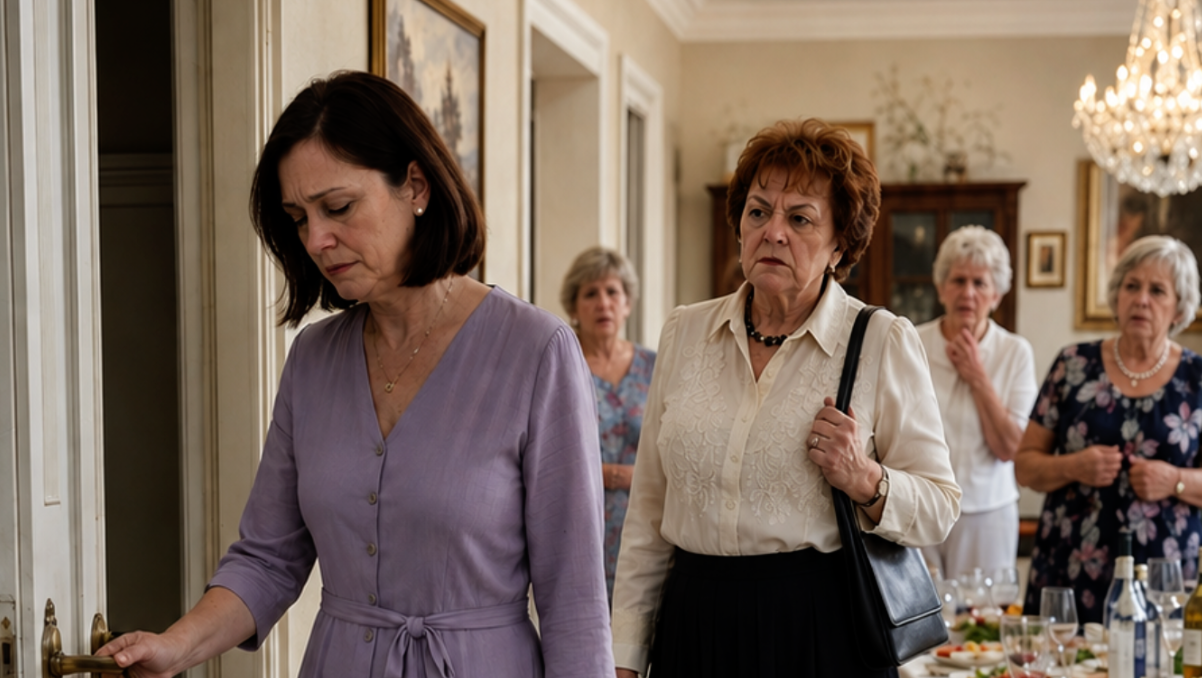
“Twenty-six years with Natasha, yes. Everything’s good, guys. Everything’s good. But honestly—truly honestly—I’ve had enough of those, uh… old ladies of hers every Friday… What was I saying? Natasha, forgive me. You know I love you. I do. But I could use someone lively. Someone young and lively. I’m not an old man yet.”
Seryozha said it directly into the microphone.
He was standing beside the long banquet table in his heavy blue jacket, his cheeks flushed a deep, mottled red from the toasts, a half-empty glass of vodka gripped tightly in his hand. The microphone squealed with a sharp, metallic feedback that did nothing to dampen his voice; if anything, the shrill whine seemed to underline the words, carrying them into every damp corner of the hall. Laughter shook the room—not the entire room, of course, but the noisy end where the mechanics and drivers from the motor depot were sitting. Antonych slapped the polished wooden table with his broad palm as though he had just heard the finest joke of the season. Someone else chuckled warmly into their plate. One woman gave a high, thin gasp—not out of genuine outrage, but merely for the sake of appearances, a polite flutter of social decorum.
I was sitting directly opposite him. In my right hand was a heavy silver-plated fork with a square of cold beef aspic resting upon its tines. I still remember that exact piece of aspic with a strange, photographic clarity. It had a single pea trapped inside it, a tiny, bright green sphere suspended motionless within the translucent amber jelly.
I heard him.
Then I heard it a second time, because he leaned closer to the silver mesh of the microphone and repeated himself—slurring slightly through the part about wanting someone young and lively, someone who didn’t smell of choral sheet music and autumn.
Then I began counting, very slowly, how many people in the room had heard it.
The answer was everyone.
He had a microphone, after all, and the acoustics of the Blue Lakes Sanatorium dining hall were built to amplify the voice of whoever stood at the head of the table.
My choir was standing by the double doors at the back of the hall. Eleven women in immaculate white blouses with ruffled collars. Tamara Petrovna, Granny Lyuba, and I had chosen those blouses together at the Fabrics shop on Sovetskaya Street during the first frost of the previous winter. We had gone there twice. The first time we didn’t buy them; the second time, we bought all eleven bolts of cloth together.
They were standing there in the drafty entrance, ready to sing our jubilee number. Five minutes earlier, before Antonych had tapped his glass with a knife, I had nodded across the room to them—a small, familiar gesture that meant, Soon, girls. Get your breath ready.
They stood quietly, with the patient, uncomplaining dignity of people who are accustomed to waiting to be called to a stage.
I could see them over Seryozha’s broad, blue-jacketed shoulder.
I saw Tamara Petrovna—she was seventy-four years old and had once been the feared and respected vice principal of School Number Twenty—slowly lower her leather handbag onto a vinyl chair beside the wall.
She didn’t drop it.
She lowered it.
It was done with a careful, deliberate slowness, as though something inside her bag had suddenly become unbearably heavy, pulling her arm toward the floor.
And Granny Lyuba—seventy-eight years old, wearing her best mid-calf wool skirt and an antique silver brooch shaped like a delicate willow branch—pulled out a chair and sat down.
She sat the way elderly women sit in a chilly district clinic when they look at the door of the examination room and realize the line is going to be three hours long.
Silently.
Her dry, vein-mapped hands rested flat on her knees, and she pulled her worn bag close against her stomach.
Nothing clicked inside my head. There was no sudden revelation, no burning flash of humiliation or theatrical rage.
It simply became quiet inside me.
It was as though someone had reached out and switched off a low-frequency radio that had been humming in the background of my kitchen all evening—a sound you hadn’t even noticed was occupying the room until the silence rushed in to take its place.
I took a slow breath.
Then another.
Two long, measured breaths, the kind I teach my sopranos to take from the diaphragm before holding a sustained note.
During the second breath, I put the piece of aspic back onto the edge of my plate. I laid the fork neatly beside it, tines down.
I stood up, walked around the table—past the bowls of Olivier salad and the sweating pitchers of cranberry juice—and went over to my choir.
“Girls, let’s go. That’s it. Forgive me.”
I said it very quietly, so that only the front row could hear.
Tamara Petrovna looked at me through her thick spectacles, her eyes steady, and picked up her handbag from the chair. Granny Lyuba stood up, using the edge of the table for balance, and smoothed down the front of her woolen skirt.
The others—Raya, Zina, Valya, the other Valya, because we had two Valyas in the second row, Galina Semyonovna, Lyusya, Tonya, Marina Borisovna, and Ritka—all turned and followed me out into the corridor like obedient schoolchildren following their teacher during a fire drill.
The corridor smelled of lemon furniture polish, damp wool, and institutional bleach. At the coatroom counter, twenty meters away down the checkered linoleum floor, I handed the elderly attendant our brass checks.
No one said a single word. And that, more than the speech at the table, was the worst part—that they were completely silent. My women were usually such chatterboxes, always whispering about grandchildren or blood pressure medications whenever we walked down a hallway together.
“Put your coats on,” I told them, my voice flat. “I’ll call taxis.”
I pushed open the heavy wooden entrance door and stepped out onto the front steps. It was drizzling. It was the end of May, but the wind was still sharp and cold, carrying the damp, raw air in from the Volga.
I ordered two taxis—a standard sedan for four people and a larger minivan for seven.
When I went back inside, they were already wearing their coats, standing in a tight, quiet knot by the radiators. Tamara Petrovna was in her dark blue coat with the wide cloth belt. Granny Lyuba was in her familiar quilted gray jacket. Ritka was wearing a heavy sheepskin coat even though it was May.
“Fifteen minutes and eight,” I said, looking at my watch. “Galya, Zina, Lyusya, and Tall Valya—you’ll take the first one. Everyone else will take the second.”
“Natash,” Granny Lyuba said, stepping forward and touching my wrist with her cold fingers, “we’re all right. Don’t worry about us. We understand everything.”
That “we understand everything” was exactly what I had been afraid of hearing. I wished with all my heart she hadn’t said it.
Tamara Petrovna said nothing at all. She simply stared past my shoulder through the glass panes of the door toward the sanatorium minibus with “Blue Lakes” painted across its white side.
I waited with them in the vestibule until both taxis had arrived, helped them into the seats, and waved goodbye as the tires splashed through the puddles.
When I returned to the banquet hall, the waiters were already serving the hot course—pike-perch baked with potatoes and onions. Seryozha was sitting in his chair, happily cutting into his fish and leaning over to tell Antonych something with a wide, careless grin. He looked across the room at me as I walked in, his eyes bright and unclouded, as though nothing out of the ordinary had occurred. Perhaps he truly no longer remembered what he had said into the microphone; by eleven o’clock at night, he rarely could.
I didn’t return to my seat beside his discarded jacket. I walked around the perimeter of the room and sat at the far end of the table, pulling up a chair beside Mitya and Katya.
Mitya looked at me, his jaw set. Under the concealment of the tablecloth, he reached over and took my hand. His hand was large, calloused, and warm—so much like his father’s had been thirty years ago.
“Mom, I’ll talk to him,” he whispered, his voice trembling with a young man’s anger.
“Don’t, Mitya. Eat your dinner.”
Katya—my daughter-in-law, thirty-one years old, who worked at a bank in Moscow—reached for the glass pitcher and poured me fresh water. Silently. She slid my clean bread plate a little closer to me. Katya generally did everything silently. That was one of the many reasons I loved her.
I stayed until the very end of the evening. I stayed until the jubilee cakes were served, until our director Valentina Nikolayevna came over and silently put her arm around my shoulders, and until Antonych raised a final, slurred toast “to our director, Sergey, who’s still got plenty of fire and life left in him!”
Seryozha and I went home together in a taxi along the night road from Tver. In the back seat, Seryozha leaned his head against the headrest and looked at me through half-closed eyes.
“Natash, what’s wrong with you? Why’d you sit way down there?”
“Seryozha, we’ll talk on Monday. Just let me get home.”
He grunted, his eyelids drooping, and fell silent. He put his heavy hand on my knee. I didn’t remove it. I simply sat there and looked out the rain-spotted window at the yellow streetlights of Kominterna Street.
At home, he undressed in the dark and went straight to bed, snoring within three minutes. I sat on the stool beside the kitchen window, looking out at the five-story apartment building across the courtyard where one second-floor window was always lit.
From the cupboard above the sink, behind a glass jar of buckwheat, I took out an opened pack of cigarettes Seryozha’s friend had forgotten in February. I opened the narrow glass fortochka and smoked into the cool May night. My hands weren’t shaking. My mouth simply felt stuffed with dry cotton, and the sharp smoke burned a clear path through it.
I thought about everything at once. I thought about how we never got to sing “Hope,” which we had rehearsed for three months. I remembered the autumn of 2000, when Seryozha had delivered printed posters to the House of Culture after his first wife died of leukemia, leaving him with five-year-old Mitya. I remembered bringing them jars of borscht, pouring his vodka down the sink when grief made him drink, and moving in together in January 2001.
I had raised Mitya as my own—helping with homework, treating his chickenpox, sitting at the military recruitment office when he turned eighteen—and he had called me Mom since second grade. Seryozha and I never had children together; I lost a baby at seventeen weeks, and eventually we agreed Mitya was enough. Twenty-six years.
On Monday morning, Seryozha came into the kitchen at seven. I was already sitting at the table, dressed in my street clothes.
“Seryozha, I’m leaving.”
He stopped halfway to the stove. “Natash, what are you talking about? Are you still on about Friday? I was joking.”
“I know you were joking. That is exactly why I’m leaving.”
He argued for twenty minutes—saying he was an old idiot, that he loved me, that he loved the old ladies too. I listened, drank my cold tea, and told him I was going to stay with Irina Lvovna, our choir accompanist.
I stayed with Irina Lvovna for three days. When I returned for my things while Seryozha was at work, I took my clothes, my documents, two photo albums, and my blue ceramic mug that said “Best Mom in the World.” I left the kettle, the pots, and the television.
We divorced quietly and divided our property without scandal. We sold our two-room apartment; he bought a place in the Yuzhny district, and I bought a bright one-room apartment on Kominterna Street, my windows facing the courtyard swings. When I called my seventy-eight-year-old mother in Torzhok to tell her the news, she was silent for a moment before sighing: “Natash, I’ve been waiting for this for a very long time.”
A week after the celebration, the choir asked to change our name from “Veteran” to “Hope.” I agreed without hesitation.
A full year passed quietly—marked by seasonal rehearsals, autumn concerts, a third-place trophy at a choral festival in Rzhev, and ten days spent with my mother in Torzhok. Seryozha sent brief, polite text messages on my birthday and New Year’s Day; I answered with equal brevity. By autumn, he and Mitya had reconciled, going fishing together on the Volga.
Then, on a warm Tuesday afternoon in May, we were rehearsing the song “Hope” in the small hall of the House of Culture. The tall windows were open to the scent of poplar trees. Out of the corner of my eye, I noticed someone standing in the corridor.
When we finished the verse, I looked out. Seryozha was standing there in jeans and a blue shirt, holding a cardboard folder. Down in the courtyard stood his black UAZ Patriot; his motor depot had won the municipal contract to repair the House of Culture’s garage.
During our break, I walked out to him.
“Natash…” he began hesitantly.
“Seryozha, we’re in the middle of a rehearsal,” I said, my tone even and calm. “You’re here to see the administration about the garage contract, right? Their office is at the very end of the corridor.”
He looked at my face for a long moment, searching for anger or grief, but found only quiet. He nodded slowly.
“Yes,” he said. “At the end.”
He turned and walked away down the checkered linoleum. I listened to his heavy, deliberate footsteps until he reached the accounting office and went inside.
I returned to the bright hall where Tamara Petrovna was adjusting her silver brooch and Granny Lyuba was sipping cool water. I stepped to the music stand and raised my hand high above my head.
“From the beginning, girls,” I said.
We began again from the beginning.