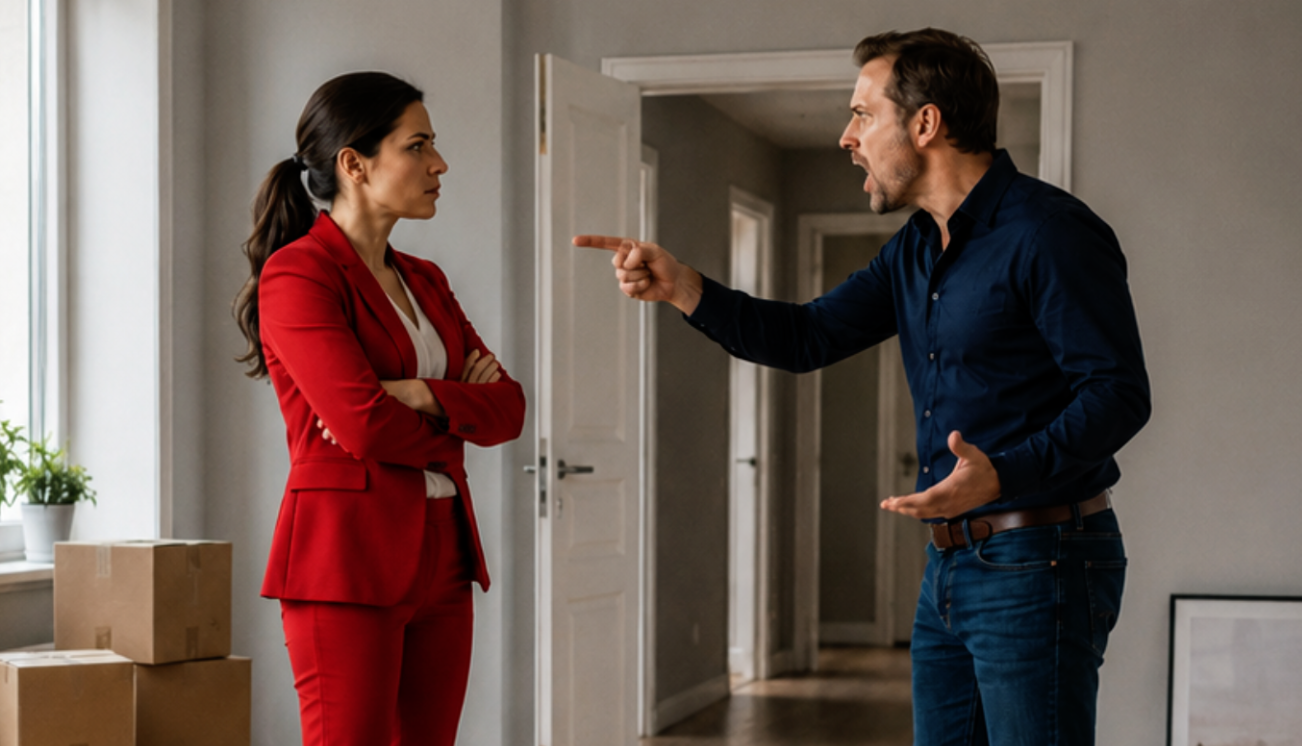
“There’s Nothing of Yours Here,” the Husband Declared Confidently. The Very Next Day, He Came Home to a Completely Empty Apartment
Someone else’s construction tape measure was lying on the kitchen table. Beside it stood an unwashed mug with coffee residue. And on the expensive ivory-colored vinyl wallpaper, someone had drawn three thick pencil crosses.
Elena silently set the bag of groceries on the floor. From the bedroom came the shuffling of feet and muttering.
She walked down the hallway. Lyudmila Petrovna was standing in the bedroom doorway. Her mother-in-law was thoughtfully holding a one-meter wooden ruler against the wall.
“What are you doing?” Lena asked. Her voice was dry. No greeting.
Her mother-in-law flinched and dropped the ruler. It hit the German laminate flooring with a loud clatter. Lena winced inwardly.
“Oh, Lenochka, you scared me. You’re home already? Anton and I were just measuring things out. There’s a nice niche here. If you move your wardrobe, my daybed will fit perfectly. You can move the wardrobe into the living room. There’s plenty of space there.” Lena gripped the strap of her bag so tightly that her knuckles turned white.
“Your daybed?” she repeated. “What daybed in my bedroom?”
Lyudmila Petrovna pursed her thin lips. The fake affection instantly disappeared from her eyes.
“Your bedroom, Elena Sergeyevna, will eventually become the nursery. But for now, I’ll live there. We’ve decided to rent out my apartment. You know what prices are like in 2026. An extra fifty thousand rubles a month won’t hurt. Antosha needs a new car.”
The front door slammed. Anton appeared in the hallway, pulling off his jacket and humming something under his breath. He saw his wife and mother facing each other and froze.
“Oh, Lenka, you’re home early today. Did they give you time off at the clinic?” He tried to smile, but it came out strained.
“No one gave me time off,” Elena snapped. “What is going on in my apartment? Why is your mother drawing on my wallpaper with a pencil?”
Anton sighed heavily and rolled his eyes. He hated arguments. He always hid behind the phrase, You’re making things complicated.
“Len, don’t start getting hysterical the second you walk in. Mom’s going to live with us. It’s temporary. Maybe two or three years. We’ll rent out her apartment and put the money into the family budget. You’re the one who kept complaining that it was taking us too long to save for a vacation.”
“You brought your mother here to live with us without even asking me?”
“And why should I have to ask permission in my own home?” Anton suddenly raised his voice. He stepped forward, shielding his mother with his body.
Lyudmila Petrovna gave a satisfied snort.
Lena looked from her husband to her mother-in-law.
Something clicked inside her.
Like a stiff switch finally being flipped.
“Your home?” Lena asked quietly. “Anton, we bought this concrete box five years ago. Bare concrete. It didn’t even have interior walls.”
“My mother gave us two million rubles for the down payment!” Anton declared, emphasizing every word. “Without that money, we never would have managed the mortgage. This apartment belongs to her just as much as it belongs to us.”
“Two million?” Lena laughed. Short and sharp. “And have you forgotten the three million four hundred fifty thousand from my inheritance that went into the renovation and furniture? My father left me a country house. I sold it and put every last kopeck into this place so we could live like human beings.”
“Oh, don’t make me laugh!” Lyudmila cut in, peeking out from behind her son’s shoulder. “You pasted some paper on the walls and suddenly imagined yourself the owner. Who cares who bought the toilet? The apartment is registered in Anton’s name! He pays the mortgage.” On the paperwork, Anton Viktorovich was listed as the primary borrower. Lena was a co-borrower. At the time, they had decided it would be easier that way for the tax deduction.
“So my opinion means nothing?” Lena looked directly into her husband’s eyes.
“Lenka, calm down. We’re one family,” her husband changed tactics. He tried to hug her, but she stepped back. “Mom will take the bedroom. We’ll sleep on the sofa in the living room for now. What’s the big deal? She’s an elderly woman.”
“My things are in the bedroom.”
“You’ll move them. Tomorrow’s Sunday. You can clear some shelves in the wardrobe while you’re at it. Mom has a lot of boxes.”
Lena looked at the thick pencil crosses on the wall. At the expensive custom-installed electrical outlets. At the oak baseboards.
“No, Anton. Your mother is not going to live here.”
Her husband turned red. His usually good-natured face twisted with anger.
“You know what, Elena? There’s nothing of yours here! Noth-ing! These square meters were bought with my mother’s money and my mortgage payments. And those little pieces of paper you call receipts for toilets and sofas are worthless. If I want my mother to move in, she will. If I want, I’ll bring my sister too. And if you don’t like it—the door is right there!”
Silence hung in the hallway.
The only sound was the hum of the refrigerator—the same two-door refrigerator that had cost two hundred thousand rubles and that Lena had waited two months to have shipped from abroad.
“The door is right there, huh?” she repeated.
“Exactly. And don’t put on a performance. Tomorrow morning I’m leaving for Tver on a two-day business trip. I’ll be back Tuesday evening. Mom will come with me, with all her things. I want the room empty by then. Understood?”
He turned and walked into the kitchen.
Her mother-in-law smirked triumphantly and hurried after her son.
Lena remained standing in the hallway.
There were no tears inside her.
No panic.
Only an icy, absolute emptiness.
And angry clarity.
Sunday morning began with the sound of running water. Anton was taking a shower.
Lena sat in the kitchen. She hadn’t slept all night. In front of her lay a tablet, a calculator, and a thick blue folder filled with documents.
Five years earlier, when they had received the keys to the bare concrete shell, Lena had taken charge of the entire renovation. Anton spent his time traveling around the region for work, while she went to building supply stores after her shifts.
She had meticulously kept every receipt.
Every contractor agreement.
Every delivery invoice for tiles, outlets, interior doors, and plumbing fixtures. The number on the calculator blinked: 3,454,200 rubles.
That was exactly how much she had invested in that “concrete box belonging to Mom.”
Anton came into the kitchen. He smelled of expensive cologne—the same one Lena had given him for their anniversary.
He was wearing a shirt she had ironed with her own hands.
“Did you make coffee?” he asked casually while fastening his cufflinks.
“No,” Lena replied evenly.
Anton snorted, walked over to the coffee machine, and pressed a button. The machine began to hum.
“Still sulking? Kindergarten, Lenka. You’ll sulk for a while and get over it. Mom’s arriving Tuesday at six in the evening. Clear out the bedroom. I’ve ordered a moving truck for her things.”
“Have a good trip,” Lena said without looking up from the calculator.
Anton drank his coffee in one gulp and tossed the mug into the sink.
The front door slammed loudly.
The lock clicked twice.
Lena waited exactly ten minutes.
Then she picked up her phone and dialed a number.
It rang for a long time before someone finally answered.
“Yes, Elena Sergeyevna? It’s Sunday,” came a hoarse male bass voice.
“Maxim. Hi. Are you and your crew working at a site right now, or are you free?”
Maxim was the foreman who had done their renovation. A gloomy man in his fifties who knew the value of good tools and honest work.
They had become friendly back then. Lena had always paid on time and brought the workers hot lunches.
“We’re free until Wednesday. Waiting for the screed to dry at the site on the avenue. What happened? Something leaking?”
“No, Max. Nothing is leaking. I need demolition work.”
“What are we demolishing?” the foreman asked, confused.
“The entire apartment, Maxim. You guys assembled all of it, right? Now I need you to take it apart. Remove the kitchen, the laminate flooring, the stretch ceilings, the doors, the outlets, the plumbing. Strip it down to the exact bare concrete state it was in when you received it from the developer.”
There was a long silence on the other end.
Max cleared his throat.
“Len… are you out of your mind? That’s vandalism. You’ve got solid oak doors there. We heated and stretched those ceilings ourselves. The laminate is glued down. Did you and your husband have a fight or something?”
“I’m divorcing him. Apparently, the apartment belongs to his mother. I was told that there’s nothing of mine here. So I want to take my belongings. I’ll pay double for the urgency. You have forty-eight hours. By four o’clock Tuesday afternoon, this place needs to be empty. Will you do it?”
Another pause.
“Max, two hundred thousand in cash. Up front. And I’ll cover the movers.”
“We’ll be there in an hour,” Maxim grunted.
By noon, the apartment was filled with deafening noise.
Six men in work overalls arrived. Lena ordered three enormous moving vans with loaders and paid two months in advance for a storage unit on the outskirts of the city.
The process began.
It turned out to be much faster than construction.
Destroying something wasn’t the same as building it.
“Lenochka, the kitchen is built in!” Max shouted over the whine of a power screwdriver. “If we pull off the cabinets along with the stone countertop, we’ll damage the backsplash tiles!”
“Knock the tiles off!” Lena shouted back. “All of them, right down to the brick! The tiles are mine too! Spanish! Three thousand per square meter!”
The workers exchanged glances, shrugged, and picked up their rotary hammers.
The apartment was dying before her eyes.
They carried the Italian bed out of the bedroom.
They dismantled the built-in wardrobe.
Lyudmila Petrovna’s favorite spot—that same “nice niche”—now gaped open with bare concrete blocks.
The workers tore out the interior doors along with their frames, exposing the expanding foam underneath.
Lena stood in the hallway with a notebook, crossing items off her list.
Light fixtures?
Removed.
Wallpaper?
Lena personally picked up a putty knife, wet a sponge, and began stripping the thick vinyl from the plaster.
The strips bearing those thick pencil crosses disappeared into enormous black 120-liter garbage bags.
“Elena Sergeyevna, are we removing the toilet too?” one of the plumbers shouted.
Lena looked into the bathroom.
The Japanese wall-hung toilet had cost eighty thousand rubles. Its installation frame was concealed inside a boxed-in wall.
“Break open the box. Unscrew the toilet. Disconnect the whirlpool bathtub too. Remove the faucets.”
“You’ll leave him without water. We’ll need to cap the pipes,” the plumber said, scratching his head.
“Cap them with the cheapest forty-ruble plastic plugs you can find. I have it written down: I paid for all the utilities and plumbing.”
By Sunday evening, the apartment looked like a war zone.
Thick cement dust hung in the air.
The downstairs neighbor came up to complain about the noise from the hammer drill. She threatened to call the local police officer.
Lena opened the door, showed her passport with the registered address, her marriage certificate, and the receipt for the work.
The neighbor made a circular motion beside her temple, indicating that Lena was crazy, and left.
The next day, the process continued.
They ripped out the oak baseboards.
The laminate flooring came up with difficulty, leaving chunks of adhesive and underlay stuck to the concrete screed.
Lena packed Anton’s belongings herself.
She stuffed them into black garbage bags.
His expensive suits.
His ties.
Shirts.
Underwear and socks.
She simply tossed everything into plastic bags and tied the tops into knots.
Three lonely bags ended up standing in the corner of the entryway.
By two o’clock Tuesday afternoon, everything was finished.
The last van left for the storage unit.
Maxim’s crew stood in the building entrance, silently smoking as they stared at what was left of the cozy family nest.
Or, more accurately, at what was no longer there.
There was nothing in the apartment.
Absolutely nothing.
Bare gray concrete covered the floor, streaked with construction adhesive.
The stripped walls were covered with patches of gray plaster.
Bundles of wires stuck miserably out of the walls—Lena had ordered the workers to remove every Legrand-brand outlet and switch.
There wasn’t a single interior door.
There was no kitchen.
The bathroom had been completely stripped.
Only short pieces of plastic pipe and a bare concrete recess remained.
They had even removed the mirror from the wall.
It was cold.
In November, the radiators normally heated the apartment well. But Lena remembered that she had purchased the Italian cast-iron radiators herself at twelve thousand rubles per section.
So they had been removed too, with cheap shutoff caps installed on the risers.
An icy November draft swept through the apartment.
“Are we removing the front door too?” Max asked gloomily, putting out his cigarette.
Lena looked at the massive steel door with its mirrored panel.
She had paid one hundred twenty thousand rubles for it.
“Take it off, Max. Cut the hinges.”
“Lenka, you’re a cruel woman. You’re going to leave him in an open concrete box in winter?”
“I’m not cruel. I’m fair. Let Antosha and Lyudochka guard Mom’s concrete themselves.”
They removed the door.
Out of kindness, Max nailed a piece of cheap plywood he had found near the building’s trash area over the doorway and propped it from the inside with a broken brick.
Lena paid the workers.
She shook each of their hands.
Then she remained alone.
She sat on a cheap folding fishing chair from Decathlon.
Every movement echoed through the bare concrete shell.
Her wristwatch showed 5:45 p.m.
She waited.
Footsteps sounded in the stairwell five minutes before six.
The voices were loud.
“Careful, movers! Carry that carefully—there’s crystal in there!” Lyudmila Petrovna commanded.
“It’s fine, Mom. Put the boxes here in the vestibule,” Anton’s voice boomed.
Keys jingled.
A metal key clicked against empty air.
Anton cursed.
Lena stood up.
She walked to the doorway, pushed the brick aside with her foot, and threw the plywood panel away.
Anton stood on the landing with his keys extended in front of him.
Behind him, Lyudmila Petrovna was panting, clutching a huge potted ficus.
Beside them, two gloomy movers were holding a folding sofa and three plaid bags.
They stared at Lena.
Then their eyes shifted past her.
The ficus slipped from Lyudmila Petrovna’s hands.
The pot shattered with a dry crack.
Soil scattered across the tiled landing.
Anton said nothing.
His mouth slowly fell open.
He blinked.
Then blinked again.
He tried to look deeper into the apartment, but there was nothing to see.
Emptiness.
Gray patches.
Wires protruded from the walls like dead worms.
Fragments of brick.
Chunks of hardened foam.
No lights.
No heat.
No comfort.
Absolute, sterile zero.
“Wh… what is this?” Anton Igorevich finally croaked.
His voice trembled and broke into a squeak.
“Your apartment,” Elena replied calmly. “Just like you said. There’s nothing of mine here anymore. Only your mother’s two-million-ruble down payment in the form of the concrete shell. I took my things.”
“My things?!” her mother-in-law shrieked. She clutched her chest and leaned against the wall. “You destroyed the apartment, you criminal! Savages! Police! I’m calling the police! This is robbery!”
Lyudmila Petrovna began frantically digging through her handbag, dropping lipstick and pills onto the floor.
Lena crossed her arms over her chest.
“Call them, Lyudochka. Go ahead. Except I already showed everything to the local police officer yesterday. I have a folder of receipts as thick as my finger. For every nail, every plank of laminate, every faucet. The court will be on my side. Everything was purchased with money from the sale of the country house I inherited. I have the receipts. I have bank statements. I took my property.”
Anton finally came back to life.
He stepped forward, directly onto the soil spilled from the ficus.
“Lenka… have you lost your fucking mind? You removed the front door! How are we supposed to sleep here?! It’ll be minus five in here at night!”
“Not my problem. You’ve got the mortgage, so you sleep here. You and your mother can cuddle together on her daybed to keep warm. The developer installed the plastic windows, so I left those. It shouldn’t be too drafty.”
“Where are my things?!” Anton screamed.
His face was covered in red blotches.
“My suits! My documents!”
Lena nodded toward the corner of the entryway.
There, huddled miserably on a layer of concrete dust, were three black 120-liter garbage bags.
“There. Everything that belongs to you is there. I took the washing machine too, so you’ll have to wash your underwear in the sink. Oh, wait. I took the sink too. The water’s shut off. The toilet is outside, around the corner at McDonald’s. Formerly Vkusno i Tochka, I mean.”
She picked up her handbag and slung it over her shoulder.
“You… you’re sick, Lenka,” her husband whispered.
He looked around, slowly beginning to comprehend the scale of the disaster.
The numbers started adding up in his head.
He still owed the bank another four million rubles.
A renovation of this quality in 2026 would cost around five million.
He had barely one hundred thousand rubles on his bank card.
Lyudmila Petrovna groaned and slid down the wall.
“Antosha… I feel sick. Give me some water.”
“There is no water, Mom!” he snapped so sharply that she flinched. “There are no pipes! That bitch cut everything out! I’m going to sue you for damaging the apartment!”
Lena laughed.
Genuinely and freely.
“Go ahead. But buy a door first. Otherwise anyone can just walk straight into your place. Oh, and I won’t bother returning the keys. There’s no point anymore. There aren’t any locks either.”
She headed toward the stairs.
The two movers carrying the sofa respectfully stepped aside to let her pass.
One of them watched her go with an expression that seemed to combine horror and admiration.
Lena went down to the first floor, stepped outside, and inhaled the freezing November air.
Somewhere behind her, on the fourth floor, her mother-in-law’s hysterical screams echoed through the building.
Lena pulled out her phone, blocked both her husband’s and his mother’s numbers, and ordered a taxi.
For the first time in many months, she could finally breathe freely.
And what would you have done? Would you have left the traitor at least the front door and the toilet—or would you also have taken everything down to the very last nail?