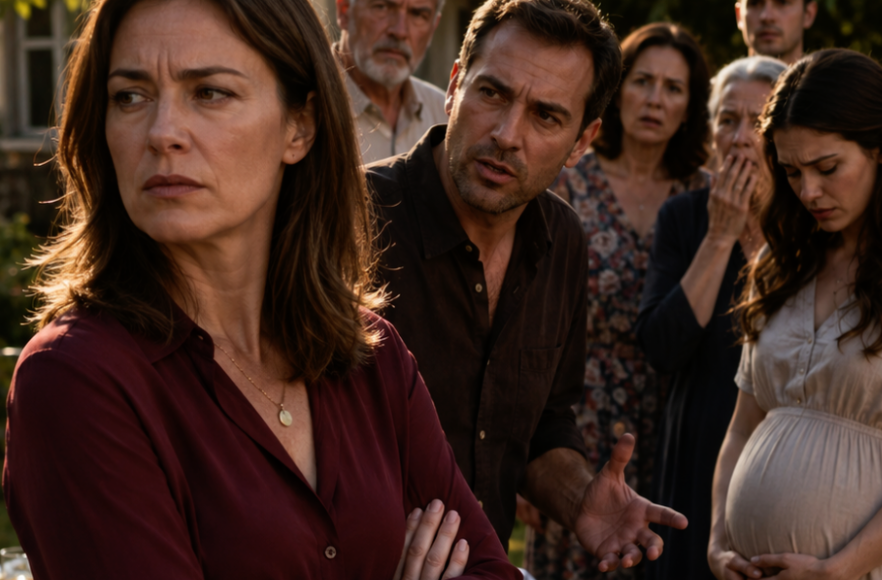
“She’s pregnant with my child, and I have to take responsibility,” my husband said in front of the entire family. But I explained where he was wrong
Natasha’s voice, amplified through the phone speaker, cut through the hum of conversation around the table:
“Listen, Mom, don’t get worked up. Lyoshka is going through puberty, his hormones are all over the place. He didn’t mean any harm. We’ll deal with it ourselves.”
I listened to my daughter with the phone pressed between my shoulder and ear while arranging eggplant rolls with garlic on a serving dish. My fingers were slippery with oil. Laughter drifted in from the living room—Igor, my husband, was already pouring Aperol for the guests. The family lunch celebrating my father-in-law’s birthday was turning into a feast for twelve. Relatives arrived in waves, each one bringing a bouquet, a box of chocolates, and another burst of noise.
Natasha spoke quickly, as though reciting something she had rehearsed. Her son, my grandson, had broken a window in the school hallway—with his shoulder, accidentally, during some stupid roughhousing. The school administration wanted his parents present and demanded a written explanation from Lyoshka himself. “So he really understands what he’s done,” Natasha quoted the vice principal. Now she was asking me to come over and stay with Lyoshka while she sorted things out with the principal.
“I’ll come,” I said. “I’ll finish setting the table and get the guests settled. Expect me in about an hour and a half.”
“Mom, thank you! You’re my lifesaver,” my daughter’s voice warmed. “Love you.”
I ended the call and looked at the screen. Two in the afternoon. Outside, the May heat was so intense that the asphalt seemed to be melting. The air conditioners were running inside the house, creating an island of artificial coolness, and the contrast with the scorching heat outdoors made me sleepy. I wiped my hands on a kitchen towel and carried the platter into the dining room.
At the large oval table were already seated Igor’s sister Lera and her husband Anton, his cousin Dima—whom I had seen only three times in my life—and Aunt Sveta, an imposing woman wearing a hat and keeping a lace napkin on her lap as though she had come to tea with the Queen of England. My father-in-law, Oleg Borisovich, sat at the head of the table like a patriarch receiving tribute. The only person missing was my mother-in-law, Alla Petrovna, who was still upstairs getting ready in the guest bedroom.
Igor noticed me, winked, and raised his glass.
“And here comes our hostess! Give her a warm welcome. Katya, why do you look so tense? Did Natasha call?”
“Yes.” I placed the platter in the center of the table. “Lyoshka is having trouble at school again. I need to leave for about three hours and stay with him while Natasha talks to the principal.”
“Again?” Igor grimaced as if he had a toothache. “That boy is going to drive his mother crazy. What did he do this time?”
“Broke a window. Accidentally.”
“Accidentally or not, what does his grandmother have to do with it?” Lera cut in, taking a sip of Aperol. “Katya, you’re like an ambulance. Someone whistles and you come running. He’s old enough. If he did it, let him deal with the consequences himself.”
“He’s ten,” I said dryly.
“When we were ten, we were already herding cows,” my father-in-law unexpectedly spoke up. “Nobody babied us. You fell—you got back up. You broke something—you paid for it yourself. But this generation? The slightest thing happens and they run straight to Mommy and Grandma.”
I felt irritation slowly tightening inside me like a tightly wound spring. Twenty-eight years of family life had taught me not to argue until everyone had finished presenting their case. Let them talk. The hot dishes hadn’t even been served yet. The main event was still ahead.
“Katya, let Natasha deal with it herself,” Lera continued. “You can’t stretch yourself in every direction. You have a celebration, guests, a whole table here. Igor, at least say something to your wife. Why is she always running around trying to save everyone?”
My husband shrugged. He rarely took my side in front of his family. After twenty-eight years, I had trained myself to believe I was used to it.
“Katya really does save everyone all the time,” he said neutrally. “That’s just her personality. You can’t change her.”
The spring inside me tightened by another turn.
I went back to the kitchen for the hot dish. My hands grabbed the oven mitts, and when I opened the oven door, heat and the aroma of pork roasted with prunes washed over my face. I was transferring the meat onto a ceramic platter when Alla Petrovna floated into the kitchen.
My mother-in-law looked impeccable: a pale blue linen suit, a string of pearls around her neck, freshly styled hair. She smelled of expensive perfume with aldehydic notes—authoritative, elegant, and strangely inappropriate for such a hot May day.
“Katya, Igor wants to make a toast,” she said, stopping in the doorway and inspecting the kitchen as though checking whether there was any dust, anything burned, or any violation of one of her unwritten standards. “Are you finished? Everyone is waiting for the hostess.”
“Yes, Alla Petrovna. I’m coming.”
I carried the platter out.
The murmur of conversation died away when Igor stood with his glass. He looked around at everyone—emotional, already slightly tipsy, wearing that special kind of theatrical warmth he displayed only in public.
“My dear family,” he began. “Today is a special day. We’ve gathered together as one big family to wish my father, Oleg Borisovich, a happy birthday. Dad, you’ve always been an example to me. An example of responsibility, courage, and keeping your word…”
He paused.
Alla Petrovna lifted a napkin to her eyes, though there wasn’t a single tear there. Lera affectionately rested her head on her husband’s shoulder.
“And I want to thank everyone who is here with us today. But especially my wife, Katya.” He looked at me. “Twenty-eight years together. Twenty-eight years. Katya, you are my support. My fortress. I could never have managed without you.”
Something trembled inside me.
Twenty-eight years.
A life together.
Words I heard rarely, and almost never in front of witnesses.
“But I want to say more,” Igor continued, his tone changing. The festive solemnity disappeared, replaced by something intimate and serious. It was the tone people used when they were about to announce important news.
Everyone at the table sensed it.
Lera straightened.
Anton stopped chewing.
“Katya has carried a sense of guilt inside her for a long time,” Igor continued. “And I believe that today, surrounded by family, it’s time to lift that burden. We have to admit our mistakes and take responsibility for them. Right?”
He paused again.
And in that pause, I felt the air in the room change. It became thick, almost difficult to breathe.
What mistakes?
What responsibility?
I looked at Igor and tried to catch his eye, but he was looking at his father, seeking support. My father-in-law gave him an almost imperceptible nod.
“The truth is…” Igor drew in a deep breath. “Katya has been a good wife to me, but fifteen years ago I did something that I have kept secret ever since. I can’t stay silent anymore. It isn’t fair to my son. My son by another woman.”
The table fell as silent as an operating room before the first incision.
I stopped breathing.
My hands froze in my lap, clutching a napkin embroidered with the words: “Family Is Life’s Greatest Happiness.”
“Her name is Svetlana,” Igor continued, his voice trembling exactly as much as necessary for dramatic effect. “She had a son by me. Artyom. He’s fifteen now. All these years she raised him alone. She never demanded anything from me. She never tried to destroy our family. But I’m a man. I have to take responsibility.”
Now he looked directly at me.
His eyes glittered—whether from tears, Aperol, or excitement over his own courage, I couldn’t tell.
A real tear finally rolled down Alla Petrovna’s cheek.
Lera covered her mouth with her hand.
Dima froze with his fork halfway to his mouth.
“Katya, forgive me,” Igor said. “But I have to be a father to my son. I’m going to acknowledge him. You have to understand and forgive me. Family is the most important thing. We’ll get through this. Together. Like we always have.”
The silence was so complete that I could hear the neighbor’s car starting outside. I could hear a child shouting on a playground nearly a kilometer away. I could hear the steady ticking of the kitchen timer, counting down the minutes until the casserole in the oven developed its golden crust.
Fifteen years.
For fifteen years he had carried this secret.
For fifteen years he had come home in the evenings, eaten dinner, watched movies with me, planned vacations.
For fifteen years our life had been a stage set, while behind it another, more real life existed—with a woman named Svetlana and a boy named Artyom.
And now he had told me in front of everyone.
In front of his mother.
His sister.
A distant relative we saw once every five years.
He announced it as though he were giving me an opportunity to redeem myself.
As though I were the one who needed to be freed from guilt.
What guilt?
For what?
The spring inside me released.
Not explosively.
Slowly, almost gently.
Like a tightly tied knot coming undone when you pull exactly the right thread.
I stood up.
The chair slid backward without making a sound—we had specifically bought chairs with felt pads on the legs so they wouldn’t scratch the oak parquet.
Igor had bought them.
He had chosen them.
Had he discussed them with Svetlana too?
Or maybe she was already in his life then and he simply hadn’t told me.
“Igor,” I said.
My voice was steady.
“Can you answer one question? Why did you decide to tell me this now? Here?”
He blinked.
He had prepared himself for tears, hysterics, maybe even fainting.
But he had not prepared himself for a calm voice and a direct question.
“Because… because I’m tired of lying. Artyom is old enough now. He deserves to know his father. Dad is right—a man’s responsibility is to acknowledge his mistakes.”
“You said, ‘She’s pregnant with my child and I have to take responsibility,’” I quoted him word for word, even though he had actually phrased it differently. “What pregnancy are you talking about?”
“Well… she was pregnant. Back then. Fifteen years ago.”
“Past tense,” I observed. “But you said ‘she’s pregnant.’ As if it were happening now.”
“Katya, what difference does it make how I said it? That’s not the point!”
“The point,” I said, looking around the table, where everyone suddenly seemed less like people and more like papier-mâché dolls—frozen faces, wide eyes, half-open mouths waiting for the climax, “is that for fifteen years you were living two lives. And today you chose to announce it not to me privately, not during a conversation between the two of us, but like this—in front of everyone. You knew that with everyone watching, I wouldn’t be able to answer you properly. You thought I’d be afraid of causing a scene. That I’d swallow it. Understand. Forgive.”
“Katya, I didn’t—”
“Be quiet,” I said.
And he fell silent.
For the first time in twenty-eight years, he actually fell silent when I asked him to—without adding a comment, without turning it into a joke, without dismissing my words with that familiar tone of, Here we go again.
“Fifteen years,” I repeated, then looked at Alla Petrovna. “Alla Petrovna, did you know?”
My mother-in-law flinched as though I had slapped her.
She didn’t answer.
Her silence was an answer.
“Lera?”
My sister-in-law looked away.
“Oleg Borisovich?”
My father-in-law covered my hand with his.
His touch was dry and hot, like paper that had spent an entire summer in an attic.
“Katya, dear, we’re all human. We all make mistakes. But family means being able to forgive. Igor did what a man should do. He confessed. He took responsibility. As a woman, you need to show wisdom and…”
I pulled my hand away.
“Oleg Borisovich, don’t you think that in your family, ‘show wisdom’ really means ‘close your eyes and don’t get in the way’? You knew for fifteen years that you had another grandson and said nothing. Alla Petrovna knew. Lera knew. Anton, did you know?”
Caught off guard, Anton choked, nodded, then shook his head, getting tangled in his own gestures.
“I see. Of everyone sitting at this table, only two people didn’t know: Dima and me. And Dima only because he’s practically nobody to us.”
I took a breath.
There was no pounding in my temples.
No lump in my throat.
I spoke calmly and clearly, as though reading aloud a document I had memorized long ago and had simply been waiting for the right moment to present.
“Now let me explain where Igor is wrong.
“First, it isn’t ‘she’s pregnant.’ It’s ‘she was pregnant.’ Using the present tense makes the situation sound urgent, shocking, as though it requires an immediate decision. But fifteen years have passed. The urgency is gone. All that remains is the deception.
“Second, this is not ‘taking responsibility,’ Igor. Taking responsibility would have meant coming to me fifteen years ago and telling me the truth. Taking the risk. Risking losing me. Giving me the right to decide how I wanted to live from that point on, instead of presenting me with a fait accompli fifteen years later, when leaving is harder, changing your life is harder, and you assume I barely have enough strength left to resist.
“You didn’t take responsibility.
“You took a pause.
“For fifteen years.
“Third, you announced this in front of everyone so I wouldn’t be able to respond honestly. So I couldn’t cry, scream, or smash that damned plate.” I nodded toward the platter of roasted pork. “You know I hate scenes. You know they give me migraines for three days afterward. You knew that. You staged a performance. And your family played along.”
“Katya, why are you doing this?” Lera jumped to her feet. “You’re just winding yourself up! Igor only wanted you to understand…”
“Understand what? That for fifteen years all of you treated me like an idiot? Yes, I understand that perfectly well. No additional explanation necessary.”
I sat down again.
Not because I was tired of standing.
I wanted to pour myself an Aperol.
Slowly, under the watchful eyes of the guests, I picked up the bottle, poured the orange liquid into an empty glass, and added a slice of orange from the fruit platter.
I took a sip.
Bitter-sweet.
Citrusy.
Cold.
“Now for the most important part,” I said, setting down my glass. “You say family is the most important thing. I agree. Family is the most important thing.
“My family.
“Me.
“My daughter Natasha.
“My grandson Lyoshka, who just broke a window and who needs his grandmother right now.”
I stood again.
My handbag was lying on the console in the hallway. I could see it through the open door.
“Where are you going?” Igor’s voice cracked into a hoarse whisper.
“To my daughter. Remember? She has a problem. Of course you don’t remember. You were too busy thinking about how beautifully you were going to announce your fatherhood.”
“Katya, wait! We haven’t finished talking!”
“We have,” I said, taking my car keys from the console. “We finished talking fifteen years ago, when you decided that your responsibility was to stay silent and mine was not to know. Everything else is just the epilogue.”
The hallway was cool.
A draft came through the slightly open front door—one of the guests had gone outside to smoke on the porch and hadn’t shut it properly.
I pushed the door open.
The May sun hit me in the face, dazzling me and making me squint.
Voices rose behind me.
I heard my mother-in-law saying, “She won’t dare. It’s just her nerves.”
Lera’s voice: “Psychological menopause, I’m telling you.”
My father-in-law: “Let her cool down. She’ll come back.”
I won’t come back, I thought.
The car stood in the shade of an old linden tree.
I opened the door and got behind the wheel.
The key turned smoothly in the ignition, and the engine started immediately.
On the passenger seat lay Lyoshka’s forgotten cap—with a hole in the top that I had promised to sew up a month ago but had never gotten around to fixing.
My phone lit up on the dashboard with a message.
Natasha:
“Mom, are you coming soon? I’m losing my mind here, he’s putting on such a circus!”
I smiled.
For the first time that day.
For the first time in many days, if I was being truthful.
“On my way. Twenty minutes. Put the kettle on.”
The car started moving and rolled through the gates.
Behind me remained the house with its columns, its oak parquet, its felt pads under the chair legs.
Behind me remained the platter of cooling pork.
Behind me remained the glass of Aperol I never finished.
Behind me remained Igor, his fifteen-year-old secret, his belated responsibility, and his theatrical tears.
I pulled onto the highway and accelerated.
Ahead of me was my grandson, his broken window, my daughter, and the kettle she had promised to put on.
Fifteen years of lies is far too long.
But the drive to Natasha’s house took only twenty minutes.
And in those twenty minutes, I lived through more truth than I had in twenty-eight years of marriage.