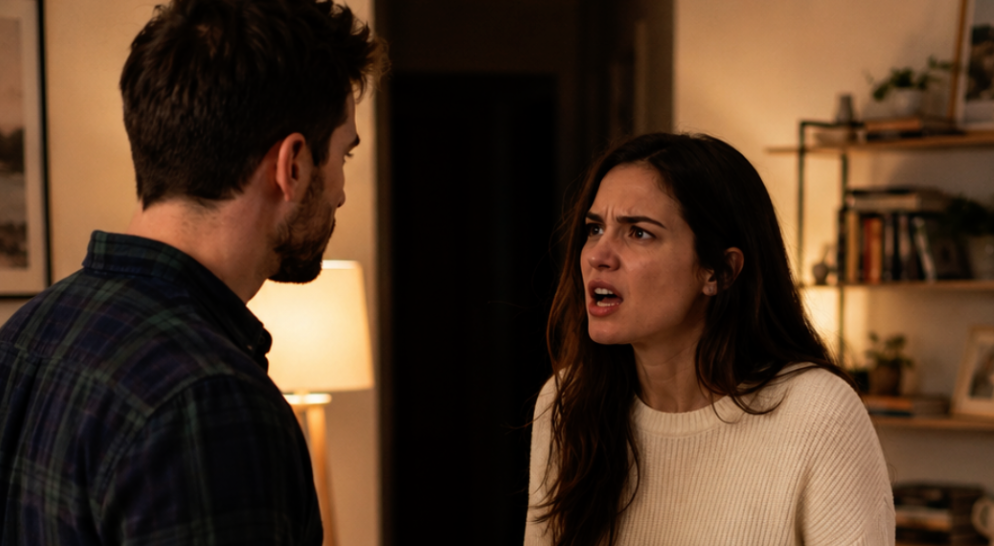
“Stop! I’ll decide for myself, darling, how and where to spend my salary.”
“Sveta, I’ve been thinking… we need to have a serious talk about our finances.”
Filipp’s voice, deliberately deep and velvety, with a note of condescension, broke the cozy evening silence of the kitchen. Svetlana was just finishing her favorite herbal tea, slowly stirring the last traces of honey at the bottom of her cup. This ritual was her way of letting go of the tension from a long workday, and she disliked having it interrupted. She raised her eyes to her husband without changing her expression and silently waited for him to continue.
Filipp, feeling like the director of an important scene, leaned his hip against the kitchen counter and folded his arms across his chest. The pose had clearly been rehearsed—the pose of a confident man, the head of the family, who was about to put things in order.
“You see, somehow we’re living… incorrectly. Without any system. Each of us spends our own money, and we don’t see the whole picture. It leads to chaos, to unreasonable expenses. I analyzed the situation and came to the conclusion that we need one unified budget. One common pool of money, which I’ll manage.”
He paused, letting his words settle in the air. Svetlana continued looking at him in silence, her spoon motionless in the cup.
“It’s a normal, healthy practice,” he continued, warming to his subject. “A man is the provider and the strategist. He sees the big picture, plans major purchases, invests. A woman… well, you know yourself—you want a new handbag, new perfume, or to meet your girlfriends at a café. Those are all emotions, impulsive expenses. I’m not saying that’s bad; it’s simply your nature. But for a family to prosper, someone needs to keep a firm hand on the financial wheel. And that wheel will be in my hands.”
He spoke as though he were doing her the greatest favor imaginable. As though he were freeing her from the unbearable burden of responsibility for her own money.
“The system is simple. On payday, you transfer your entire salary to my card. I’ll collect the money and pay for everything necessary—the utilities, groceries, the car loan. And I’ll give you a certain amount for pocket money. For your little feminine things. Don’t worry, I won’t be unfair to you, but everything will be under control. No more spontaneous purchases costing thousands of rubles. Only a sensible approach.”
Svetlana slowly set her cup on the table with a barely audible clink. She looked at her husband with a long, searching gaze, as though seeing him for the first time. There was neither panic nor hurt in her eyes. Only cold, crystal-clear astonishment at what she had just heard.
“Stop! I’ll decide for myself, darling, how and where to spend my salary.”
Filipp gave a condescending smirk. He had expected resistance, feminine whims.
“I’ve decided, so that’s how it’s going to be. Enough wasting money on all sorts of nonsense. I’m taking responsibility. For our own good.”
Svetlana said nothing more. She simply picked up her phone from the table. Her fingers moved with precise, businesslike speed. She opened her banking app. Fingerprint login. Several quick, deliberate taps. Open a new savings account. Create a complicated password. Return to the main screen. Choose “Transfer.” Select her salary card as the source. Select the newly created account as the destination. Enter the amount—“All.” Confirm.
It took less than a minute.
Then she turned the phone screen toward Filipp. On the balance line of her main card, the one where her substantial salary arrived every month, a bright, mocking figure glowed:
0.00 rubles.
“There,” she said in the same icy, calm voice. “Now you can distribute it. Zero. And if you think you’re getting even a kopeck from me, you’re badly mistaken.”
The zero on the phone screen glowed poisonous green, reflected in Filipp’s widened pupils. The condescending smile slid from his face like a cheap theatrical mask. For a second, he simply stared, unable to reconcile his carefully constructed plan with this immediate, merciless digital fact. His pose of the “confident master of the house” collapsed. He pushed himself away from the counter as though it had suddenly become hot. The blood first drained from his face, leaving pale blotches, then rushed back into his cheeks, turning them crimson.
“You… what have you done?” he hissed. There was no trace of his patronizing velvet tone anymore, only naked, confused anger. “You did that on purpose? What is this, some kind of rebellion? You’ve decided to destroy our family because of some whim?!”
He stepped toward her, his hands involuntarily clenching into fists. He could not believe what was happening. He had expected an argument, persuasion, perhaps even tears. He was prepared for those things; he had arguments ready. But he had not been prepared for this lightning-fast, cold amputation.
“I’m talking about our future together, about a strong foundation, and you’re behaving like a selfish little girl!” His voice grew louder, filling the kitchen. “I’m trying to take on a man’s responsibility, to protect us from foolish spending, and you throw this… this little stunt in my face! Wives don’t behave like this! A wife is supposed to be a support, a partner, not a competitor in her own home! You’re undermining my authority!”
Svetlana calmly locked her phone and placed it facedown on the table. She met his furious stare without the slightest trace of fear. Her calmness enraged him far more than shouting ever could.
“Your authority?” she repeated quietly, but every word was like a drop of acid. “Are you talking about the same authority that, two years ago, advised me to invest one hundred thousand rubles in your friend Denis’s ‘incredibly promising crypto project’? The same project that disappeared along with Denis three months later? Am I remembering correctly?”
Filipp flinched as though he had been struck. That was forbidden territory. A subject they had agreed never to raise again.
“That was different! It was business, and business always involves risk!” he blurted.
“Of course,” Svetlana nodded, a dangerous spark flashing in her eyes. “Especially when the ‘businessman’ hides from his ‘supportive wife’ that he took the money from our shared vacation fund. I saw the statement by accident, remember? Meanwhile, you were telling me there were temporary problems at work. Is that the same ‘male responsibility’ and ‘strategic vision’ you were just talking about? Hiding your failures and hoping no one notices?”
Each of her words was an accurate, measured strike at his most vulnerable point. She was not accusing him. She was simply stating facts, and that made it unbearable. She was exposing the secret he had carefully protected: behind the confident façade of the “strategist” was a reckless and not particularly successful gambler who confused self-confidence with competence.
“You’re twisting everything now! Mixing everything together to justify your selfishness!” he said desperately, trying to regain control of the conversation. “We weren’t talking about the past. We were talking about the future! About putting things in order now!”
“You don’t want to put things in order, Filipp. You want access to my money so you’ll have a safety cushion for your next ‘brilliant ideas.’ You want to control my income because you’re incapable of controlling your own spending. Your proposal isn’t about caring for the family. It’s an attempt to insure your own incompetence at my expense. So no. You can keep playing financial guru with your own salary. And don’t even think about looking into my wallet anymore. There’s nothing there for you.”
The mention of his failed investment hung in the kitchen air like the smell of something burned. It was a direct hit at the center of his pride. His logical arguments were exhausted, and Filipp, like a predator cornered, switched tactics—to poison. He walked around the table and stopped behind her chair, looming over her, trying at least to dominate the space physically.
“Since we’re talking about money, let’s count up all the ‘nonsense’ you waste yours on,” he said, his voice sharp and contemptuous. He began counting on his fingers as if listing evidence against a criminal. “First: your yoga. Twice a week you go somewhere to spend an hour standing in ridiculous poses. Thousands of rubles a month for the privilege of twisting yourself around on a mat with a bunch of other bored women. What good does it do? None. It’s just a fashionable pastime.”
Svetlana did not turn around. She stared straight ahead at the dark window, where their kitchen scene was reflected.
“Second: your endless get-togethers with your girlfriends. Every Friday—cafés, wine, pointless chatter. You gossip about everyone you know, brag about clothes, and complain about life. Several more thousand rubles disappear on gossip and cheap white wine. I could buy myself a new set of tools with that money. Proper ones, not the kind that break after every use.”
He stepped closer, his voice becoming increasingly poisonous. He savored every word, every belittling description.
“Third: cosmetics. God, all those jars, tubes, bottles. An entire shelf in the bathroom is covered with them. You smear five-thousand-ruble cream on your face, honestly believing it will stop time. It’s just an industry profiting from women’s fears! And you, with your education, fall for it like the biggest fool imaginable. You spend more on that stuff than I spend maintaining the car!”
He waited for a reaction. He expected her to jump up and defend her hobbies, her little pleasures. But she remained motionless. Her stillness infuriated him to the point of grinding his teeth.
“I wanted to put an end to it!” he exclaimed, no longer hiding his malice. “I wanted to redirect all those meaningless little streams into one large, useful channel! Renovating the bedroom, buying new tires, things the family actually needs! But you… you cling to your nonsense like a child clings to a broken toy!”
He finished his tirade breathing heavily. The kitchen was silent for several seconds.
Then, in that silence, Svetlana slowly—very slowly—turned her head and looked up at him. A faint, cold smile played on her lips.
“Finished?” she asked so calmly that it sounded like a sentence being handed down. “Now listen carefully, strategist. You didn’t come up with this ‘unified budget’ performance yesterday. You started preparing it exactly three weeks ago. Right after I told you I’d been promoted and my salary would now be almost one and a half times yours.”
Filipp’s face froze. He had not expected such a precise, surgical strike.
“I remember your face that evening,” she continued, her gaze drilling straight through him. “You tried to smile and said all the right things—‘well done,’ ‘I’m proud of you.’ But there was panic in your eyes. Pure animal panic. You can’t stand my success, Fil. You can’t accept that I’m overtaking you. Your famous ‘male responsibility’ is nothing more than envy and fear. Fear that next to me, you’ll look small and unsuccessful.”
She stood up, and now they were eye to eye.
“You don’t need my money for renovations. What you needed was the right to hand my own money back to me in pieces. So that even though I earn more than you, I would have to come to you with my hand out asking for money for tights. So that you could control not the finances, but me. So that you could diminish my success by turning my salary into something granted by your generosity. You don’t want to build a family. You want me to stop growing because standing next to me makes you feel small.”
Svetlana’s final words hit Filipp harder than any shout or slap could have. They exposed his motive with the merciless precision of a surgeon, revealing beneath the layers of performative masculinity and concern an ugly insecurity writhing with envy.
He froze. His face became a mask combining anger, humiliation, and despair. The words stuck in his throat. He had lost the verbal duel, defeated on every front, and only one weapon remained in his arsenal—crude, primitive force expressed through ownership.
He turned sharply and, without saying a word, strode out of the kitchen into the hallway. His movements were jerky, full of barely contained rage. Svetlana remained standing beside the table, watching him with cold curiosity. There he was—her “head of the family,” her “strategist,” reduced to a state in which his only remaining argument was ownership of an object.
In the hallway, two sets of car keys hung from a key rack. Filipp tore her keychain from the hook—an elegant one with a small silver figurine—and squeezed it in his fist so tightly that the metal dug into his palm.
He returned to the kitchen, his face twisted into a grimace of malicious triumph.
“If everything is separate now,” he said through clenched teeth, tossing the keys onto the table away from her, “then you won’t be using this either. The car may have been bought on credit, but I paid the down payment. Which means it’s mine. You can take the metro to your yoga now. Or walk. It’ll be healthier for you.”
It was his final move. An ultimatum. An attempt to put her back in her place, deprive her of comfort and freedom of movement, and show her who still controlled something in the house.
He looked at her defiantly, expecting that this time she would finally break and realize she had gone too far.
Svetlana looked at the keys, then at his distorted face. There was not a trace of disappointment or hurt in her eyes. Only disgust.
She picked up her phone again—the device that had become her main weapon in this war. Her fingers flew across the screen once more.
Filipp watched, confused.
She opened a taxi app. Calmly and methodically, she selected “Bookings.” She created a new ride for the following morning at 7:30. Destination: her workplace. Class: Comfort Plus. She checked the option to repeat it on weekdays.
Two taps, and her transportation problem was solved for the foreseeable future—with considerably more comfort than riding in the same car with him.
Then, without closing her phone, she opened the browser. In the search bar she typed:
“Urgent installation of combination lock on interior door.”
She opened the first link, found the number, and, looking Filipp directly in the eyes, raised the phone to her ear.
“Hello. Lock Service? I need a consultation and installation. A combination lock for a wooden bedroom door. Yes, without a key, using a password…” She paused and listened. “Excellent. Is a technician available tomorrow? First half of the day? Yes, that works for me. Write down the address.”
She dictated their home address in a calm, businesslike tone.
After ending the call, she placed the phone on the table.
The silence in the kitchen became absolute, heavy as a tombstone.
Filipp stood there as if struck by lightning, still holding the now-useless car keys. He had tried to take away her car, and in response, she had taken away his access to their bedroom.
To their life.
“Just so you understand, Filipp,” Svetlana said quietly, her voice cutting like glass. “This isn’t an argument. These are the new rules. Here’s your half of the apartment, and here’s mine. Starting tomorrow, my room is my territory, and you’re not allowed inside. Your car is your problem. My life and my money are my concern. We’re no longer a family. We’re neighbors sharing a communal apartment. Get used to it.”
She picked up her still-unfinished cup of now-cold tea, walked around him as one would walk around an unpleasant obstacle, and silently headed toward the bedroom.
He remained alone in the middle of the kitchen.
The car keys lay like dead weight in his hand—the symbol of his pathetic, Pyrrhic victory, a victory that had cost him everything.
He was the head.
The head of emptiness.