“You Were Born Under a Fence on a Collective Farm. You Have Nothing to Share With My Son”: That Phrase Cost Her Her Business
I will never forget that evening. Igor’s car turned into a quiet side street lined with tall fences and two-story red-brick mansions. I adjusted the modest dress I had bought on sale and felt my palms growing damp. Igor squeezed my hand encouragingly but said nothing. He rarely spoke when it came to his mother.
Margarita Valentinovna opened the door herself. Tall, with an icy stare, she was wearing an ivory silk suit. She looked me up and down and, instead of greeting me, called into the house:
“Well, show me who little Igor dragged in from the countryside.”
I pretended not to hear. Igor cleared his throat and muttered:
“Mom, this is Alina. I told you about her.”
“You did,” she said with a smirk, letting us into a living room filled with furniture that probably cost more than everything I had ever owned in my life. “Sit down. Let’s get acquainted.”
Dinner began with silent scrutiny. I could feel every second pressing down on my shoulders. My future mother-in-law poured tea, tapping the spoon against the cup, and asked questions that made me want to disappear through the parquet floor.
“Who are your parents? Do you own any property? How exactly are you planning to live? My son needs an equal, not someone who was born under a fence.”
Igor stared at his plate. I swallowed the lump in my throat and answered evenly:
“I don’t have parents. I grew up in foster care. I don’t own property. But I have my own business. I bake custom cakes. I have enough customers to support myself without living off anyone.”
She burst out laughing and dramatically set her cup aside.
“A business! Cakes! Igor, did you hear that? She thinks baking cupcakes in some rented little room is a business. You’re such a rescuer, sweetheart, I swear. You found yourself an orphan and decided to save her. But I’m telling you now—this girl is not your equal.”
My fingers went numb. The teacup slipped and clinked against the saucer. My mother-in-law grimaced.
“Oh, wonderful. She breaks dishes too. Charming.”
Igor finally spoke.
“Mom, stop it. Alina is smart.”
“Smart?” She raised an eyebrow. “I built my own business starting from a market kiosk. I know what people are worth. And this one doesn’t even have a credit history. She’ll give you a child and then live off you. Have your fun and leave her. We’ll find you someone normal.”
It felt as if someone had punched me in the stomach.
I stood up, apologized, and went into the hallway so I wouldn’t burst into tears in front of her.
Igor’s phone was lying on the coffee table. He had forgotten it there when he went to help his mother with dessert. The screen lit up with an incoming message.
I glanced at it and froze.
It was a conversation with his mother.
“Son, have your fun and dump her. We’ll find you someone normal. Don’t make people laugh.”
And beneath it was his reply:
“Mom, don’t pressure me. I’ll handle it.”
I don’t remember how I left that house. I only remember the freezing wind and Igor’s trembling voice.
“What’s wrong with you? Mom is just worried.”
I didn’t answer.
Something inside me had broken, but I still hoped I could endure it.
Two months later, Igor and I registered our marriage. Quietly, without guests.
My mother-in-law sent us a gift certificate for teeth whitening at her dental clinic, White Fang.
The note contained only four words:
“Fix your smile properly.”
I hid the certificate in a box with our documents and tried to forget about it.
After all, Igor and I lived separately. He worked as a manager in his mother’s chain of clinics, while I continued baking.
My orders increased. I even hired an assistant.
But the truce didn’t last long.
Six months later, Margarita Valentinovna invited us to her fifty-fifth birthday celebration.
The party was held at a restaurant with panoramic views over the river. The guests included construction company owners, local council deputies, and the chief physician of the regional hospital.
I baked a three-tier cake at my own expense—white chocolate, light sponge cake, and fresh strawberries.
When I entered the hall carrying the box, my mother-in-law pursed her lips.
“You didn’t have to embarrass yourself. They’re serving professional desserts here.”
I placed the cake on a separate table anyway and decorated it with fresh flowers.
The guests praised its appearance and asked who had made it. Smiling, I told them about my little business, Sweet Moment.
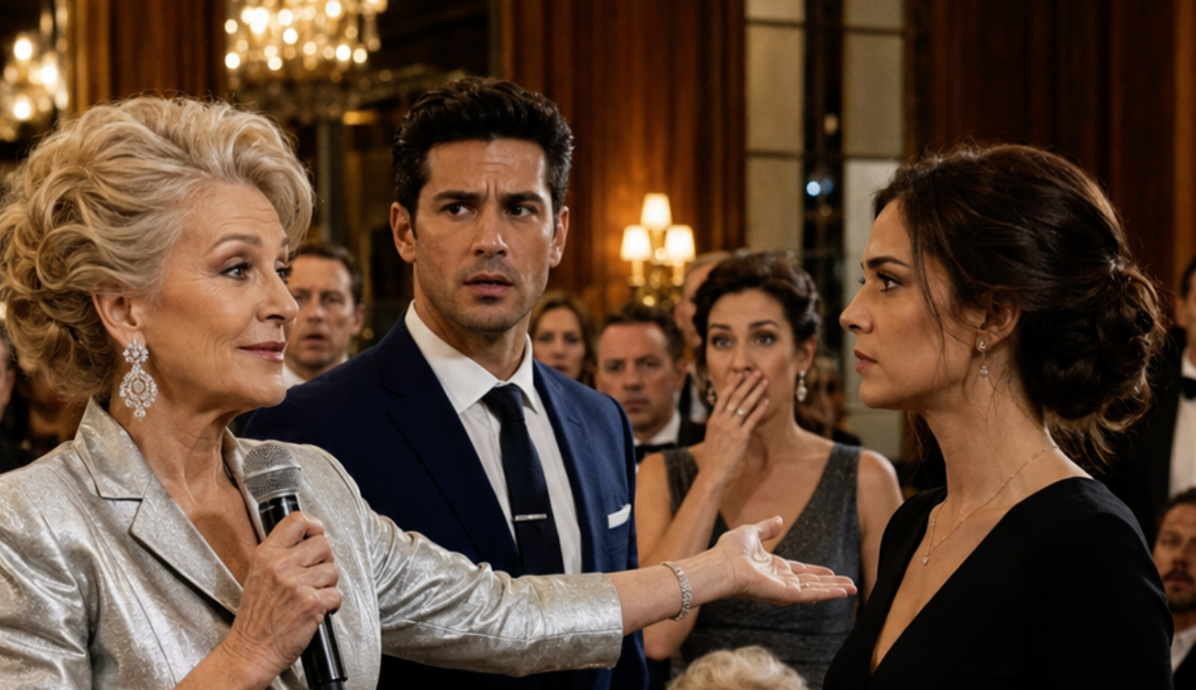
The climax of the evening came when champagne was served and Margarita Valentinovna took the microphone.
She had already been drinking, and her cheeks were flushed.
“Dear friends, thank you for sharing this evening with me. I want to raise a toast to family. To my son Igor and his… wife.”
She paused and swept the room with a haughty gaze.
“And you, Alina dear, don’t think you’ve managed to worm your way in. You were born under a fence on a collective farm. You have nothing to share with my son. Remember that.”
Silence.
Someone’s fork clattered onto a plate.
I stood there gripping the edge of the tablecloth.
Igor sat with a stone-faced expression and said nothing.
One guest coughed. Another looked away.
Slowly, I turned and walked out of the banquet hall.
Oksana, an old family friend, caught up with me in the restroom and handed me her phone.
“I recorded that circus. Here. Delete it if you want, or draw your own conclusions. But if I were you, I wouldn’t let this go.”
With shaking hands, I took the phone and forwarded the video to myself.
Then I washed my face with cold water and returned to the hall.
The evening continued as though nothing had happened.
At home, Igor tried to justify his mother.
“Mom had too much to drink. It happens. You know she’s from another generation.”
“Another generation?” My voice trembled with barely restrained fury. “She has known me for five years, and for five years she has wiped her feet on me. And you just sit there silently. Have you ever defended me even once?”
“You’re partly to blame. Why did you have to provoke her? You should have just kept quiet.”
I shut the bedroom door and didn’t open it until morning.
At five o’clock, as the gray light of dawn crept through the windows, I got into my old car, drove to my pastry workshop, and uploaded a fragment of the video to a popular local social media page called Overheard in N-sk.
I wrote a short caption:
“Recognize the owner of the White Fang dental chain? I’m her daughter-in-law. This is how she congratulated me tonight.”
Then I clicked Publish.
By morning, the video had passed fifty thousand views.
My phone exploded with notifications.
Igor called first.
“Have you lost your mind?! Delete it immediately! Mom is furious. She says if you don’t take it down, she’ll sue you for defamation.”
“It isn’t defamation, Igor. It’s the truth. You were there. You heard it.”
“I don’t care! She said she’ll forgive you and forget about it. You know she has connections everywhere!”
“Forget it?” I laughed bitterly as I watched the number of comments growing. “I won’t forget. Five years of humiliation. Did you ever stand up for me?”
He hung up.
An hour later, a comment appeared from a woman using the username Former Employee.
“I worked there for three years. She called us trash too.”
That started a chain reaction.
That evening, my lawyer, Ksenia Valeryevna, was standing outside the pastry workshop.
She was a short woman with a sharp gaze, a folder full of documents, and a voice of steel.
“I watched the recording, Alina. The video was made in a public place, your mother-in-law’s face is clearly visible, and the audio is clean. This isn’t even defamation—it’s documented fact. Her threats to sue are just intimidation. And we have an excellent opportunity here. Public insult, especially in front of witnesses, falls under Article 5.61 of the Administrative Code. The fine isn’t particularly large, but the fact that she is officially held responsible will damage her reputation much more than the fine itself. We’ll also file a counterclaim for protection of honor and dignity under Article 152 of the Civil Code and demand compensation for emotional distress. I estimate the claim at five hundred thousand rubles.”
“I don’t need the money. I want the truth,” I said.
“Truth is good. But money won’t hurt either. Prepare your documents and witnesses.”
I gave her Oksana’s contact information, along with the waiter’s number and that business partner who had sat stone-faced during the banquet.
The lawyer nodded and said she would contact them herself.
Two days later, I received a court summons.
My mother-in-law had filed a two-million-ruble lawsuit against me for damaging her business reputation, claiming that the video had been edited and that I had slandered an honest entrepreneur.
I arrived at court with Ksenia Valeryevna and formally submitted our counterclaim.
Meanwhile, the city news was filling up with headlines:
“Dental Chain Owner Insults Daughter-in-Law.”
“Business Built on Arrogance?”
The White Fang social media page was flooded with angry reviews.
Patients who had been visiting the clinics for years wrote things like:
“I don’t want to give my money to a woman who treats people like this.”
The landlord of the clinic’s downtown location sent a notice terminating the lease early “due to reputational risks.”
The main investor who had been planning to finance the chain’s expansion withdrew his offer.
Margarita Valentinovna panicked.
Her reputation-management specialists began publishing paid articles:
“Scammer Daughter-in-Law Hunted for Money and Provoked Scandal.”
One of my former classmates, whom I hadn’t spoken to in a hundred years, suddenly gave an interview.
“She was always difficult and argumentative.”
But none of it stopped the wave.
Soon afterward, the tax authorities launched an on-site inspection of the clinic.
As I later learned, several former employees whom my mother-in-law had humiliated for years had submitted a collective complaint about under-the-table wages.
I had nothing directly to do with it, but my lawyer smiled when she heard.
“Sometimes the boomerang comes back without anyone having to throw it.”
The court hearing was scheduled for a month later.
Half the courtroom was filled with journalists.
Margarita Valentinovna arrived wearing an expensive designer suit and the same arrogant expression.
The judge, a woman wearing glasses, immediately suggested a settlement.
“Perhaps the parties can reach an agreement without lengthy proceedings?”
My mother-in-law pursed her lips.
“If she deletes the video and publishes a retraction, I will forgive her.”
I answered calmly:
“I’ll delete the video when you apologize publicly for what you said about me being born under a fence.”
The settlement collapsed.
Witness questioning began.
Oksana testified first.
She repeated, word for word, the sentence everyone had heard.
Then the waiter was called.
He was a young man and clearly nervous, but he spoke firmly.
“I was serving the hot dishes, and I heard the woman in the center of the hall say that thing about being born under a fence. She said it loudly.”
My mother-in-law’s business partner, a distinguished man with gray at his temples, turned red and muttered:
“I’m uncomfortable saying this, but yes. Margarita Valentinovna lost her restraint.”
My mother-in-law exploded.
“She is nobody! I pay taxes! I created jobs! This provincial nobody wants to destroy me!”
The judge tapped her pencil firmly.
“Calm down. You are being warned.”
Then Igor was called.
He shifted nervously, looking first at his mother and then at me.
He mumbled something about his mother “making a joke,” but under cross-examination by my lawyer, he finally admitted that yes, those words had been spoken.
When he returned to his seat, I noticed his hands were shaking.
The decision was announced that same day.
Margarita Valentinovna’s lawsuit for protection of her business reputation was dismissed because the fact of the insult had been confirmed.
Our counterclaim for protection of honor and dignity was partially granted.
She was ordered to pay two hundred thousand rubles in compensation for emotional distress.
In addition, the court issued a separate ruling and forwarded the materials to the magistrate’s court for consideration of an administrative offense involving insult.
My mother-in-law caught up with me on the courthouse steps.
Her former arrogance was gone.
Only angry, hunted eyes remained.
“You think you broke me? My business doesn’t depend on this.”
“It already does,” I replied quietly. “Tomorrow, the court’s decision will be all over the media.”
That same evening, she received a call from the bank.
Her refinancing application had been rejected because of reputational risks.
According to Oksana, Margarita Valentinovna clutched her chest when she heard.
But that was only the beginning.
The following week became a disaster for White Fang.
The second branch, located in a residential district, lost its lease.
After learning about the scandal, the building owner proposed terminating the agreement early so that customers of neighboring businesses wouldn’t be driven away.
Employees began quitting entire shifts at a time.
Those who stayed demanded official employment contracts and higher salaries.
The investor pulled out of the deal permanently.
Margarita Valentinovna tried to sell the clinic chain as an operating business, but potential buyers researched the scandal and offered only a third of its market value.
A month later, I received a short message from Igor.
“Come over. Mom wants to talk.”
I went to the main clinic.
Workers on a lift were already removing the White Fang sign.
The lobby smelled of medicine and emptiness.
Margarita Valentinovna was sitting in the receptionist’s chair, staring at the bare wall where her diplomas had once hung.
When she saw me, she didn’t stand.
“Happy now?” Her voice was hoarse and tired. “The leases are gone, the loans are still hanging over me, the staff scattered. Yesterday the tax authorities sent me an additional assessment for eight million rubles. Under-the-table salaries… I thought everyone did it. Turns out people forgive things like that while you’re on top. But once you fall, they tear you apart.”
I said nothing.
Suddenly, she sobbed.
“All because of one stupid girl…”
“No. Because of your cruelty. I simply turned on the light in a room where you had been hiding the dirt.”
She covered her face with her hands.
I turned around and left without saying goodbye.
I felt no pity.
Only a strange, bitter relief.
The divorce was quick.
I filed for it myself, and Igor didn’t object.
The mortgaged apartment stayed with him. I didn’t need anything that wasn’t mine.
My pastry business remained mine because all the paperwork had been completed before our marriage.
On the day I collected my last box, Igor met me in the hallway.
He looked lost.
“Why did you never defend me?” I asked, looking directly into his eyes.
“I thought everything would blow over. I love you.”
“No, Igor. You love things when they’re convenient. Don’t pity me. I was born under a fence—I’ll survive. And you’ll stay under your mother’s wing.”
In the kitchen, an old note written by my mother-in-law before our wedding fell out of a drawer.
“Daughter-in-law, remember—you are a guest here.”
I tore it into tiny pieces and left them on the table.
A year passed.
I opened my second location, a café and pastry shop called White Sugar, in the very same building where White Fang had once displayed its shining sign.
The landlord remembered the scandal and offered me a discounted rent.
He grinned and said:
“Better for the place to smell like vanilla than scandal.”
A lot of people came to the opening.
Orders were booked two weeks in advance.
Oksana became my first wholesale customer, ordering desserts for her fitness club.
Two years later, I was interviewed by a small-business magazine.
I sat in a stylish dress, looked into the camera, and spoke openly.
“They tried to destroy me with words, and I baked a cake and built my business. When they told me I had been born under a fence, I realized something: a fence isn’t a sentence. You can use it to build a house. And paint that house white. Just like my café, White Sugar.”
That same day, while buying supplies at a shopping center, I ran into Margarita Valentinovna.
She was wearing a modest down jacket, no makeup, and a name badge identifying her as an administrator at a budget dental clinic.
When she saw me, she froze.
I approached her first.
“Hello, Margarita Valentinovna.”
She began crying without caring about the people passing by.
“Forgive me, if you can. I lost everything.”
“I forgave you. But I forgot nothing. You taught me the most important lesson: a business built on arrogance is a house of cards. Mine is built on love for what I do. And it survived.”
She sniffed and asked about Igor.
I shrugged.
We no longer spoke.
Then I walked back to my car, where my fiancé was waiting for me.
He was my former flour supplier—a kind, dependable man.
That evening, I published a post on social media:
“Two years ago, I was afraid to go to court. Today, I have thirty employees and two hundred five-star reviews. If someone tells you that you were born under a fence, build your house from that fence. And paint it white. Just like my White Sugar studio.”
A few minutes later, a like appeared beneath the post.
It was from Igor.
I saw it, smiled calmly, and continued scrolling.