“If Being With Me Is So Awful, You Know Where the Door Is,” His Wife Said. A Week Later, He Was Begging to Come Back
Andrei took his gym bag, his laptop charger, and a warm jacket, even though it was June outside. Svetlana watched him pack his things and thought that a normal person in a situation like this would at least slam the door.
But Andrei didn’t.
He calmly put on his sneakers, tied the laces in double knots the way he always did, straightened up, and said:
“Well, see you around.”
And he smiled.
He smiled so lightly, as though someone had just told him he didn’t have to go to work on Monday.
Sveta stood in the hallway, leaning against the wall, listening as his footsteps faded down the staircase. The elevator in their building had been broken for three weeks, and she counted the floors by the sound: fourth, third, second, then the slam of the entrance door.
That was it.
She returned to the kitchen, sat down on a stool, and simply remained there for about three minutes with her hands resting on her knees.
His plate of half-eaten borscht was still on the table.
Svetlana got up, poured the borscht into the sink, and washed the plate so carefully, as though something important depended on how clean she could make it.
The argument had started because of curtains.
Well, not exactly because of curtains, but that was where it began.
Sveta had been saving for new bedroom curtains for three months. She put aside a little money from each paycheck because the old curtains had faded into an ugly yellowish color and made the apartment look as though nobody had lived there for five years.
She found a suitable pair in an online store, waited for them to go on sale, placed the order, and even arranged with her neighbor Marina to help hang them. The curtain rod was high, and Svetlana couldn’t stand properly on a stepladder after her knee surgery.
When the curtains arrived, Andrei looked at the box, then at Svetlana.
“How much were those?”
“Only four thousand eight hundred,” she said.
“Four thousand eight hundred,” he repeated in the tone people usually used when announcing a prison sentence. “For pieces of cloth to hang over a window!”
Svetlana could have kept quiet.
She had kept quiet in similar situations at least twenty times over the past year, when he used that exact same voice to comment on her expensive face cream, her boots, her visit to the dentist, or her desire to buy a proper blender instead of the one that only worked half the time and smelled like burning plastic.
She could have stayed silent again.
But this time she didn’t.
“Andrei, last week you spent more money in one evening on your computer game than I managed to save in three months…”
“That’s different,” he replied instantly, without even thinking.
“How is it different?”
“Because it’s my money. My business.”
And that was the moment Svetlana felt something inside her break.
Some kind of mechanism that had faithfully switched her from anger to patience for twelve years suddenly jammed.
It stopped working.
And instead of her usual, Fine, forget it, she heard her own voice—calm and strangely unfamiliar.
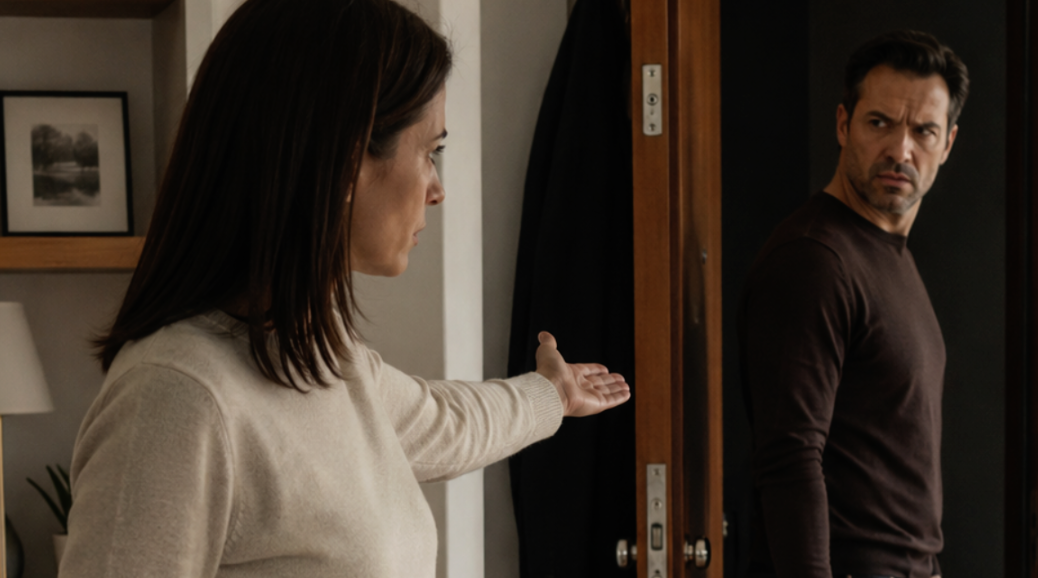
“If being with me is so awful, you know where the door is.”
At first, Andrei didn’t even understand what had happened.
He was accustomed to a different scenario.
Svetlana would get offended, remain silent for half a day, then they would drink tea together and somehow everything would blow over by itself.
Sometimes she cried. When that happened, he would feel slightly guilty, but he quickly distracted himself with his phone, and by morning they would both pretend nothing had happened.
But this time she wasn’t crying.
She looked at him calmly, and her calmness frightened him more than any shouting could have.
“Are you serious right now?” he asked.
“Completely.”
He waited about ten seconds, apparently expecting her to add something else.
But Svetlana remained silent.
The silence was so heavy he could almost physically feel it resting on his shoulders.
“Fine, then,” he said.
And suddenly he went to pack his bag.
For the first two days after Andrei left, Sveta existed in a strange state.
She couldn’t understand whether she felt good or bad, and the fact that she couldn’t tell seemed almost like a diagnosis.
Twelve years with a person—and when he left, you couldn’t even figure out what you felt.
It was like someone asking you what color the air was.
On the third day, she hung the curtains.
Marina came over with a stepladder, and they spent an hour and a half struggling with them.
When they finally finished, Svetlana stepped back toward the bedroom door and looked at the window.
The curtains were beautiful.
Dark blue, heavy, with a subtle pattern.
The entire room looked different, as though someone had finally moved into it.
“They’re gorgeous!” Marina said. “Why didn’t you replace the old ones sooner?”
Svetlana didn’t answer.
The real answer was too long and too humiliating to explain.
On the fourth day, her mother-in-law called.
Her voice was sugary sweet, with that special note of concern that meant there was no real concern at all—only preparation for an attack.
“Svetochka, what is going on with you two? Andrei says you threw him out…”
“I didn’t throw him out, Galina Petrovna. I gave him a choice, and he made it.”
“What kind of choice is that, Sveta? You’re adults! Men are like children sometimes. You can’t take everything they say literally.”
“Galina Petrovna, he’s forty-three years old. What child?”
Her mother-in-law went silent.
Svetlana could almost physically sense the woman rearranging her tactical positions on the other end of the phone.
“I’m simply trying to say that marriage takes work. Sometimes things are difficult, but you have to endure them and keep moving forward.”
“I spent twelve years enduring things and meeting him halfway. I’m tired of it. And for twelve years, every evening, he walked straight to the couch with his phone. And on top of that, I have to listen to complaints about curtains!”
Her mother-in-law continued saying something about wisdom and a woman’s patience, but Svetlana had already hung up and gone to heat up dinner.
Cooking for one person still felt unusual.
Every time, she automatically reached for a second plate before remembering there was no need.
On the fifth day, Andrei sent her a text.
It was short and businesslike:
“I forgot my electric razor charger in the bathroom. Can I stop by?”
Svetlana replied:
“Pick it up whenever you want. I’ll leave the key with the neighbor.”
She deliberately wrote nothing more, even though her fingers almost automatically wanted to type something long and explanatory.
He came while she was away.
He took the charger and left five hundred rubles on the kitchen table.
Svetlana found the banknote and stood staring at it for a long time, trying to understand what the gesture meant.
Was it payment?
A handout?
A tip?
Or simply some cash from his pocket that he had absentmindedly put down?
Eventually she placed it in a drawer and forgot about it.
A week after Andrei left, Svetlana felt like watching a movie in the evening for the first time in ages.
She chose some French film she had downloaded six months earlier but never watched because Andrei hated subtitles and always switched the television to his war series instead.
The film turned out to be mediocre.
Still, she watched it all the way to the end and went to bed in a good mood.
For the first time in several months, she fell asleep quickly and didn’t wake up during the night.
The next day, someone rang the doorbell.
Svetlana looked through the peephole.
Andrei was standing outside with a suitcase.
Not the gym bag he had taken when he left.
A large black rolling suitcase.
She opened the door and immediately understood from his expression that he had rehearsed this meeting.
He had the look of someone who had prepared his lines in advance and was desperately trying to remember the correct order.
“Sveta,” he began. “I acted rashly. I was wrong. You mean so much to me, and I want us to try again.”
He delivered the sentence so smoothly that Svetlana understood immediately.
Those weren’t his words.
Andrei had never said, “You mean so much to me,” in his entire life.
During twelve years of marriage, the best he could usually manage was to mumble, “Fine, sorry,” into his pillow before going to sleep.
And even that happened maybe once every year and a half.
“Who taught you that?” she asked.
“What do you mean?”
“Who wrote that speech for you, Andrei? Your mother? Or did you find it online?”
He blinked and stepped backward slightly, as though she had physically pushed him.
The suitcase rocked on its wheels.
“Nobody wrote it. I came up with it myself.”
“You couldn’t say ‘thank you for dinner’ for twelve years, and now suddenly it’s ‘you mean so much to me.’ Who coached you?”
He opened his mouth to answer.
But at that exact moment, a woman’s voice came from downstairs in the stairwell.
And that voice changed everything.
“Andrei! Are you going to be much longer? I already sent the taxi away!”
Svetlana looked at Andrei.
Andrei looked at Svetlana.
Between them appeared that special kind of silence that happens when one person is lying and the other understands the truth before the lie has even finished.
“Who is that?” Svetlana asked.
“That’s… that’s Zhanna. A colleague. She just gave me a ride.”
“She sent the taxi away, Andrei.”
“Well, she’ll come in for a minute. Sit down, wait. Then we’ll leave.”
Svetlana leaned against the doorframe and folded her arms across her chest.
Suddenly everything became perfectly clear.
It was the feeling you get when a puzzle you had been assembling blindly suddenly falls into place with one movement.
“Wait,” she said. “Let me guess. You came back to me because your colleague Zhanna threw you out. Correct?”
“No! I came back because I realized how miserable I am without you!”
“Then where did the large suitcase come from? You left here with a gym bag. A week ago.”
Andrei shifted from one foot to the other and looked somewhere past her into the dark hallway.
“I moved some things.”
“From where to where?”
He remained silent.
Zhanna’s voice came from downstairs again, closer now, only one flight below.
“Andrei, am I coming upstairs or are you coming down?”
Svetlana stepped out onto the landing and called:
“Come upstairs!”
Andrei grabbed her by the elbow.
“Sveta, don’t. Why do this? Please!”
She shook off his hand.
A woman of around thirty-five appeared on the landing.
She was short, with cropped hair and a tired-looking face.
She dragged another bag behind her, a cheap travel bag of the kind sold at markets for seven hundred rubles.
When she saw Svetlana, Zhanna stopped and looked at Andrei with an expression that could hardly be described as loving.
“Is that your wife?” she asked.
“Wife,” Svetlana answered. “Ex-wife. Or current wife. I’m starting to lose track of his logistics myself.”
“Wait.” Zhanna turned toward Andrei. “You told me she asked you to come back. You said she called you herself.”
Andrei stood between the two women on the fourth-floor landing looking like a man who had somehow stepped on two rakes at the same time.
“I… I can explain everything,” he muttered.
“Explain,” Svetlana said. “I’m interested.”
“So am I,” Zhanna added, her voice suddenly dry and stern.
Andrei rubbed his forehead with his palm and started talking.
From his confused explanation, a picture gradually emerged that was both predictable and pathetic.
He had left Svetlana to go live with Zhanna, with whom, as it turned out, he had already been seeing “as a friend” for four months.
Zhanna lived in a rented apartment and worked as a manager at a car dealership.
For the first three days, everything was wonderful—apart from the fact that the apartment had only one room, the washing machine was broken, and Zhanna’s enormous ginger cat named Bismarck immediately hated Andrei and started relieving himself inside Andrei’s sneakers.
On the fourth day, Zhanna asked Andrei to go shopping and buy groceries for the week.
Andrei came back with frozen dumplings, beer, and chips.
Zhanna looked into the bag and said she wasn’t going to live like that and that an adult man could at least have thought to buy some vegetables.
Andrei replied that her expectations were too high.
Zhanna replied that her expectations were perfectly normal; unfortunately, the man she had ended up with seemed defective.
Then Andrei failed to wash the frying pan after using it, and Zhanna stopped speaking to him.
After that, he started playing games on his phone.
Zhanna told him that if he wanted to lose money, he could do it somewhere else, because she paid the rent herself and didn’t need a second child in the apartment.
She already had one.
And it weighed eight kilograms.
On the seventh day, Zhanna packed Andrei’s belongings into that same seven-hundred-ruble travel bag, put it beside the door, and said:
“Andrei, you’re a good person, but living with you is impossible.”
So Andrei took out his suitcase, packed everything that didn’t fit into the bag, and headed back to Svetlana.
On the way, he called Zhanna and told her that his wife had asked him to return.
Whether Zhanna believed him or not, she had gotten into a taxi and followed him anyway, apparently wanting to see for herself.
Svetlana listened to the entire story while standing on the landing and occasionally exchanging glances with Zhanna.
By the time Andrei finished, both women were silent.
Andrei apparently interpreted their silence as understanding, because he seemed to regain a little confidence.
“Well, there you have it,” he said. “You see? I got confused. It happens. The important thing is that I’m here now.”
“Here where?” Svetlana asked.
“Well… home.”
“This is my home, Andrei. The apartment belongs to me, in case you’ve forgotten.”
He remembered.
His face showed that he remembered very clearly.
That detail, which had seemed insignificant to him for twelve years, suddenly gained weight and shape.
Zhanna picked up her travel bag and turned toward the staircase.
“There’s nothing more for me to do here,” she told Andrei.
“Zhanna, wait…”
“Goodbye, Andrei. And don’t call me again.”
Zhanna delivered the sentence and walked downstairs without turning around.
Sveta and Andrei were left alone.
He stood beside the open suitcase, with the corner of a towel and the sleeve of a shirt sticking out of it, looking at her with that apologetic expression of his.
“Sveta,” he said quietly.
“No.”
“I’ll fix everything.”
“You can’t fix something you don’t even understand!”
He tried to smile.
That same light smile he had worn when he left a week earlier.
But this time it didn’t work.
Instead, his face twisted into something pathetic, resembling the grimace of someone with a toothache who was embarrassed to admit he was in pain.
“I have nowhere to go,” he said.
“That’s not my problem.”
“I only have enough money for three nights at a hotel.”
“Call your mother. She just explained to me on the phone that men are like children and need someone to take care of them. So let her take care of you.”
Andrei stood up, zipped the suitcase shut, and remained motionless on the landing for a while, as though waiting for the apartment building itself to tell him where he should go.
“The curtains are nice,” he suddenly said. “When I came back for my things, I saw them. I liked them. The blue ones.”
Svetlana looked at him for a long moment.
“Four thousand eight hundred,” she said. “For pieces of cloth to hang over a window.”
And she closed the door.
She returned to the kitchen, sat on the same stool, and remained there for about five minutes, listening to the silence.
A television was playing in the neighboring apartment.
Someone on the floor above dropped something heavy.
And the ordinary evening noises of the prefabricated apartment building suddenly sounded more comforting than anything else in the world.
Her phone rang twenty minutes later.
Her mother-in-law.
“Sveta, he just called me! He’s completely lost. How can you do this to him? He has nobody except you!”
“Galina Petrovna, he has you, Zhanna, his games, and his frozen dumplings. He’s in safe hands.”
Her mother-in-law began saying something about a wife’s duty, but Svetlana ended the call and put the phone on the table.
Then she thought for a moment, picked it up again, and blocked her mother-in-law’s number.
Her fingers trembled slightly.
She noticed the trembling with a strange sense of detachment, as though the hands belonged to someone else.
She took the remains of yesterday’s casserole out of the refrigerator, heated it, and sat down to eat.
One plate.
No second plate.
Outside, darkness was falling, and the new curtains swayed gently in the draft.
Blue.
Heavy.
Beautiful.
Four thousand eight hundred for pieces of cloth to hang over a window.
The casserole tasted good.
Svetlana finished eating, washed her plate, and for the first time in twelve years, instead of placing it in the drying rack, she left it sitting wet on the table.
Because suddenly she realized she didn’t care where a plate stood in her own home.
At nine that evening, Andrei sent her a text.
“You’ll regret this.”
Svetlana read it, snorted, and deleted it.
Then she turned on the same French film she had watched two days earlier, skipped ahead to her favorite scene, and watched until the end credits while lying on the couch in socks with the remote resting on her stomach.
Nobody changed the channel.
Nobody said subtitles were for idiots.
Nobody asked what she was cooking for dinner tomorrow.
Nobody commented on how much her face cream cost.
Her phone rang again at eleven.
An unfamiliar number.
Svetlana hesitated, then answered.
“This is Zhanna,” said the voice. “Sorry for calling so late. I took your number from Andrei’s phone, just in case.”
“I’m listening.”
“I just wanted to tell you something. He told me the same thing—that I didn’t appreciate him. Exactly the same words. He said he was unhappy with me. That he deserved better. For four months, I kept thinking there must be something wrong with me if the man beside me was unhappy.”
“And then?”
“Then I saw him lying on the couch with his phone evening after evening, getting angry because I asked him to take out the trash. And suddenly everything fell into place.”
Svetlana was silent for a moment.
“Thank you for calling.”
She ended the call, switched off the light, and went to bed.
The apartment was quiet.
In the bedroom, the light from the streetlamp fell beautifully through the new curtains.
And for the first time in many years, the mattress beneath her seemed wide enough.