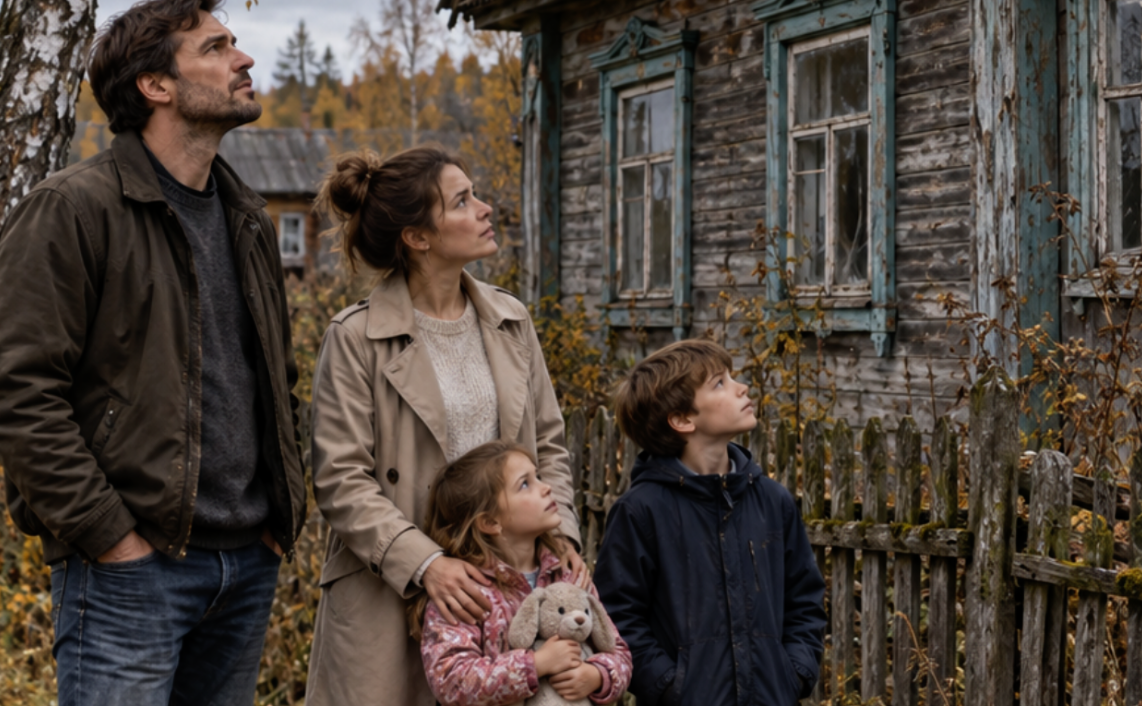
A young couple with two children bought an old house in a village without modern conveniences — and this is what they managed to do with it.
Dmitry found the advertisement completely by accident.
One evening after work, he was scrolling through his phone without much interest when a short listing caught his eye:
“Village house for sale. Cheap. Price negotiable.”
There were only three photos. One showed a crooked fence, another a faded gray facade, and the third an overgrown yard filled with tall grass.
And beside the porch stood an enormous old birch tree.
“Lena, come look at this,” Dmitry called to his wife.
Lena left her laptop and studied the photos.
“Dima, that place is practically falling apart. You can’t be serious.”
“The price is almost nothing,” he replied. “It’s not a ruin. It’s an opportunity.”
At the time, Dmitry and Lena lived with their two children in a rented two-room apartment on the outskirts of a large city. Dmitry worked as a design engineer for a construction company, while Lena worked remotely as an accountant.
Their son Sasha was seven, and their daughter Anya was four.
They earned reasonably well, but their money disappeared almost immediately. Rent, food, clothing, medicine, school activities, and everyday expenses consumed nearly everything.
Buying their own apartment seemed impossible. A mortgage meant years of enormous payments, and they had very little savings.
So Dmitry could not stop thinking about the village house.
“Yes, it’s old,” he told Lena. “Yes, it’s far from the city. And yes, it has almost no conveniences. But it would be ours.”
Eventually, he convinced her to at least see it.
The village was about forty kilometers from the city. It was quiet and remote, though not completely isolated. A bus came only three times a day. There was one small shop and one local school.
Cows, goats, chickens, and geese were everywhere. The air smelled of hay, grass, and the nearby river.
The house stood at the very end of the village street. Beyond it stretched an open field and a forest.
It had once belonged to an elderly woman named Matryona, who had died about ten years earlier. Her distant relatives inherited the property but had no interest in maintaining it, so they were willing to sell it for very little.
When Lena entered the house, her heart sank.
The porch steps were rotten. The windows were cracked and cloudy. Cobwebs covered the corners, plaster was falling from the walls, and the entire house smelled of dampness.
The old brick stove had a serious crack.
Water had to be carried from a well in the yard.
The toilet was outside.
There was no gas line.
And the ancient electrical wiring looked dangerously outdated.
Lena stood in the middle of the room and stared at her husband.
“Dima, how are we supposed to live here?”
Dmitry, however, was examining the roof, walls, and foundation.
“The roof is still good. The foundation hasn’t shifted. The logs are mostly strong. Those are the expensive things. Everything else can be repaired.”
“You call this a repair?”
“I call it work,” he said with a smile. “I design houses for strangers every day. Surely I can fix one for my own family.”
While they argued, Sasha was already running excitedly through the yard, and Anya was crouching in the grass, fascinated by a ladybug.
To the children, the old house was not frightening.
It was an adventure.
Lena looked at them, then at Dmitry.
“All right. Let’s try. But if after one year I say I can’t do this anymore, we leave.”
“Agreed.”
That decision changed their lives.
They sold everything they did not truly need: an old motorcycle, unused furniture, electronics, and other belongings. Their parents also helped them financially.
Lena’s father strongly disapproved.
“You’ll suffer there for a year and come running back,” he warned.
But they ignored him.
They bought the house and spent nearly everything else on building materials.
Renovation began in May.
First, Dmitry emptied the entire house. They removed old furniture, broken glass, damaged fabric, and years of accumulated rubbish.
Then he stripped away the wallpaper and discovered solid log walls underneath.
They were dark and uneven, but most were still strong.
He sealed the gaps and replaced several rotten logs.
Next came the windows. The old wooden frames were removed and replaced with inexpensive modern ones.
Meanwhile, Lena cleaned constantly.
She washed walls, floors, ceilings, windowsills—everything.
At night, her back hurt, her shoulders ached, and the skin on her hands cracked from cleaning products.
Still, every day the house looked a little brighter.
The neighbors often stopped near the fence to watch.
“They’re city people,” some whispered. “They won’t last.”
Dmitry and Lena heard them but kept working.
The most difficult job was the stove.
A local craftsman named Yegor examined it and shook his head.
“There’s no point repairing this. It needs to be rebuilt.”
He offered to do the work himself.
The new stove had a cooking surface, an oven, and even a large heated sleeping area.
When they lit it for the first time at the end of August, warmth slowly spread through the rooms.
Lena stood beside it, warming her hands.
Then she suddenly began to cry.
Not from exhaustion.
From relief.
For the first time, the house truly felt warm.
It felt like home.
In autumn, Dmitry installed a pump in the well and brought water into the kitchen.
It was only one sink, but to them it felt like luxury.
Before winter, they built a small insulated bathroom extension with a shower and a portable toilet. Warm air from the stove was directed into it through a simple ventilation system designed by Yegor.
Then winter came.
It was brutal.
The snow sometimes reached their waists. Dmitry cleared paths every day, watched the stove constantly, and checked the chimney.
The children caught colds.
Money became tight.
Some nights, Lena quietly cried while Dmitry slept.
But they stayed.
Spring finally arrived.
They survived.
And once the snow disappeared, they began improving the yard.
Dmitry dismantled the collapsing shed and reused good timber to build a strong new fence.
He made the gate himself.
Lena created garden beds, planted raspberries, put up a small greenhouse, and filled the yard with flowers.
One day, their neighbor Aunt Nina stopped at the gate.
“I was sure you wouldn’t last,” she admitted.
Lena smiled.
“We will.”
By summer, the transformation was remarkable.
The wooden walls had been cleaned and treated. White decorative trim appeared around the windows. Dmitry rebuilt the porch and carved its posts himself.
Inside, Lena created a real family home.
There was a sofa, a bookshelf, children’s drawings on the walls, simple curtains, and a large wooden kitchen table.
Dmitry built a bunk bed for Sasha and Anya.
They installed proper internet so both adults could continue working.
By the second winter, they no longer felt like temporary residents.
They felt like owners.
A year and a half after the purchase, Lena’s parents came to visit.
Her father walked around the yard in silence.
He examined the fence.
The stove.
The electrical outlets.
Then he sat on the porch.
“Well, Dima,” he finally said. “I didn’t expect this.”
Dmitry smiled.
“I told you.”
Her father shook his head.
“Talking is easy. Doing it is difficult. And you actually did it.”
Then he shook Dmitry’s hand.
That evening, the entire family gathered around the kitchen table.
Lena baked a cabbage pie. The children played outside. Old Yegor came by with a bottle of homemade berry liqueur.
He raised his glass.
“To the real owners of this house. May your family live happily here for a hundred years.”
Everyone drank to that.
And Lena nearly cried again.
This time only from happiness.
Today, Dmitry is thirty-two and Lena is thirty.
Sasha attends school, while Anya has become passionate about drawing.
They also have chickens, a goat named Maika, and even a couple of piglets.
But the animals, garden, and renovations are not the most important part.
The real reward is the feeling Dmitry experiences every morning when he steps onto the porch with a cup of coffee.
The sun rises over the forest.
A rooster crows somewhere nearby.
Lena waters the flowers.
The children play outside.
And Dmitry looks at the house and thinks:
This is exactly what I hoped for.
Not simply an old village house.
A real Home.
One they restored with their own hands.
Of course, problems still appear. Sometimes the roof leaks. Sometimes the water pump stops working. Sometimes Maika escapes and the whole family has to search for her.
But these problems no longer frighten them.
This is their life.
Their home.
Their place in the world.
The villagers no longer call them outsiders either.
If someone has an electrical problem, they ask Dmitry for help.
Neighbors ask Lena about gardening and preserving food.
Sasha plays football with the local children.
Anya comes home from the village shop carrying sweets given to her by elderly neighbors.
The old birch tree beside the porch still stands exactly where it always has.
In spring, it turns green.
In summer, its huge crown gives shade.
In autumn, golden leaves cover the porch steps.
And in winter, its dark branches stretch across the pale sky.
Sometimes Dmitry places his hand against its rough trunk and wonders how many people, winters, joys, and losses that tree has witnessed.
Now it is witnessing their story.
One day, when Sasha and Anya are grown, they probably will not remember much about their cramped rented apartment in the city.
They will remember something else.
The warm kitchen.
The smell of woodsmoke.
Freshly cut grass.
The creaking gate.
The enormous birch tree.
And above all, the feeling of being home.
For that feeling, taking the risk had been worth it.
And every hardship they endured had been worth it too.