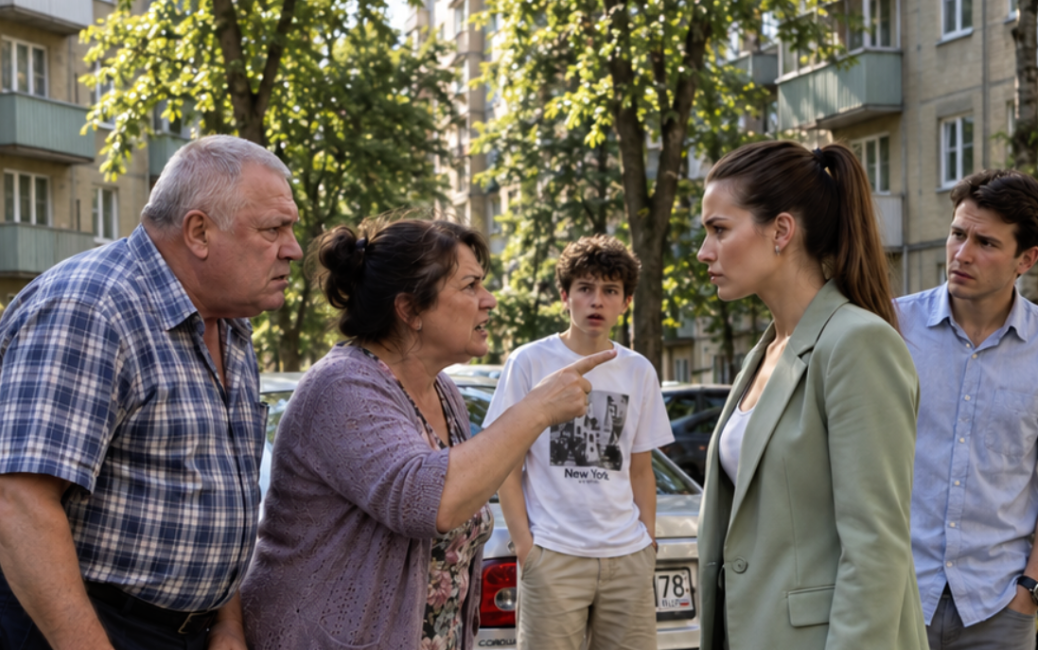
“Give your car keys to your brother!” my father-in-law demanded. I simply smiled, took out my phone, and called the police right in front of him.
The whole conflict had started a week earlier.
Pasha, my husband Maxim’s younger brother, was twenty-three and had always behaved as though the world owed him something. He could be charming when he wanted to be, but responsibility had never been his strength. Over the previous six months, he had changed jobs three times and had not stayed anywhere for longer than a couple of months.
Then he wrecked his old car.
The damage was serious: a crushed fender, a broken headlight, and problems with the suspension. Pasha had no money for repairs, so suddenly his transportation problem became a family emergency.
I first heard about it during dinner.
“Poor Pasha,” Maxim said casually. “Now he has to walk everywhere.”
“He’s twenty-three,” I replied. “Walking won’t kill him.”
Maxim gave me a strange look but said nothing.
The following day, his mother called.
“Alyonochka,” Nina Petrovna began sweetly, “you’re a reasonable woman. Pasha has job interviews, and he really needs transportation. Your car sits in the courtyard sometimes…”
“I drive it to work every day.”
“Well, surely you can take the bus occasionally. We’re family.”
I knew where the conversation was going.
“No, Nina Petrovna. The car is mine. I bought it before the marriage, it’s insured for me, and I’m not lending it to Pasha.”
Her tone immediately changed.
“But he’s family!”
“He also just wrecked his own car.”
She hung up without saying goodbye.
I thought that would be the end of it.
I was wrong.
Three days later, I returned home from work on a hot August evening. I parked in the courtyard, reached into the back seat for my bag, and saw my father-in-law, Ivan Petrovich, standing by the gate.
Pasha was beside him.
The expression on his face told me everything. They had not come to ask.
They had come to take.
“Alyona,” Ivan Petrovich said as he walked toward me. “We need to talk.”
He was a broad, heavy man who had spent his life giving orders and expecting people to obey.
He stopped between me and the driver’s door.
“Pasha needs the car tomorrow. He has an interview. You can stay home or take the bus. Give me the keys.”
He held out his hand.
Behind him, Pasha smirked.
For several seconds, I simply looked at that hand.
Then something inside me became completely calm.
I pressed the button on the key fob.
The car locked with a beep.
I stepped backward and took out my phone.
Ivan Petrovich frowned.
“What are you doing?”
I dialed.
“Hello,” I said evenly. “Two men have blocked access to my vehicle and are demanding that I give them the keys. I know them, but I have not given them permission to use my car. Please send a patrol.”
The moment I said the word “police,” Pasha’s smirk vanished.
Suddenly, the young man who supposedly could not survive without a car discovered that he was perfectly capable of walking very quickly.
He backed away, turned, and disappeared through the gate.
Ivan Petrovich’s face turned red.
“Have you lost your mind? You’re calling the police on family? The whole neighborhood will hear about this!”
“The car is registered in my name,” I replied. “It belongs to me. You demanded the keys after I had already said no. You can leave now or explain the situation to the police.”
He stared at me in disbelief.
Then slowly lowered his hand.
“Some daughter-in-law you are,” he hissed. “Maxim will hear about this.”
“I’ll call him myself.”
Ivan Petrovich walked away.
Once he was gone, I called the police back and told them the situation had been resolved.
Then I called Maxim.
He answered from work.
“Your father and Pasha came to the courtyard,” I told him. “They demanded my car keys. I called the police. They left.”
There was a long silence.
“You called the police?”
“Yes.”
Another silence.
“I’m coming home.”
When Maxim arrived, I expected excuses.
Normally, whenever his family crossed a line, he explained it away. His father was “just like that.” His mother “meant well.” Pasha was “still young.”
But this time Maxim sat across from me on the balcony and said very little.
“Dad called me,” he finally said. “He claims you made a scandal over nothing.”
“And what do you think?”
Maxim rubbed his face.
“I think he shouldn’t have blocked your car.”
That was more than I expected.
Then he surprised me further.
“I’ve always known what they’re like,” he said quietly. “I just grew up being taught not to argue. Dad said something, and that was the end of it. You obeyed.”
“That explains it,” I said. “It doesn’t excuse it.”
“I know.”
The next morning, Nina Petrovna called.
“Alyona Sergeyevna,” she began formally, “you humiliated Ivan yesterday. He has blood-pressure problems. Was calling the police really necessary?”
“Your husband blocked my car and demanded my keys.”
“We’re family!”
“I already gave you my answer before. The answer was no.”
Her tactic immediately changed.
“You just don’t like Pasha. He’s practically still a child.”
“He’s twenty-three.”
“He’s young!”
“At twenty-three, I was working and had already bought my own car.”
There was a cold pause.
“So a piece of metal matters more to you than family?”
“A piece of metal I earned myself matters more than someone else’s entitlement.”
“You’ll regret this,” she said before hanging up.
When I told Maxim about the threat, he sighed.
“She always does that when she doesn’t get what she wants.”
Then he looked at me.
“For what it’s worth, I’m completely on your side.”
“Have you told your parents that?”
He hesitated.
“No.”
“You should. Not for me. For yourself.”
Four days later, my friend Katya called.
“Do you know your mother-in-law is telling the neighbors that you attacked her husband and threw him out of the courtyard?”
I almost laughed.
So Ivan Petrovich had demanded my property, and somehow he had become the victim.
I said nothing publicly.
I did not argue.
I simply waited.
That Saturday, Nina Petrovna appeared at our apartment without calling.
She marched into the living room and sat down.
“Maxim, leave us,” she ordered. “I need to speak to your wife alone.”
Maxim hesitated but stepped into the hallway.
Nina Petrovna stared at me.
“You’ve driven a wedge between me and my son.”
“Maxim is an adult. He makes his own decisions.”
“He never behaved this way before you!”
“That may be exactly the problem.”
Her eyes narrowed.
Then she changed tactics again.
“Fine. Let’s make a compromise. Give Pasha the car for two weeks. He’ll find work, get back on his feet, and that will be the end of it.”
“No.”
“Why?”
“Because I already answered you.”
She jumped to her feet.
“You know I can make your life very unpleasant.”
“I’ve heard what you’re telling the neighbors,” I said. “The courtyard has security cameras, so proving what actually happened would be easy. But more importantly, I’m not afraid of you.”
For the first time, she looked uncertain.
“Please leave.”
She stormed into the hallway.
“Maxim!” she snapped. “Did you hear how your wife spoke to me?”
“Yes,” he replied.
“And?”
There was a pause.
Then Maxim finally said the words I had been waiting to hear.
“Mom, you came here without calling. Dad demanded someone else’s car. Pasha is twenty-three and needs to solve his own problems. I don’t know what you expect me to defend.”
Nina Petrovna froze.
She left without saying goodbye.
That evening, Maxim and I sat on the balcony.
“How do you stay so calm?” he asked.
I thought for a moment.
“I know what belongs to me,” I said. “And I don’t believe I owe anyone the same explanation twice.”
The next day, Maxim called his father.
Three months later, Pasha finally found a job—as a bicycle courier.
Ivan Petrovich never apologized. Instead, after several weeks of silence, he invited Maxim fishing and behaved as if nothing had happened.
Nina Petrovna called a few more times with suggestions about how we could “help the family.”
Each time, I listened.
Then I said no.
No arguments.
No explanations.
Just no.
Eventually, the calls became less frequent.
One evening, Maxim admitted that for the first time in his life, he no longer felt torn between his wife and his family.
I placed my hand over his.
The car still stood in the courtyard, insured and registered in my name.
Every morning, I got behind the wheel and thought about work, errands, dinner, and ordinary life.
I no longer thought about Nina Petrovna.
And perhaps that was the greatest victory of all.