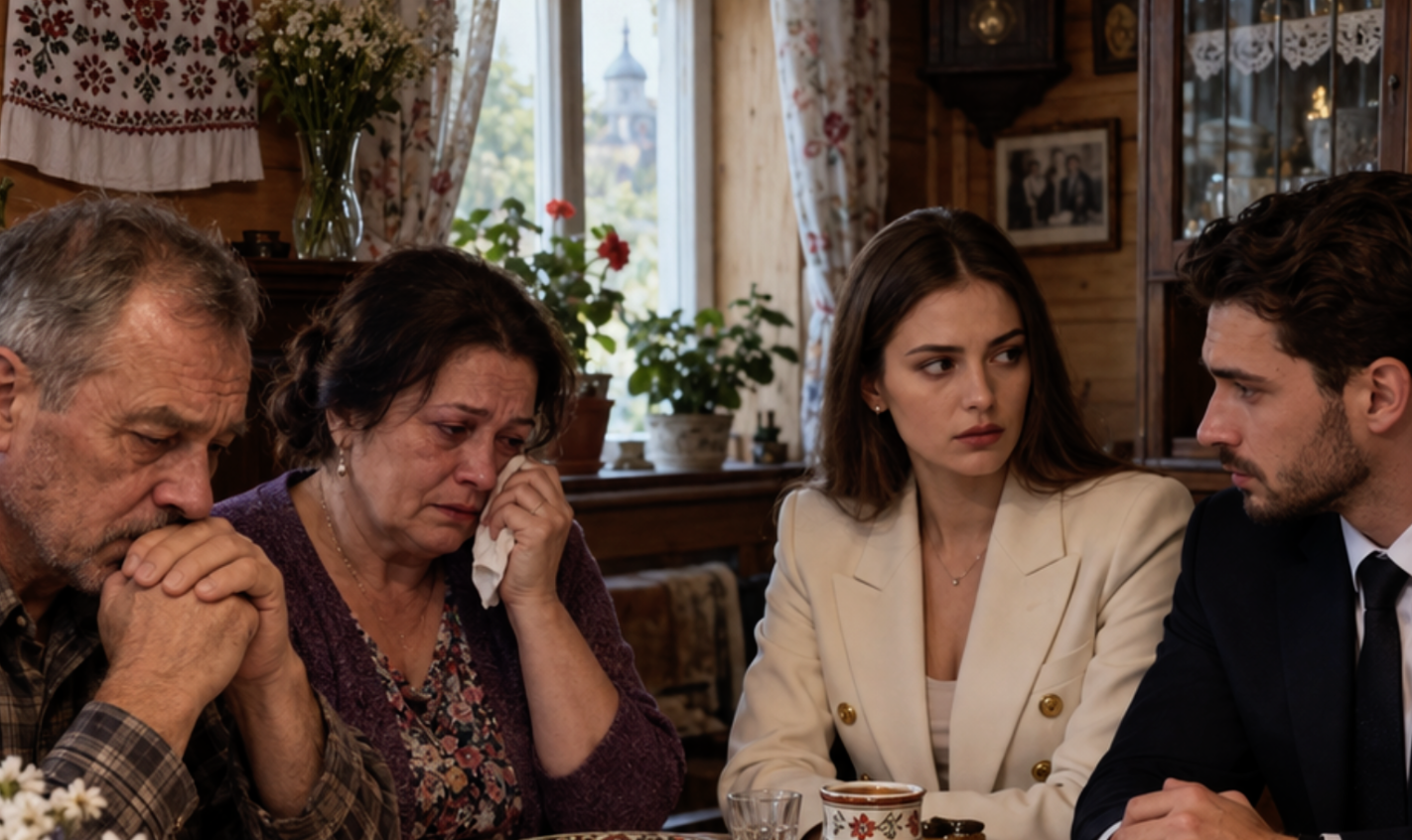
Nikolai Stepanovich Morozov had been standing by the window for nearly half an hour, staring down the empty village road. His daughter was not expected for at least another two hours, yet he kept watching as though her car might appear at any moment.
In the kitchen, his wife, Valentina Petrovna, was just as restless. She checked the oven, moved pots from one place to another, adjusted the curtains, then leaned into the room again.
“Still no one?”
“Not yet,” Nikolai replied. “But tell me, Valya, why did you cook enough food for an army?”
“It’s not an army. It’s our daughter’s fiancé. He’s coming from the capital. We should welcome him properly.”
Nikolai said nothing more. Katya was their only daughter. They had raised her with everything they had, watched her graduate with honors, leave the village, study in the capital, and build a successful life of her own.
Now she was coming home with the man she planned to marry.
His name was Artyom Strelnikov. His father was a professor, his mother a doctor, and Artyom himself worked in information technology. According to Katya, he had his own apartment, a good car, and an impressive career.
Nikolai could not explain why this made him uneasy.
Perhaps because Artyom seemed to belong to a completely different world.
The long black car appeared at last, crawling carefully over the uneven road. Nikolai noticed it first and called for his wife.
Katya stepped out.
For a moment, her father simply stared.
She was still his daughter—the same gray eyes, the same familiar smile—but everything else had changed. Her short fashionable haircut, elegant coat, heeled boots, small handbag, even the faint scent of expensive perfume spoke of the life she had built far from home.
When Nikolai hugged her, one thought passed clearly through his mind: most of her life no longer belonged here.
Then Artyom got out of the car.
He was tall, slim, polished, wearing an expensive coat and carefully cleaned shoes that immediately sank into the wet snow by the gate.
“Very nice to finally meet you,” he said with a perfect smile.
Nikolai shook his hand and noticed how soft it was.
No calluses.
He kept the thought to himself and invited them inside.
At first, everything went well.
Artyom praised the house and called the log walls “authentic.” He complimented the large stove, asked where he could charge his phone, then requested the Wi-Fi password.
When Valentina explained that there was no home Wi-Fi and that mobile internet only worked properly near one window, Artyom smiled.
“I’ll survive. Katya, you never told me there was such a serious disconnect from civilization.”
Katya frowned.
“It’s not a disconnect. It’s a village.”
“Of course,” he said lightly.
Lunch was served around one o’clock.
Valentina had filled the table with homemade dumplings, meat and potatoes, pickled mushrooms, fish pies, aspic, berry compote, and several other dishes.
Artyom looked around in surprise.
“There’s enough food here for a week.”
Valentina smiled nervously and encouraged him to eat.
He placed a napkin on his lap, picked up a knife and fork, and carefully cut a dumpling into small pieces before eating it.
He complimented the food.
“You don’t see real homemade cooking like this often. In the city, most people just order something.”
Valentina asked whether he ever cooked for himself.
“Almost never. Work takes all my time. Startups, investors, meetings. Cooking feels like too much of a waste of time.”
Nikolai said nothing.
He had spent decades working ten- and twelve-hour shifts repairing agricultural machinery and had still found time to chop wood, carry water, and heat the stove.
But he remained silent.
The conversation gradually turned to work.
Artyom spoke confidently about venture investments, scaling products, expanding markets, and business opportunities. Valentina nodded politely, even when she clearly did not understand much of it.
Katya listened with visible admiration.
Nikolai watched.
He had spent his life repairing machines, and one thing experience had taught him was that when a part was fitted badly, sooner or later the problem revealed itself.
People were not so different.
Finally, Nikolai asked:
“Artyom Andreyevich, you seem successful. You have a good career and your life is settled. So what did you see in our Katya?”
Valentina froze.
Katya blushed.
Artyom smiled.
“She’s special. Genuine. People in big cities often become artificial. Everyone chases money, status, social media popularity. Katya is different. She grew up in a simple family, far from all that, so she kept a kind of natural purity.”
Nikolai stopped eating.
Simple family.
Natural purity.
The words sounded like compliments, but something in them felt wrong.
Artyom continued.
“Katya is very capable. She just hasn’t always had the right opportunities or environment. After we marry, I can help her grow. She can improve her language skills, work with a stylist, perhaps get another degree. I have the right connections to help her enter a serious company.”
Valentina slowly put down her spoon.
Katya lowered her eyes.
Nikolai asked quietly:
“What is wrong with Katya as she is now?”
Artyom seemed surprised by the question.
“Nothing is wrong. She’s wonderful. But big-city life requires a certain standard. There are expectations. She cooks beautifully, she’s caring, she’ll make a wonderful homemaker. Growing up here helped her with that. But in other ways, she needs to catch up a little.”
“Catch up to your level?”
“To the level of the people we socialize with.”
Silence fell over the table.
Katya’s eyes filled with tears.
For the first time, perhaps, she heard clearly what those words meant.
“Artyom,” she asked, “do you really think I need to catch up?”
He immediately tried to soften it.
“Katya, don’t take it like that. I just want the best for you. I don’t want you to have to settle for less. Like here.”
He gestured around the room.
That small movement changed everything.
The old walls.
The handmade furniture.
The embroidered curtains.
The stove.
All of it, to him, was “less.”
Valentina began to cry quietly.
Nikolai looked at the young man sitting across from him and realized Artyom understood nothing about the house.
He did not know that Valentina had embroidered those curtains at night while Katya slept nearby.
He did not know Nikolai had made the table himself after work.
He did not know how many winters the stove had kept Katya warm when she was sick.
There was nothing insignificant in this house.
Almost everything had been built, bought, repaired, or preserved through work and love.
Nikolai finally stood.
“Have you ever cut grass with a scythe?”
Artyom blinked.
“No.”
“Lit a stove?”
“No.”
“Dug potatoes?”
“I don’t understand what this has to do with anything.”
“I’ll tell you. You came into a house where nearly every object carries part of someone’s life. This table took me ten evenings to make. My wife strained her eyes embroidering those curtains. This stove warmed our daughter every time she was ill. And you sit here calling all of this ‘less.’ Then you explain how Katya must reach your level. Maybe your level is measured in money. Ours is measured differently.”
Artyom’s expression hardened.
“I didn’t mean to insult anyone. I respect your traditions. But times change. You can’t live in the past forever.”
“Who said we live in the past?” Nikolai replied. “We live in the present. Just our own version of it. Katya grew up here. She knows the value of work. She knows what family means. She knows you help people close to you because that is what decent people do.”
Artyom removed his glasses and wiped them.
“I love your daughter.”
“Maybe you do. But love is not remaking someone into the person you think they should become. If you love someone, you accept them.”
Katya suddenly stood and walked to the window.
After a moment, Artyom asked her to come outside and talk.
They left the house.
Through the window, Nikolai and Valentina watched them near the black car. Artyom talked quickly and waved his hands. Katya barely moved.
Nikolai began to fear he had gone too far.
Perhaps Katya would leave with him.
Perhaps he had ruined everything.
Then Katya said something short.
Artyom froze.
A few seconds later, he got into the car and drove away alone.
Katya returned to the house, removed her coat, sat back down at the table, and looked at her father.
“Dad, pass me the dumplings. I barely ate.”
Nikolai pushed the plate toward her.
After a few moments, he asked:
“How are you?”
“I’m okay,” she said. “Actually, I’ve felt for about a month that something was wrong. I just didn’t want to admit it. Today everything became clear.”
Then she looked at him.
“Thank you.”
“For what?”
“For saying out loud what I was afraid to admit to myself.”
That evening, the three of them sat beside the stove.
Katya spoke about work, friends, and life in the city. Later, she asked her father whether loving someone truly meant accepting them as they were.
“Yes,” he replied. “If they want to change themselves, help them. But don’t reshape them to satisfy someone else’s expectations.”
Katya stared into the fire.
Then she admitted that while living in the city, she had constantly felt she needed to prove herself—to show she was not some ignorant village girl, that she belonged at the same level as everyone else.
“But today I understood something,” she said. “I don’t have to prove anything. I am who I am. I like homemade dumplings. I grew up at this wooden table. If someone has a problem with that, then the problem isn’t me.”
She also admitted that perhaps she had not really fallen in love with Artyom as much as she had fallen in love with the life around him. It looked elegant and unreachable, and she had been afraid to lose it.
So she had tolerated things she should not have tolerated—his rudeness to waiters, his contempt for her friends, his dismissive comments about her education.
The next day, Nikolai walked Katya to the bus stop.
Before the bus arrived, she asked him whether he had ever regretted staying in the village all his life.
He thought for a moment.
“Maybe I haven’t seen much of the world,” he said. “But I spent my life where I needed to be. I built my house with my own hands. I raised you. And I never bowed to anyone. Sometimes that matters more than a beautiful life.”
Katya hugged him tightly and boarded the bus.
Nikolai watched until it disappeared into the snow.
Then he turned toward home.
For the first time in a long while, he felt completely calm.
He knew Katya would return.
Maybe not to the village.
But to herself.
To the woman who loved homemade dumplings, respected the old wooden table, and did not need to “catch up” to anyone’s level.
Because she was already enough.