Mom, don’t skimp on the onions for the filling. Just fry them in butter first so they won’t taste bitter!” Andrei’s commanding voice thundered from the phone.
Lyudmila Kuzminichna held the receiver slightly away from her ear.
The cast-iron stovetop was completely empty. There were no pots of stewed cabbage, no bowls of minced meat anywhere in the kitchen. On the polished dining table, the only thing visible was a white paper napkin held down by a salt shaker.
“Are you even listening to me, or are you daydreaming again?” her son demanded, growing more forceful by the second.
“Ksenia said to make two trays with liver and three with meat. Mikhail will come home from his shift in a bad mood, and some lean food won’t be enough for him. And Ksenia’s mother is bringing her nephews from the suburbs for the weekend. So that makes exactly twelve mouths to feed. I want the trays steaming hot by eleven!”
“I heard you,” Lyudmila Kuzminichna replied.
“Good. You understand yourself that it would be embarrassing to put store-bought junk on the table in front of the in-laws.”
Arthur hesitated for a second as he shifted the phone.
“We’ll show up around eleven. Keep the gate to the yard open!”
The call ended with a short beep.
Lyudmila Kuzminichna slipped the phone into the pocket of her beige coat.
She had spent thirty-five years working as a senior dispatcher for the city power grid’s emergency service. It was difficult to rattle her with shouting, a transformer failure, or a broken high-voltage cable. When half a residential district lost power during a January snowstorm, she had assigned emergency crews without panic or trembling hands.
But for the past three years, her son’s family life had reminded her of an endless electrical short circuit.
The tradition of feeding Ksenia’s relatives every other week had begun almost immediately after the wedding. Her young daughter-in-law had quickly figured things out: why spend the family budget at cafés or dirty frying pans in their brand-new apartment when her mother-in-law had a spacious home and decades of cooking experience?
The routine had remained unchanged for years.
Around noon on Saturday, there would be a demanding ring at the door.
A noisy crowd led by Ksenia would pour inside. Shoes would be kicked off carelessly right by the entrance. Mikhail would be the first to squeeze his way toward the stove, opening the oven with the broad, confident gesture of someone who owned the place.
“Lyudmila Kuzminichna, you were stingy with the meat!” he would boom, cutting into a pie right on the baking tray.
“The filling was juicier last time!”
The guests would devour all the baked food within minutes.
Then Ksenia’s mother would settle herself on the sofa and complain about rising grocery prices, while Ksenia efficiently pulled out large enamel food containers and plastic bags.
“Mom, we’ll take the leftovers!” her daughter-in-law would announce without waiting for permission.
“Mikhail needs something to take to work tomorrow, and Andrei loves homemade food. You’ll never eat all this by yourself anyway. It’ll only spoil!”
In three years, not one of those twelve people had ever placed so much as a pack of butter or a bag of flour on the edge of the table.
The previous summer, when Lyudmila Kuzminichna happened to mention to her son that beef tenderloin at the market had nearly doubled in price, Ksenia had merely twisted her painted lips.
Her daughter-in-law declared that reproaching one’s own son and his new family over a piece of bread was disgracefully stingy.
Lyudmila Kuzminichna walked over to the sideboard.
Beside a crystal candy dish lay a sheet of notebook paper folded in half. In her neat dispatcher’s handwriting, it read:
“Gone to a health resort for treatment. Gas has been turned off. Pies are sold at the deli near the tram terminal. Lyudmila.”
Beside it lay a blue referral slip from the rheumatologist, stamped with the round seal of the district clinic.
She checked her small travel bag, adjusted her scarf, walked out onto the landing, and turned the key in the lock.
It was eight in the morning.
She still had plenty of time before the suburban bus departed.
The bus station greeted her with the roar of engines, bluish exhaust fumes from old buses, and the sharp voice of an announcer coming from the loudspeaker over the platform.
Lyudmila Kuzminichna sat down on a bench in the waiting hall.
She rested her hands on her knees.
Her joints ached as usual from the damp autumn wind, but inside she felt a calm clarity.
She had been saving for this health-resort trip for several months, denying herself nearly everything except the cheapest grains and her eye drops.
At 10:45, the phone in her pocket began vibrating continuously with incoming calls.
She waited through five long rings before pressing the green button.
“Mom!” Andrei screamed into the phone as if he had been trapped between railway cars.
“Where on earth are you?!”
“In the waiting hall, Andrei,” she replied.
“What waiting hall?! We opened your apartment with our keys, came inside, and there’s an icy draft through the whole place! The stove is empty! No pies, no tea!”
His voice shot up into a shrill pitch.
“Mikhail arrived starving like a wolf, and Ksenia’s mother practically collapsed onto the bench from outrage after the journey! There’s some ridiculous note on the table! What kind of stunt is this?!”
“It’s written there in perfectly understandable language,” Lyudmila Kuzminichna said.
“I’ve gone away to take care of my health. My legs hurt and I can barely straighten my back.”
“What health?!” Ksenia snatched the phone away.
Her daughter-in-law’s voice rang with genuine fury.
“Lyudmila Kuzminichna, have you completely lost your mind?! Twelve people are standing hungry in your hallway! The children are whining after the trip, Mikhail is furious after his shift! We didn’t even buy bread at home because we were counting on having a proper lunch here!”
She paused to catch her breath and then shouted:
“Call a taxi immediately and get back here! People are waiting!”
“Buy some pies from the deli, Ksenia,” her mother-in-law advised.
“The cabbage ones are practically dirt cheap, and they’re fresh.”
“You can eat your deli food yourself!” Ksenia shrieked.
“Andrei, do something! Your mother is deliberately humiliating us in front of my family!”
Her son’s voice thundered through the phone again.
“All right, Mom, enough of the jokes. Stay exactly where you are! We’re getting in the car and coming to the bus station right now. Your bus isn’t going anywhere without us. I’ll personally deal with the dispatcher!”
Lyudmila Kuzminichna ended the call.
There were about twenty minutes left before boarding.
By car, the trip from her apartment to the station square took ten minutes at most.
She remained seated on the wooden bench beside the wide window.
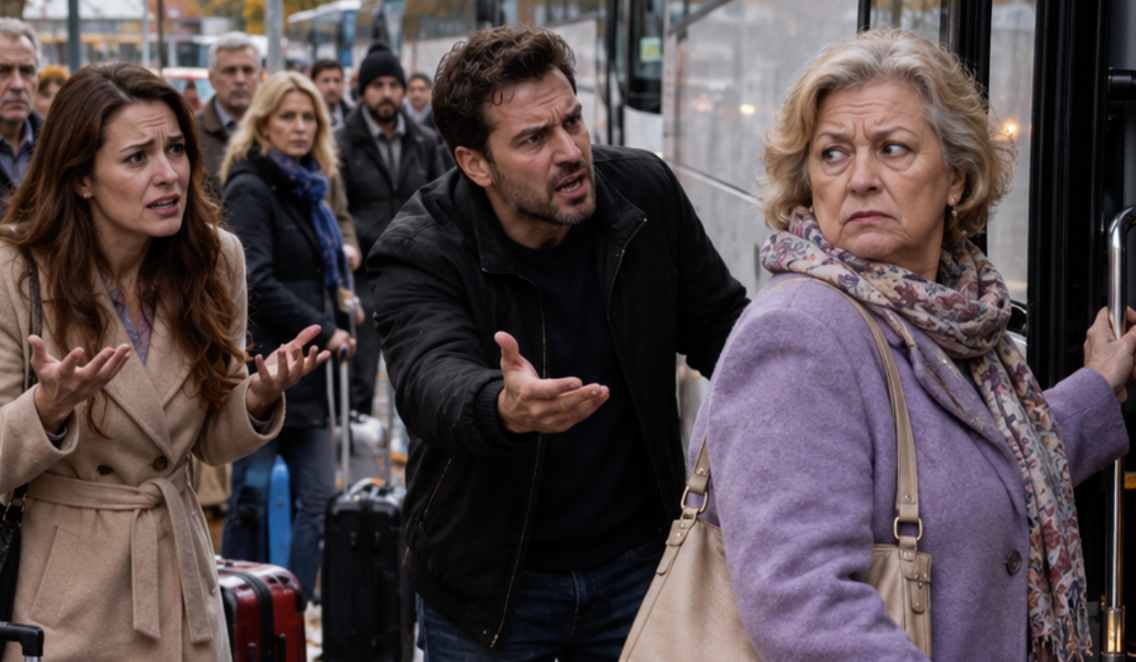
Andrei burst through the station’s automatic doors with his face red from rushing. His jacket was open and his scarf hung crookedly around his neck.
Ksenia hurried behind him, nervously fiddling with the buttons of her mint-green cardigan.
The moment Andrei spotted his mother, he quickened his pace and loomed over her.
“Have you completely lost your mind in your old age?!” he hissed, glancing nervously at the passing passengers.
“There are people sitting in an empty apartment! Mikhail is furious, and my mother-in-law is so offended she can hardly speak! Do you have any idea how this makes us look in front of them?!”
“You look perfectly normal,” Lyudmila Kuzminichna replied, looking directly into her son’s face.
“Like grown adults who invited guests and are responsible for feeding them.”
“You expect us to take them to a cafeteria?!” Ksenia burst out, pointing a finger at her mother-in-law.
“They’ll charge us a fortune for twelve people! We have a mortgage hanging over us and a car loan to pay! We were counting on a normal family meal! Are you his mother or what?! You’re supposed to help your son!”
“Exactly whom do I owe, and how much?” Lyudmila Kuzminichna asked.
“Your family!” Andrei barked and grabbed the handle of her travel bag.
“That’s enough of this performance. Get up. We’re going. We’ll stop at the supermarket on the way and buy ready-made dough and minced meat. You can handle everything in an hour if you move quickly. Mikhail can survive on sandwiches until then.”
He pulled the bag upward, but Lyudmila Kuzminichna pressed it firmly against the seat with her elbow.
“Take your hand off it, Andrei,” she said.
She did not raise her voice, but there was such steel in her dispatcher’s tone that her son immediately withdrew his hand.
Andrei froze.
In thirty-five years, he had never heard such an icy tone from his mother.
“Mom, what’s wrong with you?”
“I am not your cafeteria cook,” she said slowly and distinctly.
“And I am not free domestic help for your Ksenia. For three years, you’ve been dragging an entire crowd over to my house every Saturday. Did any of you ever bring even a bag of apples for tea? Did you ever once ask where I found the money to buy all the meat that your precious Mikhail stuffed into his containers?”
“But you invited us yourself!” Ksenia snapped.
“You always said you were lonely by yourself! You should be grateful that your relatives want to spend time with you instead of sitting alone like some miser guarding a treasure chest!”
“I invited my son for lunch,” Lyudmila Kuzminichna cut her off.
“My son. One person. Not a caravan of hungry freeloaders marching in with empty food containers.”
“Mom, stop embarrassing yourself in front of everyone!” Andrei nervously glanced at the passengers with suitcases who had begun listening to the argument.
“All right, maybe we went a little too far. Fine! Next time we’ll bring the groceries ourselves! Come back with us, please. It’s awkward in front of the in-laws. An elderly woman has come all this way and now she’s sitting there suffering!”
“Then take her to your own apartment, son,” his mother advised.
“You have a comfortable sofa and a television that covers half the wall. Let your darling Ksenia stand at the stove and fry some cutlets. She’s young and healthy. Her hands won’t fall off.”
Ksenia jerked her shoulder irritably.
“Why on earth should I spend my legitimate day off standing over a stove?! I’ve spent the entire week working myself to death in the clinic reception office!”
“And I worked thirty-five years of twenty-four-hour emergency shifts,” Lyudmila Kuzminichna said, rising from the bench.
A sharp, aching pain shot through her knees, but she straightened her back.
“And I’ve earned the right to rest on Saturdays instead of kneading an entire sack of flour for someone else’s relatives.”
She pulled the blue stamped form from the side pocket of her bag.
“Here’s my referral from the rheumatologist. It sat on my nightstand for three weeks, right under your nose when you came to take your father’s socket-wrench set. Did you ever once ask why your mother had started limping?”
Andrei stared at the blue clinic stamp and fell silent in confusion.
A mechanical crackle came through the station loudspeaker.
“Bus number two hundred forty to the health resort is departing from Platform Two. Passengers are requested to proceed for boarding.”
Lyudmila Kuzminichna picked up her bag.
“You’re not going anywhere!” Andrei stepped forward and tried to block her path to the glass doors.
“I have the keys to your apartment in my pocket! Do you hear me?! We’ll stay there until you come to your senses! Mikhail is already checking the freezer!”
“Let him check it, dear boy,” his mother said with a faint smile.
“The refrigerator has been empty and defrosted since Wednesday. There isn’t even a packet of salt on the shelf. And you can keep the key as a souvenir. When I return in three weeks, I’ll call a locksmith immediately and change the lock.”
She walked around her son.
“Lyudmila Kuzminichna!” Ksenia shouted after her with undisguised hatred.
“You’re a shameless egoist! Forget the way to our home! We’ll never come within a mile of you again! You’ll regret this in your old age, but it’ll be too late! There won’t even be anyone to bring you a glass of water!”
Lyudmila Kuzminichna did not even slow down.
“Good riddance,” she tossed over her shoulder.
“At least my frying pans will last longer.”
A fresh autumn draft swept across the boarding platform.
The old bus trembled gently at idle, releasing pale clouds of exhaust into the air.
The attendant in an orange vest checked her boarding pass, glanced at her passport, and waved toward the interior.
“Go ahead. Seat seven, by the window.”
She climbed the ribbed steps and settled into her seat.
Through the dusty window, she caught sight of Andrei and Ksenia.
Her son was furiously waving his arms, trying to prove something to his wife. Ksenia began shouting back, and then both of them nearly ran toward the parking lot.
Apparently, they had suddenly remembered that a crowd of hungry relatives was still sitting in a cold, empty apartment with empty cooking pots.
The bus rocked slightly and slowly pulled onto the suburban highway.
Outside the window stretched rust-colored strips of autumn woodland, empty bus stops, and fences around country houses.
Ahead of her waited three weeks of therapeutic baths, silence, pine-lined paths, and institutional soups prepared by a cook who was a complete stranger to her.
Three weeks passed.
Lyudmila Kuzminichna returned to the city early one morning on a regular bus.
Her steps were lighter now. The constant aching in her knees had noticeably eased, and she felt peaceful inside.
The first thing she did was dial the number from a paper advertisement she had torn from the noticeboard in her apartment building.
Forty minutes later, a broad-shouldered locksmith carrying a metal toolbox removed the old lock cylinder and installed a new brass one with a sealed set of keys.
Andrei’s old key instantly became a useless piece of metal.
The phone rang at around six that evening.
Her son’s name appeared on the screen.
Lyudmila Kuzminichna answered.
“You home already?” Andrei grumbled instead of saying hello.
His tone was sour, strained, and unmistakably offended.
“I’m home, son.”
“So how’s your health? Happy with your trip?”
“I had a wonderful rest. Thank you for finally asking how your mother is feeling.”
There was an awkward pause on the other end.
Andrei had apparently expected to hear guilt in her voice, or at least some hint of an apology for supposedly ruining the family gathering three weeks earlier.
“All right, here’s the deal,” he said, returning to his old forceful tone, although there was less confidence in it now.
“Ksenia said she’s not going to be the first one to call you. You humiliated us in front of her whole family that day. Mikhail had to leave a pretty big sum at a roadside café, and he’s still angry about it. But I’m willing to forget the past.”
Her son drew a noisy breath and delivered his prepared speech.
“Tomorrow is Saturday. Bake some pies properly, like a normal person. Meat ones and apple ones. We’ll all come over around two. And no more of your tricks.”
Lyudmila Kuzminichna shifted the phone to her other hand.
“You won’t be coming, Andryusha,” she replied evenly.
“And why exactly not?!”
“I changed the lock cylinder half an hour ago. And from now on, I bake only on major holidays. And only for myself.”
“Are you my mother at all, or some stranger?!” her son exploded.
“We’re family!”
“Your mother,” she confirmed.
“But the free food distribution center is permanently closed. The shift has been handed over. Duty is finished.”
She pressed the end-call button and silenced her phone.
A couple of days later, her neighbor from across the landing shared an amusing piece of news.
Andrei, Ksenia, and Mikhail had spent the entire previous weekend at Ksenia’s mother’s country house, digging overgrown potatoes in the drizzling rain in exchange for two jars of last year’s pickles.
The family invasion force had simply relocated to a new front.
But Lyudmila Kuzminichna no longer cared in the slightest.
She took a tube of medicinal ointment from her bag, placed it in the bedside cabinet, switched on the wall-mounted radio, and sat down to sort through old electricity bills.
The apartment was warm, spacious, and unusually quiet.