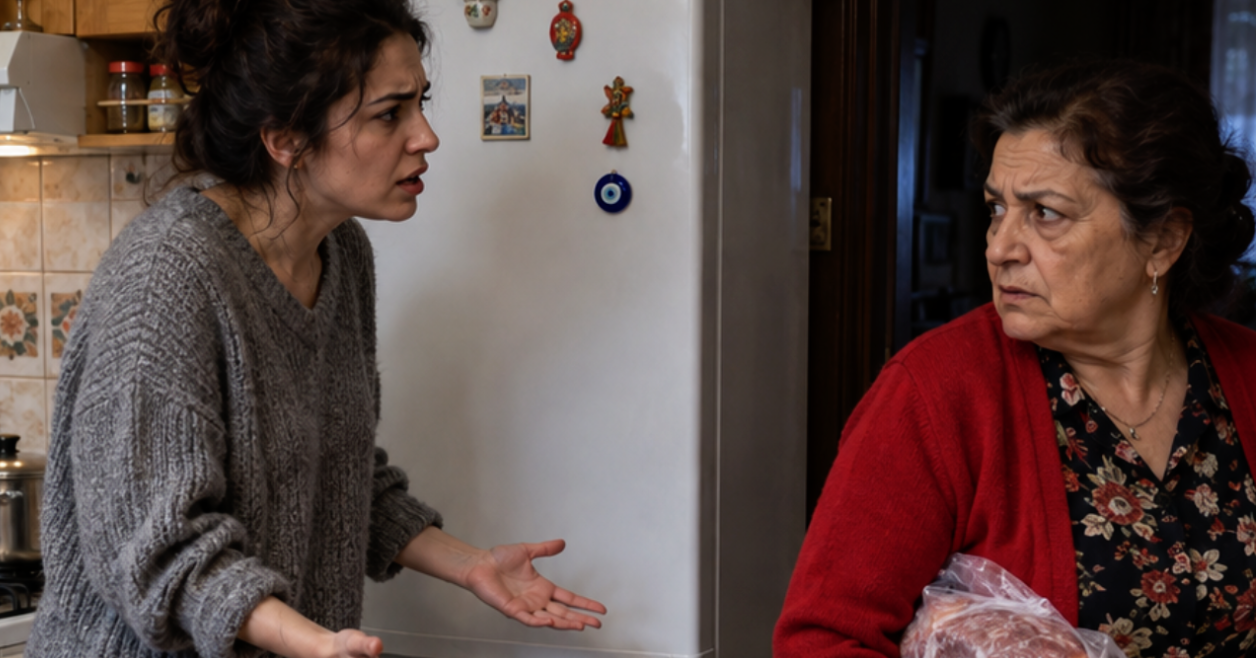
Mother-in-Law Took Half the Meat from Her Daughter-in-Law’s Freezer: “My Daughter Needs It More.” Her Son Paid for His Mother’s Next Grocery Order Entirely Himself
That Saturday evening, Natalia realized someone had been helping themselves to things in their apartment even before she opened the freezer.
There was a crumpled grocery bag on the kitchen table that hadn’t been there that morning, and the bottom freezer drawer slid out far too easily. Just four days earlier, she’d had to hold it steady with one hand to keep the packages from shifting around. Now there were only a few bags of ground meat, some chicken thighs, and one package of turkey left at the bottom.
Natalia closed the freezer, took out her phone, and opened the history of their latest grocery order.
They had bought more than thirteen kilograms of meat and poultry. There was no way that much could have disappeared in four days. Their son had eaten dinner at her parents’ house two evenings, Pavel had been working late, and Natalia herself had cooked only once.
She messaged her husband:
“Did you take anything from the freezer?”
His reply came almost immediately.
“No. Why? What happened?”
And then Natalia remembered who still had a spare key to their apartment.
Requests That Were Always “Just Little Things”
Natalia and Pavel had been living together for eight years. They both worked, their son Arseny was seven, and they divided household expenses without any complicated rules.
At the beginning of each month, each of them transferred an agreed amount to a separate card used for shared household expenses. Groceries, utilities, cleaning supplies, school necessities, and other everyday expenses were paid from that account.
Whatever money remained stayed in their personal accounts.
The arrangement suited both of them until Pavel’s mother, Lyudmila Sergeyevna, gradually began attaching her own groceries to their orders.
At first, his mother would ask them to add a package of coffee or some laundry detergent.
Pavel would usually stand beside Natalia while she filled the online shopping cart and say:
“Add some coffee for Mom, please. The delivery is coming here anyway. I’ll take it over to her afterward.”
Natalia would add it.
After a couple of grocery orders, butter, cheese, tea, and grains appeared on the list as well.
Then Lyudmila Sergeyevna began messaging Natalia directly.
“If you’re placing an order, get me a chicken and two packs of butter. I’ll pick them up later.”
Sometimes she transferred the money immediately, sometimes later, and small amounts were often simply forgotten.
Natalia never reminded her.
Starting a family accounting dispute over a few hundred rubles seemed petty.
The first unpleasant conversation happened in the spring.
Lyudmila Sergeyevna had asked for two packages of good-quality fish. Natalia added them to the order, and Pavel delivered them to his mother along with the rest of her groceries.
A few days later, Natalia stopped by Oksana’s house—Pavel’s sister—to return a pair of children’s ice skates.
One of those exact packages of fish was lying on Oksana’s kitchen table.
“Mom brought it,” Oksana said casually. “She had two.”
That evening, Natalia asked her husband:
“So now we’re buying groceries for Oksana too?”
Pavel was clearing the dinner dishes and at first didn’t understand what she meant.
“What groceries?”
“The fish. Your mother gave one of the packages to Oksana.”
He put a plate on the drying rack and shrugged.
“We bought it for Mom. What she does with it afterward is her business.”
“We bought it with money meant for our household.”
Pavel dried his hands on a towel and gave a small laugh.
“It was one package. Are we really going to start counting things like that?”
Natalia didn’t continue the argument.
That was how most situations like this passed. Each individual incident seemed too small to justify a serious fight.
But a habit had already formed.
Lyudmila Sergeyevna could come over, open the refrigerator, and ask whether she could take some sour cream or cheese.
Technically, she asked first.
But she did so while the refrigerator door was already open and the package was already in her hand.
One day, she noticed a container of cutlets.
“Can I take a couple? I don’t feel like cooking today.”
“They’re for Arseny tomorrow,” Natalia replied.
“There are plenty.”
Her mother-in-law had already reached toward the container when Natalia said:
“Lyudmila Sergeyevna, please leave the cutlets.”
The older woman immediately pulled her hand back, but she was noticeably colder for the rest of the evening.
Later, Pavel said:
“She asked first. She’s my mother, not some stranger.”
Natalia tried to explain that it wasn’t about the cutlets.
What bothered her was something else.
Pavel’s mother seemed increasingly unable to distinguish between help from her son and the belongings of his household.
The Spare Key Was Left Over from Their Vacation
They had given Lyudmila Sergeyevna a spare key during the summer, when Natalia and Pavel went away for ten days.
She watered their plants and collected their mail.
After they returned, no one asked for the key back.
Later, Pavel’s mother used it twice with their permission.
Once, she left some documents for Pavel when no one was home. Another time, she waited for a repairman.
Because of that, the simple fact that she could enter the apartment never seemed dangerous.
No one had imagined that permission to drop off documents could somehow turn into permission to sort through their groceries.
At the beginning of the month, Natalia noticed a sale and suggested stocking up on meat.
They ordered chicken, turkey, two cuts of meat, and ground meat—a little more than thirteen kilograms in total.
That evening, Natalia and Pavel divided everything into portions together.
Natalia labeled the packages with a marker while Pavel helped arrange them in the freezer.
The bottom drawer was almost completely full.
Two days later, Lyudmila Sergeyevna called her son.
She needed to drop off some documents.
Pavel was at work and told her she could use her key and leave the papers on the dresser in the entryway.
The documents were indeed there when they came home that evening.
No one thought to check the kitchen.
Natalia only noticed the missing food on Saturday.
When Pavel returned home, she showed him the freezer.
At first, her husband assumed she had moved some of the food into another drawer.
Then he opened it himself and found berries, dough, and a package of dumplings.
“Strange,” he said, no longer smiling.
“Your mother was here after we bought everything.”
“She came to drop off documents.”
“That’s exactly why I want to know whether documents were the only thing she took care of.”
Pavel offered to call his mother himself, but Natalia refused.
She was tired of always discussing everything through her husband.
“My Daughter Needs It More”
Lyudmila Sergeyevna answered almost immediately.
“Lyudmila Sergeyevna, were you at our apartment on Thursday?”
“Of course. I left the documents for Pavel.”
“Did you take anything from the freezer?”
There was a brief pause on the other end of the line.
“I took a little.”
Natalia looked at Pavel.
He was standing near the table and clearly already understood what had happened.
“How much is ‘a little’?”
“Natalia, are you really going to start counting kilograms now? I took some for Oksana. She has a lot of expenses this month, and the children need all sorts of things.”
“About half our grocery purchase is gone.”
Her mother-in-law’s voice became harder.
“It wasn’t half. And anyway, I took it from my son.”
Pavel frowned but remained silent.
“These are groceries for our family,” Natalia said. “We bought them to last several weeks.”
“Buy more. You both work. Oksana is raising two children by herself.”
Natalia was about to end the conversation when her mother-in-law added:
“My daughter needs it more.”
She said it calmly, almost matter-of-factly, as though she were talking about groceries from her own freezer.
Natalia didn’t argue about who needed what more.
“All right. Then please don’t come into our apartment anymore when no one is home.”
“What, now I’m supposed to give the key back?”
“Yes. Pavel will pick it up.”
Her mother-in-law was silent for several seconds.
“I see exactly what kind of person you are now.”
Natalia ended the call and placed her phone on the table.
Pavel opened the freezer once more, looked inside, and straightened up.
“Mom was wrong. But demanding the key back immediately was a little harsh.”
“Pavel, she entered an empty apartment and took around six kilograms of food without asking.”
“I understand.”
“If you understood, you wouldn’t be explaining why I reacted too strongly.”
He sat at the table and remained silent for a while.
“All right. What do you suggest?”
Natalia opened her banking app.
“Nothing complicated. Help your mother as much as you think is necessary. But her groceries are no longer being paid for from our household card.”
When “Just a Little” Appeared on the Receipt
Natalia scrolled through their expenses from the past several months and showed her husband several purchases: coffee, cleaning supplies, groceries for his mother, and that same fish.
“I’m not going to decide how much you’re allowed to spend on your mother,” she said. “If you want to help her, help her. Just use your personal card. Our shared budget is for our household and Arseny.”
Pavel frowned.
“What if she really is struggling?”
“Then you’ll help her. I’m not stopping you.”
“And Oksana?”
“Oksana is an adult. If you personally want to buy something for her, that’s also your decision and your money. Just don’t pretend it somehow accidentally ended up in our family grocery cart.”
For the first time, Pavel seemed to have difficulty arguing with that.
He was used to viewing every individual request from his mother as something minor.
But he had never seen all those requests put together.
An hour later, he drove to Lyudmila Sergeyevna’s home.
He returned quietly, took off his jacket, hung it in the closet, and placed the spare key in a small bowl in the entryway.
“She gave it back?” Natalia asked.
“Yes.”
“What did she say?”
Pavel gave a humorless smile.
“That you’ve turned me against my family. And that I used to be easier to deal with.”
“And what did you say?”
“I told her that if I want to help my family, I’ll pay for it myself.”
That ended the conversation at home.
For the next two weeks, Lyudmila Sergeyevna didn’t message Natalia.
Then, on Friday evening, a message arrived.
“Are you doing your grocery shopping tomorrow? I need two packs of butter, coffee, cheese, chicken, ground meat, apples, tangerines, rice, and detergent.”
Several more items were listed below.
In the past, Natalia would have simply added everything to the family order.
This time, she forwarded the message to Pavel and wrote:
“This is for you.”
He was sitting beside her on the sofa, so he opened the list immediately.
“Why is she messaging you?”
“Because she always used to message me.”
Pavel opened the grocery-store app and began putting together a separate cart.
Natalia was reading while Arseny arranged pieces of a board game on the carpet.
After several minutes, Pavel stopped tapping the screen.
“Eight thousand four hundred and sixty rubles.”
Natalia looked up.
“Sounds about right.”
“I thought it would be around four thousand.”
“That’s because before, the total was hidden inside our larger family order.”
Pavel looked through the cart again.
He didn’t remove anything.
He entered his mother’s address and paid with his own card.
A minute later, another message arrived.
“Mom is also asking me to add two packages of meat and some cheese for Oksana,” he said. “She says, ‘Since the delivery is coming anyway.’”
Natalia looked at her husband.
The wording was very familiar.
Pavel held the phone for a moment, then typed a reply and turned the screen toward his wife himself.
“Mom, I’ll pay for your order. Oksana can place her own order or transfer the money.”
A reply came almost immediately, and it was long.
Pavel read the first few lines, locked the phone, and placed it on the table.
“Apparently, I’ve changed since getting married again.”
“Looks like that change took eight years to happen.”
Pavel laughed.
For the first time in several days, he didn’t look guilty or irritated.
He simply looked tired of having the same conversation over and over again.
On Saturday, their family grocery order was delivered to their apartment.
Natalia accepted the bags at the door while Pavel checked the items in the app and carried the heavier bags into the kitchen.
Lyudmila Sergeyevna’s order was delivered directly to her.
Pavel received a notification confirming delivery and the charge to his card.
A month later, his mother asked for groceries again.
This time, the list went directly to her son.
Pavel placed the order himself without involving Natalia.
Another week later, Oksana messaged her brother and said their mother was complaining about how expensive groceries had become and that she was now afraid to ask for anything unnecessarily.
Pavel showed the message to his wife and replied to his sister while Natalia was right beside him:
“She can ask. I’ll help when I can. But no one is going to take groceries from our home anymore.”
On Sunday, Natalia and Pavel were once again putting away a large grocery order.
He placed the labeled packages into the bottom freezer drawer, then pushed it shut easily.
“There’s some space left this time,” Pavel observed.
“That’s because we bought exactly as much as we need.”
He nodded and closed the freezer door.
Lyudmila Sergeyevna was never given the spare key again.