“Here Are Your Duties”: The Mother-in-Law Handed Her Future Daughter-in-Law a List, but She Asked One Precise Question
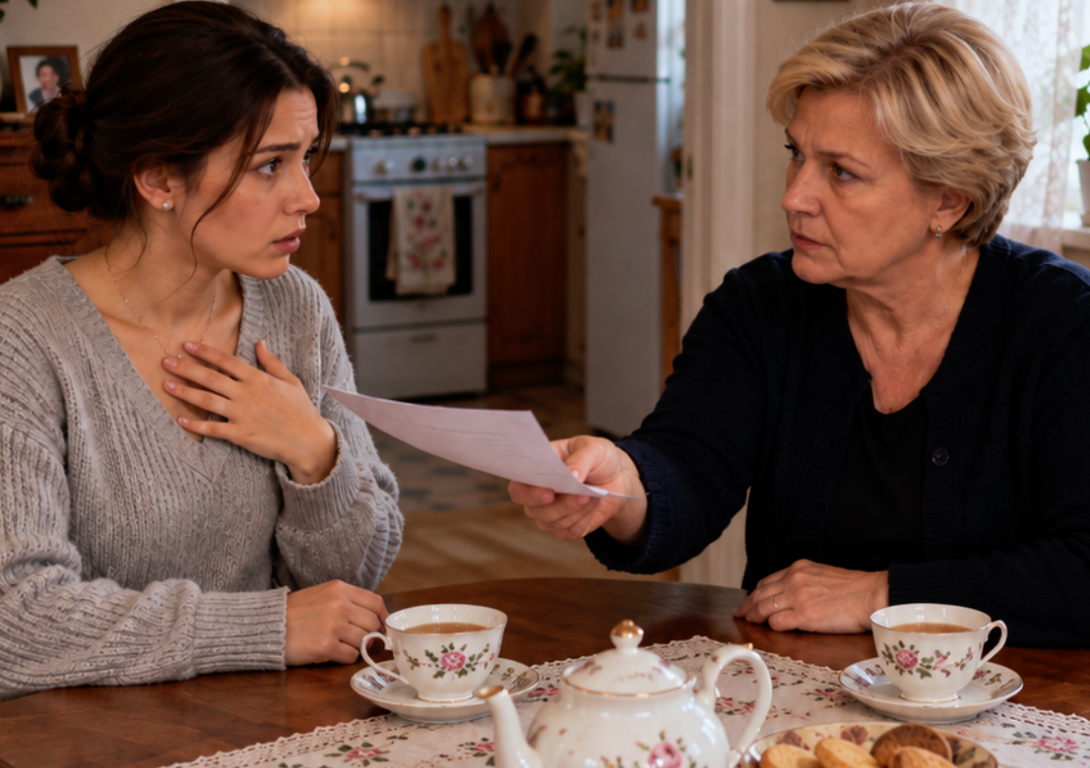
Three weeks before the wedding, her future mother-in-law handed Alina a list of duties. Alina didn’t make a scene. She asked just one question, and Valentina Sergeyevna’s face fell as though she had just been served with a court summons.
The kettle was old, the kind with a whistle that had been sold at markets back in the nineties. It whistled thinly and plaintively, as though complaining about life. Valentina Sergeyevna took it off the stove with a practiced movement, poured boiling water into the cups, and pushed a small dish of cookies toward Alina.
The cookies were store-bought Yubileynoye biscuits. Alina absentmindedly took one and bit into it. Crumbs fell onto the tablecloth.
“Don’t be shy, have another,” Valentina Sergeyevna said. “We’re going to be family soon.”
Alina nodded. She had sat in this kitchen only four times over the past two years, and every time she had felt the same thing. Everything here was arranged so that the woman of the house could reach anything without getting up from her chair. The sugar bowl. Spoons. Napkins. The television remote on top of the refrigerator.
A small fortress belonging to a lonely woman, where every centimeter had been organized according to habit.
Valentina Sergeyevna sat down, blew on her tea, and looked at Alina over the rim of her cup. It was the kind of look doctors gave patients before delivering an unpleasant diagnosis.
“Alinochka, I wanted to talk to you. Without Maksim.”
“I’m listening.”
“Our family has certain… traditions. Rules. You understand.”
Alina didn’t understand, but she nodded. At work, she was accustomed to listening first and reacting afterward. At the private clinic where she worked as an administrator, patients sometimes began conversations from very far away before finally getting to their complaint.
And usually, the longer the introduction, the more serious the problem turned out to be.
Valentina Sergeyevna stood up, opened a drawer in the sideboard, and took out a sheet of paper folded into quarters. She placed it in front of Alina and smoothed it flat with her palm.
“Here. I wrote everything down so I wouldn’t forget anything, and so you would know right away how things are supposed to work.”
Alina unfolded the sheet.
The handwriting was neat, like a schoolteacher’s.
Cooking on weekends
Saturday — lunch for the whole family.
Sunday — dinner.
Helping at the country house
May, June, August, September.
At least two weekends per month.
Cleaning up after family celebrations
New Year, Easter, birthdays.
Watching Polina and Artyom
Lena’s children, whenever Lena is at work.
Grocery shopping for V.S.
A separate shopping list will be provided on Thursdays.
Accompanying V.S. to the clinic
As needed.
Weekly phone call to V.S.
Wednesday, after 6:00 p.m.
Alina read to the end.
Then she turned the sheet over and checked the back.
Blank.
“Is that everything?” she asked.
“For now,” Valentina Sergeyevna replied. “Maybe something else will be added later. But that should be enough for the time being.”
Alina placed the sheet on the table and took another cookie.
She bit into it.
Chewed.
Valentina Sergeyevna waited.
A cuckoo clock ticked on the wall. The cuckoo itself had broken long ago and no longer came out, but the mechanism still worked, and at the appropriate time a dry click came from inside the little wooden house, as though someone were clicking their tongue disapprovingly.
“Valentina Sergeyevna,” Alina said calmly. “May I ask you one question?”
“Of course.”
“Item number four. Looking after Lena’s children. Maksim promised you he would do that, didn’t he? Two years ago, when Lena started her new job.”
Valentina Sergeyevna placed her cup on its saucer.
The sound was louder than necessary.
“How do you know that?”
“Maksim told me.”
Silence.
Valentina Sergeyevna stared at Alina as though seeing her for the first time.
Not as her future daughter-in-law.
Not as her son’s girlfriend.
But as someone who knew something she wasn’t supposed to know.
“He told me,” Alina repeated. “Actually, he tells me quite a lot. About the country house too. He promised you he would help with the greenhouse every summer. And the fence. And the roof of the shed.”
Valentina Sergeyevna remained silent.
“And he promised to call you on Wednesdays too, didn’t he?”
“Well… yes.”
“And he never did any of it.”
Valentina Sergeyevna turned toward the window.
Outside was the courtyard, a bench, and a pigeon perched on the curb.
An ordinary May evening.
“He’s busy,” she finally said. “He has work. Projects. I don’t want to bother him.”
“But bothering me is fine.”
It didn’t sound like an accusation.
More like a simple statement of fact.
Like a doctor saying, “Your blood pressure is high, but you already knew that.”
Valentina Sergeyevna turned back toward her.
“Alina, try to understand. I don’t mean anything bad by it. It’s just that someone has to…”
“Has to. I agree. But why does that someone automatically have to be me?”
Alina finished her tea.
She stood up.
She picked up the sheet of paper from the table.
“I’m not going to throw this away. I’ll think about it. But I have one condition.”
“What condition?”
“If these are family responsibilities, then they belong to the whole family. Maksim too. Lena too. And you.”
Valentina Sergeyevna opened her mouth and closed it.
Then opened it again.
“Me?”
“Well, of course. You’re part of the family too.”
Alina smiled, said goodbye, and left.
She took the list with her.
On the staircase, she stopped and read it again.
Seven items.
Neat handwriting.
Underlined words.
There wasn’t a single item on the list for Maksim.
Not one.
That was when Alina stopped finding the situation funny.
Instead, she felt sad.
Maksim was sitting on the sofa watching football when Alina came home.
“How was tea at Mom’s?” he asked without taking his eyes off the screen.
“Educational.”
She placed the list on the coffee table in front of him, directly on top of the remote.
Maksim read it.
His expression changed slowly, like the sky before a storm: first confusion, then recognition, then something resembling shame.
“That’s Mom’s handwriting,” he said.
“Correct.”
“She gave you this?”
“Presented it to me ceremoniously. Like an award certificate.”
Maksim leaned back against the sofa and rubbed his face with both hands.
Alina knew that gesture well.
He always did it when he realized a problem was not going to disappear by itself.
“Alina, I’ll talk to her.”
“No.”
“No?”
“No. You’re not going to talk to her. You’re going to do something. Item number two: the country house. We’re going together this Saturday. You promised her you’d repair the fence two years ago.”
Maksim looked at her the way people look when they have spent years believing unpleasant things can always be postponed until later—and suddenly discover that “later” has finally arrived.
“On Saturday I have…”
“On Saturday, you have a fence.”
He was silent for a moment.
“Fine.”
Wedding preparations continued, and old family habits began pushing their way to the surface like grass growing through asphalt.
Two weeks before the celebration, they needed to finalize the menu.
Alina suggested that everyone get together and discuss it.
Maksim agreed.
Valentina Sergeyevna arrived with a separate list of dishes written in the same neat handwriting.
“Aspic is absolutely necessary,” she said. “And Mimosa salad. And herring under a fur coat. We can’t do without those.”
“Mom, this isn’t a funeral,” Maksim remarked.
“What, you can’t serve herring under a fur coat at a wedding?”
“You can,” Alina said. “But you’ll be the one making it. Maksim and I will take care of the hot dishes.”
Valentina Sergeyevna froze with her pen hovering over the list.
“Me?”
“Well, who else? You’re the Mimosa expert. Maksim says yours is the best in the city.”
Maksim looked at Alina with an expression that clearly said, I never said that.
But he wisely kept quiet.
Valentina Sergeyevna straightened her back.
“Well… yes. I do make a good Mimosa salad. That’s true.”
For the first time, there was something in her voice other than a commanding tone.
Pride.
Small and warm.
Like a light glowing in a distant window.
On Saturday, the three of them went to the country house.
The fence was in such bad condition that Maksim stood in front of it for five minutes with his hands clasped behind his head.
“Two years,” Alina said quietly beside him.
“I can see that.”
“Three boards have completely rotted away. And that one looks like it’s being held up by sheer faith.”
Valentina Sergeyevna watched them from the veranda window.
Alina noticed that she wasn’t looking at the fence.
She was looking at her son.
At the way he stood there.
At the way he lifted a board.
At the way he measured a replacement.
She watched him as though she were finally seeing something she had waited for so long that she had stopped expecting it.
By lunchtime, Maksim had repaired three sections, cut his finger, and said several words Alina decided not to remember.
Valentina Sergeyevna brought him a bandage, antiseptic, and a bowl of cabbage soup.
“Eat,” she said. “Wash your hands first.”
Maksim ate while sitting on the porch in silence.
Valentina Sergeyevna sat beside him.
Alina photographed the greenhouse, pretending not to notice when her future mother-in-law placed a hand on her son’s shoulder.
Lightly.
For only a second.
That gesture made Alina suddenly understand something she hadn’t understood before.
Valentina Sergeyevna didn’t want a servant.
She wanted someone to visit.
She wanted people to occasionally appear in this house where everything had been arranged within arm’s reach.
She wanted the fence repaired not because someone was obligated to repair it, but because their mother lived there.
Their family.
The list of duties wasn’t really about control.
It was about fear.
About loneliness that she had packed into neat, numbered points because she didn’t know how to ask directly.
To simply say:
Come and visit me.
It’s empty here without you.
No one had ever taught her how to say that.
That evening, while Maksim loaded the tools into the car, Alina stayed in the kitchen with Valentina Sergeyevna.
“Thank you for coming,” the older woman said.
Her voice was different.
Quieter.
No instructions.
“Valentina Sergeyevna.”
“What?”
“You don’t need a list to make us come here.”
Her mother-in-law was wiping the table.
Her hand stopped halfway.
“I’m used to writing everything down. If you don’t write something down, people forget. Maksim always forgets.”
“I know.”
“So I thought maybe you wouldn’t forget.”
Alina sat down.
In the same chair where she had been sitting three weeks earlier when she received the list.
“I won’t forget. But not because you wrote it down. Because I care.”
Valentina Sergeyevna stood there with the cloth in her hand, staring down at the table.
The clock clicked.
Once again, the cuckoo didn’t come out.
“I didn’t mean to offend you,” she finally said. “With that list.”
“I wasn’t offended.”
“Really?”
“Really. I was upset because Maksim wasn’t on it. But I’m not angry with you.”
Valentina Sergeyevna put down the cloth and sat across from her.
“He’s a good man,” she said. “Just lazy.”
“I noticed.”
“His father was the same way. Promised things and forgot them. I lived with that for thirty years.”
“I’m not planning to tolerate it for thirty years,” Alina said. “That’s why he repaired the fence today.”
Valentina Sergeyevna looked at her.
And suddenly smiled.
Not widely.
Not radiantly.
Just with one corner of her mouth, like a person who had forgotten how to smile but had suddenly remembered.
“You suit him,” she said. “I’m glad he fell in love with you.”
It wasn’t much.
But for Valentina Sergeyevna, it was a great deal.
The wedding took place in June, more or less within the family circle.
It was small, with forty guests.
They held it at the country house under the trees, like in the old days, beneath a large marquee.
Valentina Sergeyevna made the Mimosa salad, and it really was the best in the city, although Maksim still refused to say so.
Lena, Maksim’s sister, arrived with the children.
Polina and Artyom raced between the tables, knocked over a vase of flowers, and ate half the cake before it was officially brought out.
Maksim was the one watching them.
According to the new family schedule.
He wasn’t very good at it.
But he managed.
Valentina Sergeyevna sat at the table and watched.
Sometimes she offered advice.
“Polina, don’t run around with a fork.”
Sometimes she said nothing.
Once, Alina noticed her mother-in-law looking at her and Maksim, and there was neither control nor inspection in her gaze.
Only the quiet, cautious relief of a person who had been afraid of being abandoned and had discovered that, for now, she had not been.
After the celebration, when the guests had left and the yard was empty, Alina began clearing things from the table.
Under one of the plates, she found a sheet of paper folded into quarters.
The same one.
The one with the neat schoolteacher’s handwriting.
Only now it looked different.
Someone had written new instructions over the old ones, using another pen and larger letters.
The handwriting belonged to Valentina Sergeyevna.
Weekend cooking — take turns.
Country house — Maksim
Fence, roof, greenhouse.
Alina only if she wants to.
Cleaning after celebrations — everyone.
Lena’s children — Maksim and Lena.
Groceries — I can manage myself.
Clinic — I’ll call if I need help.
Phone calls — whenever we feel like it. No schedule.
At the bottom, in tiny, almost illegible handwriting, she had added:
“Thank you for coming and for not abandoning me. I love you all.”
Alina folded the sheet and put it into her handbag.
Maksim came up from behind and put his arms around her shoulders.
“What’s that?”
“A family document.”
“What kind?”
“An important one. I’ll show you later.”
She didn’t explain.
Some things between women don’t need translation.
In the parking area, Valentina Sergeyevna was getting into a taxi.
Alina waved to her.
Her mother-in-law waved back.
Briefly.
Restrainedly.
It wasn’t the beginning of a great friendship.
It was the beginning of something else.
Something slow, awkward, and real.
Something that could never fit into any list.
The taxi drove away.
Maksim turned the key in the ignition.
“Home?”
“Home.”
Alina leaned back in her seat and closed her eyes.
Inside her handbag was a sheet of paper containing seven points that were no longer duties.
They had become something like the first honest conversation between two women who had not chosen each other, but had decided to try.