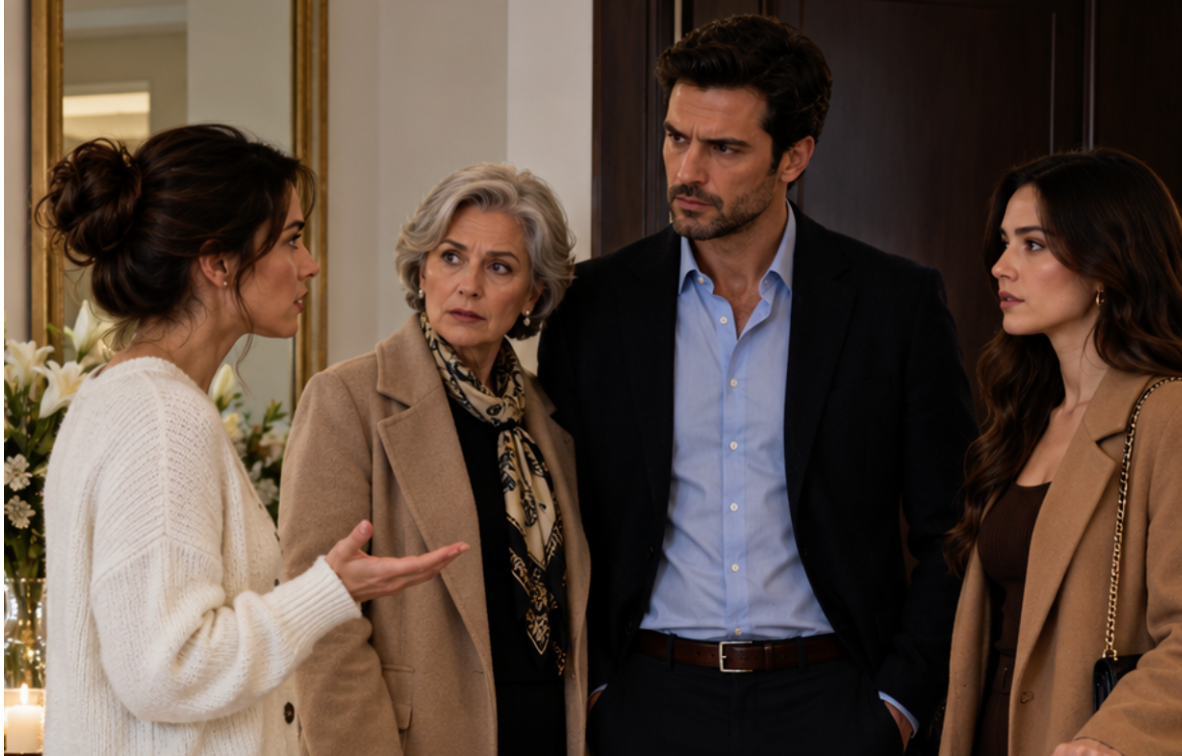
“Pack your things. I brought another woman here,” her husband said. A minute later, his mother turned pale when she saw the documents.
Marina stood frozen in the middle of her own living room, a damp kitchen towel still clutched in one hand.
Outside, a cold autumn rain tapped against the windows. The kettle whistled softly from the kitchen, but no one seemed to hear it.
Near the front door stood a woman Marina had never seen in person before. She looked about thirty-five and held the handle of a small suitcase. Beside her was Igor, Marina’s husband of nearly twelve years.
Behind them, Valentina Pavlovna—Igor’s mother—was calmly taking off her coat as if she had come for an ordinary Sunday visit.
“Say that again,” Marina said quietly.
Igor sighed with irritation.
“Don’t make this harder than it has to be. We’re divorcing anyway. Larisa has nowhere to stay right now, and you can live with your mother for a while. Later, we’ll sort out the apartment and the rest of the property.”
Larisa lowered her eyes.
Valentina Pavlovna walked farther into the room and placed her handbag on an armchair.
“Marina, please don’t make a scene,” she said. “You’re all adults. If a marriage has ended, people should know how to separate with dignity.”
Marina stared at her mother-in-law.
Then at Larisa’s suitcase.
Then at Igor.
And suddenly, she smiled.
“All right,” she said. “But before I pack anything, I think we should clarify one small detail.”
She disappeared into the bedroom and returned a moment later carrying a blue folder.
Igor frowned.
“What’s that?”
“Documents for the apartment.”
Valentina Pavlovna gave a dismissive laugh.
“So? The apartment belongs to the family.”
Marina opened the folder and pushed the papers across the table.
“No. It doesn’t.”
Her mother-in-law leaned forward and began reading.
Within seconds, her face changed.
“Igor…” she whispered. “Why does this say Marina owned the apartment before you were married?”
Igor said nothing.
For Marina, that silence was almost satisfying.
The apartment had belonged to her long before Igor entered her life.
Her grandmother had left it to her.
It was an old but beautiful three-room apartment in a brick building with high ceilings and wide windowsills. Marina had spent part of her childhood there. She remembered the smell of apple pie in the kitchen, books lining the living-room walls, and pots of geraniums on the balcony.
After her grandmother died, Marina inherited the apartment.
Years later, when she met Igor, she invited him into that home.
At first, he had seemed like the kind of man she could trust completely. He was charming, confident, attentive. He worked as a department manager for a small construction company and always knew how to make her laugh.
A year after they met, they married.
Igor moved into the apartment permanently, and soon they decided to renovate it.
Marina spent her savings. Her mother helped financially. Igor paid for some of the furniture, plumbing, and kitchen work.
The apartment changed.
And slowly, so did Igor.
Without ever saying it directly, he began behaving as though the apartment belonged to him.
His mother followed.
At first, Valentina Pavlovna called before visiting.
Then she stopped.
One morning, Marina came out of the bathroom and heard someone moving things around in the kitchen.
She rushed in and found her mother-in-law rearranging food in the refrigerator.
“How did you get in?”
“With a key,” Valentina Pavlovna replied casually.
“What key?”
“Igor gave me a spare.”
That evening, Marina confronted her husband.
“Why does your mother have a key to our apartment?”
Igor shrugged.
“She’s my mother. What’s the problem?”
“The problem is that she walks in without asking.”
“You’re talking about her like she’s a stranger.”
That conversation ended with the sentence Marina would hear many times afterward:
“Stop dividing everything into yours and mine. We’re a family.”
So Marina gave in.
She gave in when her mother-in-law rearranged the dishes.
When she threw away old towels.
When she criticized the groceries.
When she brought new curtains and insisted they were better than Marina’s.
And every time Marina objected, Igor told her to let it go.
“She means well.”
“Don’t upset her.”
“It’s just curtains.”
Little by little, Marina stopped feeling like the owner of her own home.
Then, after eleven years of marriage, Igor began to change in other ways.
His phone was always face down.
A password appeared.
He started staying late at work.
There were more “client meetings.”
New shirts.
New cologne.
A sudden interest in the gym.
One evening, Marina jokingly asked:
“You haven’t fallen in love with someone, have you?”
Igor didn’t laugh.
“Don’t be ridiculous.”
But Marina remembered his expression.
Not offended.
Nervous.
Two weeks later, a message arrived from an unknown number.
“Are you Igor Sokolov’s wife?”
Marina hesitated before replying.
“Yes.”
A photograph appeared.
Igor was sitting in a restaurant beside a beautiful brunette.
They were holding hands.
Marina recognized the watch on his wrist.
She had given it to him for his fortieth birthday.
When Igor came home that night, she placed the phone on the table in front of him.
He looked at the picture.
“Who sent this?”
Marina stared at him.
“That’s what you care about?”
“Who sent it?”
“Are you sleeping with her?”
Igor looked away.
That was enough.
“How long?”
“Four months.”
Her chest tightened.
“Who is she?”
“Larisa.”
“Do you love her?”
“I don’t know.”
“Then why?”
Igor rubbed his face.
“Because I haven’t felt anything at home for a long time.”
Marina couldn’t believe what she was hearing.
“You couldn’t tell me?”
“I tried.”
“When?”
“You were always busy.”
“With work? The house? Your mother?”
Igor slammed his hand against the table.
“This is why I can’t talk to you!”
That night, he left and went to his mother.
The next morning, Valentina Pavlovna called.
Marina expected sympathy.
Instead, she heard:
“Men make mistakes.”
“Four months is a mistake?”
“Don’t twist my words.”
Then Marina asked the question she already feared she knew the answer to.
“You knew?”
Silence.
“You knew about Larisa?”
Finally, her mother-in-law sighed.
“Igor told me you two had problems.”
“And that made an affair acceptable?”
“Marina, a woman also has to know how to keep her husband.”
Marina ended the call.
The divorce process began.
Igor stayed with his mother.
Marina remained in the apartment.
A month later, Igor came by to discuss dividing their property.
The car stayed with him. Furniture could be separated easily.
Then he mentioned the apartment.
“We need to determine my share.”
Marina stared at him.
“Your share?”
“I invested money in the renovation.”
“The apartment was mine before we even met.”
“I still invested in it.”
“Then let the lawyers decide whether you’re entitled to compensation.”
Igor became angry.
“Our apartment—”
“No,” Marina interrupted. “Mine.”
A few days later, Igor’s sister called.
“Marina, are you really selling the apartment?”
“What?”
“Igor said you’d sell it after the divorce and split the money.”
Marina felt cold all over.
“I’m not selling anything.”
There was a pause.
“Then Igor has a problem.”
A week later, Marina found out what that problem was.
Igor returned to the apartment.
This time, he brought Larisa.
And a suitcase.
“Why is she here?” Marina asked.
“She’s moving in.”
Marina almost laughed.
“Where?”
“Here.”
“With me?”
“You’ll leave.”
Then came the words she would never forget.
“Pack your things. I brought another woman here.”
Larisa suddenly looked uncomfortable.
“Igor, you said Marina agreed.”
“Agreed to what?” Marina asked.
“That the apartment would stay with him.”
Marina slowly looked at her husband.
“You told her that?”
Larisa interrupted.
“He said half the apartment definitely belonged to him.”
Without another word, Marina brought out the blue folder.
She showed them the inheritance documents and the registration dates.
Valentina Pavlovna read them twice.
Then she turned pale.
“Igor… this says Marina inherited the apartment four years before your wedding.”
Marina watched her carefully.
“Why are you so surprised?”
Her mother-in-law hesitated.
Then admitted:
“Igor told us he bought this apartment.”
The room went silent.
Marina turned toward him.
“So for twelve years, you told your family that my apartment was yours?”
“I didn’t want to explain everything.”
“Explain what? That you moved into your wife’s home?”
But the situation became even worse.
Larisa took out her phone.
“Igor, then what about the new apartment?”
Marina frowned.
“What new apartment?”
Larisa looked at her.
“We paid a deposit on an apartment in a new building. Igor said that after the divorce he would sell his share here and pay the rest.”
Everything suddenly made sense.
The affair.
The divorce.
The pressure to sell.
The suitcase at the door.
“You already spent money you don’t have,” Marina said.
Igor remained silent.
Larisa’s expression changed.
“So you lied to me too.”
“Don’t start.”
“You told me everything was settled.”
“We would have settled it!”
“How? By throwing Marina out?”
Larisa picked up her suitcase.
Igor grabbed her arm.
“Where are you going?”
She pulled away.
“Away from you.”
“Because of the apartment?”
“No. Because you’re a liar.”
She walked out.
Marina opened the front door wider.
Then she looked at Igor and his mother.
“Both of you. Leave.”
Igor laughed bitterly.
“You’ve destroyed everything.”
Marina stepped closer.
“No. I didn’t cheat. I didn’t lie for twelve years about owning someone else’s apartment. I didn’t promise another woman money from property that wasn’t mine. And I didn’t arrive here with a suitcase to throw the owner out.”
She pointed toward the door.
“You wanted a new life, Igor? Fine. But this time, pay for it yourself.”
He left.
Marina locked the door behind him.
Once.
Twice.
Then her legs finally gave way.
She sat down on the hallway floor and cried.
Not because she wanted Igor back.
She cried for the woman she had been for twelve years.
The woman who tolerated too much.
Stayed silent too often.
Always tried to make everyone comfortable.
Four months later, the divorce was finalized.
Marina kept the apartment.
Igor took his belongings and whatever property was legally his.
Larisa left him.
Eventually, even Valentina Pavlovna called to apologize.
And in spring, Marina finally changed the locks.
She removed the curtains her mother-in-law had chosen.
Repainted the walls.
Sold Igor’s oversized sofa.
Bought a smaller one she actually liked.
She hung an old photograph of her grandmother in the living room.
When the locksmith asked how many sets of keys she wanted, Marina thought for a moment.
Before, Igor had had one.
His mother had had one.
Other relatives had even kept spare copies.
“One set,” Marina said.
That evening, she made herself tea and opened the window.
Cool spring air filled the apartment.
Her phone buzzed.
A message from Olga appeared:
“Igor wants to know if it’s true you’re not selling the apartment.”
Marina looked around.
At the new walls.
At her grandmother’s photograph.
At the table by the window.
At the quiet home that finally felt like hers again.
She typed:
“It’s true.”
Olga replied:
“What are you going to do with it?”
Marina smiled.
“Live. Finally, just live.”
She placed the phone face down.
For the first time in years, the silence in the apartment did not feel like loneliness.
It felt like freedom.