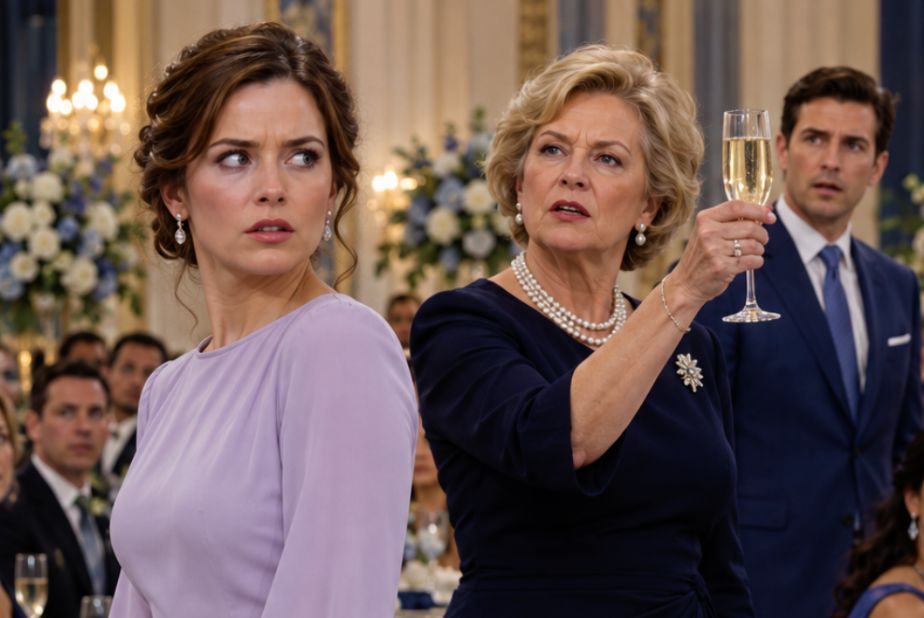
— Attention, everyone, I have an announcement!
Zinaida Pavlovna stood up with her glass in hand, looking as solemn as if she were about to present a state award. The glass trembled slightly, but her voice rang out loud and clear across the apartment.
I was sitting next to Lesha, absent-mindedly straightening the napkin on my lap. We were there to celebrate my father-in-law, Boris Ilyich’s seventieth birthday—a man as quiet as a winter morning. He sat at the head of the table, smiling as if apologizing in advance for everything that was about to unfold.
And a lot was about to happen. I sensed it the moment we arrived, when Zinaida Pavlovna greeted us at the door with an expression like we’d just missed our own farewell party.
— Faina, you could have done your hair better, she said to me instead of hello.
My hair was perfectly fine. But arguing with Zinaida Pavlovna about hairstyles is like arguing with the wind about its direction. Pointless, and your hair still ends up a mess.
Lesha silently took off his jacket. He’d long since learned to ignore his mother’s jabs, like someone living by the railroad eventually stops hearing the trains.
Boris Ilyich’s apartment smelled of cabbage pies and something floral—lilies, maybe. In the living room, a huge photo of the guest of honor hung on the wall: young, in military uniform, with a mustache that made you want to stand up and salute. Next to it, someone had pinned a balloon with “70” printed on it. It had already lost some air and looked rather philosophical.
There were about fifteen guests in total. Neighbor Klara Semyonovna, Boris Ilyich’s cousin from Kaluga, colleagues, a couple of Zinaida Pavlovna’s friends. And the two of us—Lesha and me. The perfect cast for a true family performance.
The first hour passed peacefully. Toasts, Olivier salad, herring under a fur coat. Boris Ilyich received everyone’s best wishes with the dignity of a captain accepting keys to the harbor. He stacked greeting cards into a neat pile. One—drawn in markers by his granddaughter—he set aside and gently ran his finger along it.
Meanwhile, Zinaida Pavlovna oversaw the whole process. Who needed a top-up, who to pass the bread to, who needed a little hint to slow down on the main course. She managed the table like an air traffic controller at rush hour.
— Klara, isn’t that a bit much for you? Remember your blood pressure.
— Zina, I can manage just fine, Klara Semyonovna replied, purposely helping herself to a third piece of pie.
I ate in silence. So did Lesha. Over the years, we’d perfected our strategy for family events at my mother-in-law’s: act like spies behind enemy lines. Don’t draw attention, make no sudden moves, and blend into the wallpaper whenever possible.
But in the second hour, Zinaida Pavlovna stood up. And the way she straightened her blouse and adjusted her brooch made it clear: this was it. This was what she had baked three pies and set out the dishes for since morning.
The most important moment of the party wasn’t when the candles were blown out. And it wasn’t when Klara Semyonovna dropped her glass. The truly important thing happened later, though I had no idea then how it would turn out.
— Dear guests, Zinaida Pavlovna began in the tone usually reserved for reading verdicts, — Boris Ilyich and I have been together for forty-seven years.
Boris Ilyich nodded. For nearly thirty years, he’d nodded at everything his wife said. It wasn’t so much agreement as it was a learned reflex.
“And of course, we’re thinking about the future. About what will happen when we’re gone.”
The table fell silent. Even Klara Semyonovna stopped chewing.
“This apartment,” Zinaida Pavlovna swept her arm around the room as if showing off a stage set, “is three rooms, in the center, you all know that. And we decided to discuss it in advance.”
Alyosha next to me tensed up a little. I put my hand on his knee. Stay calm. We’re scouts, after all.
“The big room,” Zinaida Pavlovna continued, “will go to Vera.”
Vera is Alyosha’s sister-in-law. The youngest sister. She lives in the Moscow suburbs, visits once every six months, calls on holidays. She didn’t come to the anniversary, by the way. She sent a postcard with a kitten and transferred three thousand rubles.
“The second room is for Vera’s son Pavlik when he gets older.”
Pavlik is four. He doesn’t even suspect yet that there’s such a thing as the apartment question, which, as we know, has spoiled all Muscovites.
I waited. Alyosha waited. Everyone was waiting.
“And the third room will be for…” Zinaida Pavlovna paused, “…well, we’ll figure it out. Maybe we’ll rent it out.”
That was it. The list was finished. Three rooms. Vera, Pavlik, “we’ll figure it out.” Alyosha wasn’t on that list. As if he wasn’t born, but just found on the street and let join the table out of politeness.
The kind of silence fell over the table when everyone wants to cough at once, but they’re all afraid to.
Klara Semyonovna looked at me. I looked into my plate. Alyosha looked out the window. Boris Ilyich looked at his wife with an expression I’d never seen on him before.
“Zina,” someone from their work friends quietly said, “what about Alyosha?”
“What about Alyosha?” Zinaida Pavlovna raised her brows so high they nearly blended into her hairline. “Alyosha’s a grown man. His wife works, he works. They’ll manage.”
She said “they’ll manage” in the same tone people use for “they’ll scrape by.” And then she smiled.
I felt Alyosha clench his fist under the table. But he stayed silent. My husband is a patient man. Sometimes I think he’s too patient.
“Mom,” he began.
“Alyosha, not now,” Zinaida Pavlovna cut him off. “Today is your father’s day.”
This was her signature move. Any uncomfortable conversation, she’d cover with a lid like a pot—”not now” or “not in front of people.” And then “not now” would turn into “we already talked about it,” even though no one actually had.
The guests stirred. Someone reached for the decanter. Someone else suggested, “Let’s toast the birthday man again.” The awkwardness spread through the room like spilled compote on a tablecloth—everyone saw it but pretended nothing happened.
I poured myself some berry juice. Honestly, I long ago stopped being surprised by Zinaida Pavlovna’s maneuvers. After twelve years of marriage, I’ve seen it all. I remember at our wedding she made a toast where she mentioned Alyosha’s ex-classmate Sveta—”such a smart and beautiful girl”—three times. I remember when our daughter was born, she gave us a set of pots and said, “Now at least you’ll learn how to cook.”
But this move with the apartment—now that was something new. Before, she only made little jabs. But now, she did it right in front of everyone, with Olivier salad and cabbage pies on the table.
After her announcement, the whole evening went sideways. Toasts sounded forced. Klara Semyonovna started loudly talking about her dacha, obviously trying to cover up the awkwardness. Zinaida Pavlovna’s friends started whispering to each other.
But Zinaida Pavlovna herself looked radiant. She was proud of herself, like a director after a premiere. She was giving everyone salad, pouring tea, asking, “So, how’s the pie? Not too salty?” As if five minutes ago she hadn’t just crossed her own son off the apartment list right in front of the whole family.
Lyosha got up from the table and went out to the balcony. I stayed sitting. I would have followed him, but I knew he needed to be alone. He’s always like that—quiet, withdraws, thinks. Then he comes back and says something calm and precise. But that comes later.
Meanwhile, I sat and watched Boris Ilyich slowly folding and unfolding his napkin. He’d been silent the whole evening. Really, he always went quiet whenever Zinaida Pavlovna spoke. But this time, his silence was different. Dense, like the silence before a storm—only no one expected a storm from Boris Ilyich, because with him, there had never been one.
“Boris Ilyich, could you tell us about your service?” someone from his old workmates asked, trying to steer the evening back to a safer topic.
Boris Ilyich nodded. But he didn’t tell any stories.
Instead, he stood up. Slowly, steadying himself on the edge of the table, like a man who knows exactly why he’s getting to his feet.
“Zina,” he said.
Zinaida Pavlovna turned away from the stove, where she’d been fussing with the kettle.
“What is it, Borya?”
“Please, sit down.”
She sat. And that was already unusual, because Zinaida Pavlovna never sat down just because someone else asked her to. She’d only sit if she chose to.
Boris Ilyich remained standing. Seventy years old, bad knee, blood pressure at one-fifty. But he stood ramrod straight, just like in the photo on the wall.
“I want to say something,” he said quietly but clearly, so everyone could hear, even Klara Semyonovna, who was now on her third glass. “Zina just told you about the apartment. I listened.”
A pause.
“Listened with interest,” he added, with a flicker of something like a smirk in his voice.
Zinaida Pavlovna straightened up in her chair. Her cheeks turned pink.
“Borya, we already discussed this…”
“We didn’t discuss it, Zina. You discussed it. With me, you didn’t discuss anything. You were talking to Vera on the phone, when you thought I was napping after lunch.”
The silence around the table got so thick, you could slice it up and serve it like aspic.
“I wasn’t sleeping,” said Boris Ilyich. “In fact, I rarely sleep after lunch. I just lie there and listen to the radio. But that time, the radio was off, and you were speaking loudly.”
Klara Semyonovna covered her mouth with her hand. One of Zinaida Pavlovna’s friends gripped her teaspoon like it might save her.
“The apartment,” Boris Ilyich continued, “is in my name. I’ll be the one to decide about it.”
He said it without any pressure, no edge in his voice. Just a fact. Like: “It’s raining outside,” or “The kettle’s boiled.”
“Borya!” Zinaida Pavlovna stood halfway up.
“Sit down, Zina. I’m not finished.”
She sat down. For the second time that evening.
At that very moment, Lyosha returned from the balcony. He stood in the doorway, frozen, sensing he’d walked right into the middle of something important.
“Lyosha,” Boris Ilyich called, “come here.”
Lyosha walked over. His father gave him a long, searching look—the kind you give someone you haven’t seen in ages, even though it had only been two minutes since they last saw each other.
“Son, I want you to know something. This apartment—it’s for the family. For the whole family. You are part of this family. So is Faina. And my granddaughter. And Vera, of course. But I’m not planning to split anything up right now, because, thank God, I’m still alive, and I hope to be for some time.”
He smiled gently, almost apologetically, as if he was sorry to have to state something so obvious.
“But as for arrangements, just in case—” he picked up a glass of mineral water from the table, “I left everything with the notary. Six months ago. Zina doesn’t know about it. Or rather, she didn’t know.”
Zinaida Pavlovna went pale. Then she turned red. Then she settled into some in-between color for which there is no word in Russian.
“Borya, are you… Are you doing this behind my back?”
“Behind your back, Zina,” he answered calmly, “I went to the notary. And behind my back, you were divvying up my apartment over the phone. I think that makes us even.”
Klara Semyonovna slapped her palm on the table and announced:
“Now that’s what I call a birthday celebration!”
Someone laughed nervously. Others soon joined in. Within a minute, almost everyone was laughing—except Zinaida Pavlovna, who sat there looking like someone who had found herself on the wrong train and arrived in the wrong city.
Boris Ilyich sat down. He took his granddaughter’s card again, gently tracing the drawn sun with his finger.
“Well, how about some tea?” he said. “The pies are getting cold.”
Lyosha came back to the table and sat next to me. He didn’t say a word, just found my hand under the tablecloth and squeezed it.
Zinaida Pavlovna silently got up and went to the kitchen. There was a good deal of clattering with cups and saucers. She returned with the teapot and poured tea for everyone, her face so intensely focused you’d think the fate of humanity depended on her pouring skills.
No one mentioned anything more about the rooms, or about Vera, or about Pavlik. The conversation casually drifted to Klara Semyonovna’s dacha, the price of tomatoes, and how “winters used to be much colder.”
I sipped my tea and thought about Boris Ilyich. For forty-seven years, he had stayed silent. For forty-seven years, he nodded, agreed, slipped away to his room whenever Zinaida Pavlovna started gathering momentum. Everyone got used to it. Everyone decided that’s just who he was. Quiet. Passive. Like a piece of furniture with the right to speak, though he never used it.
But as it turns out, he listened to the radio when he wasn’t sleeping. And he went to the notary while his wife thought he was out walking in the park. And he waited. Patiently, in his own way.
I suppose every quiet person has that moment when silence comes to an end. Not with a shout, not with a scandal. Just a perfectly timed phrase, said in front of the right people.
We left around ten. In the entryway, Zinaida Pavlovna handed me my coat. Silently. It was the first time in twelve years she had ever done that.
“Thank you,” I said.
She nodded. And you know, there was something new in that nod. Not kindness, no. More like a sort of bewilderment. Like someone who’s played chess alone all their life, and suddenly there’s an opponent sitting across from them. And he’s just made his move.
Boris Ilyich walked us to the elevator.
“Dad,” said Lesha, “thank you.”
Boris Ilyich shook his hand—firmly, like a real man.
“There’s nothing to thank me for, son. Happy birthday to me.”
The elevator arrived and the doors slid open. We stepped inside. Boris Ilyich stayed standing in the hallway, wearing his special anniversary shirt with one button undone, looking like he’d just shed ten years.
The doors closed. Lesha stayed silent all the way down to the first floor. And then he said:
“You know, Faina, I think this was his best birthday yet.”
I didn’t argue. We stepped out into the autumn evening, breathing in the scent of wet leaves and catching the distant bark of a dog. We walked home, taking our time, since there was no reason to hurry.
At the table, many people stay quiet—but carry the feelings with them for years.