Anna learned to give injections when she was eighteen.
She picked up intramuscular injections from a video online, and subcutaneous ones thanks to a nurse at the local clinic who visited once to show her, then said, “You’ll do the rest yourself, girl, I have forty more homes like yours.” Anna practiced on an orange. She later ate the orange, because there was nothing else in the fridge.
Her father was forty-four back then. In October, he suddenly fell very ill at work, right in the workshop, by the machine. After that, his entire left side barely functioned: his arm, his leg, half of his face. He could hardly speak for the first few months, only mumbling and crying when things wouldn’t work out.
By then, her mother had already been living in another city with a new husband for six years. She called once and asked if she could help. Anna said, “There’s nothing you can do.” Her mother seemed relieved to hear it.
In August that year, Anna got accepted to study architecture in St. Petersburg, on a full scholarship. She withdrew her documents in November. She made the train trip there and back in a single day because she couldn’t leave her father alone for longer.
For the next three years, she worked night shifts as a cashier at a 24-hour store across the street, so she could run home in two minutes if the neighbor called. Days were spent with her father—injections, massages, exercises from the rehab specialist. She fed him with a spoon, then taught him to hold it himself. Washed him, changed him, turned him in bed to avoid bedsores. Pushed his wheelchair to the clinic along broken sidewalks. At night, she sat at the cashier’s counter. She slept in short bursts, three or four hours at a time.
After three years, her father managed to walk again. First with a cane, then without. His speech mostly came back. His left hand was still weaker than his right, but he learned to live with it. He returned to work at the factory, this time as a foreman on lighter duties.
By the age of twenty-one, Anna suddenly realized she had nothing to call her own. No education, no friends—they had all moved on. No career. No life outside of her father, cashier work, and injections.
She started from scratch. She finished college by correspondence in graphic design. Worked at a small print shop, then at an advertising agency. Spent nights working on her portfolio. By twenty-eight, she became an art director. Her own team, her own projects, her own salary.
This was her life. Pieced together late, and only by sheer willpower. Anna was deeply afraid of losing it.
She met Maxim at a mutual friend’s company party. He worked as a manager at a construction firm—calm, dependable, with a great sense of humor. And he was a good listener.
She told him about her father on their third date. Everything: her father’s serious illness, the St. Petersburg University of Architecture, the nights spent working the register, the practice injections on an orange. Maxim listened without interrupting. Then he took her hand.
“That must have been so hard for you,” he said.
“Yes.” Anna fell silent. “You know what scares me most? That it’ll happen again. That I’ll end up owing everything to someone else, once more. That I’ll have to put my life on hold again. I can’t do it anymore. I just can’t.”
“It won’t happen again,” Maxim said. “I promise.”
They dated for about three years. They planned to get married a year and a half after they met, but decided to save up for a down payment on an apartment first—why start family life in a rented studio? So they postponed for a year.
A year later, when they nearly had enough for the down payment, Maxim’s mother, Olga Petrovna, had heart surgery. She had a valve replaced. The surgery went well, but her recovery was slow. The wedding was postponed again.
After the operation, Olga Petrovna could take care of herself. She walked around her apartment, cooked simple meals, bathed, and dressed on her own. But she got tired quickly. After half an hour on her feet, she’d sit down, pale and breathless. She couldn’t carry bags from the store anymore. She couldn’t do any cleaning, or wash floors and windows at all. She was afraid to go to the doctor alone: once, her head spun on the bus and she needed help to get off.
Maxim went to her place every evening after work. He would bring groceries, cook meals for two or three days ahead, clean up, change her bed linens. On Saturdays, he drove her to the cardiologist.
Anna helped him out. Not because anyone asked her to, but because she saw how tired he was and wanted to support him. She went with him on weekends, washed windows, accompanied Olga Petrovna to the clinic when Maxim couldn’t. Olga Petrovna was a quiet, gentle woman who always apologized for the trouble and tried to sneak pastries into Anna’s bag.
But little by little, Anna started to notice changes in Maxim’s wording.
At first, he would say, “I need to go to my mom’s.” Then it became, “We need to go to my mom’s.” Later, “Anya, can you take my mom to the doctor on Saturday? I’ve got a meeting.” It wasn’t a question anymore—more of a directive. Then, “It’s our shared responsibility, Anya. We’re almost family.”
Anna noticed it and tried to brush it off. He was just tired. His mom was recovering from surgery. This was only temporary; Olga Petrovna would get better soon.
Four months before the wedding, Maxim brought up moving.
“Listen,” he said one evening over dinner at her rented studio. “How about we live with my mom after the wedding? Just temporarily, until she gets back on her feet. It’s hard for her alone, but if we’re there, it’ll be easier. Plus, we won’t have to pay rent, so we’ll save up for our own place faster.”
Anna hesitated. She didn’t like the idea—something tightened inside her—but his reasons sounded sensible.
“How long is ‘temporarily’?”
“Well, a month. Maybe two.”
“Let’s do it this way,” Anna said. “Three or four weeks. Until we get used to it, until we figure out how things are with Olga Petrovna. Then we’ll see—maybe she can manage on her own. Does that work for you?”
“Sure,” Maxim agreed easily.
At work, Anna arranged with her boss to leave at four instead of six for the first month after the wedding. That way, she could make it to help Olga Petrovna with dinner. Her boss grumbled but agreed: Anna was known for her good reputation and often stayed late anyway.
But when Anna told Maxim about this, he didn’t seem happy at all.
“At four?” he grimaced. “Anya, that’s not good enough. With your schedule, you can’t really take care of her. Mom needs someone there during the day. And you’re at work until four. What’s the point?”
“So what do you suggest?”
“Well…” He hesitated. “Never mind. We’ll deal with it after the wedding.”
Back then, Anna didn’t pay much attention to his “after the wedding” comment. People get nervous before big events—everyone does.
The day before the wedding, on Friday, Anna went to Olga Petrovna’s to drop off some boxes with her things. The move was planned for Sunday, after the banquet, but they’d decided she could bring some stuff ahead of time.
Maxim said he’d be at his mother’s by six. Anna got free earlier, at half past five: her colleagues gave her flowers, a funny card, and a cake to send her off at work. She went up to the third floor with two boxes in her arms. The apartment door was ajar: Olga Petrovna must’ve been expecting them both and left it unlocked.
Anna put the boxes down in the hallway. She wanted to call out, but voices drifted from the kitchen—Olga Petrovna and Maxim, talking. He must have arrived early too.
“…I’m so scared, Maximka,” Olga Petrovna said softly, almost plaintively. “I’m afraid of being a burden to you. Anya’s young, she has her job, her own life. And here I am, with my heart problems. Why does she need all this?”
“Mom, don’t worry,” Maxim replied. “You’re no burden at all. After the wedding, Anya will leave her job.”
Anna froze in the hallway.
“She’ll leave?” Olga Petrovna was surprised. “She told me she just got a promotion.”
“So what? She can find another job later, if she wants. What matters now is that she’s here for you. My salary is enough for the three of us, I did the math. She’ll be at home—cooking, cleaning, taking you to your doctor’s appointments. She’ll be there with you during the day, so you’re not alone.”
“And is she okay with this?”
A pause.
“I haven’t told her yet,” Maxim said. “I’ll tell her after the wedding. She’ll understand. She knows what it’s like to care for someone who’s ill—her father was sick.”
Anna stood in the hallway between her two boxes, both labeled with marker: “Anna. Clothes.” “Anna. Books.”
She felt like the floor beneath her feet had tilted.
So they had decided everything a long time ago. Without her. Maxim had already calculated whether his salary would be enough for the three of them. Decided she’d cook, clean, take Olga Petrovna to the doctor. That she’d be home during the day. That the career she’d spent eight years building—through nights working retail and correspondence college, her first portfolio and a tiny print shop—would just be something she could “find again later.”
And he planned to tell her all of this after the wedding. When it would be too late. When she would already be his wife, moved in with boxes to his mother’s house and unable to just turn around and leave.
“She’ll understand. She had a father.”
He used her past. Her deepest fear, the one she confessed on their third date while holding his hand. He took that fear and decided that if she survived it once, she could survive it again. She knew how, after all. She knew exactly what it felt like.
Anna quietly left the apartment. She left the boxes in the hallway. She walked down the stairs, stepped outside to the yard, and sat in her car for a long time without starting the engine.
That evening, Maxim called.
“Anya, where are you? Mom says the boxes are standing there, but you’re gone.”
“I dropped them off and left. I’ve got a headache.”
“Oh, get some rest then. Tomorrow’s a big day. Love you.”
“Bye, Maxim.”
She didn’t sleep that night. She sat on the windowsill in her studio, staring out at the dark yard, lost in thought.
She thought about calling him right then to say everything. She didn’t. It felt wrong to say it over the phone. She wanted to see his face when she asked.
She thought about calling her father, too. But she didn’t. Tomorrow he’d be at the registry office, in the new suit they’d picked out together a month ago. He was so happy for this wedding. He loved Maxim very much. She didn’t want to wake him at three in the morning.
At dawn, she showered and dried her hair. At eight, the makeup artist arrived; at nine, the hairstylist. Anna sat in front of the mirror while they did her hair, staring at her reflection. A beautiful bride in a white robe. Her eyes were a little red, but you couldn’t see it under the makeup.
She put on her dress at half past ten. Simple, no puffy skirt, cream-colored, with bare shoulders. She looked in the mirror and thought: what a beautiful dress. What a pity.
The ceremony was scheduled for twelve. Guests started gathering by the registry office at half past eleven. About thirty people: friends, colleagues, Maxim’s relatives, Olga Petrovna in a festive blue dress, pale but smiling. Anna’s father in his new gray suit. He saw his daughter as she got out of the car, and his lips trembled.
“Anechka,” he said. “You’re so…”
He didn’t finish. He hugged her gently, trying not to wrinkle the dress.
Maxim was standing by the entrance in a dark blue suit, a boutonnière of a white rose. When he saw Anna, he smiled and walked toward her.
“You look beautiful,” he said.
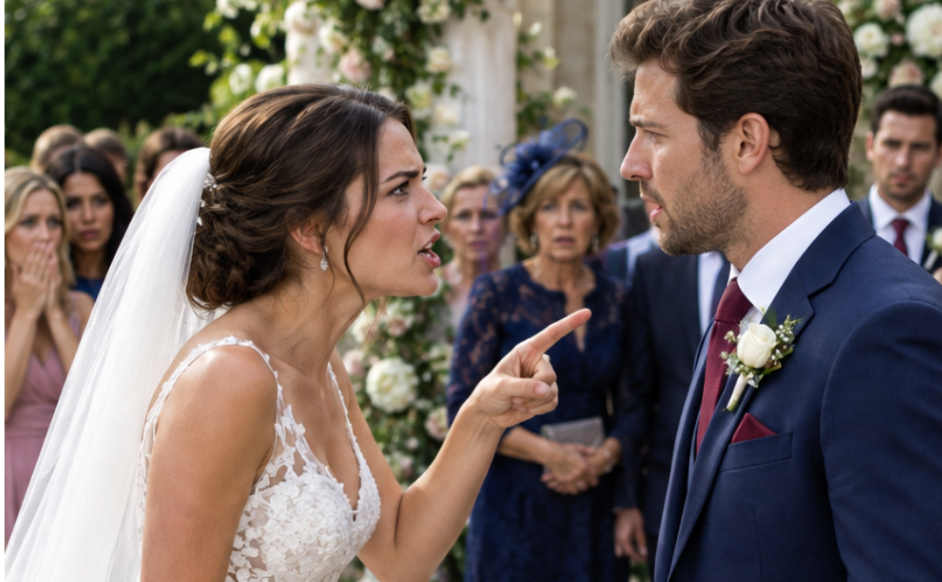
“Maxim, we need to talk. Now.”
He looked surprised.
“Now? Anya, they’ll call us in fifteen minutes.”
“Exactly. Now.”
She took his hand and led him to the side, around the corner of the building, to the old linden tree. The guests watched them with curious eyes. Someone cracked a joke about “last minute advice.”
“Anya, what’s wrong?” Maxim asked when they stopped under the tree.
“I was at your mom’s yesterday. At half past five. I brought the boxes.”
He turned noticeably pale.
“And?”
“And I heard your conversation. In the kitchen. About how I’d quit my job after the wedding.”
Maxim was silent for a moment. Then he said:
“Anya, let’s not do this now. They’ll call us in ten minutes. Let’s get married, and we’ll talk about everything calmly in the evening.”
“No. Now. Is it true?”
“Well…” He rubbed his forehead. “I was planning to tell you. After the wedding.”
“Why after?”
He averted his eyes.
“Because you wouldn’t agree right now.”
“You knew that?”
“Well… yes. I did.” He sighed and finally looked straight at her. “Anya, you have to understand. Mom needs someone with her. During the day, all the time. She’s scared to be alone. With her heart, you never know. And you, with your job till six, or four, it doesn’t matter. That’s not real caregiving. That’s just for show. But later, when we’re married and you move in, you’d see for yourself that she needs help, and you’d agree. You’re kind. You’ve been through this yourself, with your dad. You know better than anyone what it’s like.”
“You know better than anyone what it’s like.”
Anna looked at him and did not recognize him.
“Why me?” she asked. “Why should I be the one to quit my job? Why not you?”
“Come on, Anya.” He even gave a slight smirk, as if she’d said something naïve. “I’m a man. I have to earn, provide for the family. A woman should take care of the home, of family. That’s how it’s always been. It’s normal. My mom always lived that way, and she was fine.”
“My job, Maksim. I became art director just a year ago. I worked for this for years. After my dad, after all those nights at the cash register, after studying part-time. You know how hard I worked for this. I told you about it.”
“You’ll find another later. You’re talented.”
“And my life?”
He didn’t understand the question. She could see it on his face—he truly didn’t get it.
A voice called out from around the corner: “Young couple! They’re calling you! It’s time!”
Maksim took her by the elbow.
“Come on, Anya. Let’s go, let’s sign the papers, and we’ll talk it all through this evening, I promise. Please don’t make a scene. Everyone’s waiting. Mom’s waiting. Your father is too.”
Anna looked at his hand on her elbow.
In ten minutes, this man was supposed to become her husband. She was supposed to say “yes,” put her signature in the book, slip a ring on his finger. And then move, with her boxes labeled ‘Anya. Clothes’ and ‘Anya. Books,’ into his mother’s apartment. And maybe that very first night, during the celebration dinner, he’d tell her she was quitting her job. That it was already decided. That this was normal, and it had always been that way.
He had intentionally waited for the registration. He knew she’d refuse before the wedding and that’s why he kept quiet. He was counting on the fact that after the wedding, she’d be trapped.
He knew her greatest fear. And calmly, businesslike, he set it up for her.
The man standing in front of her in a navy blue suit with a white rose in his lapel was a stranger. A complete stranger. As if she’d been dating someone else for three years, and this morning he was replaced.
She pulled her elbow free.
“So after the wedding I’m supposed to quit my job and take care of your mother?” she said quietly. “Find another wife, Maksim.”
She slipped off the ring he had given her for their engagement—a simple diamond—and held it out to him.
Maksim stared at the ring in his palm and didn’t move.
“Anya,” he said at last, his voice hoarse. “Come on. Let’s just sign the papers, and then we’ll talk. If you want, you can keep working. If you want, we’ll hire a caregiver for Mom. Whatever you want. Just let’s sign the papers. Everyone’s waiting.”
“No.”
“Anya, this is silly! Over just one conversation!”
— Maksim. If I hadn’t shown up half an hour early yesterday, you would have told me tonight. When we were already husband and wife. When I was already standing with my boxes in your mom’s apartment. You would have just laid it on me. That’s exactly what you were counting on.
He stayed silent.
— Is that what you would have done? she asked.
He didn’t answer. The answer was obvious.
Anna turned and walked back to the porch.
There were guests gathered at the porch—thirty well-dressed people, holding flowers and balloons. The lady officiant in a burgundy suit peeked out from the doorway. Olga Petrovna, in her blue dress, clung to the railing. Anna’s father stood off to the side in his new gray suit.
Anna went up to him.
— Dad, can you drive me home? Please.
Her father looked at her—at her face, at her hand without a ring. Then at Maksim, who came around the corner pale, holding the ring in his fist.
He didn’t ask anything. He took her arm with his strong right hand and led her to his car.
The guests made way. Someone gasped. Someone started to ask something, but her friend Katya tugged at their sleeve. Olga Petrovna stared at Anna with wide eyes, gripping the railing. As Anna passed by, she paused for a second.
— Olga Petrovna, she said. — You’re not to blame for anything. Truly. Take care of yourself.
The mother-in-law, who never became a mother-in-law, opened her mouth to say something, but didn’t.
That evening, Anna sat in her dad’s kitchen. She was still in her wedding dress—she didn’t have the strength to change. Her dad made tea and took out cookies from the cupboard, probably bought for tomorrow, ‘for the newlyweds.’
They sat in silence for a long time.
— Dad, Anna finally asked. — Are you mad?
— About what?
— The wedding. You were so happy. You even bought a new suit.
Her father turned the cup in his strong hand.
— Anya, he said slowly. He still spoke a bit more slowly than before he got sick, and sometimes paused to find words. — I still remember everything. Those years. How you gave me injections. How you worked nights at the register, then did exercises with me in the morning. How you went to St. Petersburg to pick up documents. I used to lie there thinking, my daughter is spending her whole life on me. Nineteen years old, and instead of going to university, she’s here with me, an invalid. I was so ashamed, I felt like howling.
— Dad, it wasn’t your fault.
— I know it wasn’t. You don’t choose to get sick. He paused. — But if you had married him today, and things turned out like this again… I’d never forgive myself for not stopping you.
Anna started to cry. For the first time all day. Her father sat next to her, stroking her head awkwardly with his weak left hand.
On Monday, after the wedding that never happened, Anna went to work.
She had scheduled two weeks off for her honeymoon in Kaliningrad—tickets and a seaside hotel. She returned the tickets. She had called HR on Sunday night asking to cancel her leave.
Her boss almost dropped his coffee when he saw her at the door at nine in the morning.
— Anna? Aren’t you supposed to be…
— I changed my mind about taking time off, Igor Valentinovich.
He looked at her closely, at her hand without a ring. He didn’t ask anything, just nodded.
— Well, since you changed your mind. We just got a big new order from the coffee shop chain. Will you take it on?
— I’ll take it.
Anna walked into her office—a small room with a glass wall, behind which her team sat. She hung her coat on the rack, turned on her computer, and opened a new folder for a coffee shop chain’s project: logo, packaging, display design.
Beyond the glass, her designers—three young guys—exchanged glances and whispered. They probably already knew. Gossip spread fast in the agency.
Anna picked up a pencil, placed a blank sheet of paper in front of her, and started to sketch her first draft: a coffee cup with steam rising from it.
Three days later, Maxim came to see her at the studio.
He stood at the doorway holding a bouquet of white roses, looking disheveled and unshaven.
“Anya. Let’s talk.”
She let him in, but didn’t invite him into the room. They talked in the narrow hallway.
“Do you understand what you did?” he said. “You destroyed our family. With one conversation. Right before the registry office. Three years, Anya. Three years! All because of one sentence!”
“We weren’t a family, Maxim.”
“We were! Almost were!”
“No,” Anna shook her head. “The family didn’t end at the registry office. It ended earlier. When you decided for me how I’d live. When you counted your salary for three and thought my job didn’t matter. When you told your mom ‘she’ll understand, her father was the same.’ You decided everything without me, planning to tell me about it later, when I’d have nowhere to go.”
“I thought it would be better that way.”
“For who?”
He was silent.
“You expected me to give in,” Anna said. “After the wedding. You thought I wouldn’t be able to turn back. That I was used to giving in, because once I already dropped everything for my dad. That’s what you were counting on, Maxim—me giving in.”
He stood there for a while. Then, he put the bouquet on the hall stand and left. Later, she gave the roses to her neighbor, an elderly woman from the first floor.
A few days later, Maxim brought her some boxes from his mother’s apartment. He left them at the door without ringing the bell, just set them down. Anna brought them inside and never opened them again.
A month later, Olga Petrovna called herself.
“Anechka,” she said softly. “I wanted to say… I didn’t know Maxim hadn’t told you anything. Before the wedding he was so sure, it seemed like you’d decided everything together. Then he told me you agreed at first, but then changed your mind. I would never… Please forgive me, dear.”
“Olga Petrovna, you have nothing to apologize for.”
“Yes, I do. I saw how you used to come to us. Washing the windows, going with me to the doctors. I thought you wanted to help. But it turns out, it wasn’t like that.”
They were silent for a moment.
“How are you?” Anna asked. “How’s your heart?”
“I’m fine. Maxim found a caregiver for me, part-time. A good woman, Tamara. I’m used to it now.”
“I’m glad to hear that, Olga Petrovna.”
“Be happy, Anechka.”