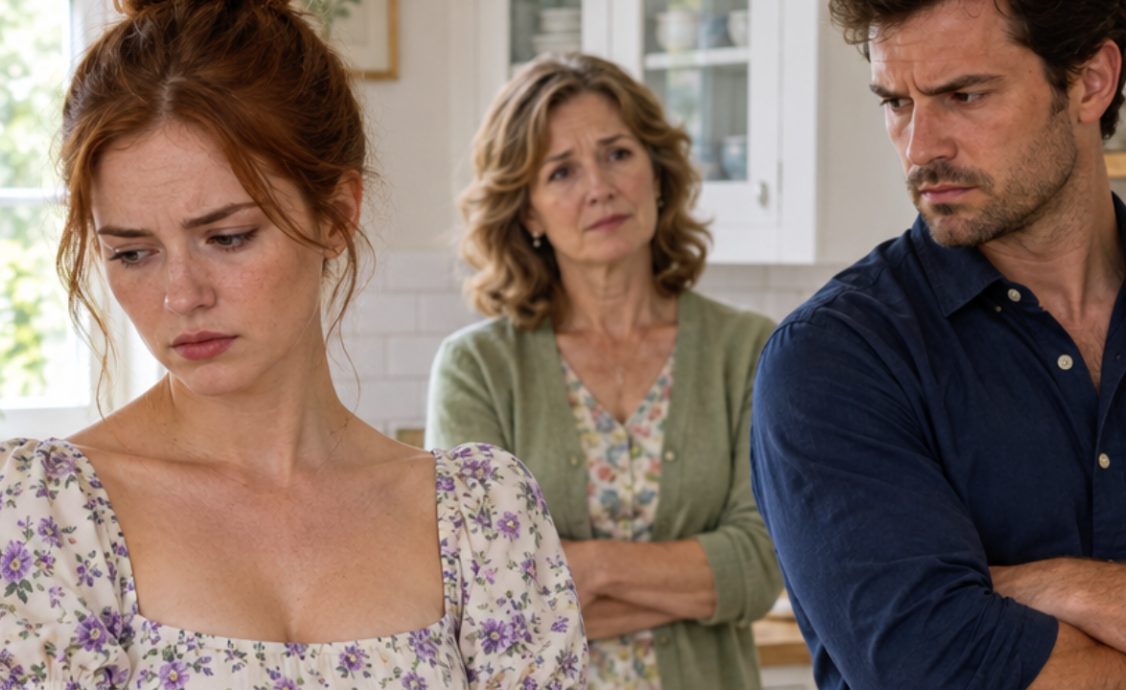
“Your borscht has gone sour again, Ol,” Alexei said with a barely concealed grimace, poking at his bowl with a spoon. “Maybe it’s time we changed the fridge? Or at least started making less.”
“Or maybe you could just eat faster,” Olga muttered without looking up from her phone. “Or even better, maybe you could just not come home at all. That way, at least the food would stay fresh.”
Alexei gave a weak, almost pleading smile. He sat straight at the kitchen table, as if someone was judging his posture. The table surface was chipped all over, and none of the plates matched—one was covered in flowers, another was a Soviet-era relic, and the third had a Megafon logo.
“I was just joking, Ol,” he said quietly, rubbing the bridge of his nose. “It’s morning. Why are you like this today?”
“Because your mom sent me a three-minute voice message yesterday,” Olga snapped, eyes finally lifting. “Do you want to listen to her call me a ‘greedy woman’, a ‘freeloader’, and an ‘ungrateful parasite’?”
“Well, she’s just…” Alexei started, then trailed off.
“What? Just what? She has eternal menopause? Or is she battery-powered by insults?”
“She’s just worried, that’s all. She’s living in a rented apartment. And you—you have eight million. She’s still my mother, after all…”
Olga put her phone aside. There was something steely in her gaze.
“You know, sometimes I wonder… are you really an accountant? Or is that just your cover for financial crimes? Because if you can really count, why can’t you figure this out: it’s my money. Legally mine. An inheritance from my grandmother—whom you, by the way, never visited. Not even once, Alexei!”
“I just… well… she lived in Voronezh…”
“And now, remind me, where does your mom live?”
“In Mytishchi…”
“And where’s our apartment?”
“In Lefortovo…”
“Exactly, such a long trip—just the same eight metro stations every time.”
Alexei fell silent. An awkward stillness filled the room. The spoons scraping on plates seemed almost embarrassed, too.
“She just wants a little place. Nothing big,” he whispered. “A simple one-bedroom. With a little yard. Just so she has her own. I mean, she shouldn’t have to live in a shed, right?”
“You know, I have a yard. It’s called the ‘Lilac Grove’ residential complex—front garden and parking, the whole deal. But for some reason, no one bought it for me. I earned it myself. Your mom doesn’t have grandkids, she doesn’t have a job, but she has enough ambition for three people.”
“Are you bringing up grandkids on purpose?” Alexei tensed.
“No, I’m just stating facts,” Olga replied coldly. “She worked twenty years in a pharmacy and only saved for lipstick. And now, by her logic, I owe her a house because… she gave birth to you. Perfect. Then you take care of her. I’ll look for a husband with less baggage.”
“That was hurtful,” Alexei muttered.
“But your mom sending me regular advice on how to behave—that’s just fine, right?”
“She’s just worried, that’s all,” he started again.
“Alexei, her whole vocabulary is three words: house, money, Olga. Everything else is just swearing or lecturing.”
The doorbell rang.
Olga raised her eyebrows.
“Speak of the devil…”
Alexei jumped up and smoothed his shirt, looking as if he was about to take a test.
“I’ll get it,” he said quickly.
Olga didn’t go into the hallway. She stayed in the kitchen, quietly chewing on a cabbage pastry—the only thing that reminded her of her grandmother. Her grandma used to bake them on weekends, carefully laying them on a tray under a clean kitchen towel. She never asked who owed what to whom; she just did it out of love.
“Well, here we are!” Tamara Petrovna announced cheerfully as she entered the apartment with a look of authority. “Are you eating that smelly cabbage again?”
“Come in, Tamara Petrovna,” Olga managed a forced smile. “Just don’t step on the rug. Last time you confused it for a rag.”
“It might as well be a rag,” her mother-in-law said, surveying the entryway. “Look, there’s dust everywhere. That’s what you get when the lady of the house isn’t a real housekeeper. If I had my own place, I’d have everything spotless.”
“Why don’t you put your own place in order first,” Olga couldn’t hold back. “Your personality, I mean.”
“Oh, here we go again!” Tamara threw up her hands. “I just walked in, and already I’m the enemy. All because of money. She’s got eight million, and I, an old mother, am stuck in a tiny rental with cockroaches!”
“The cockroaches are in your head, Tamara Petrovna,” Olga sighed, standing up. “And if you tell me one more time I owe anyone anything, I’m calling the police. Let them explain to you that adults are responsible for themselves—even if they’re sixty-three and know all the tricks to manipulate people.”
“You hear that, son?” his mother turned to Alexey. “And you said she was kind. She’s kicking me out on the street!”
“Mom, please, don’t start…”
“Don’t start?! I gave birth to you, changed your diapers, carried you to school myself! And now you can’t even help your own mother? What kind of man are you, really?”
Alexey stared at the two women like a referee who wasn’t given a whistle or the rulebook.
“Olga,” he said softly, “we could buy her a small house. Even if it’s just in Podrezkovo. I… I’ll pay you back, I promise.”
Olga froze.
“What do you mean, ‘we’ll buy’?”
“Well… I, uh… submitted the paperwork for a mortgage. Didn’t want to bother you. I did all the math, the money works out. At first, maybe you could…”
“You took out a mortgage?!” Olga asked quietly. “Whose name is it under?”
“Mine, of course. But you… you understand, right? It’d be easier for us to pay it off together…”
The kitchen fell silent.
Olga quietly walked over to the cupboard. She opened it. Took out two plates. Then she opened the window and approached it.
“Olga, what are you doing?” Alexey asked fearfully.
One by one, the plates went flying out the window, shattering loudly on the asphalt below.
“Those were the last plates from my dowry,” she said. “What you just heard was the sound of your trust breaking. And your marriage. Congratulations.”
“You can’t be serious…” he mumbled.
“I’m more serious than a mortgage in Podrezkovo. In two days, you’ll be living with your mother. I hope she has dishes. I’m now a free woman with eight million. And yes, I love cabbage pastries. Remember that, Alexey. That’s everything you didn’t know about me in ten years of marriage.”
Olga stood at the sink, mechanically rinsing out a cup. The hot, steamy water kept running, and it felt like it could wash everything away—the arguments, the accusations, and even that awful “Olechka” from Tamara Petrovna, which sounded like a knife drawn across porcelain.
Alexey tiptoed into the kitchen, as if he was afraid of startling someone—or maybe himself.
“Ol… are you… how are you?” he mumbled uncertainly, scratching his head.
“It’s hot,” she replied curtly without turning around. “I always thought hell must be hot. Looks like I was right.”
“What are you talking about now?…”
“Take a guess, Lyosha. You’ve got quite the imagination. After all, you managed to get a mortgage in your mother’s name behind my back. Without me. So you know how to take action. Getting independent, aren’t you?”
“Wait,” Alexey put up his hands, as if shielding himself. “You’ve got it all wrong…”
“Oh really? Then tell me how I’m supposed to interpret you going into debt at my expense?” She spun around sharply, staring straight into his eyes. “Come on, put your accountant hat on and explain: where’s the economic benefit—and more importantly, the human one?”
He hesitated, then sat down heavily at the table and stared into his mug, as if he might find a lifesaver inside.
“Mom… she… well, you know, she’s all alone… just renting… every month is a stress. She’s getting older, Ol. I just wanted… well, at least for her to have a place of her own, finally.”
“And who’s footing the bill for this happy ending, Lyosha?” Olga grabbed a towel and wiped her hands furiously. “Is my rented apartment keeping you up at night? Or is it your conscience that won’t let you rest because she’s not living in luxury?”
“I thought you’d help… You’ve got money now…”
“Did you even ask? Do you know that money came from my granddad, the one who raised me while your mom was bouncing around summer houses? That he saved it up for me, not your precious mother who, by the way, can’t stand me?”
He lifted his eyes.
“Well… maybe not quite can’t stand…”
“Oh, come on!” Olga laughed bitterly. “She’s always seen me as just an extra to you. And now I’m the ATM. ‘Olechka, sweetheart, you’re such a gem.’ But a mother-in-law is still a wolf—only now with manicured nails and hopes for a mortgage.”
Alexey stared out the window. The silence stretched on. The only sound was a drip from the faucet.
“I just didn’t think you’d go for the jugular like this,” he finally said. “You’re kind, you always understand everyone…”
“I am kind when I’m treated like a human,” she cut him off. “But when I’m treated like an object, that’s when my backbone shows up. You know, Lyosha, if you’d come to me honestly and said: ‘Mom’s driving me crazy, I want to help her, let’s figure it out’ — maybe I would have agreed. But you chose to play the hero behind my back. So now, be a hero and pay the price yourself.”
“I thought we were a family…”
“You were wrong. I’m the family. And you’re just an adjective.”
There was a knock at the door. Not just any knock—the kind only mothers-in-law can pull off: short, loud, and insistent. Alexey flinched. Olga didn’t budge.
“Go on,” she said curtly. “Your happiness is waiting. Maybe she even brought your slippers.”
He opened the door hesitantly. Tamara Petrovna swept in like a storm, carrying a bag with a cake and a newspaper where ‘House 4.8 million’ was circled in bold.
“Olechka!” she beamed. “Sweetie, I was thinking—we could go check it out together, what do you say? That house is a dream! Just forty minutes on the bus, but you get your own garden! And room for grandkids—plenty of space for everyone to play!”
Olga didn’t even flinch. She simply turned to face her.
“Tamara Petrovna. We never switched to first names, did we?”
“Oh, come on now,” Olga’s mother-in-law giggled. “We’re practically friends now…”
“Friends?” Olga turned to Alexey. “Did you tell her?”
“Well… I thought it was time to prepare the ground…”
“Prepare the ground,” she repeated slowly. “Seriously. Did you forget that I’m married, not enslaved?”
“Olechka,” Tamara Petrovna interrupted, “why are you being so sarcastic? I mean well… I’m not asking for a palace! Just a corner! I have nothing! No husband, no apartment of my own!”
“For your information, I also had nothing,” Olga replied calmly. “But I didn’t come asking others for help. I worked. I lived. I kept my mouth shut when you pointed at my borscht. And now, when I finally got what’s rightfully mine, you show up to take a share. Well, Tamara Petrovna, buy yourself a house. Or live with the one who loves you so much that he took out a mortgage without asking.”
“You… you mean you’re turning me down?!” Tamara Petrovna’s eyes filled with tears. “I raised you! I welcomed you like a daughter! And you…”
“Exactly, you welcomed me. Not loved me. Do you know the difference between being accepted and being loved? Love means forgiving, acceptance is just putting up with someone. You always just put up with me. So… it all makes sense.”
Silence. Even the fridge seemed to stop humming.
“Then… I’ll curse you!” her mother-in-law suddenly shouted. “Money won’t bring you happiness! You’ll regret this!”
“Well, that’s just great,” Olga replied calmly. “Now, please leave. And take your cake with you—I’ve had enough sweetness, especially with such a bitter aftertaste.”
Tamara Petrovna screeched, turned sharply, and slammed the door. Alexey stood there, slumped like a schoolboy after a scolding. He wanted to say something, but couldn’t. He just opened his mouth, then closed it again.
“You’re going to go after her now, aren’t you?” Olga asked quietly.
He nodded silently.
“Go ahead. Just don’t come back. Not even for your slippers.”
Two months passed.
Olga lived alone. Without Lyosha. Without his quiet footsteps in the mornings. Without Tamara Petrovna’s calls, which always began with a sugary “Olechka, dear” and ended with “at least think about it, we’re family.”
She thought about it.
Every evening, sitting with a glass of wine in her new apartment, bought with just part of her inheritance. She chose it without any grandeur—not an ‘elite’ place, not a tower with covered parking, just an ordinary two-bedroom apartment in a classic Stalin-era building. High ceilings, old parquet floors, and a balcony with a real wrought iron railing. Her own.
For the first time in years, she felt what it was like not to be someone’s wife, daughter-in-law, or someone’s option. Just to be herself. Sometimes it was boring. Sometimes a little lonely. But—free.
One evening, Alexey called her. At first, she didn’t want to answer. But then she did. Maybe curiosity. Or maybe there were still a couple of splinters in her soul she wanted to pull out.
“Hi, Olga.”
“Hi. Did something happen?”
“Mom’s gone,” he said quietly.
She stayed silent. Not because she didn’t know what to say. Just because—she felt nothing.
“Heart attack. At the store. She argued with the cashier over expired mayonnaise. Her heart couldn’t take it.”
“Alright. I don’t need condolences if that’s where you’re going with this.”
“No, I’m not holding a grudge. It’s just…” He swallowed. “We’ve said so much to each other.”
“Yes,” she replied calmly. “But I don’t take any of it back.”
“Me neither.”
Silence. Just an ordinary city phone line. Even in the pause, life continues: cars, sirens, footsteps heard through the receiver.
“She still has that mortgage,” he muttered. “Now I’m carrying it on my own. Honestly, I can’t manage it. I want to sell. Move somewhere simpler. Maybe just a single room to start with.”
“Why are you telling me this, Lyosha?”
“I don’t know. Maybe I wanted you to feel sorry for me.”
“Well, I don’t.”
He fell silent.
“You’ve changed.”
“No, Lyosha. I just stopped pretending.”
A week later, Alexei showed up at her door. No flowers. No cake. Just a folder of documents and a tired look. She opened the door for him like he was an old acquaintance—not an ex, not an enemy, but like he was a chapter in her life that wasn’t quite finished yet.
“These are… the divorce papers. Please sign them.”
She took the folder. Sat down. Signed. He watched her like she was something he’d lost and only now realized how important it had been.
“I never expected you’d leave for good,” he said quietly.
“I didn’t expect it either,” she replied. “But you know, every woman has that moment when she gets up and walks out. Doesn’t slam the door. Doesn’t shout. Just quietly leaves. And then never comes back. Not for her slippers, not for the past.”
He nodded.
“Was I a bad husband?”
“No. You were average. And average is worse than bad. Because you remember the bad ones at least. The average ones are like gray wallpaper. Neither cozy nor irritating.”
He stood up. Wanted to say something. Apologize? Ask for something? But he changed his mind. Turned and left. Olga closed the door behind him and, for the first time since the divorce, took a deep breath.
Later, she went to the notary. There was still a small cottage in the village under her grandfather’s name, one she’d never touched. Maybe it could be a warm place for the summer? Or just silence and apple trees.
She got on a train. Arrived. The little house was at the edge of the village, peeling and worn, but felt like home. In the grass—a flower bed she and her grandfather had planted when she was ten. Overgrown now, but tulips still pushed through the sod. Real, bright, stubborn tulips.
She sat on the porch. Breathed in deeply. And she understood: money from the dead isn’t a curse. It’s an opportunity. As long as you don’t hand it out to the living who love you for the interest.
The next day she put in for a month-long vacation. No phone. No meetings. Just her, a notebook, and a house that smelled of old books and apples.
And for the first time in thirty-five years, she was at peace. Completely.