I was rummaging through the bottom drawer of the dresser, searching for a spare duvet cover. Katya was coming over for a sleepover tonight, and I needed to make up the couch. As I dug under a stack of bed linens, my hand felt something hard.
“What’s this?…” I muttered, pulling out a worn file folder tied shut with a rubber band.
Through the transparent plastic, I could make out the word “mortgage.” My heart skipped a beat. Without thinking, I sat down right there on the floor, leaning against the dresser, and pulled off the rubber band.
October rain was pattering against the window—a consistent, soothing noise that normally helped me unwind. But tonight, it started to get on my nerves, as if someone was drumming on them deliberately. Maxim wouldn’t be home for another hour—I had plenty of time.
My two years with Maxim had felt solid: no big arguments, shared plans, and a cozy sense that I had my person and our little nest. He was a dispatcher at a logistics company, earning about ninety thousand. I worked as a nurse at a private clinic—with my steady job and side gigs, I made around seventy. We pooled all our money: splitting groceries, utilities, and most importantly—our mortgage. Every month, I sent him my share: first fifteen thousand, then, when the rate went up—twenty. I did it gladly, believing I was investing in our future, in our apartment.
We’d moved into this two-bedroom place even before I officially moved in with Maxim. Eighth floor of a new building, with a balcony overlooking the park. He’d shown me around the apartment with pride back then:
“Here it is, Katyush, our family nest! Make yourself at home, run the place!”
And I did run the place. I picked out curtains, hung photos in frames on the walls, fussed over seedlings on the balcony, scrubbed dried paint drips off the windowsills after renovations. I’d put my own touch on every corner of this apartment. Every ruble I put into the mortgage, I saw as another brick in our shared home.
As I flipped through the contract, my eyes skimmed over the sections about interest rates, deadlines, and late payment penalties. None of that meant much to me. But when I got to the first page and the part about the parties involved, the blood drained from my face. In the “Borrower” field, the name wasn’t Maxim’s—it was his mother’s, Larisa Dmitrievna.
“This can’t be…” I whispered, reading the line over and over again. “Please, not this…”
My fingers went cold, I let the papers rest on my lap and just stared ahead for a while, not even seeing the closet doors across from me. The rain kept tapping on the windowsill—tap, tap, tap—and now that sound felt unbearable, like someone was hammering on my skull.
Fragments began to come together in my mind—bits that hadn’t made sense before now fit into a bigger picture. I remembered things my mother-in-law had said. Larisa Dmitrievna, a stern woman with pursed lips, visited us every couple of weeks, and each time, she’d casually remind me of my place.
One time she rearranged the dishes in the cupboard:
“Not like that. In my house, everything is arranged differently.”
Another time, eyeing the curtains, she commented:
“A bit too pricey for a rental, don’t you think?”
Back then, I didn’t really get what she meant by ‘rental’ and brushed it off as a slip of the tongue. Then one day, when I tried to speak up at the dinner table, Larisa Dmitrievna cut me off, staring me straight in the face:
“You, dear, are a nobody here. You don’t matter at all. Here today, gone tomorrow.”
I was so hurt I almost burst into tears. I rushed to the bathroom and splashed my face with cold water. Later that evening, I went to Maksim and told him what happened. He hugged me and stroked my hair:
“Don’t pay any attention, it’s just the way my mom is. She likes to be in control. It’s not out of malice.”
But now it all made sense: Larisa Dmitrievna was telling the simple truth. Legally, in this apartment, I really was no one. Just an invisible person paying twenty thousand a month for someone else’s property.
I slowly gathered the papers back into the folder. My hands no longer shook—instead I felt strangely collected. I didn’t bother putting the rubber band back on, just set the folder right in the middle of the living room table where it was impossible to miss, and sat down to wait.
Maksim came home just before eight. I heard the key turn, then my husband whistling as he took off his shoes in the hallway. Just an ordinary guy coming home after work on a regular Thursday. Unaware that this evening was about to be anything but ordinary.
He walked into the living room and stopped short when he saw the folder on the table and the look on my face. I saw a shadow of realization pass over him—he knew what I had found.
“Maks, please, sit down,” I said quietly.
“What’s going on?” he asked, sitting down at the edge of the sofa across from me, sneaking a look at the folder.
“I was looking for the duvet cover in the dresser and found this,” I started evenly, even though inside I was all over the place. “Do you know what I read in there?”
“Anya, please, don’t get upset…”
“Did I understand correctly? The apartment is in your mother’s name? The mortgage—Larisa Dmitrievna is the borrower? She owns it?”
He ran his hand over his face and let out a heavy sigh:
“Well… yeah. The apartment is in Mom’s name. But it’s just…”
“Two years,” I let each word drop into the silent room like a heavy stone. “Two years I’ve been paying for this apartment. Twenty thousand every month. I gave up things I wanted. I haven’t bought myself a winter coat in three years now—I keep wearing the old one, because of the mortgage, because I thought it was ours. Ours, Maks! You told me yourself—it was our family nest! But it’s your mother’s!”
“What difference does it make whose name is on it!” Maksim leaned forward. “It’s just paperwork! Mom had a better credit history, so they gave us a lower rate. That’s all. It doesn’t change anything!”
“Doesn’t change anything?” I gave a humorless laugh. “Then explain to me why you kept it secret for two years? If it was just paperwork, why didn’t you ever say, ‘By the way, Anya, the apartment’s in Mom’s name, but don’t worry about it’? Why did I have to find this out from some paper stuffed under the laundry, and not from you?”
Maksim opened his mouth, shut it again, and squirmed in his seat:
“Well… it just never came up in conversation.”
“Never came up in conversation,” I shook my head. “Two years, and it never once came up that your wife doesn’t know who owns the house she’s living in and pouring half her salary into.”
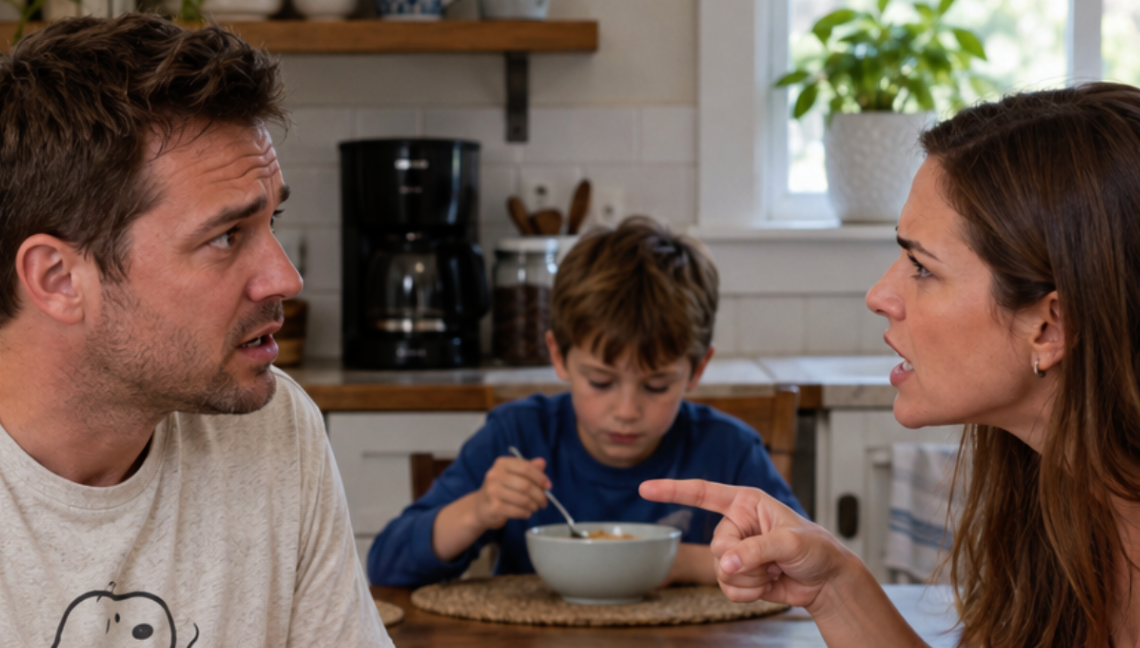
“Come on, stop making a mountain out of a molehill!” Maxim snapped. “Yes, it’s in my mom’s name. Yes, I didn’t tell you. Sorry, but I didn’t think it was a big deal. We live together anyway, so what difference does it make whose name is on the contract?”
“It makes a huge difference,” I said, standing up and pacing the room before stopping by the window. Outside, the rain turned the park lights into trembling, blurry spots. “If we break up tomorrow, what do I have left? I’ve put almost half a million into this apartment over two years. And I don’t have any rights to it. None at all. I’m basically paying for your mom’s apartment—your mom, who still calls me a nobody. And, apparently, she’s not lying.”
“This has nothing to do with breaking up…”
“It has everything to do with it, Max!” I turned around, my voice trembling. “You took my money—kept taking it for two years—and never told me the most important detail. That’s deception. Call it a technicality if you want, but you deceived me. By staying silent.”
Maxim stood up, stuffed his hands in his pockets, and paced back and forth:
“Fine. Let’s say I should have told you. I admit it, I didn’t. But what changes now? We still have to pay. The mortgage isn’t going anywhere. Your twenty thousand is still needed for the budget.”
And that’s when it finally hit me. He hadn’t even thought about giving a real apology. Didn’t even think about what I was going through right now. The only thing that bothered him was the possibility that I might stop paying.
“So,” I said slowly, “the scariest part for you in all this is that I might stop giving you money?”
“Well, how else are we supposed to manage?” Maxim blurted out the truth without even realizing it. “The payment is forty-two thousand a month. I can’t cover that by myself; I have a ton of other expenses! You have to…”
“I’m done paying for an apartment that belongs to your mother!” I cut him off sharply. “Do you hear me? Not another ruble. Enough. Two years of draining money into someone else’s home—enough.”
It felt like something snapped in the room. Maxim’s face turned crimson:
“What are you talking about?! Someone else’s place? We live here!”
“We live in your mom’s apartment. On borrowed terms. Where I’m a nobody—you’ve been confirming that with your silence for two years.”
“My mom just… she’s got her own personality!”
“Don’t talk to me about personality!” I raised my voice. “I could recite the ‘mom’s personality’ speech by heart! Every time she put me down, you’d make excuses for her! Now I finally get it—she just knew what I didn’t. That I’m nobody here. And she acted accordingly.”
Maxim clenched his fists. A spasm crossed his face, and he exhaled sharply through gritted teeth:
“If you’re not going to pay, then don’t live here. It’s my mom’s place, you said it yourself. If you’re not paying, pack your things. No one’s going to let you stay here for free.”
His words hung in the air. I stared at my husband—the man I’d been with for two years, the man I thought was mine—and I didn’t recognize him. How easily he said it. How quickly ‘our family nest’ turned into a weapon against me.
“Did you really just say that?” I asked quietly, feeling everything inside me go cold. “Out loud?”
“What’s the problem?” Maxim waved his hand in irritation. “Am I supposed to support you? From my own pocket?”
“Support me?” I couldn’t help but laugh, but the laughter came out bitter. “You call this support? I’m paying half the mortgage for an apartment that doesn’t even belong to me. I’ve poured my energy, time, and money into this—and you say you’re ‘supporting’ me?”
“So what? You’re living here! You’re using everything!”
“Yes, I’m living here. And I’m paying for it. So what am I actually doing—renting the place?” I shook my head. “You know what? You’re probably right. I don’t want to live in an apartment where my presence depends on how much money I put in each month.”
Not wanting to argue anymore, I walked to the bedroom, grabbed my travel bag, and started packing. Calmly: underwear, sweaters, toiletries, documents—now I truly understood how important it is to keep documents with you—my phone charger, my toothbrush. Maxim stood in the bedroom doorway just watching. He honestly seemed to believe I wouldn’t really leave right up until the end.
I took my bag out to the hallway and put on my old jacket (never managed to save up for a new one—everything went to the mortgage). I glanced around the hallway, where for two years I’d hung my keys on the hook, where my slippers stood by the door. I took out my set of apartment keys—which Maxim had once handed me so ceremoniously, saying, ‘Now you’re the real owner’—and laid them on the table by the mirror. The metal made a quiet clink against the wood.
“I’m leaving the key. I don’t need it anymore,” I said and walked out of the apartment.
It was drizzling outside, the rain mixing with my tears. I pulled out my phone and called Katya.
“Katya,” my voice shook, “can you still come over?”
“Of course,” my friend responded instantly. “What happened? Where are you?”
“I’m by the building entrance. I… I left Maxim.”
“Stay there, I’ll be there in ten minutes.”
Katya arrived even faster than that. When she saw my face, she silently hugged me, then helped me get into the car. She didn’t say a word the whole drive, but at one point she just squeezed my elbow—for comfort, without any words. At her place, she brewed some tea, listened to everything from beginning to end without any gasps or interruptions, and I was especially grateful to her for that. At the end, she just said:
“You know what’s the most upsetting part? He didn’t even apologize. Not really.”
“Yeah,” I said, sipping my cold tea. “And that’s probably the hardest thing. Not even the situation itself, but the way he acted. As if everything was fine. As if I was overreacting.”
“He just doesn’t get it,” Katya sighed. “Or maybe he doesn’t want to get it. The most important thing for him is that the money keeps coming in. The rest doesn’t matter.”
The next few days passed in a haze. I unpacked, settled in at Katya’s place, tried to wrap my head around how much my life had changed. Maxim started calling every other day. At first, it was quick and businesslike:
“Anya, you didn’t take your winter clothes. Are you going to get them?”
“Not yet,” I replied calmly. “Let’s figure it out later.”
Then his tone softened:
“Maybe we could meet up and talk?”
“About what, Max?” I tried to keep my voice even. “We’ve discussed everything.”
“But we’re not strangers! We lived together for two years!”
“Two years in which you kept the truth about the apartment from me. That’s part of our story too,” I reminded him.
Once Maxim realized I wouldn’t just come back, the calls grew longer—sometimes he begged, sometimes he tried to guilt-trip me.
— My mom’s pressuring me, saying I should’ve stopped you from leaving. That I’m an idiot for letting you go.
— Maksim, — I interrupted, — the problem isn’t that I left. The problem is you kept me in the dark for two years about something that affected me directly. You took my money. You kept silent. And when everything came out, you weren’t ashamed — you were just scared that the money would stop coming. Then you had no trouble shoving me out the door. Does that ring a bell?
There was a pause on the line.
— I didn’t think it was such a big deal to you, — he finally said.
— That’s exactly the problem, — I sighed. — You didn’t think. You didn’t think at all.
A month later, I filed for divorce. There was nothing to split: the apartment belonged to my mom, we had no car, I left the furniture for Maksim and only took what was mine. Maksim looked lost in court, casting glances at me as if waiting for me to change my mind at the last minute. But I didn’t. When the judge declared our marriage dissolved, I didn’t feel bitterness — only a strange sense of relief, like I’d finally shrugged off a heavy backpack I’d carried for so long I’d stopped noticing the weight.
——————
After the divorce, life started to improve. The twenty thousand I used to send toward someone else’s mortgage now stayed with me — and it turned out to be a significant sum. Six months later, I bought myself a new winter coat for the first time in three years — a good, warm one I’d wanted for ages. Leaving the store with my shopping bag, I caught myself smiling.
I rented a small one-bedroom apartment — tiny, but bright — and for the first time in my life lived alone, with no one to answer to or pay extra just to feel at home. The landlady, Irina Sergeevna, was a friendly, middle-aged woman who immediately made me feel welcome: she offered me tea when we signed the lease, told me about nearby shops and cafés, and gave me her number in case anything came up unexpectedly. I signed a clear, straightforward rental agreement — no hidden clauses — and, for the first time in a long while, felt truly safe.
One day, while unpacking, I found a small box of memorabilia — concert tickets, a dried flower from my youth, a birthday card from my parents when I turned eighteen. Sifting through these little things, I suddenly realized that in my old apartment, I’d barely owned anything that was truly mine. Everything felt like it belonged to “us”: “our couch,” “our curtains,” “our refrigerator.” Now, every mug, every book, every cushion on my couch was mine alone, chosen and bought by me.
I never saw Larisa Dmitrievna again. Only once, about three months after the divorce, a call came from an unknown number. On the other end was my former mother-in-law, her voice dry and even — without any greeting, she got straight to the point:
— Ekaterina, Maksim can’t manage the mortgage payments alone. It would be the decent thing to help your ex-husband.
I quietly hit the hang-up button. There was no denying it anymore: in that apartment, I truly was nobody. But now, I didn’t mind at all. Being nobody in someone else’s home turned out to be so much easier than pretending to be the lady of the house when all they saw in you was a wallet.
Little by little, I started building a new life. I signed up for massage classes—something I had always wanted to do but kept postponing because of a lack of time and money. Now, I finally had both. The lessons were in the evenings at a cozy studio not far from my place. To my surprise, I absolutely loved it: soaking up knowledge, practicing on mannequins, asking all sorts of questions to the experienced instructors. Soon, I had my first clients—friends of friends, then came word-of-mouth recommendations, and before I knew it, I was already running a small practice from home.
Katya became my true support. We started meeting up more often—sometimes at a café after work, other times at someone’s place with movies and pizza. One day, my friend suggested:
“How about we get out of the city for the weekend? I know a place—with a forest, a lake, so peaceful. We can take a break from everything.”
I agreed, and that trip turned out to be something like a symbolic milestone for me. We walked through the woods, picked mushrooms, grilled sausages over an open fire, and in the evening, sat by the lake gazing at the stars. For the first time in so long, I felt truly happy—just because. No conditions, no worrying about anyone else.
——————
A year went by. One spring day, I happened to walk through that very same park—not on purpose, it just happened to be on my way—and I looked up at the familiar building. Eighth floor, corner balcony. On the balcony were someone else’s clothes drying, unfamiliar flower pots. It looked like Maxim had finally rented it out—or maybe he moved out, maybe his mom let someone else live there, didn’t matter. I looked at my old window and felt absolutely nothing—no pain, no regret. It felt like it was someone else’s life, a story I’d once been told.
I adjusted the bag on my shoulder and kept walking toward the bus stop, heading home—to my own little rented apartment, where nobody ever treated me like I was invisible. On the way, I bought a bunch of tulips—just because I wanted to. The flowers were vibrant, fresh, with dewdrops on their petals. I walked along, smiling and breathing in their delicate scent. That’s when I realized: what once seemed like the end of everything actually turned out to be the start of something new—more honest, more real, and truly mine.
“So be it,” I muttered to myself, hugging the bouquet closer. “At least I know now what words and promises are really worth. And I know I can build my own life. Without anyone else’s rules, without anyone else’s judgment.”
The next day I called Katya:
“Katya, remember you mentioned those massage courses?”
“Of course,” my friend replied enthusiastically. “You decided to sign up after all?”
“Yes,” I answered confidently. “It’s time to do what I’ve always dreamed of. No more putting things off.”
“Awesome! I’m with you!” Katya exclaimed. “Well… not at the classes themselves, of course, but I’m here for you in spirit. And I can help you find your first clients, if you need!”
“Thank you, my friend,” I said with a warm smile, even though Katya couldn’t see me. “You have no idea how much you mean to me.”
“Oh, come on,” she waved off my thanks. “Someone just had to give you a little push. I’m glad that ‘someone’ turned out to be me.”
Classes started a week later. I stepped nervously into the studio—a small, cozy space filled with the scent of essential oils and relaxing music. The instructor, Marina Igorevna, greeted me with a kind smile:
“Welcome! I can see you’re serious about this. That’s good. Massage isn’t just a series of movements—it’s an art, a way to feel another person’s body and understand their needs. Are you ready to learn?”
“More than ready,” I nodded.
The first days were tough: my arm muscles ached, and my back was sore from hours of practicing on mannequins. But I didn’t give up. Every evening, I reviewed what we learned, watched training videos, and read anatomy books. Slowly, my movements grew more confident, and I began to understand the process better.
One day after class, Marina Igorevna stopped me:
“Ekaterina, I have an offer for you. One of my massage therapists is leaving for six months and is looking for someone to take her place. She really values a gentle approach and thoroughness. I think you’d be a great fit. Would you like to try?”
“Absolutely!” I nearly jumped with excitement. “Thank you so much!”
“No need to thank me,” she smiled. “Just don’t let me down. This client is demanding but fair.”
And that’s how I got my first client. My nerves before our first session were so intense I almost forgot everything I’d learned. But as soon as I started working, everything fell into place. My hands seemed to know exactly what to do. The client, an elderly woman named Galina Petrovna, was pleased:
“You have such a gentle touch,” she said after the session. “I can tell you put your heart into what you do. I’ll be happy to come again, and I’ll recommend you to some friends.”
Those words were the beginning of something bigger. Galina Petrovna’s recommendations worked: in a couple of weeks, I already had three regular clients. I started seeing people at home—in my cozy apartment, where everything was arranged just the way I liked it.
One evening, as I set out the massage oils and creams, I suddenly realized: “I’m happy.” Just happy—no conditions, no need to prove anything to anyone. And no fear that someone could take away what I thought was mine.
I called Katya:
“Katya, guess what—I had my third session this week today! And Galina Petrovna brought a friend—she wants to schedule an appointment too.”
“Wow!” my friend exclaimed. “You’re practically a local celebrity already!”
“Not really,” I laughed. “I just do what I love. And it helps people.”
“That’s what true happiness is,” Katya said seriously. “When your work is an extension of who you are.”
We were quiet for a moment, then Katya suggested:
“How about we head out of town this weekend? You haven’t been since our last trip out there. Now’s the perfect time for mushrooms—the weather’s great. We can relax and get some fresh air.”
“I’d love to,” I replied with a smile. “And you know what? I’m even bringing my camera along. I want to capture these memories—not for social media, but just for myself. So I can always remember that life can be this way: easy, bright, and full of meaning.”
On the weekend, we headed out to the forest. The air smelled like pine needles and damp earth, and fallen leaves rustled beneath our feet. We picked mushrooms, chatted about everything under the sun, and roasted sausages over a campfire. In the evening, sitting by the lake and gazing at the stars, I felt a warm glow spread inside of me.
“Look,” Katya pointed up at the sky, “there’s the Big Dipper. And right beside it—the North Star.”
“Beautiful,” I whispered. “It’s like someone hung them up there just for us to admire.”
“Maybe that’s exactly it,” my friend smiled. “Maybe the universe is showing us that life is beautiful. We just need to enjoy it.”
I breathed in the cool evening air deeply and smiled. In that moment, I knew for sure: everything I’d been through had a purpose. Every pain and disappointment brought me here—to this peace, this quiet, this freedom. And I felt grateful for it all.
“Let’s go,” Katya stood up and stretched. “We have work tomorrow, and I still need to get some sleep.”
“Let’s go,” I got up and started gathering the picnic stuff. “Thank you, Katya. For everything. For being there when things were hard. For supporting me even now.”
“Oh, come on,” she waved it off, her eyes full of warmth. “We’re friends—that’s what friends are for. To be a rock in the storm and to celebrate together on sunny days.”
We walked back to the car, leaving behind the lake, the woods, and the shimmering stars. Ahead waited a new week, new clients, new opportunities. And I moved forward with an open heart—ready for whatever tomorrow would bring. Because now I knew: my life is in my hands. And only I decide what it’s going to be.