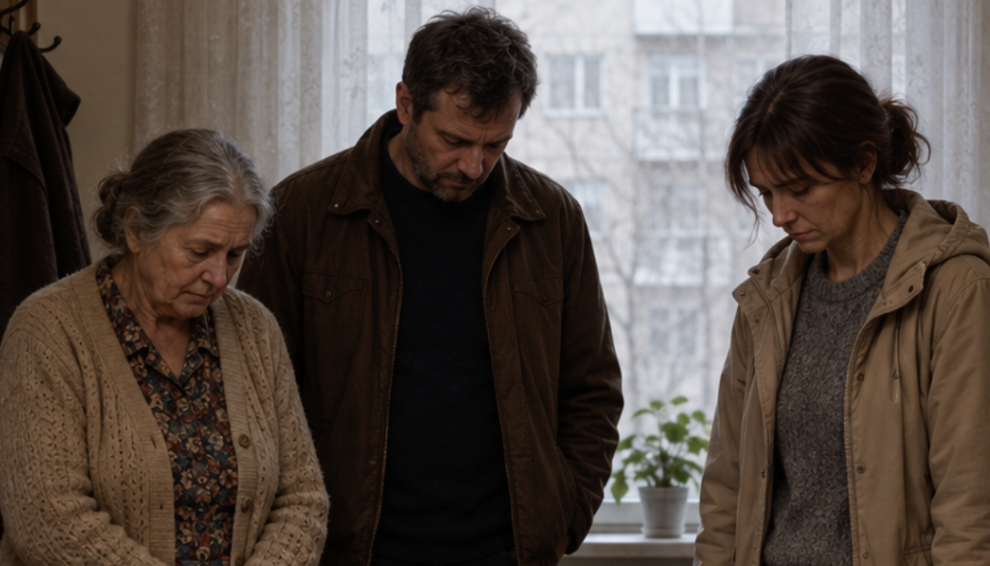
I spent a warm September day at the dacha – gathering up the last apples and covering the roses for winter. By the time I got back to the city that evening, I was exhausted and juggling two heavy bags. The hallway was filled with a sweet, cloying perfume I’d never bought in my life. On the shoe rack, right where I usually put my things, was a pair of suede boots, about a size 40. I wear a 37.
My daughter-in-law stepped out of the kitchen, wiping her hands on my towel – the one with the embroidered cornflowers.
“Elizaveta Andreyevna, we need to talk,” she said, skipping the greetings.
I took off my jacket without a word and hung it up. I set my bags by the door because the boots blocked the way to the kitchen.
“I’m listening,” I replied.
My son came out after her, looking like a schoolboy who’d been summoned to the principal’s office and hadn’t decided whether to confess or make up a story.
“Mom, here’s the thing…” he began.
And here was the thing.
My daughter-in-law’s mother, Valentina Sergeyevna, divorced five years ago and has been living in Tambov. Now she’s decided to move to our city – closer to her daughter and grandkids. She’s selling her apartment in Tambov, but the money isn’t enough to buy a place here.
Renting a place
“And Oksana worked it out,” my son shuffled his feet, “if we sell the dacha, there’ll be just enough.”
I looked at my daughter-in-law.
“Oksana,” I said, “are you serious?”
“Absolutely,” she answered. “You don’t need the dacha. You barely go there once a week. And my mom has nowhere to live.”
I stood there in my own hallway, still in my outdoor shoes, listening to them explain how something of mine wasn’t needed by me, but was much needed by another woman – one I’d met only about eight times in my life.
“The dacha is not for sale,” I said.
The dacha is my parents’ house. I took my kids there, and now I take my grandkids. I planted the strawberries myself—every currant bush still remembers my parents. But it’s not just about memories or sentiment. The point is, IT’S MINE. Mine, you see? Not anyone else’s, not jointly owned, not up for sharing.
The apartment we all lived in – me, my son, and his family – was also mine. A three-room place in a brick building with a big kitchen. I got it as an employee at the garment factory, when I worked as a cutter. I cut men’s suits – coats, jackets, trousers – for twenty-three years.
I knew how to squeeze every last bit from a roll of fabric so there were hardly any scraps left. Every day, I’d prepare up to forty layouts. There was no room for mistakes – one wrong line with the chalk and the whole piece was ruined, which meant no bonus. I was valued for my precision.
That habit of double-checking everything has stuck with me my whole life.
And now, as I stood in the hallway, I was already sizing up the situation. Valentina Sergeyevna is selling her apartment in Tambov. That’s one. The prices in Tambov and our city are worlds apart. That’s two. She’s not working, she’s sixty-two, and her pension is the minimum. That’s three. Who’s going to pay the utilities in a new apartment? Who’ll manage the repairs? Who will take her to the doctor if she needs it?
“Let Valentina Sergeyevna buy what she can afford,” I said. “A room, a studio, whatever. Why should I be adding money for her extra square meters?”
My daughter-in-law pressed her lips together.
“You don’t understand. Mom has always lived in decent conditions. She can’t just move into a studio apartment.”
“And I can’t sell the dacha.”
“Why not?!”
“Because it’s mine. And that’s my decision.”
Oksana spun around sharply and went to the kitchen. Her son stayed standing in the hallway.
“Mom, seriously,” he said quietly, “you have to see how important this is. We’re family.”
Renting a place
“You have your family,” I repeated. “But for Valentina Sergeevna, she has her own kind of family, one I don’t belong to.”
“She’s my wife’s mother.”
“She’s nothing to me.”
He looked at me with reproach, like a child denied an expensive toy. Except this child is already thirty-eight, works as a forklift driver at a food warehouse, and is a father himself.
“At least think about it,” he said.
I thought about it.
I’m always thinking. So I sat down and started crunching the numbers.
The dacha—six acres in the ‘Vishenka’ cooperative, fifteen kilometers from the city. The house is made of brick, has a proper foundation, stove heating, and a summer veranda. Water comes from a well, the toilet is outside. Electricity is there, but no gas. The market value is about 1.3 million, maybe 1.4 million if I get lucky with a buyer.
To cover the difference, I’d have to sell my dacha. But then I’m left without a dacha, and Valentina Sergeevna ends up with a two-room apartment. Where’s the benefit for me? Where’s my sense of fairness?
I read these numbers out loud—my daughter-in-law listened, standing by the window. My son sat at the table, spinning a teaspoon between his fingers.
“What if I don’t sell the dacha, but just lend you the money?” I asked. “Interest free. Say I give you nine hundred thousand. How would you pay it back?”
“With what?” my daughter-in-law smirked. “You see both of our salaries yourself.”
Legal advice
“So you don’t plan to pay it back, you just want me to give it away as a gift.”
“Not a gift,” Oksana threw up her hands, “but help! As a person! You aren’t a stranger—you’re grandma, you’re my mother-in-law. Can’t you help us?”
I stayed silent.
It’s hard. Really hard. Because the dacha isn’t just a piece of property. It’s the only place where I actually feel in charge, not just a guest in someone else’s home.
In the city apartment I live with my son, daughter-in-law, and two grandkids. My room is twelve square meters, just enough for a bed, a wardrobe, and my old hand-crank sewing machine where I hem my grandsons’ pants.
Everything else is shared space. I can’t rearrange the living room furniture without asking Oksana. I can’t cook the food I like, because my grandsons don’t eat soups. I can’t turn on the TV late at night—my grandkids have a routine.
But at the dacha, I’m in control. Those are my garden beds, my seedlings, my apple trees. It’s peaceful there. It smells of dry earth and grass. I can put the old kettle on the stove and sit on the veranda, watching the sun set behind the neighbor’s plot.
I’m sixty-five. I have no husband—he left the family when our son was twelve, and I never saw him again. Only the dacha remained. And now they want to take it too.
Two days later, Oksana’s mother came over. Apparently, her daughter called her in to back up the pressure.
Valentina Sergeevna was a petite woman with delicate features, a neat haircut, and a voice that sounded like tearing fabric—sharp and cracking. She didn’t waste any time getting to the point.
“Elizaveta Andreevna,” she said, settling into my favorite chair, “you have to understand, I have nowhere to live. Selling the dacha is the smart thing to do. You’re getting older and soon it will be hard for you to go out there. And if I move in, I’ll get settled and help out with the grandkids and do the cooking. Everyone wins.”
Family Time
“Did you sell your own apartment?” I asked.
“Not yet, but the realtor says it’ll sell quickly.”
“Let’s wait until you’ve sold it. Then we’ll see.”
“What’s there to see? There will still be a price gap. I can’t do this without your dacha.”
“So you’re selling your apartment, buying here with that money, and my money covers the difference?”
“Well of course. How else would it work?”
I asked the only question that had been on my mind from the very beginning:
“Whose name will the apartment be in?”
Valentina Sergeevna froze. Oksana, who was sitting next to her on the couch, shot her mother a quick glance.
“Mine,” Valentina Sergeevna replied.
“So,” I said calmly, like I used to when explaining a pattern to my students, “I sell my dacha, give you the money, and you buy the apartment in your own name. What do I get out of this?”
“You get a peaceful old age. Surrounded by family.”
Psychologist’s Advice
“I’m already surrounded by family.”
“You don’t understand,” she raised her voice. “You cling to that dacha like it’s treasure. But it’s just a piece of land. Your parents are gone, why do you need it? You go there—so what? Picking apples? It’s cheaper to buy them at the market.”
“It’s not about the apples.”
“What’s it about, then?”
“It’s about the fact that this is my life. Not yours.”
Valentina Sergeevna pressed her lips together. There was a long pause. My son sat in silence, clearly uncomfortable and caught in the middle, hoping we’d settle this without involving him.
But we weren’t settling anything.
Then they brought out the big guns—the grandchildren.
That evening, my oldest granddaughter, fourteen-year-old Alisa, knocked on my door. Well, ‘knocked’ is an overstatement. She just pushed the door open and stood in the doorway.
“Grandma,” she said, “why are you being so difficult?”
“Alisa, I’m busy. I’m folding laundry.”
“Oh grandma… Mom and I talked. If Grandma Valya moves in, she’ll walk us to school. And she’ll cook for us.”
I looked at my granddaughter. She was growing up beautiful and smart, but I could already see her mother molding her into a copy of herself. The same assertive tone—like whoever she’s talking to has to justify themselves. The same habit of ignoring other people’s arguments.
“Alisa, the dacha is mine. My parents left it to me. If I sell it, I won’t have anything left. Nothing of my own. Understand?”
“So what? You live here anyway.”
“Here, I’m just a guest. The dacha is my home.”
“You’re weird,” my granddaughter said, and walked away.
I finished folding a pillowcase and sat on my bed. I felt hurt—not for myself, but for Alisa. Because she’d already been taught not to respect other people’s property. Because at fourteen, she already knew that if you push hard enough, people will give in.
Will I give in? No.
Oksana stopped talking to me completely. If she needed to pass on a message, she’d tell my son, who would then relay it to me. We started having breakfast separately: I’d make my porridge and take it to my room, while they ate in the kitchen. One morning, my eleven-year-old grandson Dania asked me:
“Grandma, is it true that you’re stingy?”
“Who told you that?”
“Mom did.”
I sighed.
“Dania, imagine you have a bicycle, and your neighbor doesn’t. He asks you to give your bike to him because he needs it more. Would you do it?”
“Nooo,” he said after thinking for a moment. “It’s my bike.”
“Exactly. And the cottage is mine.”
He walked away, but I could see in his eyes that someone had explained things to him differently, and my words didn’t outweigh what he’d already been told.
My son tried to persuade me a different way. He didn’t yell or blame me—he pleaded. He’d come in the evenings, sit on the edge of my bed, and say:
“Mom, can’t you just sell the cottage? Valentina Sergeyevna is a good woman. She’ll really appreciate it. Oksana will relax. We’ll all breathe easier. I’m so tired of these arguments. It’s the same thing every night.”
“You’re tired,” I repeated. “What about me?”
“Mom…”
“Listen, Andrei. You’re my son. I raised you on my own. I never asked anything from you. I gave you the big room when you married Alisa. I looked after your kids while you both worked. I spent half my pension on groceries even though I could’ve lived on my own. I never asked you for a penny. And now your wife wants me to sell the last thing I have, just to help HER mother. Do you think that’s fair?”
He went quiet. Then he said softly:
“She’s my wife, Mom. I have to support her.”
“Support her. But not at my expense.”
He got up and left. I heard cups clink in the kitchen. Oksana was probably waiting to hear how our talk went and drinking tea.
Weeks passed. October arrived.
One day my son came home from work and said:
“Mom, Oksana wants to move out.”
“What do you mean?”
“Rent an apartment. She says she can’t keep living with someone who refuses to help her family anymore.”
I felt something twist inside me.
“And the kids?”
“The kids are going with her. And so am I. All of us.”
I stood in the hallway—the one I had painted myself two years ago because my son never found the time.
“Andrei,” I said slowly, “this is my apartment. Do you understand that?”
“I do. That’s why we’re moving out—so we won’t have to depend on you.”
“Great. And how will you get by?”
“I have my salary. Oksana has gigs at the salon. We’ll manage.”
I saw it on his face. He wasn’t lying. He truly believed this was the only right decision. As a man, a husband, and the head of a family, he couldn’t act differently. Otherwise, his wife would say he was a mama’s boy. And as his mother, I was supposed to understand.
And I did understand. I realized they had given me an ultimatum: either I sell the cottage, or I lose my family.
I didn’t sell.
Three weeks later, my son rented a one-bedroom apartment on the edge of town. Oksana took the kids and the furniture they’d bought for their room, and moved out. My grandchildren came by to say goodbye—Alisa gave me a quick peck on the cheek, Dania hugged me, but quickly let go, too.
“Grandma, will you come visit us?”
“I will. Call me when you have time.”
Now I was alone in a three-room apartment. It was so quiet I could hear water rustling in the pipes.
At first, I didn’t know what to do with myself. Out of habit, I cooked for four, but ended up eating alone. I’d walk into my grandchildren’s room — only to find it empty, just the old sofa left behind, the one we didn’t bother moving to the rented apartment.
I would call my son. Once a week, never more often. His replies were always short: ‘Fine,’ ‘We’re working,’ ‘The kids are at school.’ They never invited me over.
The pressure never let up. A month after I moved, Oksana sent me a message. It was long, took up three screens. The whole point boiled down to this: ‘Until you come to your senses, there will be no normal relationship. You deprived my mother of a home, you deprived your grandchildren of their grandmother. We will not forgive you.’
I read it and deleted it.
A day later, Valentina Sergeyevna called. Turns out, she had stayed in town — living with an acquaintance, waiting to see how things would turn out.
‘Elizaveta Andreyevna,’ she began, ‘let’s be honest. You’re refusing the deal — fine, that’s your right. But now Andrey is renting. He’s paying money that could have gone to family, to the kids. Now it’s going to a stranger. Don’t you feel sorry about that?’
‘I do,’ I said. ‘But that was his choice.’
A lawyer by training
‘But you could have made sure there was no choice. If you sold the dacha, everyone would have lived just fine.’
I listened to her strained voice and thought: what a woman. She divorced five years ago. Kept her apartment. Decided to move to another city. Miscalculated her budget. And now she thinks the whole world owes her. And I’m part of that world.
‘Valentina Sergeyevna,’ I said, ‘I feel for you. But my dacha has nothing to do with your problems.’
‘You have no heart.’
‘Maybe so.’
She hung up the phone.
I sat down at the kitchen table and turned on the electric kettle. The kettle switched itself off. I poured the boiling water over a teabag in my cup.
I remembered how, six months ago, everything was normal. Just ordinary life: the grandchildren went to school in the morning, I went to the market, afternoons were for sewing, evenings for a TV show in the kitchen—Oksana nearby with her laptop, Andrey with his phone.
Everyday conversations: ‘buy more milk,’ ‘take out the trash,’ ‘call the clinic.’ I thought — this is what a family should be. Turns out it was just a temporary arrangement, one that was dissolved the moment I refused to sign off on someone else’s decision.
What if I had agreed? The dacha would be gone. Valentina Sergeyevna would have bought an apartment. We’d have kept living together — me, my son, my daughter-in-law, the grandkids. But inside, I’d be left with resentment. A deep, lingering one.
I would look at Valentina Sergeyevna and think: ‘You live in an apartment bought with my money.’ I would look at Oksana and think: ‘You forced me.’ I would look at my son and think: ‘You didn’t protect me.’ Would that be a family? No. It would be the same wreckage, just with different scenery.
Renting a place
They didn’t give me a real choice. Or rather, any option would have meant losses.
I chose to lose those who demanded too much.
Would you have sold your dacha under such pressure from your relatives? Or would you have stood your ground?