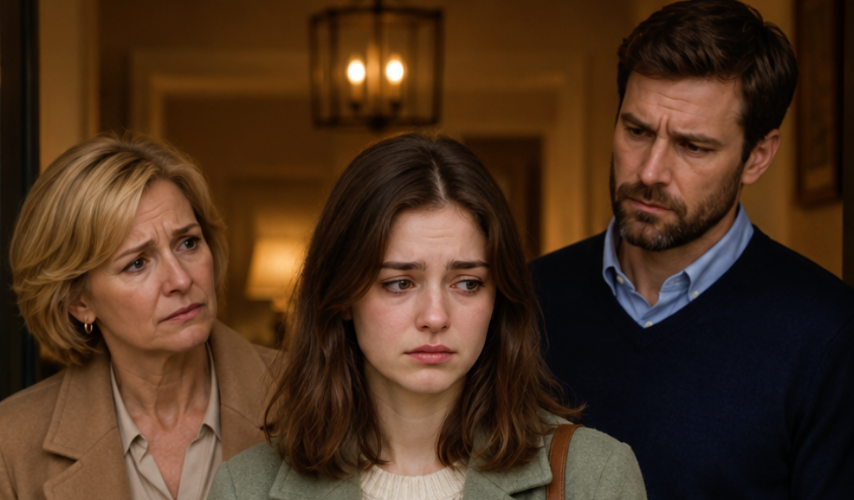
“Olenka, make us something delicious, we’ll be there soon!” my mother-in-law’s voice insisted on the phone, as demanding as always and without the slightest hint of a question.
Olga took a deep breath and closed her eyes. Here we go again. This was the third time in just two weeks that Kirill’s parents were going to show up at the dacha. And as usual, there was no checking with anyone, just a simple statement of intent.
“Yulia Nikolaevna, I had planned to check my students’ notebooks today—I’m overloaded at work,” Olga tried to object, but her mother-in-law had already hung up.
Kirill stepped out of the bathroom, toweling his wet hair dry after his shower.
“Who was that?” he asked, not yet suspecting the surprise visit.
“Your parents are coming over. Again,” Olga couldn’t hide the irritation in her voice.
“That’s fine,” Kirill shrugged. “It’s been a while since we saw them.”
“We saw them last weekend,” Olga reminded him. “And the weekend before that, too. I’m tired of being your cook.”
Kirill frowned:
“Please don’t start. They’re my parents and I’m glad to see them. Is it really so hard for you to make lunch?”
“It’s not about lunch,” Olga felt a wave of resentment rising inside her, but decided to say nothing. There was no point in arguing.
Their dacha, bought three years ago with their combined savings, was slowly turning into an extension of his mother’s house. At first, Yulia Nikolaevna visited rarely, then she started coming more often, and now it seemed she considered herself the rightful mistress there.
An hour later, the sound of a car pulling up could be heard. Olga reluctantly stepped out onto the porch. From the old Toyota, not only did Yulia Nikolaevna and Igor Yuryevich emerge, but also two unfamiliar married couples.
“Here we are!” Yulia Nikolaevna exclaimed happily, carrying bags of groceries. “Olga, meet the Sokolovs and the Petrovs, our friends. We decided to show them your dacha. Isn’t it wonderful here?”
Olga stood frozen, feeling the ground slipping from under her feet. Kirill appeared behind her, also clearly not expecting strangers.
“Mom, you didn’t say you’d be bringing other people,” there was a hint of annoyance in his voice.
Yulia Nikolaevna waved him off:
“What’s the difference? There’s plenty of room for everyone! Olga, we bought meat for shashlik. Igor will grill, and you prepare some salads. You could bake some potatoes too.”
The unfamiliar guests smiled, clearly unfazed by the awkwardness. Olga silently turned and walked back into the house. In the kitchen, she banged the kettle on and began chopping vegetables, trying to calm herself down.
Kirill followed her in:
“I know you’re not thrilled, but let’s just try to have a normal day,” he said in a conciliatory tone.
“Normal?” Olga turned to him. “Your mother brought strangers into our home without warning and now expects me to serve them. Is that your idea of ‘normal’?”
“Don’t exaggerate,” Kirill grimaced. “It’s just lunch. And they’re not strangers, they’re my parents’ friends.”
“They’re strangers to me,” Olga shot back and went back to slicing vegetables.
The day dragged on endlessly. Her mother-in-law took command in the kitchen, constantly ordering Olga around, while the guests marveled at the house, the plot, and the river view. “You’re so lucky!” they kept repeating as Olga dashed between the house and the terrace with trays of food and drinks.
By the time the guests finally left, it was already dark. Olga quietly cleared the table while Kirill saw his parents to the car.
“Thank you for a wonderful day!” Yulia Nikolaevna called out loudly, hugging her son goodbye. “We’ll come again next Saturday, just the two of us with Dad.”
Olga shuddered when she heard that. She couldn’t take it anymore.
Olga hardly slept that night. She kept thinking about how much their lives had changed in the past year. She and Kirill had once dreamed of having their own little place, spending time together, growing flowers, and having romantic dinners under the stars. Now, the dacha had become a pilgrimage site for Kirill’s family.
That morning, they had barely finished their coffee when they heard the sound of a car pulling up.
“Who could that be so early?” Kirill wondered as he looked out the window. “Oh, my parents are back.”
Olga froze, her coffee cup in hand:
“Why? They just left yesterday.”
“No idea,” Kirill shrugged and went to open the door.
Yulia Nikolaevna burst into the house carrying bags of groceries:
“Good morning! I decided we need to use up these eggplants while they’re still fresh. Olga, can you make that appetizer you did for Igor’s birthday? The one with the nuts.”
Olga felt something inside her finally break. She slowly set her cup on the table, silently left the kitchen, went to the bedroom, pulled a suitcase out from under the bed, and began to pack her things.
A few minutes later, a surprised Kirill appeared in the doorway:
“Where do you think you’re going? Who’s going to cook for us?” he exclaimed when he saw his wife with the suitcase.
Olga looked up at him:
“I’m going to my parents. And I’ll bring them back here—with Aunt Nina and Uncle Kolya. Then you can cook and take care of them like I do for your family and their friends.”
“Are you out of your mind?” Kirill blocked her way to the door. “What’s all this drama about?”
“This isn’t drama, Kirill. This is my life, and your mother has turned it into endless serving of her and her circle,” Olga’s voice was remarkably calm. “I won’t put up with it anymore.”
Yulia Nikolaevna appeared in the doorway:
“What’s going on here? Why are you shouting?”
“No one is shouting, Yulia Nikolaevna,” Olga replied. “I’m just leaving. You can handle the cooking and cleaning yourselves from now on.”
Her mother-in-law gasped:
“This is nonsense! Kirill, tell her to stop this nonsense!”
But Olga had already slipped past her husband and was headed for the exit.
“If you walk out that door, don’t bother coming back!” Kirill screamed after her, losing control.
Olga turned back:
“That’s exactly what I plan to do.”
Olga’s parents lived in the neighboring city, about an hour’s drive from the cottage. When she showed up at their apartment with a suitcase, they didn’t ask any questions. Vasily Stepanovich quietly took her luggage, and Anna Mikhailovna hugged her daughter.
“Would you like some tea?” her mother asked as Olga took off her shoes and entered the kitchen.
“Yes, please,” Olga nodded, and finally broke down in tears.
That evening, she told her parents everything she had bottled up over the years. How her mother-in-law gradually took over their space, how Kirill always sided with his mother, how she felt like a servant in her own home.
“I don’t understand why you put up with it for so long,” her father said, shaking his head. “Your mother and I never imposed on you, even though we miss you too.”
“Because I thought it was normal,” Olga sighed. “That I was supposed to respect his parents, be hospitable. But they just take it all for granted and keep demanding more and more.”
Olga’s phone was ringing off the hook with calls from Kirill, but she ignored them.
During those first few days, Kirill was furious. He couldn’t understand how his wife could do this—leaving him alone with his parents. Yulia Nikolaevna made sure to remind her son at every opportunity that she had “always seen the selfishness” in his wife.
“A real wife never leaves her husband,” she repeated as she cooked in the very kitchen where Olga usually reigned. “Back in our day, women respected their husband’s parents.”
Igor Yuryevich nodded silently, not daring to argue with his wife.
But as days went by, Kirill started to notice things he hadn’t seen before. How his mother ordered him around without asking his opinion. How she criticized everything—from the way the furniture was arranged to the color of the curtains Olga chose. How she acted like it was only natural to show up at the dacha whenever they pleased.
On Wednesday, as Kirill was getting ready for work, Yulia Nikolaevna announced:
“Your father and I have decided to stay here until the end of the week. You don’t need to worry about cooking, I’ll take care of everything.”
For the first time, Kirill felt a surge of irritation:
“Mom, I can’t leave you two alone at the dacha. I have to go into the city.”
“It’s fine,” Yulia Nikolaevna waved him off. “We’ll be just fine. By the way, I invited Valentina and Sergey for Friday. Remember them? Our neighbors from the apartment building.”
Kirill stopped in his tracks:
“You invited the neighbors to my house without asking me?”
Yulia Nikolaevna raised her eyebrows in surprise:
“What’s the problem? I’m your mother. I’m not some stranger that needs permission.”
And that’s when it hit Kirill. These were the exact words he used to tell Olga so many times. “They’re my parents, not strangers.” How blind he had been.
On Friday evening, when Yulia Nikolaevna’s neighbors arrived at the dacha, Kirill, for the first time, refused to play the friendly host.
“I need to head into the city for some things,” he said, grabbing his car keys. “Have fun without me.”
“Kirill!” his mother called out in outrage. “Where are you going? The guests have arrived!”
“They’re your guests, Mom,” he replied, feeling a strange sense of freedom for the first time. “I didn’t invite them.”
He got into his car and drove to Olga’s parents’ home, hoping to find her there. On the way, he thought about how he had allowed his mother to destroy his marriage, how he had failed to see what was right in front of him, how he had betrayed the woman he loved again and again.
Olga opened the door and froze when she saw him on the doorstep.
“Can I come in?” Kirill asked hesitantly.
She silently stepped aside, letting him in. In the living room, her parents were sitting, but when they saw their son-in-law, they got up and left for another room, leaving them alone.
“I was wrong,” Kirill began, not sure how else to start. “You were right about everything, and I was blind.”
Olga crossed her arms over her chest:
“So what made you finally see the truth?”
“A week with my mother,” he answered honestly. “It wasn’t until I was alone with her that I understood what you endured all those years. She doesn’t respect our space, she ignores our plans. She only thinks about herself.”
Olga gave a sad little smile:
“I told you this so many times, but you never listened.”
“I know,” Kirill nodded. “And I can’t blame you for leaving. I would have left too.”
They talked for a long time that evening. Kirill shared how his mother invited her friends to their dacha, how she bossed him around, and how she acted like she had the right to make all the decisions. Olga opened up about all the pain and disappointment she’d been carrying. Continued in the comments.
“I want you to come back,” Kirill finally said. “I promise everything will change. My parents won’t show up uninvited anymore.”
Olga shook her head.
“I can’t come back if they’re going to be a part of our lives. I don’t want to see your mother. Ever.”
“But that’s impossible,” Kirill said, flustered. “They’re my parents.”
“Then keep seeing them on your own, without me,” Olga said firmly. “Go visit them, call them, do whatever you want. But I don’t want them in our home.”
Kirill was silent for a long time, thinking over her words.
“Okay,” he finally agreed. “If that’s what it takes for us to make up, I agree. They won’t come to the dacha while you’re there.”
Coming home wasn’t easy. Olga felt tense, constantly waiting for something to go wrong. Kirill was being unusually attentive, clearly trying to make up for his mistakes.
Yulia Nikolaevna couldn’t accept these new rules. She called her son several times a day, complaining about her health, how neglected she felt, and insisting that “that woman” was turning him against his own mother.
Kirill tried to stay firm, but Olga could see how hard it was for him. Sometimes she caught him sneaking off to talk to his mother, either stepping outside or locking himself in the bathroom.
One evening, while checking the time on her husband’s phone, Olga saw a message from Yulia Nikolaevna: “Thank you for meeting me, son. It was so nice to have lunch together. Too bad she forbids you from seeing us.”
Olga silently placed the phone on the table and went to the bedroom to pack her things. When Kirill came home from work, her suitcase was already in the hallway.
“What’s going on?” he asked, though her expression made everything clear.
“You’ve made your choice,” Olga said quietly. “You didn’t choose me.”
Kirill rushed to explain:
“It was just lunch! I met them at a café, it didn’t mean anything!”
“It means you lied to me,” Olga replied, shaking her head. “You promised to be honest, but you chose to hide your meetings with your parents. I can’t live with someone I can’t trust.”
This time, Kirill didn’t try to stop her. He knew he had destroyed the last hope of saving their relationship.
Three months passed. Olga rented a small apartment close to the school where she worked. She filed for divorce, though every time she signed a document, she felt her heart breaking all over again. She still loved Kirill, but couldn’t stay with someone who didn’t respect her feelings.
One day, Olga’s father, Vasily Stepanovich, met with Kirill “man to man.” They talked for a long time in a small café on the edge of the city.
“I’ve always thought you were a good guy,” the older man said, looking Kirill in the eyes. “But you broke my daughter’s heart because you couldn’t put your mother in her place. Every family needs to live their own life, Kirill. Parents are parents, but your wife is your future.”
Those words stayed with Kirill. He started seeing a family counselor, trying to unpack his relationship with his mother and figure out why he hadn’t been able to stand up to her.
Yulia Nikolaevna was furious when she found out her son was seeing “some kind of charlatan.” She tried to forbid him from going to those appointments, but for the first time in his life, Kirill firmly said “no.”
“Either you accept my decisions, or we stop talking altogether,” he declared, surprised at his own determination. “I lost my wife because I couldn’t set boundaries. I don’t want to lose myself, too.”
This was a turning point. For the first time, Yulia Nikolaevna saw her son not as a boy she could boss around, but as a man ready to defend his right to live his own life.
One autumn day, Kirill called Olga and asked if they could meet.
“I just want to talk,” he said. “We need to decide what to do about the dacha.”
They met at a small café in the city center. Olga looked rested and calm, though there was still sadness in her eyes.
“How are you?” Kirill asked when their coffee arrived.
“I’m okay,” she replied. “Working, living. And you?”
“I’ve realized a lot over these past months,” he said, turning his coffee cup in his hands. “About myself, about my relationship with my parents. About why I couldn’t protect you and our marriage.”
Olga listened to him carefully, not interrupting.
“I finally explained to my mom that her interference destroyed my family,” Kirill continued. “I told her that I’ll only see them at their house, and only when I want to. She was furious, didn’t speak to me for a month. But eventually she understood—either she accepts my terms, or she loses her son.”
“And how did she take it?”
“I wouldn’t say she was thrilled,” Kirill smirked. “But she accepted it. Now I visit once every two weeks for a couple of hours. That’s enough.”
They sat in silence, each lost in their own thoughts.
“I’m thinking of selling the dacha,” Kirill finally said. “Too many bad memories.”
Olga nodded:
“I think so too. We can put it up for sale and split the money.”
“And then?” Kirill asked quietly, looking into her eyes.
“And then we each go our own way,” Olga answered, though uncertainty was clear in her voice.
“What if…” Kirill hesitated, gathering his courage. “What if we tried again? Not right away, of course. Maybe we could just meet sometimes, talk. I’ve changed a lot, Olya. And I still love you.”
Olga looked at him for a long time, as if weighing the sincerity of his words.
“I don’t know, Kirill. There’s been too much disappointment.”
“I understand,” he nodded. “And I’m not rushing you. Just think about it. We could start over—maybe get a new dacha, if you’d like, or a bigger apartment. But the most important thing is, with new rules for everyone.”
Olga didn’t answer, but she didn’t say “no,” either. She finished her coffee and glanced at her watch:
“I have to go, I’ve got classes today.”
They left the café together. Outside, a light rain was falling, and Kirill opened his umbrella over them.
“I’ll walk you,” he offered, and Olga didn’t refuse.
They walked in silence, each wrapped up in their own thoughts. The future was uncertain—maybe a new chance at building a relationship, or maybe a final goodbye. But both felt that they had grown and changed over these months.
Outside the school, Olga stopped and looked at Kirill:
“Call me next week. Maybe we can go somewhere together.”
It wasn’t a promise, but it was a glimmer of hope. And for now, that was enough.