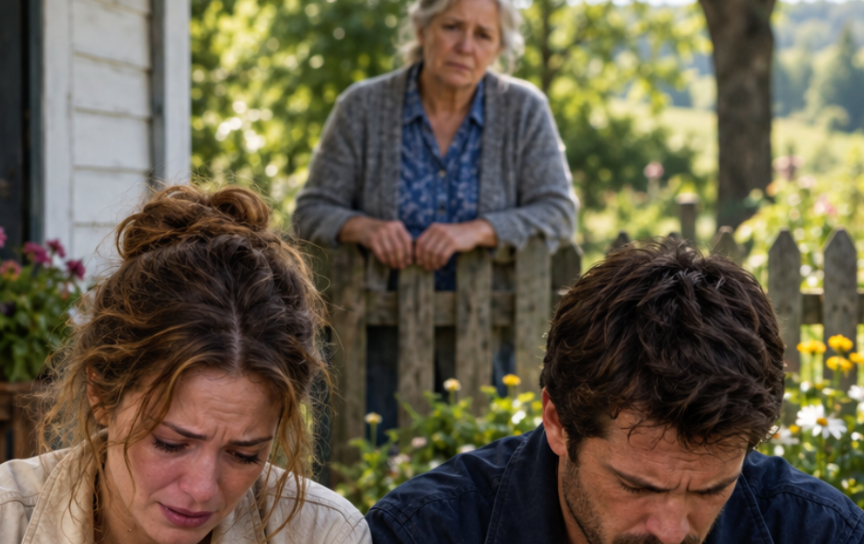
Anya turned off the engine right at the gate and spent another minute fussing inside the car—the bag of charcoal on the passenger seat had split at the seam, and little black crumbs spilled all over the floor mat. She scooped up what she could with her hand, wiped her palm on an old newspaper, and got out. She clutched the bag against her stomach, trying to keep it away from her light-colored jacket.
Sergey had told her Friday night that he’d be late on Saturday: the quarterly report was urgent at work and his boss was going ballistic. He’d promised to come by only in the evening, bringing meat from their favorite shop and a bottle of red. Anya had even felt a little relief—she’d have time to open up the house on her own, turn on the pump, wipe off the windowsills, and not have to listen to him comment on every single spiderweb in the corners.
Olga was standing by her fence with pruning shears in her hand, though she wasn’t actually trimming anything. She watched Anya closely and a bit awkwardly, the way you look at a friend who’s just come out of the doctor’s office with a referral slip.
“Are you here alone?” she asked, even though only one car door had slammed.
“Just me for now. Sergey is coming tonight, he’s swamped at work.”
“Yeah, swamped at work,” Olga snapped her shears at the air and paused. “Strange your husband didn’t tell you anything.”
Anya adjusted the bag for comfort and smiled. The first thing that came to mind was the shared fence that Olga had been planning to move half a meter onto their side for two years now. Then the well, then the HOA president who kept collecting money for gravel for the road.
“What was he supposed to tell me? Are we pitching in for the road again?”
Olga looked past her, at her own house, at the curtain in the kitchen window, and pressed her lips together.
“Well, you’ll figure it out yourself,” she said, turning away to her phlox so fast it was like something was boiling over on her stove.
Anya stood by the gate, watching Olga’s back, then shrugged and headed for the porch. The key turned easily in the lock, without the usual scrape, and at first she was glad, thinking Sergey had finally oiled it like she’d asked since spring.
Inside, it was warm, as if someone had just been heating the place. After a week empty, it usually smelled of damp and old blankets, but now the air felt lived-in, warm, with a hint of baby shampoo. Anya dropped the bag of charcoal by the door, went into the kitchen, and stopped by the table. There was a child’s plastic mug with a blue car on it, and a bit of unfinished kefir drying at the bottom.
They’d never had a mug like that. There hadn’t been any children in this house since they bought it, and all their dishes matched—white, from the same set. Anya picked up the mug with two fingers, turned it over, and set it back down, exactly on the damp ring from its base.
Near the sofa in the big room, there was a small backpack with a broken strap, a pack of wet wipes sticking out of its pocket. In the bathroom, two T-shirts hung on the drying rack. One was stretched out, with some slogan about a fun run, and looked like a man’s; the other was a woman’s, gray, with a bleach stain on the hem. Anya felt them: both were dry and freshly washed, like they’d been hung up about two days ago and then forgotten.
In the bedroom, she opened the closet and spotted a stranger’s stack: tights, kids’ shorts, and dinosaur pajamas sitting on her own shelf. Draped over the chair by the window—her favorite reading chair—was a dark green women’s jacket, light but expensive-looking, with keys jingling in the pocket. When Anya picked it up, the keys rattled and she noticed a plastic letter “V” hanging on the keychain.
She called Sergey, but he didn’t pick up. She called again and got a message after just one ring: “In a meeting, I’ll call back.” Anya texted him a single word: “Come.” Then, after a moment’s thought, she added: “Now.”
Sergey showed up exactly forty minutes later. For someone swamped with a quarterly report, he made it from the city suspiciously fast. Anya noticed this as she sat on the veranda with the green jacket in her lap. He stepped out of the car with a grocery bag, smiled at her from the gate and waved, but his smile vanished the instant he saw the jacket. He carried the bag to the porch, holding it carefully away from his body as if it had suddenly grown heavier.
“Who was here?” Anya asked.
“Anya, let’s stay calm.”
“I’m being very calm so far. I haven’t even thrown a chair at you.”
Sergey set the bag down on the step, and the meat inside sank heavily. He looked at the jacket, then at her, then shoved his hands into his pockets.
“I meant to tell you.”
“When?”
He stayed silent, rubbing his eyebrow for a long time while staring off toward the gate.
“Sergey, who has been living in our house?”
“Not living—just staying for a few days.”
“Who?”
“Vika and her son.”
Anya gripped the jacket so tightly that the keys inside the pocket clattered together.
“Who is this Vika?” she asked, her voice breaking on the last word. “Are you seriously telling me ‘Vika and her son’ like I’m supposed to know who that is?!”
Sergey sat down on the step with his back to her, spending an abnormally long time untying one of his sneaker laces, although he clearly wasn’t planning to take off his shoes. Then, without turning around, he started talking in a flat, almost tired tone—the kind people use to explain to their mother-in-law why they haven’t changed the tires yet.
Vika, it turned out, was a friend of his cousin Vadim. Her husband had left her several months ago, leaving behind debts and a rented one-bedroom apartment paid up until the end of the month. Then, suddenly, the landlord announced he was selling the place and asked her to move out within a week.
“She and her child would have been out on the street,” Sergey said. “Her child is little, Anya. The boy is four.”
“And so you decided to let them stay with us?”
“Just for a couple of weeks. Until she finds something else.”
“And you didn’t even think to call me?”
He finally turned to face her. His expression was patient, and that patience made Anya want to fling the jacket at him.
“You would’ve started worrying right away. You’re already dealing with a work check, Larisa is out sick, and you’re staying at the office till nine PM every day. I wanted to handle things first, and then calmly tell you.”
He said those last words gently, almost soothingly, and Anya got up from her chair.
“You didn’t calmly tell me, Sergey. You decided you could make decisions about our home all by yourself.”
“At least I didn’t sell it.”
“And if you had? Would you have just handled it first and then explained it to me afterward?”
Sergey frowned and stood up from the step, brushing off his jeans.
– You’re turning normal help into some sort of tragedy. The person had nowhere else to go. What was I supposed to do, just turn her away?
– You should have called me!
She walked past him into the house, yanked both t-shirts off the drying rack, pulled out some kids’ shorts and dinosaur pajamas from the closet, and started stuffing it all into a big bag that once held gardening soil. Sergey followed her and stood in the bedroom doorway.
– What are you doing?
– Packing up, since you didn’t.
– Anya, those aren’t our things. Put them back where they were.
He calmly and confidently took the bag from her, like you’d take matches away from a kid, and put it on the chair where the jacket used to be. Anya looked at the bag, at his hand still holding the handle, then suddenly asked something completely different:
– So where are they now?
– At Vadim’s. I asked them to go into the city for the weekend.
Anya nodded slowly, even giving the tiniest smirk. He’d arranged everything: for Vika, for the child, for a free Saturday, and for his wife not to see anything. And then one forgotten jacket gave it all away.
She stepped out onto the porch, and beyond the fence, behind the phlox flowers, she caught sight of Olga’s sun hat. Olga was still in the same spot with her pruning shears, still not trimming anything.
Anya never did turn on the pump in the house. An hour later, she grabbed a galvanized bucket and headed to the communal well at the corner of the street. She didn’t really need water—she just didn’t want to stay cooped up inside with Sergey. Olga showed up about five minutes later with her five-liter bottle, saw Anya, hesitated for a second, but it was too awkward to turn back.
– Did you know about Vika? – Anya asked before Olga could even set her bottle down.
Olga didn’t even try to pretend to be surprised. She just started turning the well’s handle, even though Anya hadn’t pulled up her own bucket yet.
– Of course I knew.
– For how long?
– About three weeks. Maybe a bit more.
Anya looked at her, and Olga must have read something on her face because she hastily added:
– Sergey came to me himself, told me not to worry if I saw people over there. He just wanted to help, Anya, in a really decent way.
– And why did you decide not to tell me about it?
– I just figured you already knew!
– But this morning you acted like it was weird I didn’t know. So this morning, you already knew I was out of the loop.
Olga let go of the well handle, and the bucket thudded into the water below. She wiped her palms on her apron, one at a time, slowly and carefully.
– Anya, I really didn’t want to get involved in your family business. You’re both adults, you can figure things out yourselves.
– But you did get involved by choosing to stay silent. For three weeks, you’d say hello to me over the fence and say nothing.
Olga lowered her gaze, picked up her bottle, and fiddled with the lid even though it was already tight. Anya grabbed the handle on the well, pulled up her bucket and spilled half the water on her sneakers.
– Vika hasn’t just been here for two weeks, – Olga suddenly said, looking at the wet marks on the boards.
Anya slowly turned to her, still holding the bucket in the air.
– What do you mean, not just two weeks?
– She’s been here almost a month. I told you, I’ve known for about three weeks, and before that I was at the sanatorium. When I got back, there were already clothes on your line.
Anya set the bucket on the edge of the log wall and walked away, leaving it there.
That evening, Sergey drove to the village shop to get bread and the salt he had forgotten to buy, leaving Anya alone in the house. She opened the cupboard above the sink where they kept their first-aid kit, but instead of their box of plasters and activated charcoal, she found an entire shelf of children’s medicine. There was cough syrup, almost empty, fever-reducing suppositories, nose drops, two boxes of something for allergies, and a half-used tube of ointment for bites. Their own first-aid kit was pushed further down, hidden behind the pots.
Anya took out all the children’s medicine boxes and lined them up on the kitchen table, arranging them from smallest to largest. She turned the syrup so the label faced the door. A child can’t finish a whole bottle of syrup or go through half a tube of ointment for bites in just a few days—Anya knew this without Sergey saying a word.
Sergey came back, tossed a loaf of bread on the table, and noticed the medicine. The bag of salt was still in his hand.
“You said they arrived a few days ago.”
“Well, I didn’t count.”
“Didn’t count a month, either?”
He threw his keys onto the table, and they slid across the oilcloth, bumping into the bottle of syrup.
“Anya, I didn’t want to have to explain everything to you every single day!”
“Why not?”
“Because I knew you’d start asking questions. Questions like these.”
“Were you afraid of questions?”
Sergey didn’t answer. He pushed a chair out, sat down, and started smoothing the bag of salt on his knee. Anya stood across from him, hands on the table, the row of another child’s medicine boxes stretching between them.
“Vika’s been living here all this time alone with her child?”
Sergey nodded, still staring down at the bag in his hands.
“And where did you sleep? You told me that on Thursdays you were at Vadim’s, redoing his garage roof.”
He was silent for so long that Anya could hear Olga’s TV blaring behind the fence.
“Sometimes here,” he finally replied.
“Here where?”
“Anya, on the sofa. Why do you assume the worst?”
Anya straightened and moved her hands from the table. She wanted to ask more about Vika—about her jacket, the letter on her keychain, how many evenings Sergey spent here while she was in the city eating dinner alone. Instead, she swept his keys off the table into her palm, weighed them, then placed them in front of him.
“What else don’t I know, Seryozha?” she asked quietly. “Say it now. Everything.”
“There’s nothing else.”
He said it quickly and stared at the keys. Silently, Anya began putting the medicine back into the cupboard, one box at a time, in the same order she had taken them out.
***
Sergey slept that night on the same sofa, and in the morning Anya walked in a wide arc around him as she went to open the windows. He pretended to be asleep; she pretended to believe him, and like that, they made it to lunchtime. Then Sergey left for the market to buy seedlings no one had asked for. Half an hour later, someone knocked quietly—two fingers—on the picket fence by the gate.
Standing behind the gate was a thin young woman, about thirty, wearing jeans and a man’s windbreaker clearly borrowed from someone else. This time, she didn’t have the boy with her. She was holding a bag of apples and started talking as soon as she saw Anya, even before Anya reached the gate:
Hi. Excuse me, please. I’m Vika. I came for my jacket, my friend’s apartment keys are in it… Sorry for just showing up like this. I know how it must look.
“Then explain,” Anya said, opening the gate.
Vika slipped inside sideways, like she was entering a boss’s office, and held out a bag of apples. Anya didn’t take the bag, so Vika carried it awkwardly in front of her all the way to the porch, setting it on the step. Anya brought the jacket from the bedroom and laid it on the table between them, keys facing up.
“He said the house was empty anyway,” Vika began, not touching the jacket. “That you only come on weekends – and not every weekend. Vadim told him about me, and the next day Sergei called and offered. I didn’t even ask.”
“And where did he send you on the weekends?”
“We stayed at my friend’s place in the city. He said you needed rest, that you get very tired.”
Vika lowered her gaze to the jacket and fiddled with the zipper.
“He said you both agreed to it.”
Anya closed her eyes and sat in silence for a few seconds. Somewhere nearby, Olga’s lawnmower started up and then sputtered out.
“We never agreed to anything like that,” she said. “I only found out you even exist yesterday.”
Vika turned so pale her freckles stood out on her nose.
“He told me you didn’t mind. He literally said: Anya is only happy about it, she even feels calmer knowing the house isn’t empty.”
“And you never thought to ask me yourself? Or get my phone number?”
“I felt awkward.”
“I feel awkward now too,” Anya said. “I’m sitting here on my porch meeting the woman who’s been doing laundry in my bathroom for a month.”
Vika blushed to the tips of her ears and grabbed her jacket from the table.
“I’ll start looking for another place today. Toma and I will leave, I’ll ask Vadim – his mother-in-law has space… I really thought you knew!”
She was already up, awkwardly shoving her arm into the sleeve, getting tangled in the lining, keys with a “V” clattering against the table. Anya watched her struggle, then suddenly caught her by the elbow.
“Wait. Sit down.”
Vika obediently sat, left halfway into her jacket.
“This isn’t your fault,” Anya said. “He told me you stayed a few days, told you I was happy with it, told Olga not to worry. Then he ran off to the market for seedlings. He set you and me up to clash and now he’s just waiting around for us to work things out.”
Vika didn’t say anything. She slowly pulled her arm out of the sleeve and put the jacket back on the table, then asked in a quiet voice,
“Can Toma stay here for now? He cries all the time at my friend’s, there’s a cat there and he’s allergic.”
“Let him stay,” Anya said – and she was surprised at how easily she agreed.
When Sergei came back with two crates of tomato seedlings, Vika was already gone, but the bag of apples was still there on the porch table. He glanced at the bag and asked who had visited.
“Vika. She came for her jacket.”
Sergei set the crates on the ground so carefully not a single pot wobbled, and wiped his hands on his jeans.
“And what did she say?”
“She said I was happy about all this. That we both decided. That’s what you told her, Seryozha.”
In the evening, Anya called her office and asked for three days off on her own time. Her boss grumbled about reports over the phone, but eventually let her go. Sergey was listening in from the kitchen, and when Anya hung up, he asked why she needed time off.
“Because I want to figure out what’s going on with me here,” she replied. “Since nobody seems interested in telling me.”
The talk about money happened the next day, after a dinner that nobody really ate. Anya asked why he was doing all this in the first place. Sergey pushed cold potatoes around his plate for a while, then put down his fork.
“Vika asked for help with her car. She had this old Lada leftover from her husband, and he didn’t even get a chance to transfer the papers. She needed money right away, for rent and a deposit. I sold the car through some contacts.”
“And?”
“And they hardly gave anything for it, Anya. There’s rust all along the sills, and the gearbox grinds. It wasn’t even enough for the first month’s rent.”
“So you chipped in more.”
“I did chip in,” he said. “But then it turned out that she still didn’t find an apartment; the landlady gave it to someone who offered more. So I figured, since she already had the money, they might as well stay here for now.”
Anya pushed her plate of cold potatoes away from her.
“You gave her money?”
“Yes.”
“How much?”
He told her the amount, and Anya recognized it immediately—it was exactly what they had in their joint vacation account. They had been saving that money since February, from her bonus and his side jobs, planning to go to Kislovodsk in September.
“Sergey, did you take our money without telling me?”
“I was going to put it back.”
“When?”
Sergey got up and went to the sink, even though there was nothing to wash. Anya took her phone from her pocket, opened her banking app, and started scrolling through her transaction history. Her fingers were cold and shaky, making it hard to tap the screen. She found the withdrawal right away, and below it saw more transfers: five thousand, eight, fifteen, another five. All sent to the same Viktoria Andreevna S., marked “For Tyoma’s kindergarten,” “for medicine,” “for groceries.”
“What’s this?” Anya turned the screen toward him. “‘For Tyoma’s kindergarten?’ So now you’re paying for her kid’s daycare too?”
“Anya, it’s just small amounts. The boy needs to go to kindergarten, and she’s looking for a job.”
“This isn’t just a couple weeks’ help anymore, Sergey! This is like you’ve started a second family and just didn’t bother telling me!”
He stepped away from the sink, sat down opposite her, very close, and spoke quietly, as if someone might overhear them.
“I just wanted to do the right thing. Treat people decently. You wouldn’t understand—everything in your life is always neatly organized.”
Anya looked at him—his neatly rolled-up sleeves, the watch she’d given him for his forty-fifth birthday.
“You wanted to look like a good person at my expense,” she said. “You’re good for Vika, you’re good for Olga, you’re good for Vadim. But it’s Kislovodsk that pays for everything.”
Sergey wanted to say something in response but just waved his hand and went out to the porch to smoke—even though he quit three years ago.
Two days later, Sergey suggested that everyone get together. He walked around the house looking like he’d found a solution, insisting that they just needed to sit down, calmly discuss everything, and put an end to the confusion. He pointed out that everyone was just repeating things to each other instead of talking it through. At first, Anya said there was no way she’d go to any meeting in her own house. But when she spotted Olga at the gate in a clean apron, she finally stepped out onto the veranda.
Vika showed up last and brought Tyoma with her. The boy immediately ran off to the swings behind the house, while Vika kept glancing back in his direction as she settled on the edge of a stool. Olga brought a jar of raspberry jam and placed it in the center of the table, but no one reached to open it.
Sergey stood while everyone else sat, keeping his hands in his pockets.
“I asked you all here so we could put this matter to rest,” he began. “I never meant to fool anyone. It just happened that things got a bit out of control, and I didn’t have time to explain everything to everyone…”
“Sergey, you told me something different,” Olga cut in.
He turned to her with a look as if she’d mixed up the day.
“What exactly?”
“That Anya knew everything and agreed to it. You told me right by the well: ‘Anya’s in the loop, Olga, just don’t bring it up again, she’s worried.'”
Vika lifted her head and looked at Sergey.
“You told me the same thing. That Anya was happy about it.”
Anya stayed silent. She picked up the jar of jam from the table and turned it over in her hands, studying the crooked label signed by Olga: “Raspberry, year 23.”
Sergey glanced from one woman to the other, forcing a crooked smile that only made it to one side of his face.
“Come on, girls. I was just trying to keep everyone calm. Otherwise, each of you would’ve gotten upset, started calling around and digging into things. I just wanted everything to be okay for everyone.”
Olga heavily placed her elbows on the table and leaned in.
“You weren’t trying to calm anyone, Sergey. You just told each person what they wanted to hear. You told me Anya was aware, told her Anya was glad, told Anya they’d only stayed for three days. Meanwhile, you went back and forth between us like a postman.”
From behind the house, the creak of the swings and Tyoma mumbling to himself could be heard. Sergey looked at Anya as she set the jar back on the table, placing it exactly in the center.
Then she pushed back her stool and stood up.
“Vika, stay until the end of the week,” Anya said. “I’ll help you find a place—lots of people at my work have rentals. Sergey won’t be making any more decisions for you.”
Sergey pulled his hands out of his pockets and planted them on the table.
“So you’ve decided everything already, huh?!” he snapped, startling Vika. “Without me? On your own?”
“Yes, on my own,” Anya replied. “For the first time this month, I made a decision all by myself.”
She grabbed her sweater off the railing and headed into the house. Olga sat for a while longer, then silently opened the jar of jam and slid it over to Vika.
A week later, Vika and Tyoma moved into a small apartment on the outskirts of town, on the second floor of a two-story house. Gas water heater, windows facing the courtyard—the place had everything they needed. Olga found the landlord: it turned out to be her former colleague, who was renting out his late mother’s apartment. He even agreed to split the security deposit into two payments. Meanwhile, Anya, through a work contact, found a woman with twin kids who needed a part-time nanny, and she gave Vika her number, scribbled on the back of an old receipt.
Before leaving, Vika came to Anya herself and placed a bundle of keys to the country house on the table.
“These are from Sergey,” she said. “He gave them to me that very first day. I was going to return them to him, but it’s better if you have them.”
Anya took the keys and slipped them into her pocket.
Sergey headed back to the city alone the same day Vika left. Anya stayed at the country house for another two days, turning over the garden for the seedlings he had bought and planting every last pot. Then she returned to the city and a now-empty apartment.
Sergey called her every evening at exactly nine. For the first three days, she didn’t answer, but on the fourth, she picked up and told him she’d meet him at the café near her work during her lunch break, just for half an hour.
He arrived early and ordered her a coffee with milk just the way she liked, and her favorite éclair. Anya sat down, pushed the éclair to the edge of the table, and asked the waitress for water.
“Do you want me to forgive you?” she asked.
“I want you to understand why I did what I did.”
“I do understand.”
“What do you understand?” he asked, leaning forward.
Anya looked at his hands, folded on the table, and at the wedding ring he still hadn’t taken off.
“You’ve been making decisions for both of us for a long time—where to go on vacation, which car to buy, when I should visit my mom. I used to call it caring.”
Sergey lowered his eyes to his cup.
“Do you really want to end things over this? Over Vika? Anya, come on, it’s ridiculous. We helped someone, she’s settled, everyone’s fine.”
Anya was silent, took a sip of water, and set her glass back down.
“I’m not ending this because of Vika.”
She pulled the bundle of keys out of her pocket—the very ones Vika returned—and placed them on the table next to the éclair.
“These are yours. A month ago, you gave them to a stranger and decided I didn’t need to know what was going on in my own life. That’s why I’m ending this.”
Sergey stared at the keys but didn’t reach for them. Anya got up, left money for her water under the glass, and walked back to work without waiting for him to look up.
A month later, Anya returned to the country house on her own. The key turned in the lock with its familiar scrape, and she actually found the sound reassuring. Inside smelled of damp and old quilts—the kitchen had her set of white cups, and the usual box of bandages was still in the cupboard above the sink.
Olga approached the fence as Anya was taking clothespins off the line, forgotten there since summer.
“So, how are things with Sergey?”
“We live separately,” Anya said, tossing the clothespins into a bucket. “We haven’t filed for divorce yet. He’s staying with his mom.”
Olga nodded, plucked a dried phlox head from a bush, and crushed it between her fingers.
“I really should’ve told you everything right away,” she said. “The very first day I saw it.”
“Yes, I was supposed to.”
Olga nodded, staring at her fingers in the orange sawdust.
“I’m sorry, Anya.”
“I’ve forgiven you,” Anya replied. “But from now on, if anyone tells me my husband said I’m aware of something, I’ll first ask myself if I really am.”
Olga was the first to laugh, a short chuckle, and Anya smiled too as she unclipped the last clothespin.
That evening, Anya locked up the house, checked if the pump was off, and drove to the city by herself.
The next day, she was packing rubber gloves and a bag of garlic seeds into her bag for her next trip, when her phone chirped on the table. Sergey had texted: “Can we talk?” Anya read the message, put her phone face down, and went to the bathroom to look for other gloves, since the ones she had now had a torn finger.