The sun barely peeked into the small kitchen of the standard two-room apartment Tatiana bought on a mortgage three years ago. Winter’s chill pressed insistently against the windows, but the heaters did their job, filling the space with cozy warmth. Tatiana sat in front of her coffee cup, sorting through the stack of bills arranged on the table. Checking the family budget on Saturday mornings had become her little ritual. At thirty-eight and with fifteen years’ experience as an accountant, she treated finances with seriousness and precision.
Her phone buzzed on the table. It was only eight in the morning, but her sister’s name was already glowing on the screen. Tatiana took a deep breath, bracing herself. Vika never called just to chat, especially not this early.
“Hi, Tania,” her sister’s voice was syrupy sweet. “Did I wake you up?”
“No, I’ve been up for a while,” Tatiana took a sip of coffee, waiting for the inevitable follow-up.
“Listen, I’ve got a bit of a situation… Katya’s school just told us she needs to bring money for an excursion. Totally slipped my mind, and the trip is already tomorrow. Four thousand… You know how it is, there’s still a week until payday.”
Here it was. Another request. Tatiana glanced at the neat columns of numbers in her notebook. The monthly budget was planned down to every last ruble: mortgage payment, utilities, groceries, transport. A small sum was set aside for a vacation she’d been planning for summer—the first one in three years.
“Okay, I’ll transfer it,” Tatiana responded dryly, making a note in her notebook. “When will Katya be back?”
“Monday evening,” Vika’s voice sounded relieved. “Thank you, Tanechka! You get it, I’m just trying to do the best for my kid. I don’t want her to feel left out.”
After the call, Tatiana opened her banking app and sent the money. This was already the third “help out” this month. First, antibiotics for Katya, then an unexpected washing machine repair. Vika always knew how to phrase things—”you’re the older sister,” “you understand,” “just this once.”
Tatiana remembered how it all began. Five years ago, Vika got divorced and was left alone with her daughter. The first requests really were necessary—food, medicine, clothes for growing Katya. Tatiana couldn’t say no when she saw her sister’s tears and her niece’s sad eyes. And honestly, she didn’t want to—she earned well, lived alone, and could afford to help her family.
A week later, stopping by her mother’s place, Tatiana found Vika there with a new handbag.
“What a beautiful bag,” Tatiana couldn’t help commenting.
“Isn’t it?” Vika beamed. “I got it at a sale in ‘Liniya,’ only six thousand! Sometimes I just want to treat myself.”
Something pricked at Tatiana inside. Six thousand for a bag, when only a week ago there “wasn’t enough before payday” for a school trip? Tatiana kept silent, not wanting to spoil the mood.
The door to the room opened and in came their mom—Irina Pavlovna, a lively sixty-three-year-old woman with neatly styled gray hair.
“Tanechka’s here!” her mother exclaimed happily. “I just baked your favorite cheese pastries.”
Over tea, the conversation inevitably turned to money.
“Vikula told me you’re helping her,” Irina Pavlovna said, placing her hand on her eldest daughter’s shoulder. “Good job. That’s the way a real family member behaves. You’re like the man of the house now—you earn good money, you’re responsible.”
“Mom, Vika has a stable job too,” Tatiana was surprised by the comparison.
“But she has a child!” Irina Pavlovna shook her head. “And besides, it’s always harder for a woman. And what kind of salary does she get, really? How much do you make, Vik?”
“Twenty-five,” Vika replied with a shrug.
“See? And you? It’s sixty thousand, right?”
“Mom, I’m the chief accountant, it’s a big responsibility,” Tatiana felt awkward with her salary becoming a family topic.
“Exactly!” Irina Pavlovna exclaimed triumphantly. “That means you need to help. Family means responsibility.”
Tatiana sat there, stunned by her mother’s bluntness. When did this become a given? When did helping turn into an obligation?
Spring brought new requests. Vika called, asking Tatiana to pay for Katya’s English classes—twelve thousand for six months. Then it was a new smartphone for herself, ‘to stay connected with work.’ By June, Mom added her own asks—fixing the fridge, replacing the kitchen window.
Every time, Tatiana reached for her wallet or opened her banking app. Every time, she felt expectant gazes on her. Each time, she heard the familiar words: “You understand, right?”
The day the office announced bonus cuts due to company financial troubles, Tatiana felt genuine anxiety for the first time. Her income dropped by a third, but the necessary payments stayed the same. She’d have to tighten her belt—maybe even skip a vacation.
That evening, Vika messaged: “Hi! I need your help. Katya wants to go to the seaside camp with her class. The trip costs 35,000. I’ll manage half, but the rest… You know how important this is for a child.”
Tatiana stared at the screen. Seventeen and a half thousand—exactly what she’d been saving for her own vacation over the past few months.
“When was the last time you took a vacation?” asked Tatiana’s coworker, Svetlana, noticing the dark circles under her eyes.
“Three years ago,” Tatiana rubbed her temples. “I just can’t seem to get away.”
“Is it work or money?” Svetlana asked kindly.
“Both,” Tatiana replied evasively. “And family stuff, too…”
“I get it,” Svetlana nodded. “My brother’s the same way. The moment I get paid, he’s on the phone asking to ‘borrow’ money. But I drew the line a long time ago. Love is one thing, but money is our own hard work and time. No one should control my resources except me.”
Her colleague’s words stuck with her. ‘No one should control my resources.’ Tatiana remembered every time she’d reached into her wallet without thinking, every time she’d put off her own needs, every time she’d made sacrifices for others.
Vika called three times, but Tatiana didn’t answer. That evening, a new message: “What’s wrong? Why are you not answering? So, will you help with the camp or not? Katya’s already told everyone she’s going.”
Tatiana took a deep breath and typed her reply: “Not this month.”
My phone blew up with messages: “Are you serious?” “What am I supposed to tell Katya?” “I thought I could count on you.” “You’ve changed. You used to be different.”
That last message hit me right in the gut. Not a single word of thanks for all the times before. Not even a hint of understanding. Just blame.
Irina Pavlovna called the next morning.
“Tatyana, what are you thinking?” my mother’s voice rang with indignation. “Vika spent the whole evening crying yesterday! Katya was dreaming about going to camp!”
“Mom, my bonuses were cut,” Tatyana replied calmly. “I can’t help out the way I used to right now.”
“But this is for the child!” Irina Pavlovna wouldn’t listen. “Can’t you just deal with it for a while? You’ve always only thought about yourself!”
Something inside Tatyana snapped. “Only ever thought about myself”? After all these years of constant help? After all the silent money transfers?
“Mom, let’s talk later,” Tatyana ended the call without waiting for an answer.
Two days later, the family gathered to celebrate their cousin aunt Klavdia Mikhailovna’s birthday. Tatyana didn’t want to go, but refusing would only give them more to talk about.
Aunt’s living room was packed with relatives. The festive table was loaded with food. Tatyana took a seat in a far corner, hoping not to draw attention. But when it came time for gifts, all eyes turned to her.
“Where’s your present, Tanechka?” Klavdia Mikhailovna asked. “You always give the most wonderful things!”
Tatyana pulled out a small box with silver earrings. A modest but lovely gift.
“Is that all?” her aunt said with disappointment. “Last time, you gave me a tea set.”
An awkward silence fell over the room. Vika sat across from Tatyana, deliberately avoiding her gaze. When it was time for tea, Irina Pavlovna suggested:
“Tanya, go to the store for a cake. We’re short on dessert.”
Everyone looked at Tatyana, expecting her to agree as usual. Expecting she would, once again, pull out her wallet.
Tatyana caught her niece’s eyes. Katya was watching her with a strange expression—a mix of expectation and… hope? No, calculation. The girl already knew her aunt never said no.
The silence dragged on. Everyone was waiting.
“I’m not going,” Tatyana said calmly, sipping her tea. “If we need cake, we can all chip in.”
The relatives exchanged glances. No one expected this twist. Vika snorted, as if her sister had said something outrageous. Klavdia Mikhailovna blinked in confusion, not knowing how to react.
“Fine then,” Irina Pavlovna pursed her lips. “We’ll do without cake.”
The evening dragged on in a tense, uneasy atmosphere. Tatyana left early, saying she had a headache. Truthfully, her head really was pounding—but not from physical pain, from heavy thoughts. For the first time in her life, Tatyana had refused her family, and the feeling was both terrifying and… liberating.
Two weeks later, another important date arrived – Irina Pavlovna’s birthday. In recent years, this celebration had turned into a sort of ritual of service for Tatyana: reserving a table at a restaurant in advance, buying a gift (usually some household appliance or jewelry), cake and champagne. All of this silently, but inevitably, landed on the shoulders of the elder daughter.
That morning, Tatyana dialed her mother’s number.
“Happy birthday, Mom,” Tatyana greeted warmly.
“Thank you, my dear,” Irina Pavlovna’s voice was reserved. “What time are you coming? Everyone’s arriving by four.”
“I’ll be there by four,” Tatyana confirmed, then hung up.
At the arranged time, Tatyana climbed up to the second floor of the five-story panel building where her mother lived. Her hands were free—just a small purse over her shoulder and a modest bouquet of chrysanthemums. No grocery bags, no heavy gift boxes.
Vika opened the door, looking her sister over with barely concealed surprise.
“Where’s everything?” her younger sister blurted out.
“What do you mean, everything?” Tatyana asked calmly, handing over the bouquet.
“Well… groceries, cake…” Vika hesitated, not quite daring to say out loud what was on her mind.
“I brought flowers,” Tatyana said as she stepped inside the apartment, taking off her shoes in the hallway.
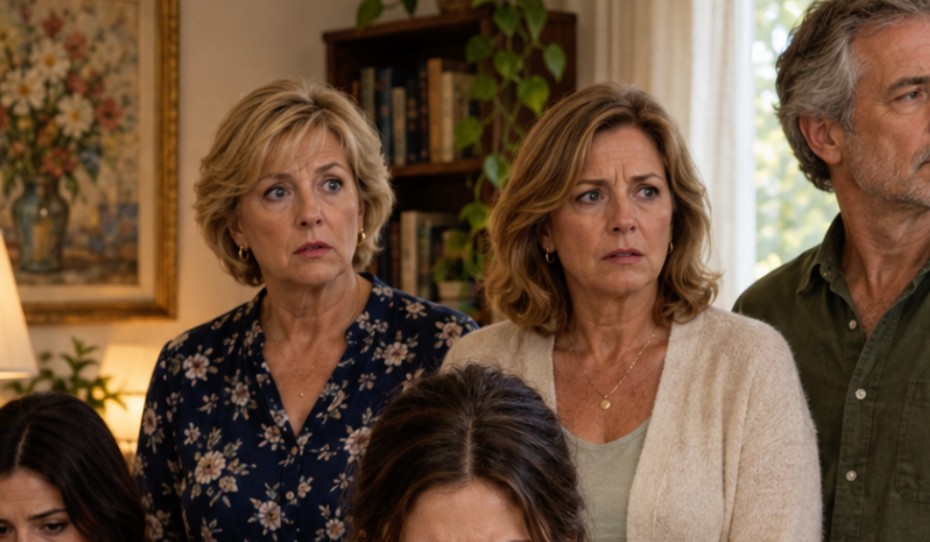
Other family members were already sitting in the living room. Uncle Kostya—Irina Pavlovna’s brother and a hefty man with a balding head—occupied an armchair by the window. Brother-in-law Viktor awkwardly shuffled near the balcony, fiddling with a shirt button. Katya, Vika’s thirteen-year-old daughter, sat glued to her phone. Irina Pavlovna bustled in the kitchen.
The table looked unusually modest: Olivier salad, slices of sausage, bread, a few pickled cucumbers on a plate. There was no birthday cake, no signature French-style chicken that Tatyana usually ordered from the restaurant, and not even a bottle of champagne.
“Tatyana’s here!” Vika announced as she followed her sister into the room.
“You came alone?” Irina Pavlovna peeked out from the kitchen, giving her daughter a thorough look from head to toe.
“Yes, who else were you expecting?” Tatyana kissed her mother on the cheek. “Happy birthday, Mom. Chrysanthemums, your favorites.”
“Thank you,” Irina Pavlovna took the bouquet, but disappointment was clear in her eyes. “And… nothing else?”
Tatyana pretended not to notice the hint.
“Everyone, take a seat—the food’s ready,” Irina Pavlovna sighed as she placed the flowers in a vase.
Everyone gathered around the table. Vika opened her bag and started counting her cash, whispering comments to her husband. Viktor just shrugged, as if to say, “What can I do?”
“Didn’t think we’d have to place the order ourselves,” Irina Pavlovna sighed theatrically while serving salad onto plates. “Usually, Tanya took care of everything.”
Tatyana calmly spread butter on her bread and took a bite, ignoring the not-so-subtle hint.
“Maybe we should order pizza?” Vika suggested, glancing at her sister. “Tanya, what do you think?”
“Not a bad idea,” Tatyana nodded. “Who’s going to order?”
“Well… you usually do,” Vika nudged her phone toward her sister.
“This time, you handle it,” Tatyana smiled and took a sip of water from her glass.
An awkward silence settled over the room. Every eye was fixed on Tatyana, as if waiting for her to suddenly jump up, apologize, and pull out her wallet. But Tatyana just continued eating her salad calmly, keeping up a meaningless conversation about the weather.
“Maybe we should all chip in?” Uncle Kostya finally broke the tense silence. “A thousand each?”
“I’ve only got five hundred,” Viktor grumbled.
“I don’t have any money at all,” Katya shrugged without looking up from her phone.
“My pension comes in three days,” Uncle Kostya sighed.
Vika silently placed a thousand rubles on the table, giving Tatyana a pointed look.
“Here you go,” Tatyana calmly added her own thousand. “That should be enough for a couple of pizzas.”
“But you always used to pay for everything,” Vika couldn’t help herself. “What happened?”
“Nothing happened,” Tatyana shrugged. “Everyone pays for themselves, isn’t that how it’s usually done?”
“But it’s Mom’s birthday!” Vika protested.
“Exactly,” Tatyana agreed. “That’s why we’re all here—to celebrate Mom. Together.”
Viktor actually seemed glad about this turn of events. He quickly pulled out his phone and started picking out pizza before the conflict could get any worse.
Time ticked by slowly. Conversation stalled. Irina Pavlovna occasionally cast hurt glances at her eldest daughter. Vika nervously jiggled her leg under the table.
“Are we going to give the gifts now?” Katya asked once the pizza was finished.
“Of course,” Vika pulled a small box out of her bag. “Here you go, Mom, from Katya, Viktor, and me.”
Inside was an inexpensive bottle of perfume. Irina Pavlovna thanked them, but it was clear the gift didn’t live up to her expectations.
“What about from you, Tanya?” Katya asked, curiosity in her eyes as she looked at her aunt.
“Flowers,” Tatyana answered simply. “Mom’s favorite chrysanthemums.”
“Is that all?” Vika couldn’t contain herself.
“Yes,” Tatyana nodded. “Beautiful flowers for a beautiful woman.”
The room sank into heavy silence. Tatyana calmly finished her tea and checked her watch.
“I have to go,” she said, rising from the table. “I have to get up early tomorrow. Once again, happy birthday, Mom.”
When the door shut behind Tatyana, a deep silence filled the room. Irina Pavlovna stared uncertainly at the chrysanthemums in the vase. Vika nervously tapped her fingers on the table. Viktor let out a quiet sigh of relief. Katya finally put down her phone and glanced around at the adults in surprise.
“What happened to Aunt Tanya?” the girl asked. “Why is everyone acting so weird?”
“Aunt Tanya has changed,” Vika muttered through clenched teeth. “She used to be a normal person, but now… she’s just full of herself.”
“I think she just stopped paying for everyone,” Viktor suddenly chimed in. “And good for her.”
“What?!” Vika turned to her husband indignantly.
“What?” Viktor shrugged. “How long can we keep taking advantage of her? She has her own life and expenses.”
“Whose side are you even on?” Vika raised her voice.
“I’m on the side of common sense,” Viktor looked his wife straight in the eyes for the first time in a long while. “We’re all adults here. It’s time to stop waiting for someone else to fix our problems.”
It was as if someone had switched off the power in the apartment. Suddenly, the silence was so deep that you could hear the ticking of the old wall clock. But it wasn’t about electricity at all—the unspoken expectations faded away, and the invisible routines that had kept the family together for years simply collapsed.
Tatyana walked through the city in the evening, breathing in the cool spring air. A strange feeling of freedom filled her chest. It wasn’t that she had stopped loving her family—her love was still there. But the silent chains of obligation, the invisible threads of guilt and duty that had bound her for years, had finally disappeared.
“Loving someone doesn’t mean having to pay for everything,” Tatyana thought, pulling her coat collar up against the chilly wind. Deep inside, she still hoped that one day her family would understand: real relationships are built on equality and mutual respect, not financial dependency.
For now, she would live her own life. For the first time in many years.