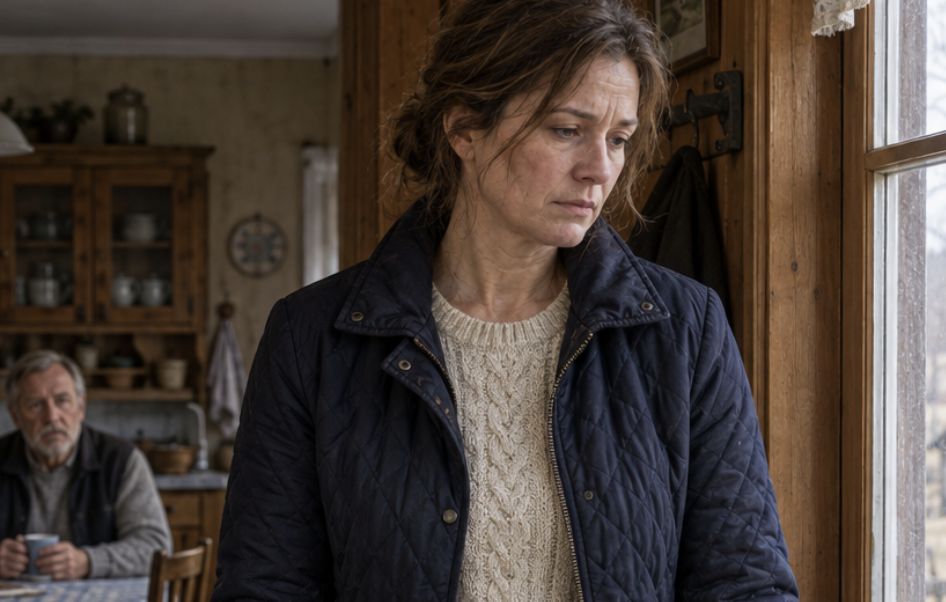
A drop from the old brass sink fell into the enamel basin below with a heavy, rhythmic thud. This sound had been etched into Nadezhda’s temples for twenty-eight long years—ever since, at the age of twenty-two, she first stepped into this five-walled home as its rightful mistress. The entryway smelled of damp wool, dried dill, and a deep-seated, long-lasting resentment that clung in the air.
Nadezhda zipped up a small brown leather bag. She hadn’t packed much: two changes of underwear, a warm beige sweater, her passport, her agronomist diploma—tucked away at the bottom of the linen cupboard years ago, just in case—and her mother’s silver brooch set with a faded river stone. She straightened, smoothed her dark blue quilted jacket, and placed the ring of keys on the wooden shelf by the cracked mirror.
The smell of fried pork fat drifted from the kitchen. In the doorway stood Viktor—heavyset, fifty-three, with thick, overhanging eyebrows and that perpetually displeased, crooked crease by his mouth. He was holding a mug of cold tea in his hand.
“And where do you think you’re going at the crack of dawn?” he rasped, his voice sharp and habitual, eyes narrowing at the bag by her feet. “Putting on a show again? You think I’ll go running after you in the village, begging on my knees?”
Nadezhda didn’t respond. She looked at his weather-beaten, bloated face and suddenly had a startling realization: there was nothing left inside her. No anger, no fear, not even tears—she’d cried rivers of them through twenty-eight years of shared misery. Just emptiness. Clean, like a freshly washed window.
“I’m leaving, Vitya,” she said quietly, her voice steady. “For good.”
Viktor choked on his tea and burst into a hoarse, mocking laugh:
“For good?! Have you looked at yourself in the mirror lately, you scarecrow? You turned fifty just last Tuesday! Who’d want you, all washed up? Who needs a woman with not a penny, no man, no roof? You haven’t held a real job a single day—all these years, leeching off me, eating well! You’ll come crawling back in two days, begging to wash my feet just so I’ll let you on the porch!”
Nadezhda silently grabbed her bag by its worn strap, pushed open the front door, and stepped outside.
The morning greeted her with thick, chilly autumn fog, carrying the scent of damp alder and the first hint of frost. The gate clanged shut behind her. Her feet, in old boots, moved easily along the frozen track—as if a crushing weight had finally been lifted from her shoulders.
For twenty-eight years, she had lived someone else’s life. Once, after tech school, Nadezhda had dreamed of working in greenhouses, breeding northern berries, breathing in the scent of soil. But after they married, Viktor quickly and effectively clipped her wings: “A woman’s place is the kitchen and garden. Stay home, don’t embarrass me at the farm.” He never hit her with his fists—he struck with words, every day, cunningly, relentlessly. Every bite of bread came with reproach: “You live off my back.” Every new coat led to a week of silent terror: “You spendthrift, sucking me dry.” continued in the comments.
She endured it all. She endured for the sake of her children. Her daughter Olechka was just four when her husband first publicly called her a ‘loudmouth’ at the collective farm’s holiday party. Their son Artyom was seven when their father, in a fury, threw his wife’s horticulture books out into the snow, declaring all they did was gather dust in the house. Nadezhda would swallow her tears in the corners, pressing an apron to her mouth so the kids wouldn’t hear, whispering to herself: “Once they grow up, once they find their footing… The family has to stay together. It’d be shameful to get a divorce—people would judge.”
The children grew up. Olechka graduated from university, got married, and moved hundreds of miles away. Artyom finished his military service and found work as an engineer at a northern oil rig. On her last visit, Olechka sat with Nadezhda in the bathhouse, gazing with sadness at her mother’s slumped shoulders, and said:
“Mom, who are you living for? Dad doesn’t treat you like a person. Leave him. Come stay with us, you can help take care of your grandson.”
But Nadezhda didn’t want to move in with her children. She didn’t endure all those years to become a burden to a young family, to be the odd one out in someone else’s apartment. She wanted just one thing: to breathe. Simply to breathe freely, without anyone watching over her or barking in her ear.
A local bus took her to a larger neighboring village at a crossroads of taiga roads. Nadezhda was carrying thirteen thousand rubles secretly earned over the summer from selling strawberry runners and knitted mittens.
She went straight to the management office of the local forest nursery. All summer, she’d been hearing rumors that the head there was looking for workers for the greenhouses: young people wanted to move to the district center, but there was no one to look after a million pine and cedar seedlings.
The manager, a hefty gray-haired man in camouflage, turned her thirty-year-old diploma over in his hands for a long time:
“Smirnova Nadezhda Mikhailovna? Graduated technical school with honors… Where have you been for thirty years, agronomist?”
“Stayed at home,” Nadezhda replied honestly, looking straight at the manager. “My husband wouldn’t let me work. But my hands remember everything. I know how to propagate cuttings, I’m skilled at transplanting, I can graft anything. Put me on probation. I only need a corner to live in. Even a little guardhouse by the warehouse would do.”
The manager grunted, looked at her clean, work-hardened fingers, and nodded:
“There’s a guardhouse. Wood heating, electricity, electric stove. Water from the well. The salary isn’t much, but the seedlings are at risk—they need to be planted. Move in.”
The guardhouse turned out to be a tiny room in a log outbuilding on the edge of the nursery. An iron bed with a mesh frame, a round table, a little wood-burning stove, and a window looking out over endless rows of film-covered greenhouses.
On the first evening, Nadezhda fired up the stove with birch logs. She sat down on a stool, rested her hands on her knees, and froze in place. The room was absolutely, piercingly quiet. No one slammed the fridge door. No one yelled from the living room, “Where are my socks?! The tea’s cold, you fool!” She could sip her tea slowly. She could set a spoon down next to the saucer and nobody would call her clumsy. Nadezhda lay down on the hard mattress, wrapped herself in the standard-issue quilt, and for the first time in 25 years, fell asleep without a lump in her throat.
Nadezhda threw herself into her work. The land turned out to be the very escape her soul had been longing for. The greenhouses were filled with the rich, earthy scent of damp peat, pine needles, and fresh shoots. From dawn till dusk, she fussed over tiny cedar sprouts, saved seedlings from damping-off disease, and adjusted the drip irrigation system. She knew things about plants that no university could teach — she could feel them with her fingertips.
After three months, the women in her crew wouldn’t start pruning without Mikhailovna. Nadezhda stood tall, the heavy gray crease between her eyebrows smoothing away, her eyes warm and soft, her walk light and springy. She trimmed her thick, dark chestnut hair into a neat, strict cut and used her first paycheck to buy a simple but beautiful beige sweater with a high collar. People in the village began to greet her with respect: “Good day, Nadezhda Mikhailovna.” No longer just “Vitka’s woman” or “Smirnikha,” but called by her full name and patronymic.
Meanwhile, back in their home village, Viktor was getting furious.
For the first week, he strutted around, thinking his wife would come crawling back by the weekend after blowing off some steam. But a week went by, then another, then a month… The house, without a woman’s touch, quickly sank into filth. The stove was sooty, his shirts could stand on their own, and he had to eat store-bought dumplings stuck together. Neighbors chuckled behind the fence: “What’s up, Vitka, your little bird flew away? Turns out you weren’t feeding her, she was the one carrying you on her back.”
Viktor tried complaining to the kids. He called his son at his job:
“Artem! Your mother’s lost her mind! Taken off in her old age, shaming the whole village! You go find her and knock some sense into her!”
His son answered in a low, firm tone:
“Dad, Mom put up with your behavior for thirty years. She deserves peace. Leave her alone. If you even touch her — I’ll come down there myself, and it’ll be a different kind of conversation.”
His daughter didn’t even take his call and just replied with a short message: “Leave Mom alone.”
By April, Viktor couldn’t take it anymore. After finding out from some driver friends where his runaway wife had settled, he put on his best brown vest, caught the morning bus, and headed to the tree nursery.
It was a bright, dripping day. The snow around the greenhouses had melted into sparkling streams. Viktor pushed open the heavy glass door of the main greenhouse, ready to make a scene, twist her arm, and command: “March home, you cow!”
But the words caught in his throat.
Nadezhda stood in the middle of a sunlit row. She held a watering can with warm water, gently misting blooming primroses, laughing brightly and girlishly at her young coworker’s joke. She wore a clean work apron, her face was rosy from the spring warmth, and her chestnut hair shone in the light. She looked ten years younger — calm, beautiful, confident, a woman untouched by anyone’s rudeness.
“Nadya…” Viktor rasped, stepping forward onto the concrete path.
Nadezhda turned around. Her laughter faded, but there was no fear on her face. She glanced at her husband with a calm, indifferent look — the way you might look at an empty plastic cup tossed by the wind at your feet.
“Hello, Viktor. Why are you here?”
“What… what are you doing here?” he stammered, suddenly feeling awkward and out of place among the delicate green shoots. “Enough messing around, Nadya. You played at independence – it’s time to stop. Let’s go home. You can clean the stove, wash the curtains… I’ll even buy you new boots for the fall. Don’t be mad. Let’s forget everything.”
continued in the comments
Nadezhda gave a barely noticeable smile at the corners of her lips. In that calm smile was such undeniable feminine strength that Viktor instinctively stepped back half a pace.
“Home? I don’t have a home with you, Vita. And I never did. It was a prison where I locked myself up just because of what others might think. I filed for divorce at the district court. I don’t need any of the property—keep your five-walled house. I don’t even want a rusty button from you.”
“Who do you think you are without me?!” Viktor tried to roar, but his voice broke into a pitiful falsetto. People around were beginning to watch; some of the men glared, gripping their shovel handles tighter.
“I am Nadezhda Mikhailovna,” she said clearly. “An agronomist. And you can go now, Vita. The bus leaves in twenty minutes. If you’re late, you’ll have to walk through the mud.”
Viktor stood there, gasping for air, spat at his feet, and slouched away toward the exit, dragging his feet like a beaten dog.
Two years passed.
On the edge of the settlement’s nursery stood a small, newly built wooden house with carved window frames. The fence was hidden under clusters of lush double lilac, and the front garden was full of rare northern flowers. Nadezhda was able to buy this home thanks to a cooperative loan and her son Artyom, who now flew up to visit her every summer.
On a warm June evening, Nadezhda sat on the wide wooden porch, holding a mug of tea brewed with currant and mint leaves. The sun was setting slowly beyond the taiga, pouring thick golden honey across the land.
From the yard, Pavel approached—wiping his hands on a clean towel. He was the head of the carpentry shop, a quiet 52-year-old widower with kind wrinkles around his clear blue eyes. He had been fixing the carved gazebo in the yard, the one Nadezhda had mentioned only a week ago.
Pavel wasn’t one for grand speeches. He simply sat down gently beside her on the steps, looked out at the distant river, and quietly said:
“Your tea smells all down the street, Nadusha. Are you tired after the day?”
“Not at all, Pavel,” Nadezhda replied softly, placing her warm hand over his large, rough palm. “The earth takes your strength, but it gives it back too.”
She leaned her shoulder against his strong one and closed her eyes. She was fifty-two. Ahead of her was a whole life—without shouting, without fear, filled with quiet evening tea, blooming lilacs, and that simple human happiness that’s worth closing a creaky door behind you forever just to gain.