Vera opened her laptop to send out a report and noticed someone else’s tab was open. Her husband had forgotten to log out of his email. She read one message, then another, and suddenly, their sixteen years together seemed different.
The laptop was still warm, even though Vera hadn’t touched it since last night. She lifted the lid, and instead of her spreadsheets, someone else’s email inbox glowed on the screen.
The frying pan was sizzling in the kitchen. Sonya was in her room, listening to something through her speaker—a dull, steady beat pulsed through the wall, like a heartbeat outside a door. Vera wiped her hands on the towel slung over her shoulder and sat down on the wobbly stool—the one with the short leg Gleb had promised to fix back in September.
A sticker of a silly yellow cat was still stuck to the laptop lid. Sonya had put it there three years ago, when Vera was given this laptop at work for finishing the annual report. The cat was peeling at the edge. Every morning, without even noticing, Vera would brush that worn corner with her fingernail.
At the top of the inbox, there was an email from someone called “Pakhomov & Partners Legal Bureau.” The subject line read: “Regarding your question about the apartment on Sadovaya.”
The apartment on Sadovaya was hers. Her grandmother’s. Two rooms, high ceilings, and the kind of radiators that kept things so warm in winter you had to crack a window. Vera had inherited it two years before she got married.
She didn’t open the email right away. Instead, she glanced at the frying pan. The cutlets were already darkening at the edges, and hot oil was popping onto the stovetop.
“Mom, is dinner ready yet?” Sonya shouted from her room.
“Five minutes.”
“You’ve been saying ‘five minutes’ for fifteen minutes now.”
“Well, this time it’s really five,” Vera replied, surprised at how steady her voice sounded.
She stood up, flipped the cutlets, turned down the heat, and went back to the stool. The cursor blinked over the word “Inbox,” and Vera stared at it for so long that the screen began to dim.
What could it be? Gleb sometimes helped friends with paperwork. Maybe he was asking for someone. Maybe a coworker wanted to buy property in their area and had asked Gleb to look into it. Maybe.
She touched the trackpad. The screen lit up again.
Gleb came home a little before eight. Vera heard him fidgeting with the key for a long time, even though the lock usually turned easily. Then his shoes banged in the hallway—first one, then, a second later, the other.
“What’s that smell?” he asked from the hallway.
“Cutlets.”
“Oh, perfect timing! Seriously, I feel like a dog today. Been on my feet all day.”
Gleb was short, one seventy-three centimeters, with a receding hairline he combed forward and a habit of rubbing the bridge of his nose with two fingers as if taking off invisible glasses. He never actually wore glasses. Forty-four years old, and his vision was like a pilot’s, he would say proudly—and that was one of the dozen phrases Vera could finish for him.
She closed the laptop before he came into the kitchen. Closed it gently, without a sound, and placed a potholder on top.
She didn’t know why she covered it with the potholder. Her hands just did it.
“Did Sonya eat?” Gleb opened the fridge, peering inside without taking anything out.
“We’ll all eat now.”
“What’s up with you?”
“What do you mean?”
“I don’t know. Just… something.”
“I’m exhausted,” Vera said. “Quarterly report.”
“Ah, yeah. That’s sacred,” he replied, closing the fridge without taking anything out and rubbing the bridge of his nose. “Listen, I borrowed your laptop yesterday, is that okay? Mine died again and I needed to check something real quick.”
“It’s fine.”
“I think I might’ve left something open on it. Did you notice?”
He asked casually while pouring water from the filter into his mug. It was a white mug with a chipped edge near the handle, with the words “Best Dad” written on it—Sonya had given it to him when she was eight. He only drank from that mug. If it was dirty, he washed it himself, even though he never washed anything else.
“No,” said Vera. “I didn’t turn it on today.”
That was the first real lie she had told him in sixteen years, looking him straight in the face.
She knew it was the first. All the other little things—about the price of boots or not liking his brother—weren’t really lies, just ways to keep peace at home. But this felt different.
“All right then,” Gleb took a sip of water. “I’ll check it later, just in case.”
“Check it after dinner.”
“Okay.”
He sat down at the table, and the stool beneath him wobbled too.
“I’ll fix it,” he said, tapping the leg with his finger. “This weekend, I’ll fix it.”
“Okay.”
Sonya came in with her phone in hand, smelling of strawberry shampoo. At fifteen, she was already a meter sixty-eight tall—four centimeters taller than her mother—with bangs she cut herself in the bathroom using manicure scissors, always a bit crooked on the left.
“Dad, you promised to drive me to Dasha’s on Saturday.”
“I will.”
“You promised last Saturday too.”
“I had a project last Saturday, Sonya.”
“You always have a project.”
Gleb laughed and ruffled her hair. Sonya dodged, but she smiled. Vera was setting kotlets on plates, watching them laugh together, thinking: I’m not going to say anything right now. Nothing. I’ll read first.
But what if there’s nothing there? What if I’ve just gone mad from the quarterly report and not sleeping for the third night in a row?
She served Gleb three kotlets, just the way he liked. She took only one for herself. She had no appetite at all, and the meat felt like soggy cardboard in her mouth.
She opened her laptop in the bathroom at half-past eleven, sitting on the closed toilet lid. Gleb fell asleep quickly. He was out in five minutes, sleeping on his back with his arms spread out, snoring softly with a whistle on each inhale.
The bathroom smelled of his shaving foam and dampness. The cold tiles chilled Vera’s bare feet. She curled her toes and set the screen to its lowest brightness.
He hadn’t logged out. The email was still there.
The letter from the lawyers was long. Vera read it slowly, every paragraph twice, because the words kept slipping away.
“Gleb Arkadievich, about your question. If an apartment was inherited by your wife before the marriage, it remains her personal property and isn’t subject to division. However, if marital funds were used for investments that significantly increased its value (major renovations, remodeling, replacement of utilities), a court may consider the property to be joint. To prove this, you’ll need to show that the investments came from shared finances and document their amount. We recommend collecting receipts, contractor agreements, and bank statements.”
A little further down, Gleb’s reply—sent a week ago.
“I have some of the receipts, the renovation was done in 2019, all through my crew. I can backdate the contracts, that’s not a problem. Question: if she finds out too soon, could she do anything with the apartment? Sell it, give it away?”
And the lawyer’s response: “In theory, yes, she could. That’s why we recommend you don’t delay with filing the claim and don’t let your wife know about your intentions until after you submit it.”
Vera closed her eyes.
The renovation in nineteen. She remembered it by the smell: spackle, paint, damp plaster. They spent six months living at Lidiya Pavlovna’s, her mother-in-law, cramped in a small apartment on the outskirts, with Sonya sleeping on a pull-out bed in the kitchen. Vera took the money for the renovation from her grandmother’s savings—the same money that had been sitting untouched since the nineties, money her grandmother had told her, “don’t touch it unless you absolutely have to.” Gleb said back then: I’ll do everything myself, with my own crew, at cost price, no need to overpay strangers.
At cost price.
Vera opened her eyes and looked at her knees. On her left knee was an old scar—a white line from a bicycle accident when she was ten. She traced it with her finger.
The rest of her inbox was full of everything: newsletters from DIY stores, emails from clients, estimates. Vera kept scrolling without stopping—until she came across a name she didn’t recognize.
Inga Kovalyova.
Their conversation had started in the spring. There were many emails; Vera didn’t bother to count, but the scroll bar was squeezed to a thin black line.
She opened the latest one.
“Glebushka, I went to see that two-bedroom on Rechnaya again today. The realtor says they won’t hold it until summer. Will you make it in time? I don’t want to rush you, but I’m tired of living out of a suitcase. And Mom keeps asking when you’ll finally come and meet properly, not just drop in for half an hour.”
Gleb’s reply.
“Inus, hang on a bit. The lawyer says if it’s done right, I’m owed half her apartment, and the market’s good now—enough for the down payment and renovations. The main thing is that she doesn’t catch on too soon. I’m not telling her anything yet; she hasn’t noticed a thing, she’s buried in her reports. We’ll sort it all out this summer, I promise.”
She’s buried in her reports.
Vera read that sentence over. Then again. Then caught herself mouthing the words, her lips moving like a first-grader learning to read.
On the other side of the wall, Gleb snorted in his sleep and turned over. The bed creaked. Vera froze, and in the next second, her laptop screen darkened, as if it was startled along with her.
She sat in the dark. The water dripped from the tap into the sink, slowly, at even intervals, and she started counting the drops, because she needed something to count. Twelve. Thirty. Forty-one.
By the time she reached one hundred, her toes were completely numb from the cold.
Nelly picked up the phone immediately, even though it was ten minutes to midnight.
“What’s up? What happened? Mom?”
“Mom’s fine.”
“Sonya?”
“Nell, everyone is okay.”
“Phew, I was already… Okay, hang on, let me go to the kitchen, Kostya is asleep.”
Nelly was three years younger, lived in the next neighborhood, worked as a nurse at the children’s clinic, and always spoke very quickly, swallowing her words as if she was worried time would run out before her shift ended. Vera listened to her sister’s slippers slapping the floor, the kettle clanging.
“Talk to me.”
“I don’t know how to say it.”
“Is he seeing someone else?”
Vera stayed silent.
“Vera, is he cheating?”
“That’s not even the worst part.”
“What do you mean not the worst? What are you talking about?”
And Vera told her everything. Quietly, sitting on the hallway floor, leaning against the closet so her voice wouldn’t carry to the bedroom. She shared about the lawyer, the receipts, the backdated documents, the two-bedroom on Rechnaya. About “she’s got her own reports.”
Nelly didn’t interrupt. That was unusual for her. When Vera finished, the only thing she could hear through the phone was her sister breathing.
“Did you take screenshots?” Nelly finally asked.
“No.”
“Do it. Right now. Everything you have. And send them to your phone, and to me, too.”
“Nell.”
“What, Nell? Do you want him to wake up tomorrow, log out of the email, and delete everything? Take the screenshots, I mean it.”
“What if I misunderstood?”
“How could you misunderstand? He wrote that he’s entitled to half of grandma’s apartment. Grandma’s, Vera. The one where you and I used to sit on the windowsill and eat sunflower seeds.”
Vera covered her face with her hand. Her hand was freezing cold.
“I just don’t get how he could,” she said. “Sixteen years. He carried Sonya out of the maternity hospital. He gave me that present for my fortieth…”
“Vera. Screenshots.”
“I’m doing it.”
She went back to the bathroom. Opened the laptop. She pressed the shortcut keys, saved, pressed again. Her hands worked methodically, just like at work when you balance the books and suddenly spot a million dollar mistake. They didn’t shake. They just did the job.
Once everything was sent, she logged out of his email herself. Then she hesitated, and signed back in. If he woke up in the morning and noticed the email was logged out, he’d get suspicious.
Vera left everything as it was. She left the laptop on the kitchen table, cat sticker facing up—the way it had been yesterday.
She lay down next to Gleb. In his sleep, he threw his arm over her, heavy, warm, smelling of soap. She used to fall asleep under that arm. Now she just lay there, staring at the ceiling, where a trembling yellow patch of light flickered from the streetlamp outside.
How many times had he hugged her in his sleep like this over the past year? While texting Inga, “be patient”?
She didn’t move until morning.
The morning felt just like any other, and that was the scariest part.
Gleb was frying eggs for himself, humming something under his breath. He always sang while making eggs—the same line from some old song, never knowing more than the first few words. Sonya was getting ready for school, searching for her second sock and blaming everyone in turn for it being missing.
“Mom, did you take my gray sock?”
“Why would I need your sock?”
“I don’t know. It was here and now it’s gone.”
“Look under your bed.”
“I did!”
“Look again.”
Gleb gave Vera a wink over his shoulder. She smiled back at him. Turns out, it was actually easy. Her facial muscles remembered how to do it and just did it automatically.
“Listen, Vera,” he said, setting the fried eggs on her plate. “I’ve been thinking. Maybe we should do something about the paperwork for this apartment, huh?”
Her cup stopped halfway to her lips.
“What do you mean?”
“Well, I read that property taxes are going up. And if, God forbid, something happens to you, then there’s inheritance and Sonya would have all the hassle. Maybe we should put it in both our names? Shared ownership or whatever it’s called. Just for security.”
“For security,” Vera repeated.
“Yeah. It just came to mind. There’s no rush, of course.”
He sat down to eat, quickly leaning over his plate to scoop up the yolk with bread. Vera gazed at the top of his head, the thinning hair combed forward, the small mole at his hairline she used to kiss.
Used to. In another life. Just a week ago.
“I’ll think about it,” she said.
“Think about it. I’m not rushing you.”
Hang in there, Inusya. I’m not pressuring her.
Vera got up, poured the unfinished tea into the sink, and washed the cup for a long time, even though there was nothing left to clean.
At work, she didn’t open a single file. She just sat in front of the monitor, a spreadsheet frozen on the screen, moving her mouse every so often so it wouldn’t go to sleep. Her office mate, Tamara Ivanovna, offered her valerian drops twice, even though Vera hadn’t complained about anything.
“You’re as pale as the wall,” said Tamara Ivanovna. “Maybe it’s your blood pressure?”
“Maybe.”
“Go home, I’ll cover for you.”
“No, I need to finish my report.”
“What report? You’ve been staring at the same cell for half an hour.”
Vera looked at the cell. There was an amount in it, and she couldn’t remember where that sum had come from.
At lunch, instead of going to the cafeteria, she went to the little park behind the office. She sat on a wet bench, not bothering with anything underneath, and dialed a number she’d found online that morning. Legal advice for family matters, first consultation free.
“How can I help you?” said a woman’s voice on the other end—tired and calm.
“I need to know,” Vera began, then hesitated. “I need to know about my apartment. The one from before marriage. My husband wants to split it.”
“Are you currently married?”
“Yes.”
“How did the apartment come to you?”
“Inheritance. From my grandmother. Two years before the wedding.”
“Did you do any renovations during your marriage?”
“Yes. But it was my money. From my grandmother’s savings account.”
“Do you have documentation of the account? Bank statement?”
Vera thought for a moment. Her grandmother’s savings book was in a jewelry box along with her labor medal and old letters. Vera had never thrown away anything of her grandmother’s.
“I have the savings book. And I think the bank can provide a statement.”
“They can. If you can prove the renovations were paid with your own pre-marriage funds, his claim becomes very weak. Very. Come in and bring everything you have. And most importantly, don’t sign anything. No agreements, no deeds of gift, no paperwork for shared ownership.”
“That’s exactly what he suggested this morning.”
“He suggested shared ownership?”
“Yes. For, you know, security, he said.”
There was a pause on the other end.
“Come in tomorrow,” the woman said. “Ten o’clock. I’m putting your name down.”
Vera spelled out her last name. Her voice was steady. The wind tugged at her coat, and in the park the air smelled of damp leaves and car exhaust from the avenue. Somewhere nearby, in a kiosk, they were frying doughnuts, and the sweet smell was so out of place it almost made her sick.
In the evening, Lidiya Pavlovna called. Her mother-in-law always phoned on Thursdays, exactly at eight, and Vera knew this schedule better than the train schedules she used every day.
“Verotchka, hello, my dear. How are you all doing? Is Glebushka home?”
“Not yet.”
“Still at the job site, huh? He really works hard, just like an ox. Takes after his father. He also worked straight through until retirement, no days off, no skipping out. Like I always say: the early bird gets the worm.”
Lidiya Pavlovna was sixty-eight, wore chunky amber beads to every celebration and even just for a doctor’s visit, and she always had a proverb for every occasion. Vera once thought this was adorable. Then she got used to it and eventually stopped noticing.
“But there’s another reason I’m calling,” her mother-in-law went on. “Gleb mentioned you two were thinking of moving this summer? He was a bit vague, you know. Said, ‘Mom, by summer everything will change.’ I asked what will change, and he just laughed.”
Vera stood by the window. Down in the courtyard, a man was trying to squeeze his car between two other vehicles, twisting the steering wheel over and over. Red brake lights flickered and faded.
“I don’t know, Lidiya Pavlovna. We haven’t talked about it.”
“Well, maybe he’s planning some kind of surprise. He’s always had an imagination, that one. Don’t be too hard on him if something happens. Men, they’re just like children—only bigger!”
“Alright.”
“And how’s Sonechka? Studying well?”
“She’s studying.”
“That’s great. Knowledge is light. Tell Glebushka to at least call me this weekend. It feels like I have a son, but never get to see him.”
“I’ll let him know.”
She set her phone down on the windowsill. The man below had finally wedged his car in, got out, and then realized that the door wouldn’t open because he was too close to the neighboring vehicle. He stood there for a moment, then got back in and started the process again.
“By summer, everything will change.”
He’s already telling his mother the same thing. Vaguely. Laughing it off.
For the next three days, Vera lived as if she were in a play, acting out her own life.
She cooked, ironed, checked Sonya’s algebra homework. She smiled. She answered questions. Gleb didn’t notice anything was wrong, and that became its own peculiar sensation: sixteen years side by side, and he didn’t notice her hands were cold, that she’d stopped eating, that she lay awake all night with her eyes open.
She had reports of her own to deal with.
The consultation took place in a small office on the second floor of what used to be a research institute. There was a dried-out aloe plant on the windowsill and someone seemed to be drilling endlessly behind the wall. The lawyer turned out to be the same woman Vera had spoken to before—around fifty, with a tired voice, short gray hair, and glasses hanging on a chain.
“Savings book,” the lawyer said, flipping through the pages. “Good. Withdrawal in March 2019, a large amount, and repairs began in April. Good. Be sure to request a bank statement. Do you have receipts for materials?”
“I have some. I bought the tiles and plumbing fixtures myself. He bought the mixes and all that other stuff.”
“Which card were the purchases made with?”
“He told me it was his. I transferred the money to him from my own account.”
“Are the transfers visible in your transaction history?”
“They should be.”
The lawyer took off her glasses and let them dangle on the chain, swaying against her chest.
“Vera Sergeevna, listen to me. The screenshots you showed me, they’re not for court, they’re just to help you understand. There’s no need to bring someone else’s messages to court; those aren’t your emails. But your documents, your transfers, your savings book—those are yours. With those, he won’t get anywhere. But if you sign away your share, then he will. Is that clear?”
“Yes, it’s clear.”
“Are you going to file for divorce?”
Vera looked at the dried-up aloe plant.
“My daughter is fifteen,” she said. “So I can’t do it through the registry office, right?”
“That’s right. Since the child is underage, you can only do it through court. A magistrate will handle it if there’s no dispute about the child. As long as he doesn’t contest where your daughter will live, it’s pretty straightforward. Child support would be a quarter of his income, until she turns eighteen. You can request that in the same claim.”
She explained this so calmly, as if she was just listing the steps of a cake recipe. Vera nodded. Inside, a small, scared voice was screaming: wait, wait, where are you going, this is Gleb, he’s her father, he’s the “Best Dad” on the mug.
But another part of her, grownup and composed, calmly wrote in her notebook: statement, transfers, magistrate, quarter.
“I’ll think about it,” she said as they parted.
“Take your time,” the lawyer replied. “Just don’t do anything with the apartment for now. And to be honest, you’re not obliged to let him in either, if it comes to that. He’s just registered there, right?”
“Yes.”
“You’re the owner. He only has residency, not ownership. He can be removed through court later. But that’s for later.”
On Saturday, surprisingly, Gleb took Sonya to her friend’s place. He came back with a bag of pastries from the bakery on the corner and a bouquet of small white chrysanthemums.
“These are for you,” he said, handing her the flowers in the hallway. “Just because.”
Vera took the bouquet. The chrysanthemums smelled bitter—like autumn, earth, and something herbal.
“What’s the occasion?”
“Why, can’t a man give flowers to his wife? You’ve seemed stressed lately. I thought I’d try to cheer you up.”
“Thank you.”
She put the chrysanthemums in a vase in the kitchen. Gleb switched on the kettle, unpacked the pastries, and arranged them on a plate. Two tartlets, two éclairs. Her favorite éclairs. He remembered.
And suddenly Vera wondered: what if she was wrong?
Not about the words. The words had been there, the words hadn’t gone anywhere; she could open her phone and read them again. But about what they meant. Maybe he was just chatting with this Inga? Maybe that’s what men do—they promise things, brag, and then nothing comes of it? Maybe the lawyer was just asked out of curiosity, and now he’s changed his mind, and here are the flowers, the éclairs, and he still remembers she loves éclairs.
Maybe they just need to talk?
“Gleb,” she said.
“Hm?”
“We need to talk.”
He turned away from the kettle. In his hand was his mug with the chipped rim.
“About what?”
Vera opened her mouth. And just at that moment, his phone chimed in his pocket.
He pulled it out and looked at the screen. His face changed—only very slightly, so slightly that before, she wouldn’t have noticed. The corner of his mouth twitched upward, and then he quickly forced it down, as if he’d caught himself.
“One second,” he said. “Work call.”
He stepped out onto the balcony, closing the door behind him.
Vera stood by the table with the eclairs. The kettle boiled and clicked off. Steam drifted up to the ceiling. Through the glass balcony door, she saw her husband’s back in his gray sweater, the way he pressed the phone to his ear, shifting from foot to foot, laughing with his head thrown back.
That’s not the kind of laugh you hear about work.
She remembered how he used to laugh when they first met. At a mutual friend’s birthday, in a rented apartment with tattered wallpaper, he was telling some joke, throwing back his head to laugh just like that. She was twenty-five then. She thought: what an easygoing person. Nothing feels scary with someone like him.
Gleb came back about ten minutes later.
“Sorry. The client’s impossible, can’t make up their mind about the tile. So, what did you want to talk about?”
Vera looked at him. At his open, calm face. At the hand he used to rub the bridge of his nose.
“It’s nothing,” she said. “Later.”
“Later it is, then.”
He sat at the table, picked up an eclair, and bit half of it. Cream stuck to his top lip, and he licked it off just like a kid.
Vera picked up a tart. Put it back. Picked it up again, took a bite, and the shortbread crumbled into dry dust in her mouth.
She wasn’t wrong about anything.
That night, she opened the laptop again. Not in the bathroom, but right there in the kitchen, under the exhaust’s light. Gleb was asleep. Sonya was spending the night at a friend’s.
His email was still open. He hadn’t logged out. Did he forget? Or was he sure she wouldn’t poke around?
A new email had come in last night. From Inga.
“Gleb, I talked to the realtor today. He said if we don’t pay the deposit by June first, the apartment will go to someone else. I can’t do this anymore. You promised you’d talk to her about the share. Did you?”
The reply went out at 18:47. Right when he stepped onto the balcony. He hadn’t written from his computer but from his phone, but the mail was synced, so everything was right there and easy to see.
“I talked to her. She said she’d think about it. Don’t worry, I’ll push her — she’s soft, she always gives in if you approach her right. I bought her flowers today, her favorite pastries. The main thing now is getting her to sign, and after that we’ll talk differently. Kisses.”
Vera read it once.
She didn’t read it again.
She closed the laptop and sat there for a long time, her hands resting on the battered cat sticker on the lid. The exhaust hummed. The fridge shuddered occasionally, then started purring louder, then fell quiet again. In the vase on the windowsill, chrysanthemums stood, and in the extractor’s light their petals looked gray, not white.
She’s soft. She always gives in.
Vera stood up. She walked to the vase, took out the chrysanthemums, shook the water off them over the sink, and gently, one by one, snapped each flower’s stem in half. She put them in the trash. She washed out the vase and put it on the top shelf, all the way at the back, behind the pots.
Then she got a roll of big black trash bags from the closet—one hundred and twenty liters each.
She started packing at six in the morning, just as Gleb left for his run. He ran on Sundays, for an hour, around the park, and came back sweaty, red-faced, pleased with himself.
She had an hour.
First, the closet. Shirts, jeans, sweaters. She took them off the hangers and folded them. She didn’t throw them—she folded them neatly, sleeve to sleeve, like in a store. She didn’t know why herself. Maybe because throwing things would be a tantrum. And this wasn’t a tantrum.
The gray sweater he was wearing yesterday while laughing on the balcony lingered in her hands the longest. It still smelled of his cologne and just a hint of smoke, even though he’d supposedly quit smoking five years ago. So, he hadn’t really quit. So, he’d been sneaking cigarettes somewhere. Another little lie in a mountain of bigger ones.
She put the sweater into a bag.
Next, the bathroom. Razor, shaving cream, toothbrush, his dandruff shampoo that sat on the shelf next to her creams. Then the hallway: jackets, boots, sneakers, the baseball cap he never wore but wouldn’t let her throw out. The toolbox from the closet. She picked it up—it was heavy—and set it by the door.
In the kitchen, she paused at the shelf with his mug. White, chipped at the handle. ‘Best Dad.’
Vera picked it up. Turned it in her hands. Sonya had chosen it at a souvenir shop by the sea when she was eight, carefully inspecting every mug until she picked this one because ‘the letters are pretty.’ Gleb had teared up that day. Real tears—Vera saw them.
She put the mug back on the shelf.
That’s not his. That’s Sonya’s.
There were seven bags in all. Vera carried them out to the landing, lined them up against the wall, then set the toolbox beside them. She went back, took out her keys, and removed his apartment key from the keychain he’d left on the hallway table. She put the keyring on the top bag.
She locked the door from inside using the top lock—the one that can’t be opened from the outside without a second key. Only she and Nelly had that second key.
At 7:12, she texted Nelly: ‘It’s done.’
Nelly replied a second later: ‘On my way.’
He rang the doorbell at seven twenty.
First once, quickly. Then longer. Then he started knocking.
— Vera! Vera, what’s going on? What is this?
She stood on the other side of the door. Through the peephole she could see his red, sweaty post-run face, distorted by the glass, his huge nose, and small eyes. He was holding a bunch of keys.
— Vera, open up. Is this some kind of joke?
— It’s not a joke, she said through the door.
— What do you mean not a joke? Are you crazy? Open up, I said!
— No.
He fell silent. She could hear him breathing heavily—out of breath from running. She heard the downstairs entry door slam, then someone else start up the stairs.
— Vera, he said more quietly. — Let’s talk about this. What happened? Did I do something? Just tell me what happened.
— You forgot to log out of your email.
The silence was so thick that Vera could hear the hallway light buzzing.
— Which email? he asked. His voice sounded different now. Not loud but cautious.
— Yours. On my laptop.
— Vera, you’ve got it all wrong.
— I haven’t even said yet what I understood.
— I know what you saw in there. It’s not what you think. It’s work stuff. That isn’t even my conversation—it’s for a friend. Remember Sergei? He asked me, his wife…
— Gleb. ‘Inusya, hang in there’.
He went silent again.
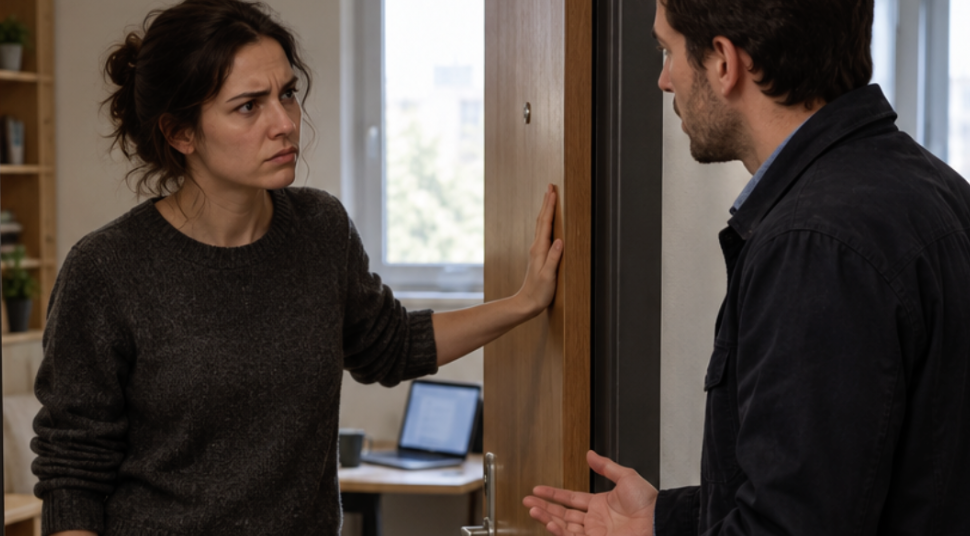
A neighbor from the fifth floor was coming up the stairs—a senior man with his dachshund on a leash. The dachshund busily sniffed the bag closest to it. The neighbor glanced at Gleb, then the bags, then the door. He muttered ‘Good morning’ and kept climbing, urging his dog to hurry up.
‘Alright then,’ Gleb said once the footsteps faded. ‘Alright. Yes, there’s another woman. Yes. I’m guilty, I admit it. But that isn’t an excuse to do this—throw my stuff out on the stairs! In front of the neighbors! Vera, we’ve been together for sixteen years. Can’t we sit down and talk this through? Like grown-ups.’
‘We’ll talk. In court.’
‘What court? What are you even talking about?’
‘About the apartment. My grandmother’s apartment, the one you tried to split. About the receipts you tried to backdate. About claiming your share, just to be safe.’
He hit the door with his palm. Not hard, but Vera stepped back and bumped into the coat rack.
‘You have no right to kick me out,’ he said. ‘I’m registered here!’
‘Registered, sure. But I’m the owner. Ask your Pakhomov and Partners if you want.’
‘You went through my mail!’
‘You left it open on my laptop.’
‘That still doesn’t…’
‘And you bought me flowers just to win me over. I’m soft. I always give in when something is presented the right way.’
He didn’t say anything. Vera leaned her forehead against the cold door. The metal smelled of paint and dust. She could feel her temples throbbing, steady and loud, and all she kept thinking was: Just don’t cry. Not here. Not in front of him.
‘Vera,’ he finally said, his voice cracking. ‘What about Sonya? Did you even think about Sonya?’
‘She’s all I’ve been thinking about. For five nights.’
‘What will you tell her?’
‘The truth. At least the part she should know at fifteen.’
‘You’ll turn her against me.’
‘You turned yourself against her when you tried to take away the apartment she grew up in.’
The door downstairs slammed again, and a quick clatter of heels sounded on the stairs. Vera recognized the footsteps.
‘Well,’ Nelli called out loudly, ‘Look who finally showed up, Gleb Arkadievich!’
‘Nelli, stay out of this.’
‘I’m not getting involved. I’m just here to support my sister. You take your bags and go to your dear Inusa. Say hi to her from me, by the way. And tell her to look for a down payment somewhere else before June first.’
‘You read it too?’ Gleb practically shrieked. ‘Did the whole family read my mail?’
‘You tossed it around so carelessly, it would have been a crime not to read it.’
Vera opened the door. Not all the way, just enough for the chain. Through the gap she saw Gleb—wet, in sweatpants, keys in hand—and Nelli beside him, wearing a puffer jacket over her pajamas, messy hair, a bright red scarf around her neck.
‘Gleb,’ Vera said. ‘Take your things. Please. The rest, we’ll handle through lawyers.’
‘Vera.’
‘Please.’
He looked at her through the crack for a long moment. Then his eyes dropped to the bags, the toolbox, his ring of keys—except it no longer had a key to this door.
‘You’re not like this,’ he whispered. ‘You never were.’
‘I know.’
She closed the door.
She sat right there on the hallway floor, hugging her knees. Through the door, she could hear Nelli talking urgently, swallowing her words. Gleb answered, short and angry. Bags rustled. Something heavy, probably the toolbox, knocked against the wall.
Then footsteps going up and down the stairs. Again and again.
Then silence.
Nelli rang the doorbell with their secret code—two short rings and one long—just like they used to do as kids playing spies.
Vera opened the door. Her sister came in, took off her puffy coat, dropped it on the floor, and hugged her, right there, kneeling down next to her as Vera sat.
Nelli smelled of frost and hospital soap.
“That’s it,” she said. “That’s it, Verka. You did great.”
Vera buried her face in Nelli’s shoulder. And only then, it seemed, did she finally start to breathe.
Lidia Pavlovna called that same evening. Not at eight, but at half past five, breaking her usual routine, and Vera understood everything even before picking up the phone.
“Vera,” said her mother-in-law, and there was no “dear” or “Verotchka” in her voice. “Gleb is with me.”
“I know.”
“He told me everything.”
“Everything?”
“Well. That you kicked him out. Over some messages. That you snooped in his email. Vera, is that really how you do things? So a man made a mistake, it happens to everyone. You don’t air your dirty laundry in public. You’ve been together sixteen years.”
“Lidia Pavlovna, did he tell you about the apartment?”
“What apartment?”
Vera paused. She looked at the kitchen table, where the laptop with the cat sticker sat. Gleb hadn’t logged out of his email. He’d probably changed his password from his phone, but the page was still open in the browser, frozen, showing the latest message.
“Ask him about the apartment,” Vera said. “About the lawyer. About how he tried to sue me for half of my grandmother’s apartment, the one where Sonya grew up. So he could buy a two-bedroom on Rechnaya for another woman. Ask him. And if he tells you the truth, then call me again, and we can talk about airing dirty laundry.”
There was silence on the line for a long time. Then her mother-in-law coughed.
“That can’t be.”
“It can.”
“He didn’t say. He told me you just got jealous.”
“Ask him.”
“Vera…”
“I won’t keep Sonya from you,” Vera said. “You’re her grandmother. Come visit whenever you want. That won’t change.”
Her mother-in-law coughed again, and Vera suddenly realized she was crying—quietly, trying to cover the receiver.
“The apple doesn’t fall far from the tree,” Lidia Pavlovna said in a choked voice. “His father too. When he left, he wanted to take everything, down to the last spoon. I thought Gleb wouldn’t be like that. I thought I raised him differently.”
Vera didn’t know what to say. The only thing she ever heard about her father-in-law was that he had died young, when Gleb was fourteen. Nobody had ever mentioned him leaving.
“I’ll call you,” her mother-in-law said. “Later. I need to talk to him…”
“Of course.”
She hung up. Sat on the wobbly kitchen stool, which rocked under her on its short leg. I’ll fix it, he’d said. This weekend.
Vera stood up, found an old piece of sandpaper in the storage room, and crouched down to sand the long legs of the stool. She worked at it for a long time, until it stopped wobbling. Fine sawdust settled on her jeans and smelled of pine.
She talked to Sonya that same evening, after her daughter came home from her friend’s place.
At first, Sonya didn’t understand. She stood in the hallway, looking at the empty coat rack where her dad’s jacket usually hung, and at the empty shoe shelf.
“Where’s Dad?”
“Sonya. Sit down. Come to the kitchen.”
“What happened? Did someone die?”
“No one died.”
They sat down at the table. Vera poured her daughter some cocoa, just like when she was little, complete with the foamy top that Sonya always scooped off with a spoon and parked on the edge of her cup. But this time, Sonya didn’t touch the cocoa at all.
“Your dad and I won’t be living together anymore,” Vera said.
Sonya stared at her. Her lips pressed into a thin line, and Vera recognized the gesture: Gleb had the same look when he was angry and silent.
“Why?”
“Because your father did things I can’t forgive.”
“What things?”
“Your dad has another woman.”
Sonya turned to the window. She fidgeted with her uneven bangs on the left, twisting a strand around her finger tightly—so tight the tip turned white.
“I knew,” she suddenly said.
Vera blinked.
“What?”
“I knew. Well, I didn’t know; I suspected. He’s always on his phone. And whenever I came in, he’d flip it over. And once, in March, I saw him standing with some woman outside the store. He didn’t see me. I thought maybe it was for work.”
“Sonya. Why didn’t you tell me?”
“What was I supposed to say? ‘Mom, Dad was with some lady outside the grocery store’? You would’ve thought I was making it up. Or you’d get upset.”
She said it so grown-up that Vera felt a deep ache in her chest, under her ribs.
“That’s not all,” Vera added. “He wanted this apartment to partly be his. To sell a share and buy a place for that woman.”
“This apartment?” Sonya turned around. “Grandma’s place? Great-grandma’s?”
“Yes.”
“But it’s ours.”
“Yes. And it will stay ours. I checked everything. I have the paperwork. He won’t get anything.”
Sonya stayed quiet for a long time. Then she picked up her cocoa, took a sip, and the foam left a white line over her upper lip—just like the cream on Gleb’s face yesterday.
“Will I see him?” she asked.
“Of course. Whenever you want. He’s still your dad. That doesn’t change.”
“What if I don’t want to?”
“Then you won’t. Not until you want to.”
Sonya nodded. She got up, went to the shelf, and picked up a white mug with a chipped rim—”Best Dad.” She turned it over in her hands.
“He forgot it,” she said.
“I left it there. It’s your gift.”
Her daughter looked at the mug. Then she opened the cupboard above the sink—the one where useless things like cake molds and old lids were kept—and put the mug deep inside, in the very back.
“Let it stay here for now,” she said. “I’ll decide what to do later.”
And she went to her room. Vera could hear the speaker come on through the wall—the same dull beat, only louder than usual.
She didn’t go in to ask her to turn it down.
Gleb tried to come back twice.
The first time was a week later. He showed up sober, clean-shaven, wearing a new jacket and carrying a huge bouquet of red roses—the kind he’d never once bought her their entire life together. He stood at the door, and Vera spoke to him through the chain.
“I broke it off with Inga,” he said. “It’s over. I was a fool, Vera, really. It was just some kind of haze. Midlife crisis, you know. I’ve even signed up for a therapist. Let’s try again.”
“And the lawyer?”
“What about the lawyer?”
“Did you drop the lawyer too?”
He hesitated, rubbing the bridge of his nose.
“Well, that’s different. It was just a consultation. I didn’t file anything.”
“But you planned to. You wanted to sign those papers and backdate them.”
“I did. But I didn’t!”
“You just didn’t get the chance.”
“Vera, why are you getting hung up on the words?”
She looked at the roses. Big, dark, velvety. They had to be expensive. Probably, with that money, she could have bought Sonya the new winter boots she’d been asking for since October.
“Gleb,” Vera said. “You’re not here for me. You came because things didn’t work out there. Inga didn’t wait until the first of June, did she?”
He stayed silent. That, in itself, was an answer.
She closed the door. He left the roses on the mat. Vera brought them inside an hour later, after the footsteps downstairs faded away, and stood them in a three-liter jar—she didn’t feel like getting out a vase. The roses lasted a week. The petals dried at the edges, darkened, curled in. She didn’t throw them out right away. She watched, day by day, as they wilted, and something about that slow change felt right to her.
The second time, he came with his mother.
Lidia Pavlovna stood beside him, wearing her amber beads and a coat with a fur collar, not looking at Vera, but off to the side, at the doorframe.
“Vera,” she said. “I brought him. Let him tell you himself.”
Gleb stayed quiet. His mother nudged him with her elbow.
“I’ll give it up,” he said in a low voice. “All my claims to the apartment. In writing. I’ll tell the lawyer. I won’t demand anything.”
“Alright,” Vera replied.
“And you… maybe you’ll think about it? About us?”
“No.”
Lidia Pavlovna sighed. Deeply, her whole chest, making her beads clink.
“Well, you reap what you sow,” she said, looking at her son. “Let’s go, Gleb. Come on, dear.”
She took his arm, like he was a little boy, and led him toward the elevator. As the doors were closing, she turned back to Vera and said:
“Can I see Sonechka on Sunday? I’ll bake a pie. With cherries. She loves them.”
“Of course. I’ll bring her.”
The elevator doors closed.
Vera brought the lawsuit to the magistrate at the end of November. The lawyer, with her silver haircut, helped draft everything in one evening: divorce, daughter’s place of residence with her mother, child support for underage Sofia in the amount of a quarter of the earnings. There was nothing about the apartment. There was nothing to split. The apartment was hers, and now everyone knew it, Pakhomov and his partners included.
In the courthouse hallway, it smelled of damp clothes, bleach, and someone’s sweet perfume. On the bench next to her was a young woman with a baby, and the baby was sucking on the edge of her scarf. Vera watched them and thought that for this woman, everything probably began with some little thing too. With an unclosed tab. With a phone turned face-down. With flowers for no reason.
Gleb came to the hearing. He sat at the far end of the hallway and didn’t come over. He’d lost weight, and his receding hairline was no longer combed forward, now he wore his hair short, almost shaved, making his face look older and somehow unfamiliar.
When they were called in, he stood and let her go first, holding the door for her.
The judge asked if either side had any objections. Gleb said no. She asked if he agreed that their daughter would stay with her mother. He said yes. Then she asked about child support. He said he agreed.
His voice was quiet, steady. No emotion.
It all took twenty minutes.
Outside, he caught up with her on the steps.
“Vera.”
She stopped. The wind blew into her face, and melting water dripped from the canopy above the steps, right onto her shoulder.
“Can I call Sonya on her birthday? In January.”
“Go ahead. She’ll decide if she wants to pick up or not.”
“She hasn’t picked up yet.”
“I know.”
He nodded. Stood there for a moment, as if he wanted to say something else. He rubbed the bridge of his nose. Then he just shoved his hands in his pockets and walked down the steps, toward the bus stop, where people were already gathering under the yellow streetlight.
Vera watched him leave. She waited for something to shift inside her, to ache or rise up. But nothing did. There was only her damp shoulder and cold fingers, and far away, the sound of a tram ringing as it turned the corner.
In January, on Sonya’s birthday, Vera came home from work late. Her daughter was sitting at the kitchen table with a laptop, typing something.
“Mom, I borrowed yours, is that okay? Mine’s glitching.”
“That’s fine.”
Vera took off her shoes and hung up her coat. She went to the kitchen. On the table sat the cake they had bought together yesterday, with ‘16’ written in pink frosting. Next to it, right at the edge, was a white mug with a chipped handle. Sonya had taken it out of the cupboard.
“He called,” Sonya said, eyes still on her screen.
“And?”
“I answered.”
“How was it?”
“It was fine. He wished me happy birthday. Asked about school. I said everything’s good. Then we were quiet for a bit. Then he said, ‘well, bye.’ That’s it.”
Vera poured herself some water. The glass clinked against the faucet.
“And the mug?”
Sonya looked at the mug. She shrugged one shoulder, her uneven bangs swaying.
“I thought—I’ll just leave it out. I’ll use it for tea. It’s mine. I picked it out.”
“It’s yours,” Vera agreed.
Sonya finished typing, clicked a button, and leaned back on her stool. The stool didn’t wobble.
“Mom, I logged out of my email,” she said, closing the lid. “Just so you know.”
A scruffy yellow cat stared at the ceiling from the laptop lid. Vera traced its edge with her fingernail. Just like she did every morning.
Then she took a knife from the drawer and started cutting the cake—carefully, into eight pieces. The first and largest one, with the pink-iced number, she set on her daughter’s plate.