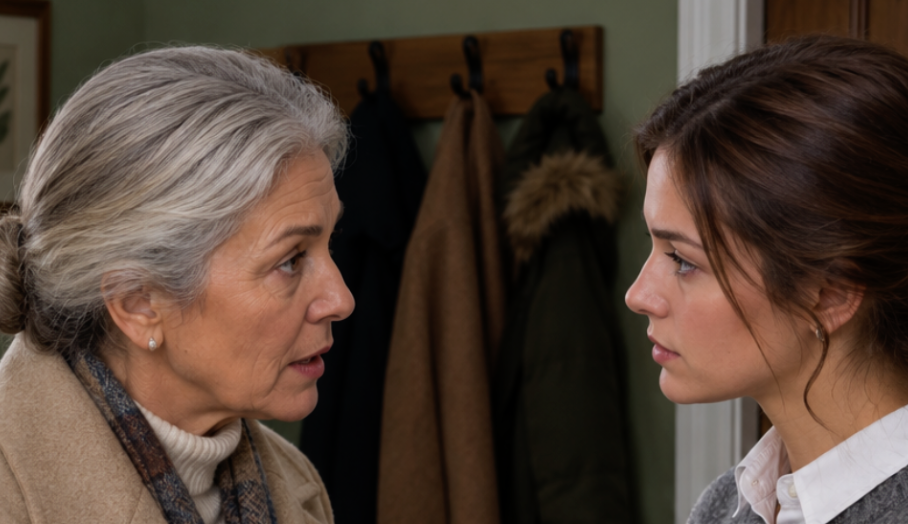
“So, you changed the locks? Half of this apartment belongs to my son, so hand over the keys to him, no arguments.”
Natalia barely had time to put down her bag of groceries. Her former mother-in-law was standing on the doormat, dressed in a beige coat and clutching a purse under her arm. The way she stared made it seem less like a visit, and more like she was here to carry out an inspection.
Zinaida Pavlovna hadn’t called in almost a year – not even for Misha’s birthday or New Year’s. And now here she was on Saturday around lunchtime, unannounced, talking about keys the moment she walked in.
“Hello, Zinaida Pavlovna,” Natalia said evenly. “Come in, since you’re here. Just don’t wake Misha, he’s catching up on sleep after his competition.”
Her mother-in-law walked straight to the kitchen without taking off her coat. Sitting on the edge of a stool, she started inspecting the walls, the curtains, and the fridge decorated with magnets. Her gaze was sharp and judgmental, like a market customer already convinced the goods weren’t worth her time.
“You live modestly,” she finally said. “But Vitya claims you’ve made yourself a queen here. In his apartment.”
“Ours,” Natalia corrected her, pressing the electric kettle button. “Half is mine, half is his. The court decided that three years ago. And since then I’ve paid the mortgage for both halves all by myself.”
Zinaida Pavlovna pursed her lips. Natalia knew that gesture from their very first family dinner fifteen years ago. Back then, her mother-in-law pursed her lips after tasting her salad and said, “You’ll learn, eventually.”
“Vitya is going through a tough time right now,” the guest said, staring out the window. “He has his own business, you know—investments, partners. He needs money. He wants to sell his share.”
“Let him sell it. I just don’t have the money to buy it out.”
“You’ll figure it out. Borrow it. You’re the independent one, after all.”
Natalia placed two cups on the table. Her hands were steady, though inside she felt tightly wound.
“Zinaida Pavlovna, did Vitya tell you he hasn’t paid child support in two years? Not a penny. Misha is growing and needs clothes, classes, books. I’m handling everything: the apartment, my son. Maybe you should be asking him about money instead.”
Her mother-in-law lifted her chin.
“Don’t make things up. Vitya said you refused the money yourself. Showed off your pride. And you don’t let him see his son.”
Natalia was left speechless. It was so absurd she almost wanted to laugh. Viktor had seen Misha exactly twice in the past year; both times he was an hour late, and both times he left early.
“I see,” she simply said.
“You see nothing,” Zinaida Pavlovna shot back, getting up without even touching her tea. “Vitya will sell his share to strangers. Then we’ll see how you like sharing your kitchen with outsiders. And give him the keys—he’s the owner, it’s his right.”
The door slammed behind her so hard that the hallway coat rack shook.
Natalia sat for a long time over her now-cold tea. Misha shuffled out of his room, groggy, his hair rumpled, wearing a dinosaur t-shirt.
“Mom, who was here?”
“Grandma Zina.”
“Why didn’t she stay?”
Natalia stroked his head but said nothing. How do you explain to an eleven-year-old boy that his own grandmother didn’t come to see him, but only to get the keys to his home?
A week later, a thick envelope stamped by a notary showed up in the mailbox. Natalia opened it right there on the stairwell, leaning against the railing.
Inside was an official notice from Viktor, telling her he was selling his half of the apartment. The price he set was so high Natalia had to read it three times. It was nearly the full value of their two-room apartment, not half. She had one month to respond. If she refused or stayed silent, he was free to sell his share to any other buyer.
Natalia went upstairs, sat on the stool in the hallway, and felt the floor drop out from under her. She didn’t have that kind of money. She wouldn’t have that kind of money even in ten years.
That evening, Olga called—a friend from college days. Now Olga worked as a lawyer and understood housing disputes way better than Natalia understood her own paycheck.
“Send me a photo of the notice,” Olga said briskly. “And don’t panic just yet.”
Half an hour later, Olga called her back.
“Listen closely. He’s required to offer you his share first—that’s your preemptive right. He did that, but he’s jacked up the price on purpose so you’ll turn him down. It’s an old trick. Then he’ll try to sell his share for cheaper, but this time, not to you.”
“And what happens then?”
“If he sells it to someone else for less than he offered you, that’s illegal. Within three months, you can go to court and request that the buyer’s rights are transferred to you, at the price it was actually sold for. So keep that envelope safe like it’s gold. At the same time, we’ll start filing a claim for unpaid child support. Collect all your receipts, bank statements, correspondence—everything.”
Natalia wrote down every word on the back of an old receipt. For the first time that evening, she felt like maybe she had some ground to stand on.
The days dragged by, heavy and thick like syrup. Accounting work, commute, lessons with Misha, dinner, paperwork. She laid out bank statements, mortgage payment receipts, money transfer printouts on the kitchen table. Three years of her life fit into a thick buttoned folder.
One evening, the doorbell rang. On the landing stood two men in matching dark jackets, holding a tablet.
“Good evening. We’re here for the valuation. Can we see the apartment? The owner is aware.”
“I’m the owner here,” Natalia said, without removing the chain from the door. “And I haven’t agreed to any valuation.”
“The other owner set it up,” one of them replied with a polite, empty smile like the window of a closed shop. “We won’t take long. Five minutes.”
“Goodbye.”
She closed the door and leaned against it. She could hear her heartbeat thundering in her ears.
The next morning, on her way to the elevator, her neighbor across the hall, Valentina Petrovna, stopped her. Valentina was over seventy, had spent her whole life working as a school deputy principal, and still knew everything going on in the building.
— Natasha, those two came knocking on my door yesterday too. They were asking about your family, who lives with you, and if the neighbors are noisy. Of course, I didn’t tell them anything. But just so you know, I’ve seen types like that before. My friend’s brother sold his share in the neighboring building. Some company bought it, and within a month, three strange men moved in. She put up with it for half a year and then sold her half for next to nothing.
Natalya nodded. She couldn’t bring herself to speak.
— Don’t give up, — Valentina Petrovna squeezed her hand with her dry, warm fingers. — I’ve lived in this building for forty years. I won’t let something like that happen here, not while I’m alive and well.
But that wasn’t the worst part. The worst came on Wednesday.
Misha came home from school quiet and withdrawn. He spent a long time fiddling with his shoelaces in the hallway, then went to his room and closed the door. Half an hour later, Natalya peeked in. Her son was sitting on the bed, turning a brand new phone over in his hands.
— Where did you get that?
— Dad gave it to me. He was waiting by the school.
Natalya sat down next to him.
— And what did Dad say?
Misha was silent for a while, looking at the screen.
— He said you’ll make us leave here soon. That you don’t want to share and the apartment will be sold anyway. And he’ll take me to live with him. Grandma Zina is going to have a big apartment soon, and I’ll have my own room with a computer.
He looked up at her. There was so much worry in his eyes that it took her breath away.
— Mom, are we really going to be kicked out?
She hugged him tighter than she probably had since he was a little boy.
— No one is going to kick us out. Do you hear me? This is our home. I’m holding onto it not because it’s special, but because you live here.
She didn’t sleep that night. She sat in the kitchen, staring at the dark window. Waves of hot, helpless anger washed over her. Viktor could do whatever he wanted to her. But dragging a child into this, scaring him, trying to buy his trust with a phone…
And then one phrase stuck with her. “Grandma Zina is going to have a big apartment soon.”
Zinaida Pavlovna had a three-room apartment in an old brick building by the park. High ceilings, oak parquet, a massive china cabinet that her mother-in-law polished every Sunday. She’d gotten that apartment from her factory and was very proud of it. Why would she need a bigger one soon if she already had such a big place?
Natalya remembered how, half a year ago, during one of their rare family celebrations, her mother-in-law had mentioned signing a paper at the notary for Viktor. Supposedly so he could pay her utility bills himself and deal with the housing management. Back then, she’d boasted about what a caring son she had. Natalya hadn’t paid it much attention.
She opened her laptop. For about twenty minutes she browsed real estate listings in the park area. And she found it.
“Three-room apartment, brick building, high ceilings, parquet. Urgent sale. Documents ready, being sold by a representative of the owner with power of attorney.”
In the third photo was that very same china cabinet. With all the crystal. And on the wall behind it, the rug with deer—under which Misha had learned to walk when he was three.
Natalya stared at the screen, her fingers turning cold.
Viktor was secretly selling his own mother’s apartment. He did it quietly, behind her back, using a power of attorney she’d signed, thinking her son would use it just to pay utility bills.
Natalia didn’t sleep a wink until morning. She just sat there, lost in thought, trying to figure out what to do.
The easiest thing would be to stay silent. This woman had come into her home demanding keys. This woman hadn’t called her grandson for a whole year. For fifteen years she had chosen to believe her son, not her. Let her find out on her own now what kind of son she raised.
But then she pictured Misha. He loved his grandmother. He loved her cabbage pies, her stern ‘sit up straight,’ her glass cabinet—he’d make funny faces at his own reflection there. If Zinaida Pavlovna ended up homeless, someday Misha would find out that his mother knew and stayed silent.
And suddenly, Natalia realized something very clearly. Her mother-in-law had been deceived, just like she had. She just didn’t know it yet.
In the morning, she took Misha to school, called in sick at work, and headed to the park.
Zinaida Pavlovna didn’t open the door right away. First, she looked through the peephole for a long while. Then she unlocked the door, but only as far as the chain would let it.
“You? What do you want? Did you bring the keys?”
“I need to talk to you. It’s about your apartment.”
“My apartment has nothing to do with you.”
“Please, Zinaida Pavlovna. Just ten minutes. Then I’ll leave, and you’ll never have to see me again if you don’t want to.”
Something in her voice must have convinced her mother-in-law to take off the chain. Natalia walked into the familiar room. The glass cabinet. The crystal. The deer rug. Everything was in its place, just like in the photos.
She silently handed her the phone.
Zinaida Pavlovna took it, put on her glasses, and stared at the screen for a long time. She scrolled through the pictures. Went back to the first one. Scrolled again. Then slowly sat down on the couch.
“These… look like old photos.”
“The listing was posted nine days ago. It says the apartment is being sold by a representative with power of attorney. Didn’t you sign a power of attorney for Vitya at the notary?”
Her mother-in-law stayed silent. Her lips had turned pale.
“You’re lying,” she finally said, but with less conviction. “You set this all up just to make Vitya look bad.”
“Just call him,” Natalia said softly. “Just ask him.”
Zinaida Pavlovna looked at her for a long time. Then she picked up her old button phone from the table and dialed the number. She put the call on speaker, maybe without realizing it.
“Yeah, Mom,” Viktor’s voice sounded irritated and rushed. “I’m in a meeting, make it quick.”
“Vitya, there’s an ad on the Internet. About my apartment. It says it’s for sale.”
There was a pause. A long one. Natalia could hear traffic in the background on his end.
“Come on, Mom—” his voice turned gentle, coaxing. “I was going to tell you, I just haven’t had time. I really need the money right now, you know? A lot. What do you need with three rooms all by yourself? We’ll sell it, I’ll pay off my debts, and we’ll get you a little place closer to me. Or you can stay with me for a while. Anyway, Natasha won’t buy out her share, I’ll sell that too, and then…”
“You’re selling my apartment,” his mother cut him off. “Without asking me first.”
“Mom, I’m doing this for us…”
Zinaida Pavlovna ended the call. She set the phone on her lap and sat still for a long time. Natalia didn’t rush her.
“He told me you were spending his money on yourself,” her mother-in-law finally said, her voice muffled and unfamiliar. “Said he sends you money every month, and yet you let Misha go around in old clothes just to embarrass him. I believed him. I hated you… I couldn’t love you because of that. So he wasn’t sending you anything at all?”
Natalya opened her bag, took out a snap-folder, and placed it on the table.
“Here are bank statements for the past three years. Every payment I made on the mortgage. And the official court order for child support. See for yourself.”
Zinaida Pavlovna paged through the documents for a long time. She would stop now and then, adjust her glasses, and trace her finger along the lines. Natalya sat quietly beside her, gazing at the deer on the rug.
“What should we do now?” her mother-in-law asked, closing the folder. And for the first time in fifteen years, Natalya heard not an order, but a plea in her voice.
“The power of attorney can be revoked. Any time, at the notary’s office. Let’s go right now—before he gets a chance to sign anything.”
Zinaida Pavlovna stood up, walked to the wardrobe, and pulled out her Sunday coat. Her hands wouldn’t cooperate; the buttons just wouldn’t go through the holes. Without a word, Natalya came over and fastened them one by one.
They spent nearly two hours at the notary’s office. The power of attorney was revoked, the notary logged the cancellation into the registry, and issued her mother-in-law a document. The elderly woman at the desk explained calmly and thoroughly that now, no transaction could be completed with that power of attorney. Zinaida Pavlovna listened, nodded, and held onto Natalya’s sleeve, just like a child holds onto a mother at the clinic… or in a crowd at the train station.
When they stepped outside, a light rain was beginning to fall.
“Natasha,” her mother-in-law suddenly said, stopping at the steps. “Why did you come? I came to you with keys… and after all the things I said to you.”
Natalya shrugged… She was silent for a long time, searching for the right words.
“Because Misha loves you. And because I know what it feels like when the person closest to you lies straight to your face. I didn’t want you to find out about it when it was already too late.”
Zinaida Pavlovna didn’t answer. She just turned away and stood for a long time, watching the raindrops on the trees.
Viktor showed up the following evening. He rang the doorbell so hard, it was as if he wanted to push the button through the door.
Natalya opened up without taking off the safety chain.
“What are you doing?” His face was red with anger, his eyes glinting. “You’ve turned my mother against me! The power of attorney is canceled, the buyer is gone, do you even know what this cost me?”
“I do,” Natalya replied calmly. “It cost you your mother’s apartment—which you never got the chance to sell.”
“It’s none of your business! You interfered in my family…”
“Vitya.”
A voice called out from the kitchen. Viktor stopped mid-sentence. Zinaida Pavlovna appeared in the hallway, wearing one of Natalya’s house cardigans, a dish towel in her hands. She’d come over during the day to help Misha with his history project and ended up staying for dinner.
“Mom? What are you doing here?”
“I’m baking pies for my grandson. Take off the chain, Natasha. Let him in.”
Natalya took off the chain. Viktor stepped inside, hesitant, as if the floor underneath his feet might give way.
The three of them sat together in the kitchen. Misha stayed in his room, and Natalya put a cartoon on a bit louder for him.
“Here’s how it’s going to be,” said Zinaida Pavlovna, folding her hands on the table. Natalia immediately recognized that tone of voice. Her mother-in-law used to talk to her factory boss like this and, as they say, she always got what she wanted. “You’re not getting a single penny from me anymore, son. Not one signature either. I spent all last night reading Natalia’s files. For two years, you haven’t given your child a ruble. But you kept telling me she was taking you for everything you had.”
“Mom, you don’t understand, I have my reasons…”
“Everyone has their reasons. Natalia has her own circumstances. A mortgage, a job, a child. Somehow she manages without selling her mother’s house behind her back.”
Viktor opened his mouth, then closed it again. Suddenly, he looked just like that little boy in the old childhood photo sitting in his mother’s china cabinet. Scared, guilty.
“What do you want from me?” he finally asked, his voice low.
Natalia placed a sheet of paper on the table. She and Olga had been working on it all evening.
“You sell me your share. At a fair market price, as determined by an independent appraiser—not the amount you put in your notice. From that, your missed child support payments are deducted. I’ll pay the rest in installments, we’ll have everything notarized. You’ll get your money, clear your debts, and you won’t bother me, Misha, or Mom again.”
“And if I refuse?”
“Then there will be a court case over child support, and you’ll have to pay that debt one way or another. And if you try to sell your share to someone else for less than you offered me, I’ll go to court and have the deal transferred to me. Olga has everything set up already. There’s nothing to gain, Vitia. You’ll just waste your time.”
He stayed silent for a long time. Looking at the paper, his mother, and then Natalia.
“Where are you getting the rest of the money?” he finally asked. “You don’t have any.”
“I’ll cover part of it,” Zinaida Pavlovna suddenly said. “I have some savings. I was saving them for a rainy day. Well, I guess that day has come. Not for me, but for Misha. This is for my grandson. Natalia will pay me back when she can. And if she can’t, that’s fine too.”
Natalia turned to her. She wanted to protest, but her mother-in-law just waved her dish towel.
“Don’t argue. I’ve been arguing with you for fifteen years. That’s enough.”
Viktor signed the agreement two weeks later. No drama or slamming doors. He showed up at the notary’s office in a wrinkled jacket, signed wherever they pointed, and left without looking at anyone. At the door, he turned back and said to Misha, who was waiting in the hallway with his grandmother:
“Forgive me, son. I didn’t tell you the truth. No one’s going to kick you out.”
Misha nodded seriously, like an adult. Then, after his father left, he turned to his mom and quietly asked:
“Mom, do I have to give the phone back?”
“No, you don’t,” Natalia smiled. “It’s a gift. You don’t have to give back gifts.”
The next month was all paperwork. Registrations, statements, new receipts. Natalia took out a small loan to cover the rest of the amount, tracked every ruble, and for the first time in three years, she realized it was possible to make it out. It would be hard, but it was possible. The apartment was all hers now. Hers and Misha’s.
Olga met her outside the registration office, hugged her and asked:
“So, did you win?”
“No,” Natalia thought. “It’s just air. Finally, I can breathe.”
Zinaida Pavlovna started coming over on Wednesdays and Saturdays now. She always called ahead. She would bring little pies, check Misha’s notebooks, and firmly remind him, “Sit up straight.” She and Natalia didn’t talk much, but their conversations felt different now—no sharp remarks, no tight lips. One day, after tasting Natalia’s borscht, her mother-in-law actually said, “You know, it’s delicious. You learned.” They both suddenly burst out laughing, remembering that very first awkward dinner fifteen years ago.
When Valentina Petrovna heard how everything turned out, she brought over a jar of raspberry jam and spent a long time sitting with them in the kitchen.
“I told you, Natasha, don’t give up. See? The truth won out in the end.”
One evening at the end of autumn, Zinaida Pavlovna stayed late. Misha was already asleep, rain was drizzling outside, and Natalia offered to walk her mother-in-law to the bus stop. In the hallway, as she put on her coat, Natalia opened a drawer in the nightstand and took out a keychain with two new keys and a little house on it.
“Take these.”
Zinaida Pavlovna looked at the keys, then at Natalia. Suddenly, her eyes sparkled.
“Back then… right at the door… I demanded the keys.”
“Back then you demanded them,” Natalia said quietly. “Now I’m giving them to you myself. It’s different.”
Her mother-in-law held the keys in her palm for a long time. Then she tucked them into her coat’s inner pocket, right where she kept her most important things. And for the very first time in fifteen years, she hugged her former daughter-in-law. It was awkward, brief, but completely genuine.
Natalia closed the door behind her and stood for a moment in the quiet hallway. The home felt peaceful, warm, like it finally belonged to her. There were no strangers here anymore. No strange people, no strange lies, no strange fears.
Just her and Misha now. And grandma, who comes on Wednesdays and Saturdays—with her own key.