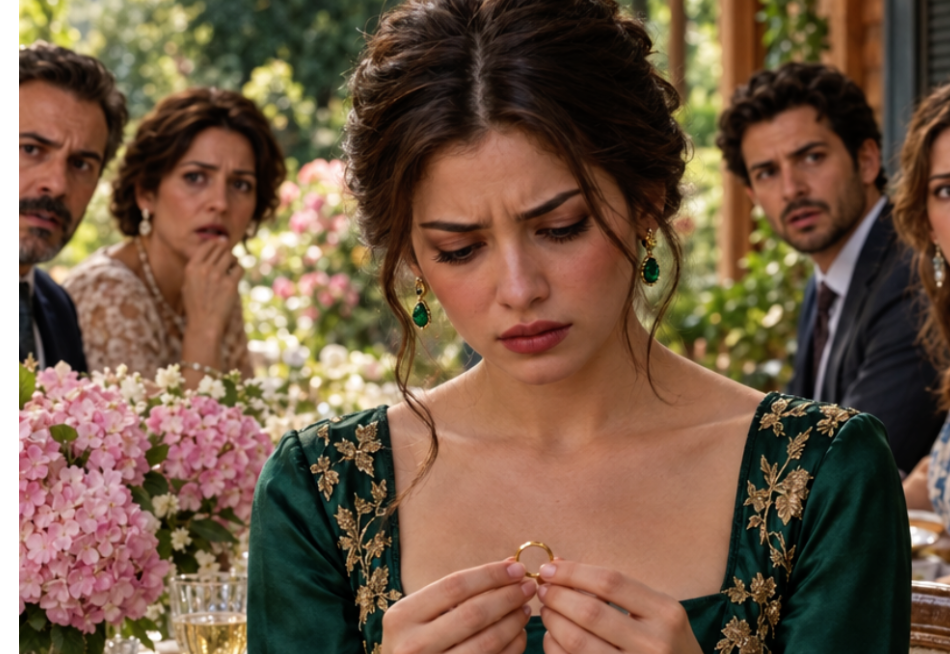
At his mother’s birthday party, Anton once again told his “funny” story about his wife. Everyone burst out laughing. Nina didn’t cry or yell. She did something else, and suddenly the whole table fell silent.
Nina twisted her wedding ring on her finger. It was a habit she had for ten years without even noticing.
The veranda was filled with the scents of grilled meat and dill. Twelve people sat around a long table, covered with a sunflower-patterned tablecloth. It was her mother-in-law’s birthday. Zinaida Pavlovna had just turned sixty-eight, and every year seemed etched into her straight-as-a-ruler back.
Since four in the morning, Nina had been peeling potatoes, marinating chicken, and chopping up bowls upon bowls of salad. Meanwhile, Anton had gone into town to buy wine and came back with his friends, who lounged in the gazebo calling out for “something to go with the beer while we wait.” By two in the afternoon, she’d already changed her apron three times.
“Ninochka, you really are so patient,” her mother-in-law said, passing by the kitchen.
The guests took their seats. Vadim with his wife Tamara. Anton’s cousin from Tula. Colleagues, neighbors, someone’s grown daughter with her husband. Anton sat at the head of the table—even though it wasn’t his birthday. But Anton always took the main seat, and no one ever thought to ask why.
The first half hour went as usual. Toasts for good health, for many years, for the wisdom of the birthday girl. Nina served salad, changed plates, brought out the hot dishes. She perched on the edge of the bench, got up, sat down again. No one seemed to notice.
“Let me tell you all something!” Anton slapped the table so hard that the shot glasses jumped.
Nina stopped chewing.
She recognized that tone instantly. After fifteen years of marriage, she knew it as well as she knew her alarm’s melody. That tone only ever meant one thing: another story was coming. And it would be about her.
“So, my Nina decides she wants to get a job!”
Anton glanced around the table to make sure everyone was listening. They all were. He just had that knack for drawing in a whole room’s attention, like a magician pulling a scarf from his sleeve.
“Three months ago, she comes to me and says: I want to work as a manager at a company. I say: Nina, you’ve been at home for fifteen years, what kind of manager? But she got offended. She found an opening, signed up for an interview. Bought herself a blazer. A blazer! Nina! In a blazer!”
Someone snickered. Vadim grinned, not even knowing where the story was going yet, but already eager to support his friend with laughter.
“She went for it. Two hours later she comes back. I ask: well, how’d it go? She stays quiet. Later I hear it from Vadim—he works in that office building.”
Anton nodded at Vadim, and Vadim nodded back, happy to be included in the story.
“Nina mixed up the floors! She didn’t go to HR, she went to accounting. Sat right across from the chief accountant and started explaining why she wanted to be a sales manager!”
The table erupted in laughter. Anton’s cousin from Tula covered her mouth with her hand. Vadim slapped his knee. Even Zinaida Pavlovna let herself smirk slightly, even though she usually considered loud laughter at the table to be bad manners.
“The accountant listened to her for about twenty minutes! Then finally said: dear, do you even know this is the accounting department? Nina turned red and ran out. She didn’t even make it to the interview! She came home and didn’t say a word for two days!”
He threw up his hands like after telling a good joke. As if to say, what can you expect from her? A housewife, in a blazer.
Nina sat there, staring at her plate where a piece of chicken—marinated by her at four in the morning—was getting cold.
But that’s not how it happened at all.
Nina had signed up for an interview at a logistics company. Customer service manager: attention to detail, calmness, and people skills—three things she had more than enough of.
She didn’t go buy a blazer. She pulled out her old pre-wedding one and stitched it up in the evening while Anton watched football on the couch. The blazer fit perfectly, and Nina spent half an hour admiring herself in the hallway mirror, careful not to make a sound.
She hadn’t mixed up the floors. The building was under renovation, and the signs had been put up wrong. Five people wandered into accounting that day—not just her. The chief accountant, a woman around fifty with a short gray haircut, listened, nodded, and said calmly:
“You need the fourth floor, right wing. Don’t worry, everyone gets confused here.”
Nina went up to the fourth floor. She passed the interview. The HR manager looked over her résumé, asked twelve questions, and asked her to complete a test assignment. Nina did it that evening, in between dinner and washing the dishes.
They called her a week later and offered her to start on August first.
She didn’t tell Anton about the fourth floor, the test assignment, or the call. Because he didn’t need the truth. He needed a story for the dinner table—a funny story about his silly wife who tried something out of her league and embarrassed herself.
And the ‘friend from the company’? Vadim, who was now slapping his knees with excitement? Vadim worked in the next building and saw Nina walk into the business center. He made up the rest. And Anton embellished it for effect.
That’s how family anecdotes are born—from a scrap of fact, a handful of guesses, and the habit of laughing at someone who hasn’t learned to snap back.
Tamara wasn’t laughing. She sat across from Nina, poking at a tomato and staring at her plate. Tamara knew about the interview. She knew about the job offer call. And she knew about the suitcase that had been lying in the trunk of Nina’s silver Toyota for the second week, hidden under an old checkered blanket.
Nina raised her head.
Everyone was still snickering. Anton poured wine, pleased with the reaction. Zinaida Pavlovna adjusted her napkin. The world kept spinning in its usual rhythm, where Nina played the part of a joke character—not a living person with plans and choices.
“Anton, tell us again about how she took her driving test!” Vadim leaned forward, eager for another round of laughter.
Anton drew in a breath.
And at that very moment, Nina did something she hadn’t done in fifteen years.
She didn’t stand up. Didn’t raise her voice. Didn’t cry.
Nina slowly slid her wedding ring off her finger. She set it on the table next to her half-finished glass of wine.
The gold band touched the sunflower-patterned tablecloth and made a quiet, delicate sound.
Then she stood up, carefully folded her napkin, pushed in her chair. She looked at Anton—not with resentment, not with anger, but with a calmness that people have when a decision was made long ago and all that’s left is to take the final step.
And she walked out.
The veranda fell silent so abruptly it was like someone had just yanked the cord out of the speaker. The cousin from Tula froze, fork in mid-air. Vadim stopped smiling. Zinaida Pavlovna straightened her back even more—though it seemed impossible to sit up any straighter.
Anton stood there, bottle in hand, staring at the ring.
“Guess she took offense,” he said, trying for a smirk. But his smile was crooked and uncertain, like someone who, for the first time, truly doesn’t know what to say.
No one said a word.
The silence lasted thirty seconds, but every second felt like a minute. Someone coughed. Someone else reached for the water pitcher. The cousin put her fork down and stared into her plate as if she saw something important there.
“You went too far, Anton,” one of his colleagues said quietly. At the silent table, those words sounded deafening.
Anton set the bottle down and walked into the house.
The bedroom door was open. Nina’s house slippers were lined up neatly by the threshold, toes pointing to the wall, just the way she always placed them. But the wardrobe where she kept her things was now half-empty. Anton only just noticed this. Blouses, dresses, that blue skirt Nina always wore to his mother’s—gone. The bookshelf was sparse, too.
He walked through the hallway and stepped out onto the porch. The silver Toyota by the fence was gone.
Anton took out his phone. Dialed her number. Long rings. Tried again. More rings. On the third try, the voicemail picked up.
He returned to the veranda. The guests were still in their seats, but the party was over. Food sat cooling. The wine was untouched. Zinaida Pavlovna was crumpling her napkin, and for the first time all evening, her straight back slumped just a little.
“Mom, call her. She’ll listen to you,” Anton pleaded.
Zinaida Pavlovna looked at her son for a long time. Then she quietly replied,
“For fifteen years I kept telling her just one word: endure. You think she’s going to listen to me now?”
Anton opened his mouth, then closed it. There was nothing to say.
Nina was driving down the evening highway. The windows were down, warm August wind tossing the hair she’d let down from her usual tight bun.
On the back seat was a suitcase packed two weeks ago: documents, a change of clothes, her makeup bag, a bank card with an account she’d opened in March. The money was from side jobs Anton never knew about—custom knitting, translating texts, consulting friends on planning home parties. Not much, but enough to get started.
The GPS was leading her to a rental apartment. One bedroom, third floor, windows overlooking the park. Tamara found it for her three weeks ago. Nina already paid two months in advance.
Her phone kept vibrating in her bag. She ignored it. First, there would be irritated messages, then bewildered ones, then apologetic ones. She knew this pattern by heart: from “fine, whatever” to “come on, forgive me, it was just a joke”—it usually took about two hours. That used to be enough. She used to come back.
But not this time.
At the gas station, Nina bought herself a coffee in a paper cup. She stepped outside, leaned against her car. The sun was setting behind the tree line, turning the sky a pink-orange shade, just like the apricot jam she used to make every summer for Zinaida Pavlovna.
There won’t be any jam this year.
The coffee was bitter and nothing special, just from the machine. But it was the first coffee she’d sipped not in a rush between the stove and the sink. The first in a long, long time when she didn’t have to hurry or answer for every hour.
That evening, Anton did the dishes himself. For the first time in fifteen years. The guests had all left early, awkwardly, barely saying goodbye—like people leaving after a party that never happened. Zinaida Pavlovna went to her room without a word to her son.
He stood at the sink, scrubbing a plate with a sponge still stained yellow from Nina’s marinade. Hot water streamed, the steam rising to the ceiling. And Anton wondered: when exactly did everything fall apart?
Not today. Not because of this story.
Maybe it was back when he first told everyone at the table how Nina had reversed into a pole in the parking lot. She sat next to him, quietly smiling, because that was easier. Or maybe it was when, in front of his mother, he said out loud: “Nina doesn’t think, she feels.” And his mother nodded, just as people do when something seems obvious.
Or maybe it was even earlier. In their third year of marriage, Nina suggested going to school for accounting. He replied, ‘Why? I earn enough.’ And she agreed. Because back then, she still thought that giving in meant loving.
The plates were done. Anton dried his hands on a towel with little embroidered cherries. Nina had bought it at a fair two years ago, picking it to match the curtains. He hung the towel back on the hook and looked at the fridge. Under a magnet from Anapa was a note in Nina’s neat handwriting: ‘milk, bread, apples, chicken’.
The list was still there. But Nina was gone.
On the first of August she started work. That same altered blazer, buttoned all the way up. Out of habit, she tied her hair in a bun. Stood in front of the mirror. Thought for a moment. Then took it down.
At her new job, they gave her a desk by the window. A computer, notebook, pen. A coworker, a girl about twenty-five with a short fringe, showed her where the water cooler and the printer were. She asked her name. Nina introduced herself and, for the first time in a long while, used her own last name—her maiden name.
Tamara called her at lunch.
“How are you doing?”
“It feels a bit strange. But also good.”
“Anton called Vadim. He wants me to tell you to come back. He says he overreacted.”
Nina was quiet. Outside the window, a man was walking his red-haired dog down the sidewalk. Just an everyday scene, nothing special. But she liked that she could simply sit and watch without worrying about anything.
“Tell him I’m not angry,” she said. “But I’m not coming back.”
“Are you sure?”
“I’m sure.”
She hung up and got back to work.
Anton found the ring the next morning under the table on the veranda. It had rolled into a crack between the floorboards, near the leg of the chair.
He picked it up. Twirled it between his fingers. Put it in his pocket. Took it out. Placed it on a shelf. Picked it up again.
Fifteen years on the same finger. And it weighs almost nothing.
Or does it just seem that way