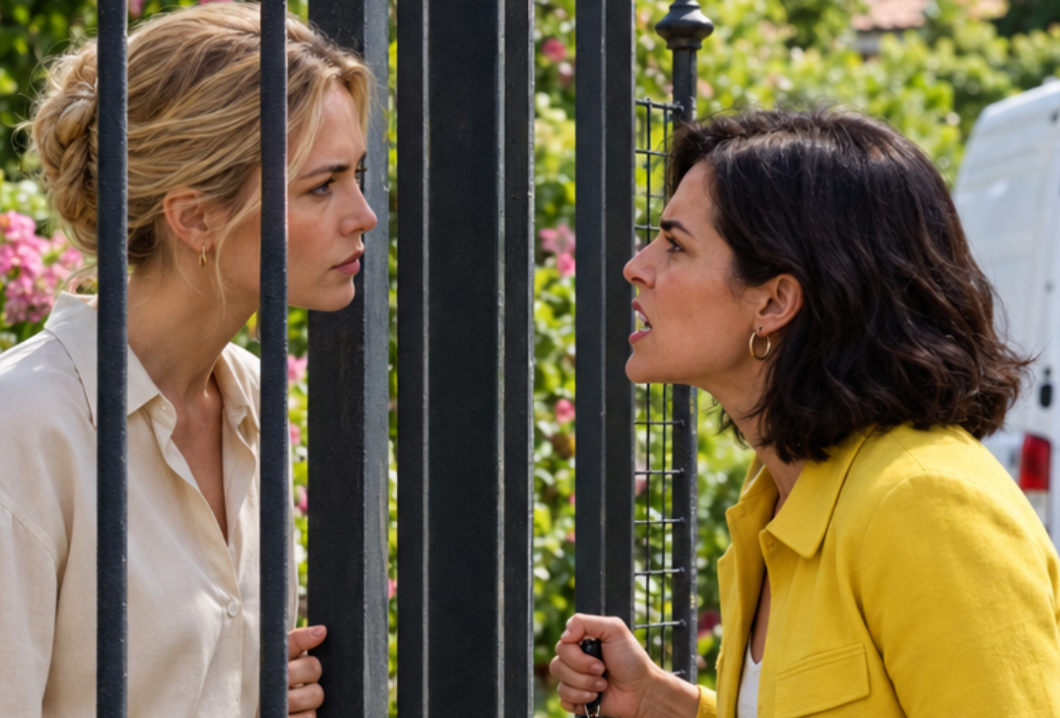
“Pavel already gave us the key, so just open up and don’t make a scene,” Oksana said. “We’re moving in tomorrow. We’ll take two rooms, Kostya gets the shed for his tools, and you’re barely ever here except on weekends anyway.”
Irina Vlasova had her phone on speaker. Her husband Pavel stood by the fridge in the kitchen, staring at the door like it was the first time he’d seen the Suzdal magnet on it.
“Pavel gave you the key to my house?” Irina asked.
Oksana laughed so loudly that even Pavel could hear it.
“To your family house, Ira. Stop splitting things into ‘yours’ and ‘mine’. You’re my brother’s wife, not a stranger. We have kids, our lease is ending, we need a place to live.”
“Then find one,” Irina replied. “You’re not moving into my house.”
Pavel immediately looked up.
“Ir, don’t start. Oksanka isn’t asking for this out of luxury.”
“She’s not asking. She’s informing me.”
“Because we’ve already discussed everything,” Oksana cut in quickly. “Mom said you having nine hundred square meters to yourself is too much. The house is big, 96.4 square meters, you’ll be fine. Liza needs her own room, Artyom needs space, Kostya will tidy up the yard. You’ll thank us later.”
Irina glanced at Pavel. He looked away.
At that moment, everything became clear: her husband’s sister wasn’t moving in on impulse. The house had already been promised to her. Without Irina. Behind her back. With a key, with rooms assigned, and the shed clearly earmarked by Konstantin for his endless tools.
“Oksana, tomorrow at the gate you’ll be met with the owner’s refusal,” Irina said. “If you try to enter, I’ll call the police.”
For a second, the line went silent. Then Oksana burst out laughing.
“You’d call the police on your own relatives? Shows your true colors. Pavel, do you hear your wife?”
Pavel heard. And for the first time that evening, he stopped pretending.
“Ira, you’re being unreasonable. They have kids.”
“They have parents, jobs, a husband, and a responsibility to solve their own problems.”
“You talk as if they’re strangers.”
“To my house, they are just tenants.”
Pavel slapped his hand on the table. Not hard, mostly for the effect.
“We’ve been married eight years. I’ve stayed there, I’ve helped out, I get a say too.”
“You may have stayed there, yes. But you don’t get a say in what happens to the house.”
He straightened as if he’d been slapped, even though Irina had simply stated the truth. The country house in the ‘Beryozka’ garden association had been given to her in a deed of gift in May 2019. Both the house and land were in her name. Pavel came later. First as a guest, then inviting friends, then handing a spare key to his mother ‘just in case.’ At that point, Irina chose not to start a fight over the key.
Now that ‘just in case’ appeared in the form of Oksana, her husband Konstantin, two kids, and a car packed full of their things.
“You’re willing to ruin our relationship over a summer house?” Pavel asked.
“It’s not a summer house for your whole family. It’s my home.”
“There you go again with your paperwork.”
“Yes. Because with words, you’ve already divided everything among yourselves.”
Pavel grabbed his jacket off the back of the chair.
“I’m going to mom’s. Call me when you’ve cooled off. Oksana will come tomorrow anyway, and you’re not going to make a scene in front of the kids.”
“I’m not going to make a scene. I’m going to record it.”
He slammed the door. Irina was left alone in the kitchen, but for the first time that evening, she felt a little lighter. She wasn’t calm—no, not that. But it was finally clear to her that persuasion wouldn’t fix this.
She took a folder with documents from the cupboard: the deed of gift, the property registry extract, the plot’s cadastral number, the house payment receipts. Then she opened her messages. Oksana had already sent a new one: “We’ve ordered the moving van for tomorrow. If you throw a tantrum, that’s on your conscience.”
Right after that, she got a message from Pavel: “I gave her the key. Don’t embarrass me.”
Irina took screenshots, emailed copies to herself, and called police officer Sergey Antonov. She still had his number from the incident last year in the community, when someone broke into the neighbors’ shed.
Sergey Antonov listened, showing no emotion, and immediately separated family arguments from facts.
– Are you the owner of the house and the plot?
– Yes.
– Are they registered there? Did they live there full-time? Is there a rental agreement or written consent?
– No. None of that.
– Then tomorrow, keep your documents with you. If they show up and start opening the gate or bringing things in against your wishes, call the police dispatch. Don’t push, don’t grab for keys, don’t argue with the movers. Just state clearly in front of witnesses that you don’t agree to their entry or living there.
– They’ll shout that it’s just a family dispute.
– Let them shout. The police don’t decide who gets the property, but they have to register a report if someone tries to enter against the owner’s will. Then there will be an investigation.
Irina made a brief note: documents, clear refusal out loud, call, statement. This wasn’t about revenge. This was about order—something Pavel’s family had never liked.
The morning of June 10th, Irina arrived at ‘Beryozka’ at 10:40. The gate was closed with the old inner bolt. On the outside, there was a brass sign: ‘Private Property.’ Her father had put it there back when he gave her the house. She used to think the sign was too stern for a simple summer cottage village. Now, she saw those words as a real lock—just one without metal.
Everything in the house was in place: garden gloves on the veranda, empty shelves in the small room, the closed tool closet. Irina purposely walked through the rooms and shot a short video—not for aesthetics, but just in case someone later claimed, ‘We already lived here,’ and brought their own belongings.
At 12:07, Valentina Yegorovna called.
– Irina, what are you doing? – her mother-in-law started without a greeting. – Oksana has been a bundle of nerves all night. The kids are asking why Aunt Ira is being so stingy.
– Because Aunt Ira isn’t letting her house be taken over for someone else’s move.
– Someone else’s? That’s your husband’s sister.
– Exactly. My husband’s sister—not the owner.
Her mother-in-law exhaled loudly.
– Hiding behind your paperwork. People should live like humans. Oksana is going through a tough time, Kostya is looking for a job, the kids are bored in the city all summer. And you’re sitting all alone in a house on nine acres.
– Valentina Yegorovna, if you feel so sorry for Oksana, let her stay with you.
The conversation instantly turned harsher on the other end.
– I don’t have any space.
– You have a spare room.
– I’m doing renovations. Besides, I’m an elderly woman, I can’t have a lot of noise.
– So you can’t have noise at your place, but I can at mine?
My mother-in-law didn’t answer. Then she spoke more quietly, but with even more anger:
“Don’t push Pavel. No man will put up with this for long. You’ll end up alone in that palace, remembering how you pushed your family away.”
“If family means someone else’s key and moving men, then I don’t need a family like that.”
Irina was the first to end the call.
At 1:20 pm, a white Gazelle van pulled up by the gate. Right behind it was Oksana’s silver crossover. Konstantin stepped out in his work vest, immediately opened the truck and called to the movers not to waste time. Inside were boxes, bags, a disassembled child’s bed, and a big plastic container labeled “Kitchen.”
Oksana was the last to get out. She wore a bright jacket and a red keychain with a key dangled from her wrist. She looked around, as if inspecting the house to see if her room was prepared properly.
“Well?” she called out loudly to Irina. “Open up. The movers charge by the hour.”
Irina stood on the porch, phone in hand.
“Turn the van around. I don’t agree to your moving in.”
“Don’t start this in front of the kids,” Oksana said, waving toward Artyom and Liza. “We’ve already moved out of the apartment. Pavel said it was settled.”
“Pavel doesn’t make decisions about my house.”
Konstantin walked up to the gate and gave a smirk.
“Listen, lady, we’ll unload the stuff and then you can talk things over peacefully. No need to keep everyone waiting.”
“You’re not unloading anything.”
“And what are you going to do?” Oksana lifted the key. “We’ve got access.”
She put the key into the lock. Irina didn’t run to grab her hand or argue with Konstantin. Instead, she turned on her phone’s recorder and spoke loudly for everyone to hear:
“Oksana Morozova, I, Irina Vlasova, owner of this house and property, forbid you, your husband, and the movers from coming onto my property or bringing in your things. I have not given consent for anyone to move in.”
Oksana twisted the key. The lock clicked, but the gate stayed shut—there was a bolt on the inside. Right away, Konstantin started inspecting the fence, as if checking whether he could reach through a gap to open it from the inside.
“Don’t touch the fence,” Irina said, dialing the local police. “At my address, in the Biryozka garden community—it’s my lot, but people are trying to get in with someone else’s key and move things in against my refusal. I have all the documents.”
Oksana suddenly stopped smiling.
“Are you seriously calling them?”
“Yes.”
“Pavel!” she yelled toward the road, even though Pavel wasn’t there yet. “Look how far your wife has gone!”
The movers walked away from the van. One told Konstantin they wouldn’t get involved in family drama. Annoyed, Konstantin slammed the Gazelle’s door, but he didn’t leave the gate.
Pavel arrived about ten minutes later with Valentina Yegorovna. My mother-in-law got out first, marching straight to Irina without even looking at the boxes.
“You’re calling the police on your own family?” she hissed. “What a disgrace for the whole neighborhood.”
“I’m calling the police because someone’s trying to enter my house without permission.”
“Don’t you dare talk like that about Oksana. She has kids.”
“Kids don’t give you the right to take over someone else’s rooms.”
Pavel came up to the gate, trying to sound calm but failing.
“Ira, please open up. We can sort this out without calling the police. Oksana got upset, you got upset. Let the movers just put the things in the shed, and we’ll talk it out tonight.”
“No.”
“It’s just stuff.”
— This is just the beginning of living here. You get that.
Oksana immediately jumped in:
— Of course, living here! Where are we supposed to go now? You yourself said she would grumble and then calm down.
Pavel shot a sharp look at his sister. For the first time that day, he realized she wasn’t helping him out anymore—every word she said only made things worse for him.
— I said I’d talk to Irina, he muttered.
— That’s not true. What you said was: “You’ll have the key, move in, I’ll take care of it.”
Irina looked at her husband. Now she didn’t need to prove anything—Oksana had already made the main point clear herself.
A patrol car appeared on the road. Sergei Antonov got out with another officer, greeted everyone, and asked for documents. Irina handed over a folder, her passport, and a printout of their messages.
Oksana immediately started speaking loudly:
— This is a family dispute. We’re not thieves. We came to see my brother—he gave us permission himself.
Sergei Antonov turned to look at Pavel.
— Are you the owner of the house or the land?
Pavel fell silent.
— No, Irina answered. I’m the owner. Here’s the paperwork.
The officer flipped through the documents and turned to Oksana.
— Without the owner’s consent, you can’t enter the property or bring in your things. If you think you have the right to live here, you’ll need to resolve it through the proper channels. Right now, you’ve been clearly refused access.
Konstantin frowned.
— We have a key.
— Having a key doesn’t give you residency rights, said the officer. Besides, the owner has directly refused permission.
Oksana flushed red.
— So you want us and the kids out on the street? Just because she’s greedy?
For the first time that day, Irina didn’t reply to Oksana, but addressed her mother-in-law instead:
— Valentina Yegorovna, you have a spare room. You’re family, after all.
Her mother-in-law immediately looked away.
— I’m having renovations done. And my blood pressure is high. I can’t have any noise.
Oksana slowly turned to her mother.
— So we can’t stay with you, but it’s alright to come here?
— Don’t start, Valentina Yegorovna said irritably. I’m old, I need peace and quiet.
— So what are we supposed to do? Oksana’s voice cracked with anger. Pavel said it was all settled!
Pavel stood by the gate, staring at the ground. His role as the provider had ended the moment it came time to take responsibility for his promises.
Irina took out her phone and opened the messages.
— I’d like to submit a statement. Here’s Oksana’s message about moving in. Here’s Pavel’s message giving them the key. Today they arrived with their things, tried to open the gate and bring in their belongings after I’d already refused them entry.
Pavel lifted his head.
— You’re showing my messages too?
— Yes. Because you gave out access to my house without my consent.
— You’re going against your own family.
— No, Pavel. You’re the ones who came against me.
Sergei Antonov was taking their statements down without any unnecessary comments. That’s what made it hit the hardest. Neither Oksana nor Valentina Yegorovna could turn the conversation into a familiar family dispute. On paper, there were no feelings—just actions: the key, the movers, the attempt to open the gate, the owner’s refusal.
The movers demanded payment for their time and trip. Konstantin started to argue, but quickly realized nobody was going to haul the boxes back for free. Oksana was now yelling at Pavel, not Irina:
— You set us up! I told people we were moving in. We gave up our apartment. We packed our things. What are we supposed to do now?
Pavel tried to say that everything could have been resolved peacefully, but even Valentina Egorovna wouldn’t look at him. She was only concerned with saving herself.
“Oksana, you can come stay at my place for a couple of days,” she said reluctantly. “Just don’t bring all your things. I really don’t have much space.”
Oksana let out a short, bitter laugh.
“Of course. You can bring a whole bed into Irina’s house, but with you, it’s ‘don’t bring all your things.’”
Irina stayed silent. This scene didn’t need her anymore. The relatives who had just an hour ago pressed her with a united front were now splitting up the inconveniences, the cost of the Gazelle van, and other people’s promises among themselves.
The police officer handed Irina back her documents.
“We’ll register your statement. You’ll be informed about the results of the investigation. For now, they’ve been told: they can’t enter or unload anything without your permission.”
“Thank you,” Irina said.
Oksana heard this and shot a sharp look in her direction.
“Happy now? You’ve shamed the family and kicked the kids out onto the street.”
“No, Oksana. You brought the kids to a closed gate because you decided my refusal didn’t count.”
Konstantin slammed shut the van’s trunk. The movers got into the cab. Artyom quietly took his backpack from the van, while Liza clutched her plush bunny, looking not at the house, but at her mother. For the first time all day, that look made Oksana fall silent.
Pavel approached Irina when everyone else was already getting back in the van.
“Let’s not get divorced,” he said quietly. “I’ll get the key back from Oksana. Please, don’t make this worse.”
“You gave her the key. You promised her the house. You asked me to swallow all this for your sister’s sake. So what exactly am I not supposed to make worse?”
“I was just trying to help.”
“With my property.”
He winced.
“You always reduce everything to the paperwork.”
“Because you all showed up with a moving van instead of acting human.”
Pavel wanted to argue, but the police officer was standing nearby, and Oksana was behind him, once again demanding he pay half the cost of the movers. It suddenly felt awkward to argue.
“I’ll come get my things,” he said.
“Today from 6:00 to 7:00 PM. With Marina present. I’ll have a list ready.”
“So now I have to schedule an appointment to come home too?”
“After today, yes.”
He looked at her as if he just now realized that the Irina he once knew—the one who always smoothed over arguments—was gone, not in words, but in her actions.
That evening, Pavel came to the apartment to get his things. Marina, Irina’s cousin, sat in the kitchen with a notepad and didn’t interfere. There were two bags on the floor: Pavel’s clothes, a box of documents, a laptop, and his fishing gear. Irina didn’t argue or bring up the past. She just handed him what belonged to him, checking things off the list.
“Marina, could you step out?” Pavel asked. “I need to talk to my wife.”
“I’m here as a witness,” Marina replied calmly.
Pavel smirked.
“Ira, are you really going to throw everything away over Oksana?”
“Not because of Oksana. Because you made the decision for me.”
“I thought you’d understand.”
“You didn’t think. You were testing to see if I’d give in or not.”
He lowered his eyes to the bag.
“Mom says you’ve turned into a stranger.”
“Tell Valentina Egorovna that for once, she’s right.”
Pavel lingered by the door. You could tell he was waiting for that last pause when Irina would usually give in: she’d ask not to fight, suggest talking tomorrow, try to find a compromise for everyone. But today, compromise had already driven away in a white Gazelle van, still loaded.
“I’ll return the house key,” he said.
“Today.”
“Oksana has it.”
“Then get it from Oksana and bring it back today.”
Pavel almost lost his temper but caught himself when he looked at Marina. Two hours later, he sent a courier with an envelope. Inside was the key on a red keychain—the very same one Oksana had waved at the gate.
Irina took a photo of the key, put it away in a drawer, and sent Pavel a single message: “Received. For all other matters—put it in writing.”
The next day, Oksana sent a long message. She wrote that the kids had spent the night at their grandmother’s on fold-out beds, that Konstantin paid for the Gazelle van for nothing, that Irina could have ‘understood their situation.’ At the end, she wrote: ‘We didn’t take anything away, we just wanted to stay for a while.’
Irina replied briefly, with no fake harshness: “Living in someone else’s house is only possible with the owner’s consent. I never gave mine.”
Oksana never messaged her again.
By the evening of June 11, Irina returned to ‘Beryozka’ and fixed a new sign next to the old brass one: ‘Entry only with the owner’s permission.’ No decorations, no lengthy explanations. Just to make it clear for the next person with a spare key.
The house now stood clean and free of other people’s things. Konstantin’s boxes were gone from the shed. Oksana’s bags were nowhere in the rooms. The Gazelle van didn’t wait by the gate. Pavel had stopped giving orders, and Valentina Egorovna no longer called to talk about family duty.
Irina walked around the yard, closed the latch, and checked the door. Then she sat on the porch steps and opened her to-do list: the path by the porch, the lilac by the fence, the shelf in the pantry. The usual homeowner’s chores—the kind no one ever noticed until there was a debate about whose house it really was.
Her phone flashed with a short message. Marina wrote that Oksana had rented a small house in the next district. She paid money for it. No porch, no garden, no owner to push around.
Irina read the message and put her phone away. There was no joy, just a simple, clear truth: someone else’s life was now set up—not at her expense.
She closed the gate, checked the latch once more, and walked inside. Outside the door, she left other people’s keys, their plans, and their habit of deciding things for her.