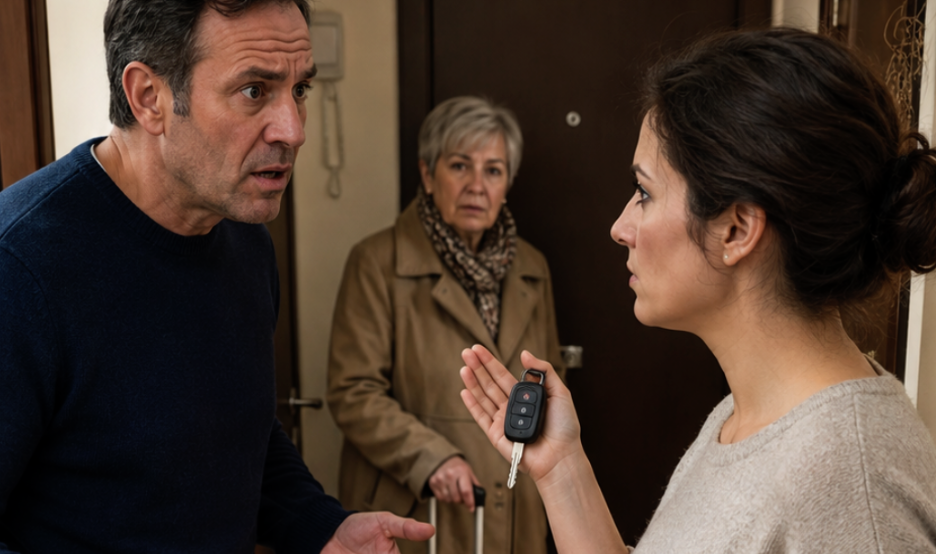
“What do you mean you’re not going anywhere? Mom is already here.” — My husband was counting on my car. But he was the one who had made promises to his relatives
“What do you mean you’re not going anywhere?! The family is already on their way!” Anton stood in the hallway with his phone in his hand, unable to understand why Svetlana was calmly putting her work papers into her bag. “Mom and Ira are already coming.”
“I know.”
“Then why is the car still outside, and why aren’t you dressed yet?”
Svetlana zipped up her bag and placed it beside the chair.
“Because I’m not driving any of you anywhere. I told you that on Tuesday.”
Anton quickly opened their messages, scrolled through several of them, and stopped at her words:
“I’m not going out of town on Sunday. If you invited your relatives and promised them transportation, arrange it yourself.”
Underneath was his reply:
“Okay.”
Anton read it and irritably swiped his finger across the screen.
“I thought you’d stop being stubborn. Mom will be there, Ira and her husband. Denis and Olya are counting on us too.”
“Not on us. On you.”
Anton checked the time.
“Sveta, people have plans.”
“Plans that you made.”
Anton stepped toward the door and started typing to someone again. Only now did he realize that this argument was not going to end the way it usually did.
It had been happening for years.
Anton was always eager to help his relatives, but a significant part of that help consisted of Svetlana’s time.
She worked as a procurement specialist and frequently drove around the city. She owned a car, knew the neighborhoods well, handled heavy traffic calmly, and was rarely late.
Anton quickly turned that into a family convenience.
At first, the requests were occasional.
Pick up his mother from the shopping mall.
Drive Irina somewhere because she had heavy bags.
Stop by and collect Denis if taking public transportation with transfers was inconvenient for him.
Svetlana did not mind driving itself. Quite often, she offered to help when she was able to.
The problem was the way Anton phrased things.
He did not ask:
“Would that be convenient for you?”
Instead, he informed her:
“I already told Mom you’d pick her up.”
If Svetlana objected, the same argument always followed: the person was already waiting, it would be awkward to refuse now, why disappoint everyone?
Several times Svetlana changed her own plans because she did not want to explain to Anton’s relatives that he had made arrangements without consulting her.
Over time, he stopped noticing the difference between her agreeing to something and him promising it on her behalf.
Once, Irina called Svetlana in the morning and thanked her for agreeing to drive her that evening to pick up a large purchase.
“What purchase?” Svetlana asked, confused.
Irina fell silent.
It turned out Anton had arranged everything with his sister the day before.
He had not said a word to Svetlana.
That evening, Svetlana went anyway. Irina had already taken time off work and scheduled the pickup.
After that trip, Svetlana demanded for the first time that her husband stop speaking for her.
“If I haven’t told you yes, then you don’t promise anything on my behalf.”
Anton agreed almost too easily.
For several weeks, he really did ask first.
Then the old habit returned.
On Tuesday, he came home in a good mood and immediately announced:
“On Sunday we’re going out of town to Uncle Lyosha’s. Mom has wanted to get everyone together for a long time. I told her we’d pick her up, then Ira and her husband, and we’d collect Denis and Olya on the way.”
Svetlana looked up from her laptop.
“In what?”
“Your car.”
“There are seven of us.”
Anton thought for a moment.
“Denis and Olya are going separately. So there will be five of us. That’s fine.”
“No.”
Anton put his glass down on the table.
“What do you mean, no?”
“I’m not going, and I’m not driving anyone.”
“Sveta, it’s just one day.”
Svetlana closed her laptop.
“It’s my day off.”
“The whole family is getting together.”
Anton spread his hands as though that alone should have settled the matter.
“Then go.”
“And how am I supposed to take everyone?”
Svetlana looked at him.
“That’s something you should have figured out before promising everyone the use of my car.”
Anton began explaining that his mother disliked intercity buses, that it was inconvenient for Irina to transfer between routes, and that family gatherings like this happened rarely.
Svetlana listened until he once again said:
“You’re free anyway.”
“I am free,” she replied. “And that is exactly why I get to decide where I go.”
Anton left the room irritated.
An hour later, Svetlana sent him a message so that her refusal could not somehow be turned into another misunderstanding.
He replied:
“Okay.”
They did not discuss the subject again before Sunday.
Svetlana noticed that Anton did not look up transportation companies, did not call his relatives, and did not ask anyone how they planned to get there.
She did not remind him.
He had already been told.
On Sunday morning, Anton was in no hurry.
He ate breakfast, took a shower, and chose a shirt.
Svetlana worked on her laptop. She wanted to finish a spreadsheet before the beginning of the workweek.
Only shortly before they were supposedly due to leave did her husband finally ask:
“Did you fill up the car?”
“No.”
He stopped in the doorway.
“Why?”
“Because I’m not going anywhere.”
At first Anton thought she was restarting their old argument.
A minute later, he understood that this was not an argument.
That was when he exclaimed:
“What do you mean you’re not going anywhere?! The family is already on their way!”
Anton quickly called Irina.
“Where are you?”
Svetlana could only hear his side of the conversation.
“You’re already nearby?.. No, everything’s fine… Come upstairs.”
He ended the call and immediately opened a ride-booking app.
“Could you at least drive us there? I’ll figure out the return trip myself.”
Svetlana put her phone into her bag.
“No.”
“Sveta, Mom has a bag.”
Anton pointed toward the hallway as though the bag were already sitting there.
“Carry the bag.”
“It’s outside the city.”
“I know.”
He looked up at her.
“Did you deliberately wait until this morning to do this?”
“No. I deliberately warned you on Tuesday.”
The intercom buzzed before Anton could respond.
Irina came in first. Her husband followed her, and then Anton’s mother arrived carrying a small travel bag.
“Are we early?” Irina asked. “You wrote that Sveta wanted to leave on time.”
Svetlana turned toward Anton.
He immediately began talking.
“What difference does it make who wrote what? There’s just a small transportation problem.”
Irina frowned.
“What problem?”
“I’m not going anywhere,” Svetlana said. “Anton has known that since Tuesday.”
Anton’s mother placed her bag beside the wall.
“Wait. He told me you were the one who suggested picking everyone up in the car so nobody would have to struggle with transportation.”
Anton sharply turned toward his mother.
“Mom, that’s not exactly what I said.”
“That’s exactly what you said,” she replied. “I even asked whether it would be too crowded in the car.”
Irina took out her phone.
“You wrote to me, ‘Sveta will drive everyone, don’t buy tickets.’”
The hallway suddenly felt cramped, not because of the number of people in it, but because of one simple fact.
Anton had not merely assumed his wife would eventually give in.
He had presented her agreement as though it were already settled.
Svetlana did not lecture him.
“Now arrange what you promised.”
Anton opened the ride-booking app again.
For several minutes, he silently looked through the options.
“It’s difficult to find a vehicle for five people this quickly.”
“There are four of us,” Irina said. “Sveta isn’t going.”
Anton looked at his sister.
“Thanks. I know how to count.”
“Judging by this situation, not always.”
Anton’s mother stopped them with a short gesture.
“Don’t argue. What are our options?”
And now Anton had to answer not to Svetlana, but to the people to whom he had handed out her time without permission.
He called Denis.
Denis was already driving with Olga in their own car and could not take three additional passengers because the back seat was filled with things they were bringing to Uncle Lyosha.
Anton called another number, asked whether a vehicle was available, gave the address and the time.
He clearly did not like the price.
“How much?” Irina asked.
He told her.
“That’s fine,” she said. “My husband and I will transfer our share.”
Anton shook his head.
“I’ll pay.”
“You invited everyone into this arrangement,” his sister pointed out. “So you can sort it out yourself.”
Svetlana went back into the room and returned to her laptop.
She could hear fragments of conversation from the hallway, but she did not interfere.
After a while, a minivan arrived.
Anton helped his mother carry her bag downstairs. Irina and her husband followed.
Before leaving, Irina looked into Svetlana’s room.
“I really didn’t know you had refused.”
“I know.”
Irina adjusted the strap of her bag on her shoulder.
“If I had known, we would have arranged transportation ourselves from the beginning.”
“Next time, just ask me directly.”
Irina nodded.
Anton paused by the door.
“Are you satisfied now?”
Svetlana closed her laptop.
“No. But you’re finally fulfilling your own promise yourself.”
He wanted to say something else, but the driver called from downstairs.
Anton left.
The apartment immediately became quiet.
Svetlana did not feel victorious.
What bothered her was something else: for a simple “I can’t” to finally mean something, the situation had to reach a point where her husband had nowhere left to shift the consequences.
That evening, Anton returned alone.
He carefully hung up his jacket, even though he usually tossed it over the edge of the coat rack.
“Mom didn’t say a word the entire way,” he said.
Svetlana did not answer.
“Ira said I made you look like someone who canceled at the last minute.”
“That’s exactly what you did.”
Anton rubbed the edge of the table with his palm.
“I already explained that you had warned me.”
“Good.”
He walked into the room and sat opposite her.
“There’s one thing I don’t understand. Would it really have been so difficult for you to drive us just this once?”
“No.”
“Then why do all this?”
Svetlana was silent for a moment.
“Because this stopped being about the drive a long time ago. First you promise people that I’ll do something, and only afterward do you tell me what I’m supposed to do. And every single time, you count on the fact that I won’t refuse in front of your relatives.”
“I don’t promise you to people.”
“Today your mother arrived with a bag because you told her I had agreed. Ira didn’t look for other transportation because you wrote that I would drive everyone. What would you call that?”
Anton looked away.
“I was sure you’d agree.”
“Exactly.”
He sat silently.
Svetlana did not add anything else.
She did not need five more examples to prove something that was already obvious.
Two days later, Anton’s mother wrote in the family group chat. She needed to travel to another part of the city and pick up an order.
In the past, Anton would have answered almost automatically.
This time, he wrote:
“I’m going after work. If it’s more convenient for Sveta to go earlier, ask her yourself.”
Svetlana saw the message and did not comment.
Anton’s mother messaged her separately.
They arranged a convenient time because Svetlana really was going in that direction.
Several days later, Denis wrote in the group chat saying he needed a ride from the railway station that evening.
Anton replied first:
“I can’t. I don’t speak for Sveta.”
No family argument followed.
Denis called a car himself.
Later, Anton approached Svetlana while she was packing her work bag.
“Mom asked for help with a trip. I’m picking her up myself after work.”
“Okay.”
“I’m just telling you so you know.”
Svetlana zipped up her bag.
“That’s how it should be.”
He nodded.
The car documents and Svetlana’s work bag were lying on the cabinet by the door.
Anton no longer asked whether she was free simply because her car happened to be parked outside.
He took his jacket and went out to pick up his mother himself.
Svetlana stayed home.
And that day, nobody decided in advance how her time would be used.