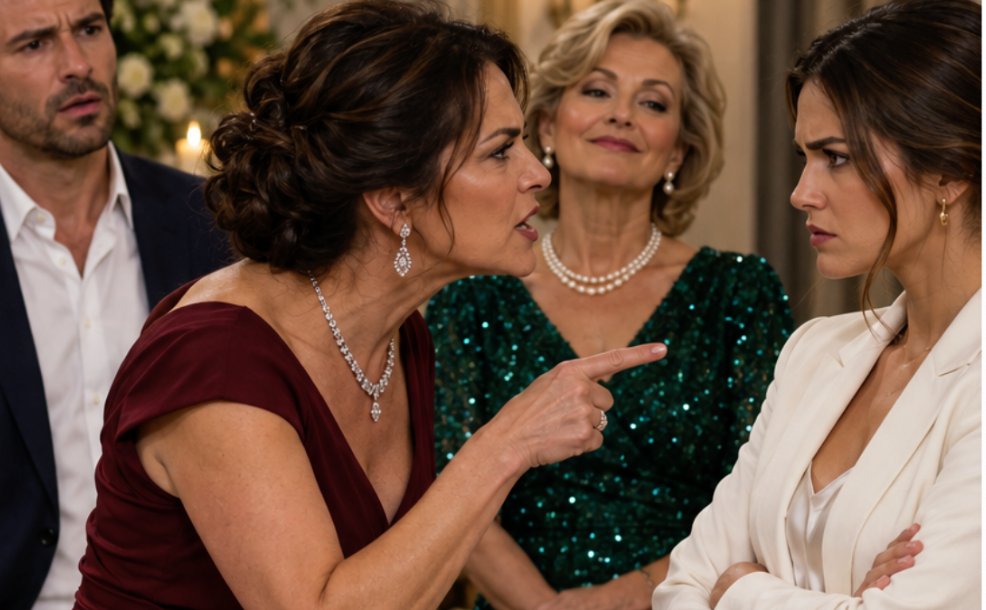
My mother-in-law had invited her friend Raisa to lunch. I already knew plenty about Raisa, even though I’d only met her a couple of times. She worked as a deputy principal at a school, wore her hair just like Margaret Thatcher, and loved to size up everyone and everything within a few meters.
Before lunch, my husband Lyosha said, “Please don’t argue with her, okay? It’s important to Mom that she comes.”
I nodded. I was thirty-two, teaching music at a children’s arts school, and felt like I’d forgotten how to argue with stern school deputies back in my third year of conservatory.
A family lunch
Raisa turned up with a cake. The cake was store-bought but wrapped so thoroughly you’d think it hid some sort of Michelin culinary masterpiece. My mother-in-law bustled around, hurried to put on the kettle, while Raisa sat opposite me and started observing.
And it didn’t really seem like she was looking at me. It was the space around me she was examining—the kitchen, the curtains, my hands on the table.
“You’ve really settled in,” she said.
Not to me, though. More like she was talking to the fridge.
My mother-in-law came back with the kettle and plates. Lyosha was slicing bread by the window. It was just another typical Sunday lunch, like we’d had hundreds of times before—borscht, cutlets, compote. And now, cake, too. I was pouring the first course into bowls, keeping quiet, while Raisa did all the talking.
She talked about her niece who’d had a bad marriage, then about a neighbor who’d married even worse, and then about a colleague who never married at all and now lives alone with her cats.
Every story ended the same way: “Well, what do you expect?”
“See, Natasha, you got lucky,” Raisa suddenly said, locking eyes with me.
Natasha—that’s me.
“Lyosha’s a golden guy. He’s got an apartment, a steady job. He doesn’t drink or run around. You, Natasha, are a woman who lucked out in marriage.”
She said it like she was reading an official statement for my personal file—here’s the fact, here’s the stamp, sign here.
My mother-in-law nodded in agreement. Lyosha quietly kept slicing bread.
At that moment, I felt an unusual sense of wonder bloom inside me. A quiet, almost ringing amazement, like when someone tells you that you should be thankful just for the air you breathe on this planet.
But I stayed silent. After all, Lyosha had asked me not to argue.
Then Lyosha started speaking himself.
He set down the knife, wiped his hands on a towel, and sat at the table. I thought he was about to say something polite—maybe about the weather or the cake.
“Raisa Mikhailovna,” he began, his voice calm and steady, “you know, I also think about luck sometimes.”
Raisa raised an eyebrow. My mother-in-law stopped chewing.
“I was lucky that Natasha agreed to marry me. I actually proposed three times before she finally said yes.”
That was true. I turned him down twice. The first time, I was twenty-four and scared of getting married. The second time, he proposed in the subway, between stations, and I decided he wasn’t being serious.
The third time, he came to my concert.
I was playing Chopin, a nocturne in E-flat major. After the concert, he waited for me at the staff entrance with a bouquet of yellow chrysanthemums. It was November.
“I thought that if you said no again, I’d just keep coming to all your concerts,” he told me then.
That time, I didn’t say no.
Raisa listened. My mother-in-law looked at her son as if she was seeing him for the first time.
“Natasha left her PhD program when Misha was born,” Lyosha continued. “She could have completed her dissertation and taught at the conservatory. But instead, she decided to teach at the local arts school for kids, because it was closer to home and she could pick up our son.”
He spoke calmly, without any drama. He was simply listing things.
“She gets up at six every morning to make me breakfast, even though I’ve told her a thousand times that I can do it myself. She irons my shirts, even though I could wear them un-ironed. She calls my mother, even though she has her own mom.”
My mother-in-law looked down. It was the truth.
“So luck, Raisa Mikhailovna, isn’t about Natasha. The lucky one here is me.”
A heavy silence fell over the table—I could hear the clock ticking in the hallway. Raisa Mikhailovna cleared her throat, reached for her cup, and took a sip.
“Well,” she said, “well, that’s different.”
And then she turned her attention to the cake.
I just sat there, looking at Lyosha. At his hands, which had just been slicing bread. At his forehead, where the lines had grown deeper over the past year. At his shirt, the very one I had ironed that morning.
I wanted to say something. But I couldn’t find the words.
Because every word that came to mind felt too small compared to what I was feeling.
After lunch, Raisa left. My mother-in-law was washing dishes in silence, lost in thought. She soaped each plate, rinsed it, and put it in the drying rack with the kind of care most people reserve for crystal.
Lyosha stepped out onto the balcony for a smoke. He’d quit two years ago, but every now and then he bought a single cigarette from the kiosk by the metro—for special occasions.
I joined him.
“Why did you do that?” I asked.
He took a drag and exhaled smoke. The November air was cold, so the smoke mixed with the steam of his breath.
“Why not?”
“You could. It just caught me off guard.”
He was quiet for a moment.
“You know, it annoys me when people judge you. Like an object. They say you got lucky, as if you were picked up at a sale.”
I laughed. Then I stopped. Because he wasn’t laughing.
“Natasha, I mean it. You’re not a trophy. And you’re not a prize. You’re a person who chooses every single day to be with me. And I want everyone to know that. Even mom’s friends.”
He finished his cigarette and flicked the butt into a tin can on the railing. Made it in.
“By the way, is your concert on Friday?”
“It’s on Thursday.”
“I’ll come.”
“You come every time.”
“And I’m going to keep coming every time.”
We stood on the balcony, watching the people below. Someone was walking their dog, someone else carried shopping bags. Outside the window, autumn lingered in the chilly air and with the scent of fading nature.
I thought about Raissa Mikhailovna.
About how passionately she said the word “lucky.” With such conviction, as if luck was the only reason why a woman wasn’t alone.
Not her hard work or patience. Not the love she nurtures every day, like little seedlings on the windowsill, watering and talking to them. Not her choice.
Just luck. Like the lottery.
Then I thought about Lyosha. And how he said, ‘Luck is my thing.’ That evening, I called my mom.
“He’s absolutely right,” my mom said. “Been a long time coming.”
“Mom, you didn’t even hear him.”
“I don’t need to. I know Lyosha. He puts up with things for a long time, but when he finally speaks, he only needs to say it once.”
I hung up and went to iron a shirt for Monday. Lyosha would’ve told me it wasn’t necessary. And I’d have ironed it anyway. Because someone who talks about luck probably never ironed someone else’s shirt at six in the morning just because they wanted to.
The next day, my mother-in-law called Lyosha. I overheard bits of their conversation from the kitchen.
“Yes, mom. No, I didn’t mean to offend Raissa. Yes. No, I’m not sorry. Mom, it’s fine. The borscht was delicious, I’ll tell Natasha thank you.”
He hung up and shouted to me, “Mom says the borscht was delicious!”
I smiled. The borscht was actually made by my mother-in-law. But those little details didn’t matter to anyone.
A week later, Raissa Mikhailovna sent me a postcard. An ordinary paper postcard, by mail. It had asters drawn on it, and said: “To Natasha. With respect.”
Well, would you look at that…
I set the postcard on the piano, next to Chopin’s sheet music. Let it stay there.