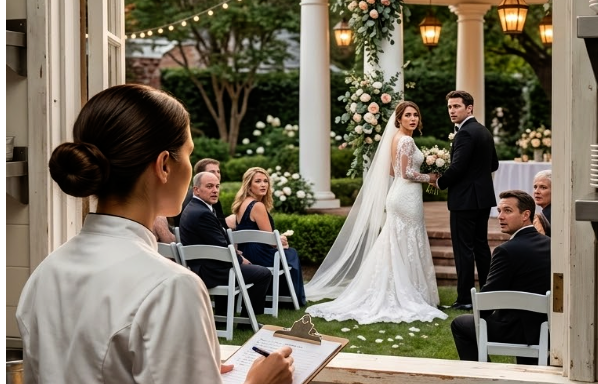
To understand why my ex-husband, Mark, stood at an altar in early June and forgot to say “I do,” you first have to understand the eleven years that preceded that moment. Our marriage wasn’t built on a single grand gesture; it was built on a series of small, grinding sacrifices that I made without a second thought. I was twenty-three when we wed—idealistic, hardworking, and convinced that love was a collaborative investment.
I spent a decade being the scaffolding for his skyscraper. When he got into graduate school, I didn’t just celebrate; I picked up double shifts at a high-volume Italian restaurant, coming home with the smell of garlic and floor cleaner etched into my skin, just so he could focus on his thesis. When his career required relocation, I packed our lives into boxes four separate times. I learned to find a new grocery store, a new social circle, and a new job in four different time zones. I was the constant variable in his shifting equation.
Then came the evening that redefined my existence. Mark sat me down in the living room of the house I had helped pay for and told me I was “predictable.” He said I wasn’t “exciting” anymore. It wasn’t just that he was leaving; it was the clinical way he diagnosed our life together as a failure of entertainment. He had met Brooke, a twenty-six-year-old gym trainer who represented everything I supposedly wasn’t: novelty, spontaneity, and a lack of history. He told me he “loved me but wasn’t in love with me”—the coward’s anthem—and expected me to be “mature” about it.
The divorce was a surgical removal of my past. He kept the house because his name was on the deed, a technicality that ignored a decade of my financial contributions. I left with a suitcase, a small settlement, and the realization that I had spent my thirties building a temple for a man who didn’t want to worship there. Starting over at thirty-five is a unique kind of quiet terror. I moved back to my hometown, a place I hadn’t lived in since I was a teenager, and took a job at a local catering company. I didn’t have the luxury of a breakdown; I had bills to pay. But in the rhythmic chopping of vegetables and the intense heat of a commercial kitchen, I found a different kind of peace. I realized that while I had spent eleven years catering to Mark’s emotional whims, I had actually become exceptionally good at the literal act of catering.
I saved every cent. I worked holidays, funerals, and corporate retreats. For two years, my life was a blur of stainless steel and 4:00 AM prep shifts. When I finally launched my own business, “The Curated Table,” I didn’t just want to provide food; I wanted to provide excellence. I wanted my reputation to be so undeniable that it preceded me. By year three, my team was the most sought-after in the region. I had traded my “predictable” marriage for a highly disciplined, successful career.
Then the phone rang.
Hearing Mark’s voice after years of silence was like hearing a ghost try to order a pizza. He was upbeat, oblivious, and profoundly arrogant. He told me Brooke loved my menu samples online. He talked about “moving on” as if it were a race he had won and I was still at the starting line. He even had the audacity to ask for a “family discount.”
I said yes to the job. It wasn’t out of lingering love or a desire for revenge. It was because, as a business owner, a high-budget June wedding is a cornerstone of the annual revenue. I wanted to see if I could stand in the epicenter of his new life and feel absolutely nothing. The three months of planning were an exercise in psychological endurance. Mark relayed Brooke’s demands like a high-stakes intermediary. She wanted a “raw bar” with West Coast oysters, a hand-rolled pasta station, and a five-course seated dinner featuring filet mignon with truffle butter. She wanted seven different dessert options, including a raspberry mousse that required a specific brand of Valrhona chocolate.
It was a menu designed to scream “Old Money” through a “New Money” megaphone. Brooke wasn’t just hiring a caterer; she was unknowingly hiring the woman she had replaced to validate her new status. Mark called me twice a week, his tone oscillating between patronizing and desperate. He kept thanking me for being “mature,” a word that had become a code for “thank you for not making me feel guilty.”
I treated every request with clinical precision. I sourced the best scallops from the coast; I found the exact vintage of champagne Brooke requested. I was building a masterpiece for people I despised, and the irony was that the better I did my job, the more I proved that I was far more than the “boring” woman he had left behind. The day of the wedding arrived with the kind of clear blue sky that wedding planners dream of. I arrived at the venue at noon, my chef coat starched, my clipboard in hand, and my team moving like a well-oiled machine.
Mark wandered into the kitchen an hour before the ceremony. He looked at me—not the wife who used to wait up for him, but the CEO of a thriving company directing a staff of twelve. He looked smaller than I remembered. He tried to compliment my appearance and asked if I was “seeing anyone.” I gave him the only response he deserved: professional silence. I had a timeline to maintain.
The ceremony took place in the garden, visible through the wide kitchen windows. I watched as Brooke made her entrance, a vision in lace and tulle that cost a small fortune. She looked beautiful, but she also looked terrified. As the officiant reached the part of the ceremony regarding objections, the unthinkable happened.
Mark didn’t look at his bride. He looked at the kitchen window. He looked at me.
The silence that followed was heavy enough to break the garden’s tranquility. Two hundred guests shifted. Brooke’s face turned from a bridal glow to a sickly pale. The air left the room. When the officiant repeated the question, Mark’s voice cracked. “I…” he started, and then he just stopped.
The ceremony disintegrated into a hushed, frantic intermission. I stepped away from the window, my heart hammering not with love, but with the sheer professional annoyance of a timeline being derailed. My pasta water was at a rolling boil; my scallops were prepped for the sear. His existential crisis was ruining my service window. Minutes later, Mark burst into the kitchen service hallway, his tuxedo disheveled. He looked like a man who had finally realized he’d traded a diamond for a rhinestone. He started babbling about “mistakes” and how seeing me “confident and successful” made him remember why he fell in love with me.
It was the most pathetic display of ego I had ever witnessed.
“You don’t have feelings for me, Mark,” I told him, my voice as cold as the raw bar ice. “You have feelings about the fact that I didn’t die when you left. You loved the version of me that was small and convenient. You can’t handle that the ‘boring’ woman you left turned out to be the most interesting person in this room.”
I told him to go back to his bride. Not because I wanted them to be happy, but because I had a contract to fulfill. I had 200 guests who were hungry, and I wasn’t going to let his mid-life crisis tarnish my business’s five-star rating. I walked back into the kitchen and told my team to prepare for service. The drama at the altar was a footnote; the food was the headline. As the reception eventually began—after a tense, forced reconciliation between the couple—I gained a clearer picture of the situation through the wedding party.
Nora, the maid of honor, sought me out in the kitchen. She revealed that Brooke had been obsessed with me for months. Brooke hadn’t hired me because she loved my food; she hired me as a trophy. She wanted to look at the woman she had “defeated” and feel superior. But seeing me thrive had backfired. It had turned the wedding into a constant comparison that Brooke was losing in her own head.
Then came Grayson, the best man. He offered a different perspective. He told me that Mark had spent the last two years framing the divorce as something that “happened” to him, rather than a choice he made. Grayson admitted that Mark’s restlessness was already surfacing with Brooke. He was a man who chased the “exciting” until it became “predictable,” and then he looked for the next exit. Today wasn’t a sudden realization of love; it was the onset of Mark’s habitual buyer’s remorse.
Finally, I spoke with Edmund, Brooke’s father. He was the one who had written the check for my services. He was a shrewd businessman who saw exactly what was happening. He didn’t think the marriage would last a year, but he respected my work. “At least the food is memorable,” he sighed. He saw the irony of hiring the ex-wife, and he respected the grace with which I handled the absurdity. The most pivotal moment, however, was the private conversation with Brooke. She found me in the hallway, her makeup ruined by tears. She didn’t come to scream; she came because she was drowning in her own insecurity. She asked me how I stopped loving him.
“I didn’t stop loving the man I married,” I told her. “I just realized that man didn’t exist anymore. The person you’re marrying today isn’t a partner; he’s a consumer. He consumes people until they aren’t ‘exciting’ anymore, and then he goes shopping again.”
I saw the light go out in her eyes. It was the same realization I’d had three years prior. I didn’t feel joy in her pain, but I felt a profound sense of closure. I was no longer the victim of this story. I was the mentor Brooke didn’t want but desperately needed. The wedding ended, as all weddings do, with a messy cleanup and a tired staff. But for me, it was a beginning.
Dorothea, my former boss and mentor who attended the wedding as a guest, pulled me aside that night. She was retiring and offered me her entire client list—a portfolio of corporate giants and high-society events that would triple my business overnight. She had watched me handle the altar disaster with a level of professionalism that she said was “unmatched in forty years of service.”
I moved into a new, 5,000-square-foot commercial kitchen that October. I hired a manager, Payton, to handle the daily operations so I could focus on growth. I even started dating again—a man named Jake who didn’t want me to be “exciting” or “predictable,” but simply wanted me to be myself.
The news eventually reached me that Mark and Brooke’s marriage lasted exactly four months. He tried to call me after their split, likely looking for the “boring, stable” port in his latest storm. I blocked his number without a second thought.
I am thirty-eight years old now. I am a business owner, a mentor, and a woman who knows her worth isn’t measured by a man’s attention span. I built a life from the ashes of a “predictable” marriage, and looking back, I realize that Mark stopping his wedding wasn’t about me at all. It was the last gasp of a man realizing he had walked away from the only person who actually knew how to build something that lasted.
I don’t cook for ghosts anymore. I only cook for the future.