In the spring of 2025, my life was a study in curated inadequacy. I was living with Liam, a man whose entire existence was tethered to the superficial apex of the fitness world. Liam was a personal trainer at an elite, glass-walled gym in the city—a place where the air seemed filtered through expensive supplements and the clientele consisted exclusively of influencers and models whose faces were their primary currency. In that world, aesthetic perfection wasn’t just a goal; it was the baseline for human value.
Liam didn’t just work in that environment; he brought it home like a contagion. I remember the evening before his company’s annual gala. I was standing in front of the mirror, trying to feel comfortable in a dress I’d spent two weeks’ salary on, when I felt his fingers, cold and clinical, pinching the skin at my waist.
“You need to lose at least ten pounds before the party,” he said, his voice devoid of heat, as if he were discussing a faulty piece of gym equipment. “I have a reputation to maintain, and I can’t have people thinking I’m settling for a cow.”
The word “cow” hung in the air, a heavy, ugly thing. He didn’t say it to be mean in the traditional sense; he said it with the detached authority of a professional. That was his greatest weapon: the idea that he was “helping” me. Every time he tore me down, he framed it as an act of altruism. He’d point out the width of my nose in photos, the slight puffiness under my eyes, or the way my posture lacked the “alpha” confidence he demanded.
But beneath the surface of my compliance, a quiet rebellion was taking root. Every time he called me ugly, every time he spent an hour digitally altering my face before allowing me to be seen on his Instagram feed, I would wait until he was asleep. Then, I’d open my banking app and transfer twenty dollars from our joint account into a secret, high-yield savings account he knew nothing about. It was my “Freedom Fund,” and each increment represented a tiny brick in the wall I was building between us. By our six-month anniversary, Liam’s obsession with “improving” me had reached a clinical fever pitch. He had taken to using a red felt-tip marker—the kind teachers use to grade failing essays—to circle what he called “problem areas” on my actual skin. I would stand naked under the harsh bathroom LED lights while he performed his “assessments.”
“I’m just trying to help you become the best version of yourself,” he would whisper, the tip of the pen cold against my thigh. “Most guys wouldn’t care enough to point out areas for improvement. They’d just leave. But I see potential in you.”
This psychological conditioning was reinforced by his social circle. We spent our weekends with people like Ryan, a supplement mogul who treated women like thoroughbred horses. I remember a brunch where Ryan looked at me, then at Liam, and said quite clearly, “Your girlfriend’s maybe a six on a good day, Liam. You’re a ten. You could definitely upgrade if you wanted to. Think about the brand alignment.”
I sat there, staring at my avocado toast, feeling my soul shrink. But then I remembered the balance in my secret account. I was three weeks away from having enough for a security deposit on a studio apartment I’d found in a quiet neighborhood three miles away. I just had to endure the Miami trip. Liam, however, was not content with only “fixing” me. His own vanity was a bottomless pit. Despite his near-perfect physique, he became obsessed with the “next level.” He decided that for the Miami influencer retreat, he needed a more “masculine” profile. He booked a marathon session of plastic surgery: a jawline sharpening, cheek implants, and a rhinoplasty refinement.
“I’m going to be unrecognizable,” he boasted, scrolling through the Instagram pages of surgeons who specialized in “The Hero Look.” “When we hit South Beach, they won’t be looking at anyone else.”
The surgery took place on a Tuesday. I was supposed to sign my new lease on Wednesday and disappear while he was in recovery. But the universe had other plans. Four hours into his procedure, the clinic called me in a panic. Liam had suffered a rare, aggressive inflammatory response. By the time I reached the hospital, his face was a distorted mask of trauma. The jaw implants had shifted and become septic, the infection was spreading toward his orbital bones, and his nose had partially collapsed.
He looked like he had been attacked by a swarm of hornets. The man who lived for mirrors couldn’t even open his eyes to see one.
At that moment, my resolve wavered. I saw a broken man, not a monster. I felt a crushing sense of duty. I canceled my apartment viewing, told the landlord I’d had a family emergency, and decided to stay to nurse him back to health. I thought, surely, this brush with mortality and “imperfection” would humble him. I thought he would finally see me for the heart I had, not the “six” I was ranked as.I was wrong. Tragedy doesn’t always build character; sometimes, it just strips away the mask of politeness. As the weeks turned into months, Liam underwent three more corrective surgeries. Each one left him more lopsided. His jaw was now permanently crooked, his left eye drooped due to nerve damage, and a deep dent remained in the bridge of his nose.
His shallow friends—the “sixes” and “tens”—vanished the moment he lost his aesthetic utility. He was fired from the gym because, as his boss brutally put it, “Nobody wants to look at a car crash while they’re trying to get a summer body.”
Instead of turning toward me in gratitude, Liam turned into a tyrant. He blamed me for everything. “If you’d been prettier, if you’d been a ten, I wouldn’t have felt the pressure to get work done!” he’d scream, his voice muffled by the scar tissue in his jaw. “Now I’m stuck with a cow, and I’m a monster. We’re both disgusting now.”
The verbal abuse shifted into something darker. He began throwing things—my books, my clothes, the expensive candles he used to insist we burn to “set the mood.” He started blocking the doors when I tried to leave for work, demanding I stay and listen to his rants about how the world had betrayed him. He took my keys, he timed my commutes, and he began checking my phone with a manic intensity. I realized then that I was no longer just in a bad relationship; I was in a cage with a wounded predator. I reached out to Lena McLoughlin, a domestic violence advocate I found through a shielded browser search at the public library. Lena taught me the difference between a “departure” and an “escape.”
“Leaving an abuser is the most dangerous time,” she told me during our first secret meeting at a coffee shop. “You have to be a ghost before you’re gone.” Following Lena’s instructions, I began a process of “micro-moving.” I couldn’t pack a suitcase—that would be a death sentence for my plan. Instead, I started moving one or two items of high value to my work locker every day. My grandmother’s locket. My birth certificate. A single pair of high-quality jeans.
I bought a burner phone—a cheap, prepaid device—and hid it inside a hollowed-out gym foam roller in my locker. This was my only link to Lena and the outside world. I also began documenting the physical reality of my life. I took photos of the dented walls, the shattered frames, and eventually, the dark purple marks Liam left on my wrists when he tried to stop me from going to the grocery store. The most terrifying part was the digital surveillance. Lena warned me that Liam likely had spyware on my primary phone. She was right. I found spikes in data usage at 3:00 AM. He was mirroring my texts, tracking my GPS, and listening to my environment.
To counter this, I kept my “decoy” life perfectly normal. I continued to post “happy” photos of our dinners (carefully cropped to hide his scars and my fear). I texted my friends about mundane topics. Meanwhile, on my burner phone, I was communicating with Daisy Garner, a leasing agent who specialized in secure housing.
Daisy was a godsend. She understood the urgency. “We have a studio opening in ten days,” she whispered over the burner line. “It has 24-hour security, gated parking, and the mail is handled through a central office so your unit number stays private. Can you get the deposit?”
I looked at my Freedom Fund. Between my secret savings and the furniture I’d been secretly selling on Marketplace (claiming to Liam that I was “decluttering” for his recovery), I was only four hundred dollars short. The week of the move-out was a blur of adrenaline and nausea. I had coordinated with Henry, my manager at the gym. Henry was a former Marine who didn’t say much, but he’d seen the way I’d changed over the last year. When I told him I needed help moving, he didn’t ask questions. He just said, “My truck will be there at 0900. Be ready.”
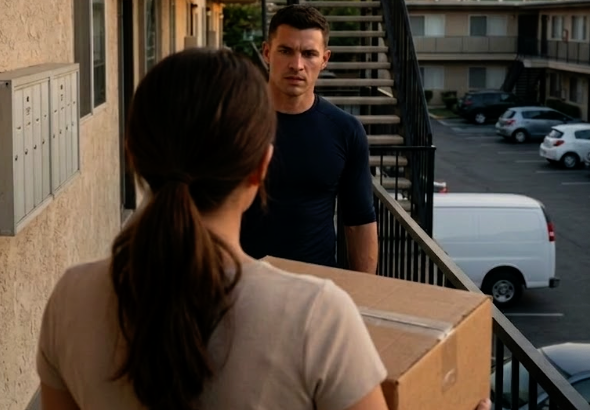
On the morning of March 15th, I waited for Liam to leave for his court-mandated physical therapy. I had a two-hour window. Henry arrived with another trainer from the gym. We moved with the speed of a pit crew. We weren’t just moving boxes; we were extracting a life.
We were almost finished—the bed frame was disassembled, the dresser was in the truck—when I heard the screech of tires. Liam’s car swung into the parking lot. He’d forgotten his physical therapy paperwork.
He didn’t walk up the stairs; he stormed. When he saw the open door and the empty living room, the sound that came out of him wasn’t human. It was a guttural, terrifying roar.
“You think you can leave me?” he screamed, his lopsided face twisting into a horrific snarl. “After I spent two years trying to fix you? After everything I lost?”
He lunged for me, but Henry stepped in. It was the first time in two years I hadn’t been the smaller person in the room. Henry didn’t hit him; he just stood there, a wall of muscle and calm. “She’s leaving, Liam. Stand back.”
Liam, blinded by a toxic cocktail of narcissism and rage, didn’t care about the odds. He tried to shove past Henry to grab my throat. I did exactly what Lena had taught me: I didn’t engage, I didn’t argue. I pulled out my phone, hit ‘Record’ on the video app, and shouted at the top of my lungs for the neighbors to call 911.
The arrival of Officer Vicente Herrera changed the energy of the room instantly. Liam, ever the performer, tried to pivot. He started crying, claiming I was the abuser, that I’d stolen his money, that I was mentally unstable. But I had the folder.
I handed Officer Herrera the photos of the property damage. I showed him the video Henry had just recorded. I showed him the log of the 300+ text messages Liam had sent me in a single weekend. And finally, I showed him my wrist.
Liam was led away in handcuffs, still screaming that I was “ugly” and that “nobody would ever want a traitor.”
The first night in my new studio apartment was the quietest night of my life. There were no red pens. No clinical assessments of my waistline. No muffled rants about jawline symmetry.
But freedom isn’t a destination; it’s a practice. For the first month, I lived in a state of hypervigilance. I slept with a chair wedged under the doorknob. I jumped at the sound of the refrigerator cycling on. I checked the locks so many times my fingertips were raw. I began attending a support group at the community center. Sitting in a circle with eight other women, I realized that the “red pen” wasn’t unique to Liam. Abusers all use the same script; they just change the font. Hearing their stories helped me understand that my “imperfections” were never the problem. The problem was his need to diminish me so he could feel large.
I also adopted Scout, a wiry-haired terrier mix from the shelter. Scout didn’t care about my nose or my weight. He just cared that I was home. His presence gave me a reason to walk in the park, to breathe fresh air, and to re-engage with a world that didn’t require a filter to be beautiful. In moments of doubt, I looked at the data. According to domestic violence statistics, nearly 1 in 4 women and 1 in 9 men experience severe intimate partner physical violence. In our city alone, the police respond to over 15,000 domestic disturbance calls annually. These aren’t just numbers; they are a silent army of people reclaiming their lives. Seeing the sheer volume of survivors made me feel like part of a movement rather than a victim of a tragedy. Today, a year after the surgery that went wrong and the escape that went right, I am the supervisor at the gym where I used to hide in the equipment room. I don’t use filters on my photos anymore. I have a small scar on my wrist where Liam gripped me too hard that day, and I’ve decided not to have it removed. It’s a reminder that I am made of something much stronger than plastic or bone.
I am not a “six.” I am not a “cow.” I am a woman who owns her own keys, her own bank account, and her own reflection.
The journey from victimhood to agency is rarely a straight line, and every survivor’s path is paved with impossible choices. If you were in that hospital room, looking at the man who broke your spirit and now broken himself, would you have stayed as long as I did? Or would you have recognized that a monster with a broken face is still a monster?
I’ll be reading through the comments. You always bring the best insights.