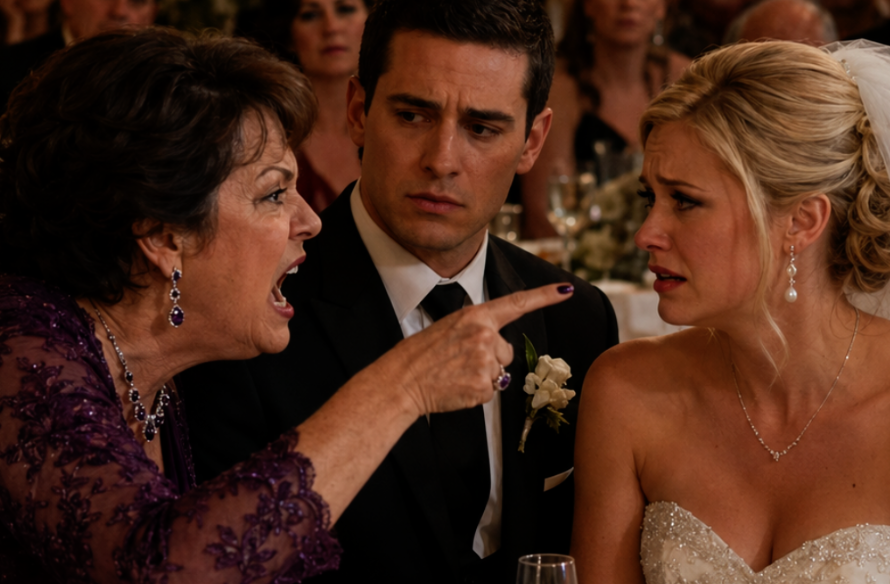
“So, Tanya, you should thank my dear Pasha! You basically came to us from under a fence. Any other man wouldn’t even have looked in your direction. An orphan is an orphan, after all. No relatives, no dowry, no home, no family. You got lucky!”
That was my mother-in-law, Rimma Gennadyevna, speaking at our wedding. Loudly. With laughter. So that all the guests could hear. So that her cousin Lyuda — with whom she had been competing for forty years over “whose daughter-in-law had the better pedigree” — would hear it and understand just how generous and kind-hearted Rimma was.
I sat there in my white dress. I didn’t cry. I only smiled from the corner of my mouth. Pasha, sitting beside me, tensed up and squeezed my hand under the table.
“Mom, stop it,” he hissed.
“What? What did I say? I’m only telling the truth! Tanyusha, you’re not offended, are you? You’re simple, one of our own, without any airs. Everyone knows you’re from an orphanage, and look at you — you still grew into a decent person. That’s what I’m saying. Good for you. Appreciate the fact that you ended up in our family.”
The guests chuckled. Awkwardly, but they chuckled. Some out of politeness, not wanting to argue with the hostess. Some sincerely. Aunt Lyuda was practically glowing: her daughter-in-law was “a colonel’s daughter,” and compared to me, Rimma was losing badly. Rimma understood that and compensated with volume.
I stayed silent. Pasha stayed silent.
And no one — absolutely no one at that table — knew one simple thing.
Yes, I really was “from an orphanage.”
Just not quite in the way they imagined.
My name is Tanya. Tatyana Andreyevna Severtseva. I really did grow up in an orphanage, from the age of six to eighteen. That is true. That is what Pasha knew when we met at university. I told him everything on our third date because I didn’t want any “it turns out later” situations.
What I didn’t tell Pasha — and what, as you have probably guessed, his mother didn’t know — was what happened to me when I turned twenty-two.
By then, I had already finished my third year at the economics faculty. I lived in a dormitory. I worked part-time as a waitress. And one day, a man found me.
He was a lawyer. His name was Valery Stepanovich. He came straight to my dormitory with a folder and an ID.
“Tatyana Andreyevna? Severtseva? Good afternoon. I represent the interests of… let’s say, one family. Are you the daughter of Andrei Viktorovich Severtsev?”
“Yes. He died when I was six.”
“Yes. And your mother’s name was Irina Vladimirovna, maiden name Koretskaya?”
“Yes. She died a year after my father. I grew up in an orphanage. What is this about?”
Valery Stepanovich took out some documents. And then he told me the story of my own life — a story I myself had not known.
My grandfather. On my mother’s side. Vladimir Petrovich Koretsky. He was alive. He was eighty-three years old. He lived in Yekaterinburg. He had a business — a decent, mid-sized one — a chain of pharmacies, about thirty of them across the Urals. And all his life, he had no idea he had a granddaughter.
Why didn’t he know? Because my mother had quarreled bitterly with him when she was young, left for Moscow, and married my father against my grandfather’s wishes. My grandfather had been categorically against it. He said, “If you leave, don’t come back.” My mother left. And she really didn’t come back.
My parents died in a car accident. I ended up in an orphanage because social services looked for relatives, but my mother and grandfather had not been in contact for fifteen years, and her old address books burned along with the apartment in a fire. The accident, as it turned out, had also caused a fire. No one in Moscow knew about my grandfather in Yekaterinburg. And my grandfather didn’t know his daughter had ever had a daughter.
He found out by chance. His assistant, in 2024, started digging through family archives for some reason — searching for lost documents for one of my grandfather’s apartments — and came across records of my birth.
My grandfather hired a lawyer. The lawyer found me. In an MSU dormitory, in a room for three.
“Tatyana Andreyevna,” Valery Stepanovich said, “your grandfather would like to meet you. If you agree. I should also inform you that he has already drawn up a will in which you are the sole heir to his business and property. Whether you meet him or not.”
I traveled to Yekaterinburg as if in a dream. I kept thinking: I’ll arrive and there will be no one there, it’ll be a scam, fraudsters. But I arrived. An elderly man in a coat met me at the airport. Gray-haired. Tall. With my eyes — exactly the same as the ones I saw in the mirror.
He hugged me. He cried. And he said:
“My girl. Forgive this old fool. I lost your mother because of my pride. I will not lose you now.”
We lived together for a year. I moved in with him. I finished my studies remotely. I learned the business from him — he deliberately took me into all his pharmacies, introduced me to managers, showed me the paperwork, taught me how to read balance sheets.
A year later, he died. Quietly, in his sleep. He had a weak heart, and he knew he didn’t have much time left.
I was left as the heiress to a chain of thirty-two pharmacies. An apartment in the center of Yekaterinburg. A house in the suburbs. And around forty million in bank accounts.
I was twenty-three.
I met Pasha a year after that — already in Moscow, where I had moved after putting an experienced manager, one of my grandfather’s old people, in charge of the business. Pasha was my age and worked as an engineer. A good man. Kind. A little naive, but his honesty made up for it — a rare quality.
I told him about my grandfather. About the inheritance. About everything.
He was probably the only man in my life who reacted properly. He said:
“Tanya. I don’t care. I have my own salary, my own plans. Your money is yours. I don’t want access to it, no joint accounts. I simply love you. If it makes you feel better, let’s sign a prenuptial agreement so you never have any doubts.”
And we signed one. Before the wedding. Everything I owned before marriage and everything I inherited would remain mine. Pasha signed it without blinking.
He did ask for one thing, though.
“Tanya. Don’t tell my mother. She’s… complicated. If she finds out you have money, she’ll either start sucking up to you or she’ll hate you. There’s no third option. Let’s not tell her for now. Let her get to know you first. As a person.”
I agreed. It was logical. And, honestly, I wanted people to love me — or not love me — for myself, not for the pharmacies.
We got married.
And at the wedding, the scene I began with happened.
After the wedding, we lived with my mother-in-law. Temporarily, while repairs were being done in the apartment Pasha and I were renting. Two months. Two months of hell.
Rimma Gennadyevna never missed a chance to remind me who I was and where my place was.
“Tanyusha, washing dishes is women’s work. I stood at the sink for half a century, that’s enough.”
“Tanyusha, let Pashenka rest, he’s the breadwinner. Why are you sitting there? Go warm up dinner.”
“Tanyusha, do you still have that orphanage habit of turning off the bathroom light? Saving electricity, are we? We don’t save like that. We’re a normal family.”
I stayed silent. I smiled. I cleaned, cooked, and turned off the lights.
Pasha tried to defend me, but Rimma would start a scandal.
“I raised you alone, I gave you my whole life, and now you’re tearing me apart because of this orphan?!”
I told Pasha:
“Pasha, don’t stand up for me. I’ll endure it until the renovation is finished. We’ll move out, and it will all end.”
The renovation was completed two months later. We moved into our rented apartment. Rimma stayed in hers, offended that we had “run away from her.”
And a year and a half later, something happened that Rimma would later call “a catastrophe.”
She was fired. She was fifty-eight. She had worked as a warehouse manager in a large household appliance retail chain, and they pushed her out during a reorganization. Without severance pay — she had some complicated conflict with management, and they dismissed her “for cause,” somehow registering absences even though there had been no absences. Rimma screamed that she had been set up. Maybe she had been — I didn’t look into it.
But the fact remained: she was fifty-eight, two years away from retirement, with no job, no pension yet, and a mortgage on her one-room apartment. The monthly payment was twenty-eight thousand.
She called Pasha.
“Pashenka, my son, you’ll help your mother, won’t you? I have nothing to pay the mortgage with! My savings will last three months at most!”
Pasha was stunned.
“Mom. My salary is one hundred and ten. Forty goes to our rent, twenty to food, twenty to the car loan. I have thirty left. I’ll give you what I can, but I can’t manage twenty-eight. Fifteen at most.”
“And what about that Tanya of yours? She works too! Let her help her mother-in-law!”
Pasha faltered. Then he said:
“Mom. Tanya will decide for herself how much she wants to help and whom she wants to help.”
“What is there for her to decide?! She’s a rootless orphan. My son brought her into decent society. She owes my family until the day she dies!”
Pasha hung up. He came to me. Sat down on the couch. And said:
“Tanya. You don’t owe her anything. Nothing at all. I’ll pay what I can. Mom will find some part-time work. We’ll manage.”
I looked at him. At my Pasha, who had kept my secret for two years, who had never once reproached me for a single kopeck, who had never once hinted, “But you have your pharmacies.”
And I said:
“Pasha. I’ll help. But in my own way.”
The next day, Rimma Gennadyevna came to our place. With a pie. To make peace.
“Tanyusha, forgive me, I lost my temper. Well, you understand, I have this situation, the mortgage, retirement…”
I poured her tea. Sat her down opposite me. And placed an envelope in front of her.
“Rimma Gennadyevna. There are two hundred eighty thousand here. That covers ten months of mortgage payments. You will take it and cover your payments until you have your pension and a new job.”
Her eyes widened.
“Tanyusha… where did you get…”
“I’ll explain. But first — one condition.”
I placed a sheet of paper next to the envelope.
“This is a written acknowledgment of debt. You will write by hand that you borrowed two hundred eighty thousand from me, interest-free, with repayment due in three years. And you will sign it. It’s a formality, but I’ll feel more at ease this way.”
“Tanyusha, what kind of written agreements do we need between family…”
“Rimma Gennadyevna. I am an orphan. I don’t have ‘family.’ I have Pasha. And you are Pasha’s mother. And a receipt is just a piece of paper. Let’s not take offense. You are not asking me for money as a gift, are you? You will pay it back, right?”
She grimaced. But she signed it. She urgently needed the money.
And then I told her.
About my grandfather. About Yekaterinburg. About the pharmacies. About the inheritance.
She listened. Turned pale. Then red. Then she said:
“Tanya… so you… so you have… so you’re rich?”
“Well-off. Yes.”
“Why did you keep quiet?! I thought you were…”
“You thought I was an orphan whom your dear Pashenka had blessed with happiness. I know. You announced it to the entire hall at the wedding. Remember?”
She lowered her eyes.
“Tanya, I didn’t mean any harm… I was just… being motherly…”
“Motherly is something else, Rimma Gennadyevna. Motherly would have been finding out I was from an orphanage and hugging me. Not laughing at me in front of the guests. But that is in the past. Let’s talk about the present.”
I poured her more tea.
“I will help you. Because you are my husband’s mother. And because Pasha is a good man. He wants to help you, and I will support him. But from now on, you and I will have rules.”
“What rules?” she asked warily.
“First. You will never again call me an orphan, a beggar, rootless, or anything else humiliating. Not to my face and not behind my back. If I find out, the help stops.”
“Tanya…”
“Second. In front of everyone — in front of Lyuda, Pasha, all the relatives — you will apologize for the wedding. Once. At the table. Quietly, like a human being. No hysterics and no ‘well, you understand.’”
“What are you…”
“Third. You will pay the money back. Gradually, from your pension, from part-time jobs — however you can. But you will pay it back. That matters. Because gifts corrupt people. Debt keeps them alert.”
She was silent for a long time. Then she said:
“You’re tough, Tanya.”
“I’m fair, Rimma Gennadyevna. Those are different things.”
She agreed to everything.
What else could she do?
A month later, at Pasha’s birthday, the relatives gathered. The same Aunt Lyuda was there, with her “colonel’s daughter.” Rimma stood up with a glass and said:
“I want to apologize to Tanya. At the wedding, I behaved… shamefully. I called her something no one should be called. She is a good daughter-in-law. And a good person. Forgive me, Tanya.”
Aunt Lyuda nearly choked. Pasha squeezed my hand under the table — tightly. I smiled at Rimma.
“Accepted. Thank you, Rimma Gennadyevna.”
No one ever heard the word “orphan” from her mouth about me again.
Two years passed. Rimma Gennadyevna repaid almost the entire debt; only thirty thousand remained. I told her not to bother, that it was enough. She got a job as a security desk attendant in a business center near her home — two days on, two days off. She likes it. She loves “controlling the passes.” She says it is the best job of her life.
Pasha and I bought an apartment. Without a mortgage — I bought it with my own money. Pasha continues to work as an engineer. We live on his salary, and I take dividends from the pharmacies once a quarter — not millions, but enough to go on vacation and not count every kopeck.
And recently, Rimma came to my office. With a bouquet. I had opened a small branch in Moscow and started developing the chain here.
She sat down. Put the bouquet on the table. And said:
“Tanyusha. I want to ask you one thing. Have you… forgiven me? Truly? Or am I just paying you back the mortgage money for forgiveness?”
I looked at her. At my mother-in-law — graying, tired, with swollen veins on her hands from her security shifts.
“Rimma Gennadyevna. I forgave you on the day I gave you that envelope. Otherwise, I would not have given it.”
She began to cry. Quietly. It was the first time I had ever seen her cry.
“Tanya. I could have lost you, foolish woman that I am. Such a daughter-in-law. All because of my tongue. Forgive me again.”
“I already have, Rimma Gennadyevna. I already have.”
I poured her tea from the office thermos. We sat there and drank it. Two women who had not chosen each other immediately, but who, it seems, had chosen each other after all.
Do you know what I understood over the years?
People humiliate those they consider weak. It is their way of feeling strong. Rimma humiliated me not because I was an orphan, but because she herself was afraid, lonely, and felt that her son was leaving her for a stranger.
When she found out about my pharmacies, she did not change. It is a myth that “once people learn about money, they start respecting you.” No. People start respecting you when you know how to say no. And when you say it calmly, without shouting, with a signed receipt and a list of rules.
Whether I am an orphan or an heiress does not matter.
What matters is who you are inside.
I am Tanya. Severtseva. And I have not been an orphan for a long time.
I have a husband, a home, a business, my mother’s portrait on the wall, my grandfather’s portrait beside it.
And even a mother-in-law.
Not perfect.
But mine.
We all belong to someone.
P.S. Be honest — would you have forgiven a mother-in-law like that? Or, even after she found out you had money, would she still have remained a stranger to you?