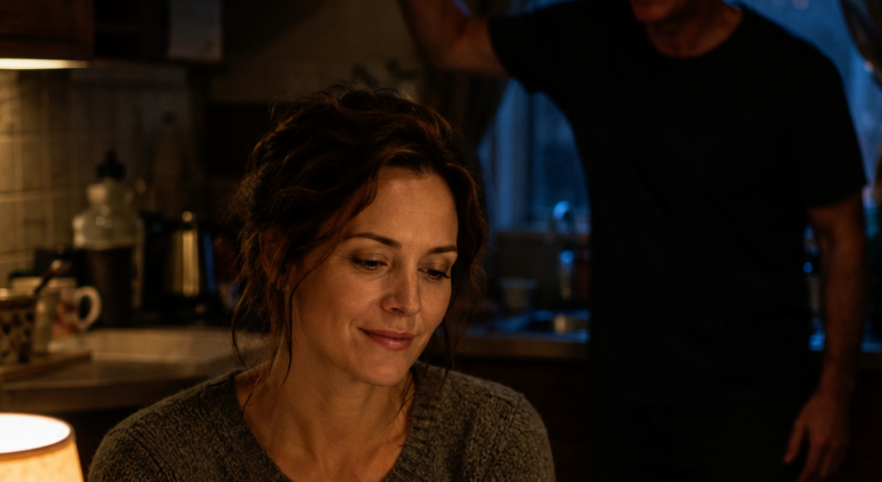
Andrey was yelling so loudly that my right ear went numb. The very same ear into which he had whispered “I love you” eleven years ago in the maternity ward, when they brought Sonya to me.
“File for divorce and you’ll end up on the street, and I’ll take the children! Do you hear me?! You’re nobody! You don’t have a proper job, you don’t have a home! The apartment is in my name, the car is in my name, the business is in my name! You sat here for ten years with everything handed to you, and now you think you can start demanding rights?!”
I wasn’t looking at him.
I was looking at a small ketchup stain on the collar of his white shirt. Sonya had splashed it there that morning when he took her sandwich away from her.
“Don’t put so much on it, you’ll get fat.”
He said that to our eight-year-old daughter.
You’ll get fat.
For some reason, I remembered that stain forever.
“Are you even listening to me?!” he slammed his fist on the table. The cup jumped, and tea spilled onto the tablecloth. “I’ll drag you through the courts! I have connections! I have Igor Semyonovich on the bar association!”
“I hear you, Andrey,” I said quietly. “I hear you very well.”
“Then sit down and use that chicken brain of yours! I’m offering you a peaceful way out. You leave quietly, I rent you a one-room apartment for a year, and the children stay with me. I have better conditions. But if you start resisting, I’ll make you look like such a mother that you’ll only see them once a month through glass.”
I nodded.
I stood up.
I walked to the hallway closet and took out a folder — an ordinary blue cardboard folder that cost forty rubles at the stationery store.
I placed it in front of him.
“What is this?” he asked, suddenly wary for the first time during the entire conversation.
“This, Andryusha, is your life for the last three months. Open it.”
And it all began in August.
In August, I found underwear.
Not mine.
It was in the pocket of his gym bag, the one he had thrown into the hallway after “training at the gym.”
Lace. Size S.
I wear M.
And I don’t wear red.
I didn’t make a scene.
I put them back and closed the zipper.
That was the first time I didn’t scream.
And I think that was the exact moment something inside me clicked — quietly, like the lock on an old suitcase.
I went to the kitchen, poured myself some tea, and for the first time in ten years, I had a clear thought:
“What do I actually know about him?”
Here is what I knew.
Andrey was a lawyer, a partner in a small firm. He earned decent money. The apartment we lived in — a three-room apartment in a residential district — had been bought during our marriage, but it was registered in his name. The car was in his name. The country house was in his mother’s name. The business was in his and his partner Igor Semyonovich’s names.
And then there was me.
Lena, thirty-four years old. Two university degrees — including law, by the way, the very law faculty where Andrey and I had met — but for the last ten years, I had been “sitting at home with the children.”
Sonya was eight. Artyom was five.
I did some freelance English translation work, five to ten thousand a month — pocket money.
Andrey always said:
“Why do you need to work? I provide for you.”
And I believed him.
Idiot.
That August evening, I opened my laptop and, for the first time in ten years, dug out my old legal notes.
Family law.
Division of marital property.
After that came three months of quiet work.
Step one.
I went to see Marinka — my former classmate, the one I used to prepare for state exams with.
Marinka was now a practicing family lawyer, and half the male population of our city hated her.
She listened to me, poured cognac — even though it was noon — and said:
“Lena, everything acquired during marriage is split in half, regardless of whose name it’s registered under. The apartment, the car, the business share. As for the children, the court almost always leaves them with the mother if the mother is mentally stable and capable. No ‘connections’ of Igor Semyonovich will be enough to take your children away from you. But!”
“What do you mean, but?”
“But if he starts hiding assets — transferring things to his mother, his partner, moving money around — it’ll become a mess. So your job is to collect proof of what he owns. Right now. Before he suspects anything.”
I nodded.
And I started collecting.
Step two.
I bought a small voice recorder.
Not for spying — for myself.
So I could hear how he spoke to me and not later wonder whether I had imagined it.
I recorded several conversations.
I reread the transcripts.
I realized I had not imagined it.
He had been speaking to me like a servant for the last four years.
Step three.
Documents.
Quietly, one by one, I photographed everything I could reach: the apartment ownership certificate, which was lying in his desk drawer; the vehicle registration papers; an extract from the state register for his company — that information was public anyway, I downloaded it from the tax service website in five minutes.
The country house agreement.
The garage agreement — and by the way, I hadn’t even known about the garage until I got into his “secret” folder on the computer.
He hadn’t changed the password since 2015.
Sonya’s birthday.
Step four.
Money.
I started saving.
A little bit at a time — from translation jobs, from leftover grocery money.
In three months, I collected eighty-seven thousand.
Not a fortune, but enough for the first month with the children, if necessary.
Step five.
Work.
I wrote to my former boss.
Ten years ago, I had worked as a lawyer at an international company. I went on maternity leave and never returned.
Elena Viktorovna remembered me.
We had a video call.
She said:
“Lena, we currently have remote contract work. English is needed, experience isn’t critical — we’ll get you up to speed in a month. Eighty thousand take-home to start. Then we’ll see.”
Eighty thousand.
I almost cried right there on Zoom.
I started on November 1.
I didn’t tell Andrey.
He wasn’t interested in what I did as long as the children were fed and his shirts were ironed.
Step six — the most painful one.
The mistress.
I figured out who she was in an hour and a half.
Not because I was a genius.
I simply looked at which of his female colleagues liked all his stories within two minutes of posting, no matter the time of day.
Anna.
Twenty-seven.
Legal assistant.
Never married.
I didn’t talk to her.
I did something simpler.
I saved screenshots of their messages.
Andrey was not smart enough to log out of WhatsApp Web on the home computer.
Once a week, I would log in, read, take screenshots, and log out.
The messages were unbelievable.
And there was the main thing: he discussed with her how to “gradually transfer the apartment to his mother so Lena wouldn’t get anything if something happened.”
If something happened.
That phrase finished me.
Step seven.
I chose the day.
Friday, when the children spent the night at my mother’s — a tradition we had every two weeks.
An empty apartment.
No one to interfere.
On Friday, I cooked his favorite meal — stewed beef with potatoes.
I poured him beer.
I sat across from him.
“Andrey, I want a divorce.”
He choked.
Started coughing.
Looked at me as if I had announced I was an alien.
“What?”
“A divorce. I’m filing the petition on Monday.”
And then he started yelling.
About the apartment.
About the children.
About Igor Semyonovich.
About how I was “nobody” and “where would I even go.”
And that was when I placed the folder in front of him.
“What is this?” he repeated.
“Open it. Go on.”
He opened it.
On top was a printed copy of his messages with Anna.
The most revealing page — the one where he suggested “transferring the apartment to his mother.”
He went pale.
“This… this was obtained illegally! The court won’t accept this!”
“The court may or may not accept it,” I smiled. “Although, actually, there is legal precedent for accepting such evidence. But that isn’t the point. The point is that I already know everything. Turn the page.”
He turned the page.
There was a list of his property with document details.
A complete list.
Including the garage, which he had apparently hoped I knew nothing about.
“Next, Andrey.”
The third page was a certificate from my new job.
Eighty thousand a month, official salary, contract dated November 1.
“You… you work?”
“For two months already. Remotely, while you’re at the office. You didn’t notice.”
The fourth page contained the divorce petition and the claim for division of property.
Both ready.
Both signed.
Only the date was missing.
The fifth was a petition to determine the children’s place of residence with me.
With attachments: a character reference from Sonya’s school, one from Artyom’s kindergarten, medical certificates, witness statements from my mother and from our neighbor Aunt Galya.
She had heard quite a lot through the wall over the years.
The sixth page — and this was when he truly turned white — was a copy of a complaint to the bar association against Igor Semyonovich.
Based on messages where he had “promised to help settle the property division in a friendly way.”
“Marinka Sokolova is my lawyer,” I said calmly. “Remember her? She didn’t like you even back during our state exams. She’ll be very happy to deal with you.”
Andrey sat there blinking.
Just blinking.
Opening and closing his mouth like a fish on ice.
“Lena… Lenochka…” his voice suddenly became quiet, soft. “Come on. Why do it like this? We’re family. I made a mistake, the devil got into me, it happens to everyone. Let’s talk calmly. I’ll… I’ll fire Anna. Tomorrow.”
“Andrey.”
“What?”
“Ten minutes ago, you promised to take my children away and leave me with nothing. I recorded it. The voice recorder is in my pocket.”
I took out the small black device and placed it on the table beside the folder.
“I don’t want to talk calmly with you. I want a divorce and half. According to the law. Nothing more, nothing less.”
He was silent for a long time.
Then he asked quietly:
“The children?”
“The children stay with me. You can see them as much as you want. I’m not a monster. Child support according to the law — one quarter of your official income. Challenge it if you want. But you understand, don’t you, Andrey? If we fight to the death, I’ll add the messages with Anna to the claim. And then your reputation in the legal community is finished. You’re a lawyer. You know how this works.”
He closed the folder.
Slowly.
He placed his hands on top of it, as if he wanted to hide it.
“How did you… when did you even manage all this…”
“Andryusha,” I stood and poured myself tea from the kettle.
My hands weren’t shaking.
That surprised even me.
“For ten years, you thought I was ‘nobody.’ That I couldn’t do anything, didn’t understand anything, didn’t see anything. But I was beside you all this time. I was simply silent. I’m a lawyer too, remember? Or did you forget that as well?”
The divorce was finalized in two months.
Without a scandal — Andrey turned out to be smart enough not to drag things into court with my folder as physical evidence.
We signed an agreement: the apartment was sold and split in half.
With my half, I bought a two-room apartment in the same district so Sonya wouldn’t have to change schools.
He kept the car and compensated me with money.
His share in the business was appraised, and he paid me in installments over the course of a year.
He pays child support on time.
He sees the children on weekends.
Anna, by the way, left him a month after the divorce — once she realized that the “partner at the firm” was now living in a rented one-room apartment and paying child support.
It happens.
I work.
Not for eighty thousand anymore, but for one hundred and twenty.
I got promoted.
Sonya takes dance classes.
Artyom goes swimming.
In the evenings, we eat macaroni and cheese and watch cartoons.
Sometimes Sonya asks:
“Mom, do you miss Dad?”
“No, sweetheart. I don’t miss him.”
“Then what do you miss?”
I think for a long time.
“Those ten years when I thought I was nobody.”
Sonya looks at me seriously — she is very serious for her age — and says:
“Mom. You are somebody.”
And I laugh.
And I hug her.
And I realize that I will probably keep that blue cardboard folder.
Let it stay on the top shelf.
Girls should know that their mother has a folder.
Just in case.