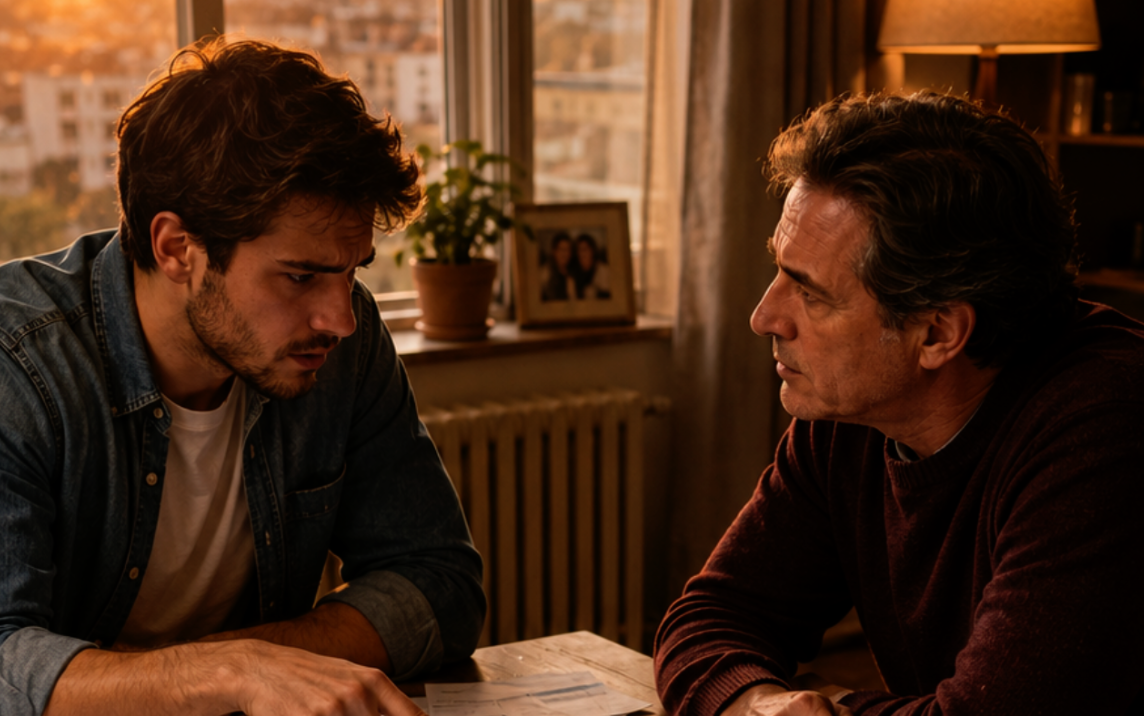
Dad, I don’t understand… Is this some kind of mistake?” Artyom’s voice trembled as he ran his finger across the cold tablet screen, where the will file was open. His name had been neatly crossed out. With a blue pen. In firm, decisive lines.
I watched him from behind the desk, trying to remain calm. Inside, everything had frozen, turned to ice. I had imagined this moment hundreds of times.
“There is no mistake,” I said evenly. “Everything is correct.”
He recoiled as if he had been struck. His eyes, so much like his mother’s, showed pure confusion.
“But why? Because of Lera? Do you hate her that much?”
I did not answer. Too many words had been spoken over the past year. Too much silence had accumulated over a lifetime. Now only this remained — silence and blue ink crossing out twenty-five years of fatherhood.
It all began with Lera. Or rather, with the way my son changed after she appeared. Artyom had always been a calm, intelligent young man, the soul of any group, but with a firm inner core. His mother Irina and I adored him. We saw him as the one who would continue our work — a small but successful construction company that I had built from nothing. After graduating from university, he came to work for me and grasped everything instantly. We had plans.
And then she appeared. Lera. A girl from some questionable family, with endless whims and appetites that clearly exceeded her means. I saw her gaze — calculating, cold — when she first came to our home. She was not looking at Artyom. She was looking at our walls, the furniture, the view from the window.
“Father, we’re getting married,” Artyom announced one evening, without any preamble.
We were sitting in my study. He had just closed a difficult project. I set aside the folder with documents.
“Are you sure?” I asked. “You’ve only known each other for six months.”
“I love her. That’s enough.”
“Enough for what, Artyom? For marriage? Do you know her family? Her goals?”
“I know that she loves me,” his gaze turned sharp. “Or are you only concerned about her social status?”
That was the first blow. He had never allowed himself to speak to me like that before. We argued. Truly argued, for the first time.
After that quarrel, I often remembered his childhood. Little Artyom, climbing onto my lap while I worked at home, poking his finger at the computer keyboard.
“Dad, what are you doing?”
“I’m building a house, son.”
“Will we live in it?”
“No, we’ll build it for other people. And one day we’ll build the very best one for ourselves.”
He believed me. He looked at me as if I were a god. Later, those looks became rarer. Adolescence, his own friends, university. But there was still a connection between us, an invisible thread. We understood each other without needing many words. We worked as one. I saw him not just as my son, but as a friend, a successor. Everything I had built was for him. I dreamed of handing the business over to him when I retired, so he could continue it in his own way — stronger, better.
Irina, my wife, died five years ago from a sudden, aggressive illness. She adored Artyom. Before her death, she made me promise her something.
“Watch over him,” she whispered, squeezing my hand. “He’s so trusting. Don’t let him make a mistake.”
I promised. And I watched. And I saw him making a mistake.
The wedding took place despite all my warnings. I silently gave them money, a lot of money — for the wedding, for the down payment on a good apartment. I hoped that perhaps I was wrong. That Lera would calm down, understand that she was loved, and respond in kind.
At first, it even seemed that way. They came to Sunday dinners, Lera tried to be sweet, helped set the table. Artyom glowed. He was happy. And looking at his happiness, I gradually surrendered. Maybe I really was getting old, becoming a grumbler. The main thing was that my son was happy.
I even offered Lera a job at our company — not a responsible one, more of a representative position. Meeting clients, conducting negotiations. She had charm and knew how to make an impression. She accepted gladly.
And that was when everything began. She came to the office as if she were strolling through boutiques. She was not interested in projects, only in her salary, the company car, the benefits package. She constantly compared our conditions with those of some mythical “friends from Europe.” Then came the hints.
“Artyom, darling, Vika’s husband is already a director, and you’re still a senior manager.”
“Dad, haven’t you thought about new shareholders? Lera’s uncle, by the way, has available funds.”
I laughed it off, but inside, everything tightened. I saw my son, always so independent, beginning to give in to that pressure. He became irritable, often argued with me over trifles, and more and more often quoted Lera and her “wise” relatives.
The blow came from where I least expected it. My old friend and partner, Nikolai Petrovich, invited me to lunch.
“Listen, Viktor, I have to tell you something,” he said, turning a glass of water in his hands and avoiding my eyes. “Your daughter-in-law came to see me. Lera.”
“Why?” My heart sank.
“She offered… well, how should I put it… to buy part of your share in the business. She said you were no longer coping, that it was time to hand the reins over to the younger generation. Specifically — to her and Artyom. She assured me that your son was completely on her side.”
The world collapsed. She was not merely a fortune hunter. She wanted to take away the work of my entire life. And she was using my son to do it.
That very evening, I summoned Artyom to my study.
“Your wife went to Nikolai Petrovich. She offered to buy my share from him. Did you know about this?”
He turned pale. And lowered his eyes. Only for a second. But that was enough.
“Dad, she just… she’s worried about the future. About our prospects. You really aren’t getting any younger.”
Silence fell. The blood pounded in my temples. He knew. He knew and had kept quiet. Or maybe he had even supported her. My support, my successor, the son for whom I had lived and worked, had betrayed me for a woman who saw us as nothing more than a wallet on two legs.
I did not shout. I did not reproach him. I simply looked at him and said:
“Everything is clear.”
The next morning, I called my lawyer.
“Alexander, please prepare amendments to my will. And give Artyom his full final settlement. As of today, he no longer works for the company.”
It was frightening. It hurt, as if I were tearing off a part of myself. But along with the pain came a strange, icy calm. For the first time in many years, I felt that I was doing the right thing. Not as a father blinded by love, but as a person protecting what he had created through incredible effort. I remembered my promise to Irina — not to let him make a mistake. Sometimes preventing someone from making a mistake means stopping them, no matter how cruel that stopping may seem.
I wrote a will in which all my assets — the company, real estate, accounts — were transferred to a charitable foundation in my name, one that would help young entrepreneurs. Artyom would be left only with the capital I had already transferred to him earlier — for the wedding, for the apartment. It would be enough for a comfortable life, but not for the luxury his wife imagined.
I did not see my son for several months. I lived alone in the large house and handled business affairs, which became only more difficult after Artyom’s departure. But I gained something else — self-respect. I was no longer a hostage to my own pity and fatherly duty. I understood that love is not permissiveness. Sometimes the strongest love is the ability to say “no.”
Mutual acquaintances called me, urging me to reconcile, saying that Lera was furious, that Artyom walked around depressed. I listened politely and hung up. My decision was final.
And then one day, late in the evening, the doorbell rang. I looked through the peephole and froze. Artyom was standing on the doorstep. Alone. Without Lera. He looked tired, thinner, rumpled.
“May I?” he asked quietly.
I opened the door. He came in and stopped in the hallway, not daring to go any farther.
“She left,” he said without preamble. “Filed for divorce. Said she had no intention of living with a man who had been deprived of his inheritance. That she had ‘wasted the best years of her life’ on me.”
He spoke evenly, without emotion, looking at the floor. And I looked at him and saw not a traitor, not a stranger, but my boy, who had been painfully burned.
“Dad, I…” his voice broke. “I let you down so badly. I didn’t listen. I allowed her… I allowed all of this to happen.”
He raised his eyes to me, and there were tears in them. For the first time in many years.
“I read the will. Her lawyers sent it to me as an attachment to the lawsuit. And I understood everything. You didn’t want to leave me poor. You wanted to leave me without her. Even back then. You were trying to save me.”
I was silent. There was a lump in my throat.
“She’s already found herself a new… sponsor,” he said with a bitter smile. “And I’m alone now. Without a job. Without you. Without anything.”
He waited for me to say something. To embrace him. To forgive him. But I could not. The wounds were too deep.
“Why did you come, Artyom?” I asked, and my voice sounded tired.
“I don’t know. Just… to sit for a while. If I may.”
He went into the living room and sat in his favorite armchair, the same one from which he had watched me work as a child. He sat hunched over and silent. And I looked at him and understood that the blue ink in the will had not crossed him out, but the illusion we had been living in. It had crossed out her power over him.
I did not embrace him. I did not offer him a drink. I did not say that everything was all right. Everything was not all right. But he was here. Alone. Without her.
I walked over to my desk, took a folder with drawings for a new, complicated project I had been struggling with for several weeks. I returned and handed it to him.
“Take a look,” I said briefly. “I need a fresh eye. I can’t find the error in the calculations.”
He slowly raised his head, looked at me in surprise, then at the folder. He took it. His fingers, accustomed to work, automatically untied the ribbons. He opened it. And began to read.
He simply sat there and read. And I sat opposite him, watching him. The house was quiet. Only his steady breathing and the rustle of paper could be heard. And in that silence, full of pain and unspoken words, something new was beginning. Something very fragile, but real. Not a word, not an embrace, not forgiveness. Just an action. The first, hardest step.
He looked up at me.
“Dad,” he said, tapping one of the sheets with his finger. “Here. You didn’t account for the material resistance.”