My Husband Put a Camera in the Kitchen to Watch Me. A Week Later, I Played the Recording in Front of His Mother — and She Fell Silent Forever
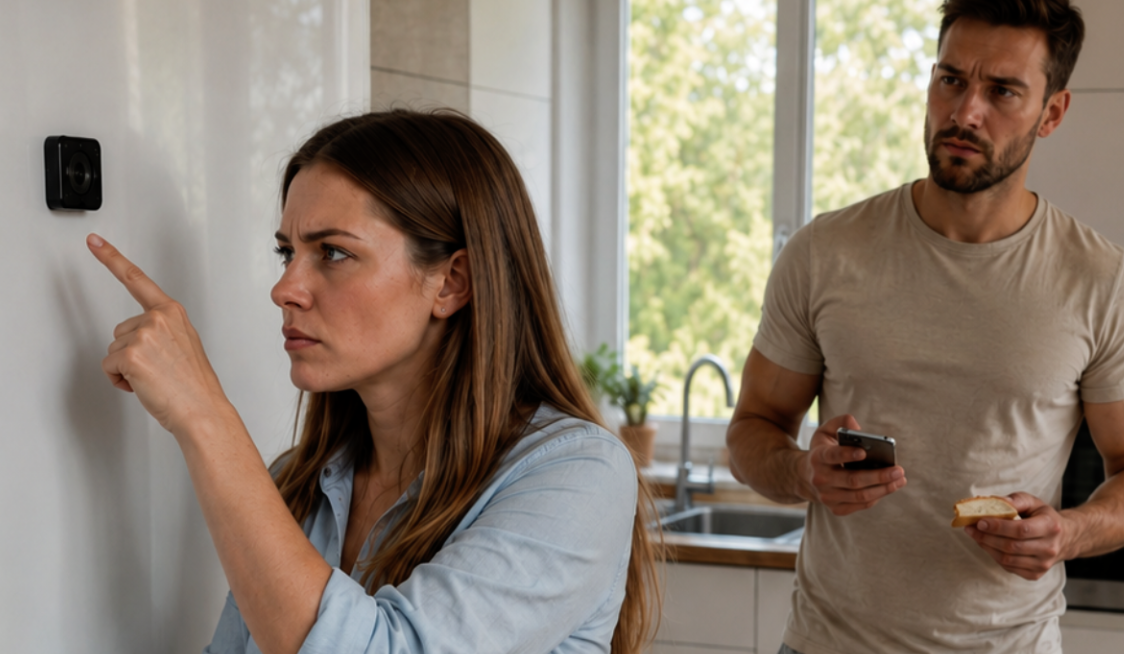
“What is that?” I asked, pointing at the little black box above the refrigerator.
Gennady did not even turn around. He was spreading butter on bread, staring down at his phone.
“A camera.”
“Why?”
“Because.”
He took a bite of his sandwich. Chewed. Only then did he raise his eyes.
“I want to know what you do all day. You sit at home from morning till night. I’m out there working hard, and you’re here doing who knows what.”
I tucked a strand of hair behind my ear.
Eight years of marriage. For eight years, I had been hearing that phrase — “who knows what.”
I work remotely as an accountant. Six hours a day at my laptop. Clients, reports, reconciliations, contracts. Then cooking, cleaning, helping Kirill with homework, drawing with Dasha. But to Gennady, I “sit at home.” As if I spend the whole day wearing out the couch.
“I work, Gena. You know that.”
“Sure. You sit at your laptop. Work.”
He said it as if I spent the day playing solitaire.
The camera looked at me with its black little eye. Small, no bigger than a finger, but I felt it immediately. Like a stranger’s stare in an empty room. An unpleasant, sticky feeling — as if I had been stripped bare and placed under a spotlight.
“And what if I don’t like it?” I asked.
Gennady finished his tea. He placed the cup in the sink — he did not wash it, just put it there.
“If someone doesn’t like it, they must have something to hide.”
Then he went into the hallway to put on his shoes. The door slammed shut. And I stood there in my kitchen, in my apron, in front of my sink, feeling like a defendant on trial.
That evening, while I was washing dishes, I noticed an icon on his phone. Gray, with the image of a lens. He had left his phone on the table while he went to take a shower.
The app was called HomeWatch.
I remembered it. I did not touch anything. I put my hands behind my back and stepped away.
After all, the camera was watching.
For three days, I lived as usual.
I got up at six, cooked porridge for Dasha, saw Kirill off to school, and sat down to work. The camera watched. I tried not to think about it, but I could not help it.
Every movement now had a witness.
I poured myself tea — so that meant I was relaxing.
I stood up to stretch — so that meant I was being lazy.
I called my mother for five minutes — so that meant I was chatting.
I started eating at my laptop so I would not have to get up again. My back stiffened. By evening, my neck ached. But getting up and walking around the kitchen? No. The camera was recording.
On the fourth day, Gennady left on a business trip. Two days in Nizhny Novgorod, some project site.
And Lyudmila Petrovna, my mother-in-law, came over “to help with the children.”
I had not asked her. She never asked.
Three or four times a month, she appeared without warning. The doorbell rang — and there she was, with a bag. Sweets for the grandchildren. Sausage for her son. Nothing for me.
She barely even greeted me properly. Just a nod, like I was a cashier at a store.
In eight years, she had never given me a single birthday present. Not a card, not a word. As if I were just household staff attached to her son.
“Where are the children?”
“Kirill is at school, Dasha is at kindergarten.”
“Good. I’ll tidy up here for now.”
That “tidy up” meant one thing: she would walk through my kitchen, move the jars around, wipe the stove I had already cleaned that morning, shift the salt shaker, straighten the towel. Then she would call Gennady and say, “Your place was filthy, I cleaned everything.”
Every time. The same performance. I knew it by heart, but I stayed silent.
I went into the room to work. I closed the door, opened my laptop.
An hour later, I heard the front door close.
Lyudmila Petrovna had left.
But the camera remained.
That evening, after the children had fallen asleep, I downloaded HomeWatch onto my phone.
Gennady’s login and password were simple — his date of birth and “1234.” He always did that. For every account, every service. Even his bank card PIN was the same four digits.
The app showed an archive of recordings from the past seven days.
The camera recorded not only video. It recorded sound too.
Clear, sharp, perfectly understandable sound.
Gennady had not spared money — judging by the model, the camera must have cost around twelve thousand rubles.
I put on headphones and opened the recording from that day. I fast-forwarded to the moment when I had gone into the room and Lyudmila Petrovna had stayed alone in the kitchen.
My mother-in-law was talking on the phone with Gennady.
Loudly.
She always spoke loudly when she thought no one could hear her.
“Genka, you can see it yourself on the camera. She sits on her phone all day. What kind of work is that? A freeloader. And you break your back at construction sites. Leave her before it’s too late. I’ll take the children. With me, they’ll grow up into proper people, not with that woman.”
I stopped the recording.
The phone in my hands felt hot. Or maybe my fingers had turned cold. I could not tell.
“Freeloader.”
I heard that word and understood: it was not new. It had been spoken behind my back for years. I simply had not heard it before.
I pressed play again.
Gennady answered:
“Mom, I’m thinking about it. I’m watching for now. The camera isn’t there for nothing.”
“That’s right, son. Gather evidence. Have you been to a lawyer? You need to make sure the children stay with you. She’s nobody. No apartment, no car. She can’t even cook properly.”
It was true that I had no apartment or car. We lived in Gennady’s apartment.
But I had put four hundred thousand rubles into the renovation — my own money, saved over three years before the wedding. Wallpaper, bathroom tiles, the kitchen set.
He had apparently forgotten that.
Or he simply did not count it.
I fast-forwarded through the recordings.
Over four days, Lyudmila Petrovna had come twice. And both times, it was the same performance.
Sweets for the grandchildren. Sausage for her son. Then a phone call to Gennady from my kitchen, from my chair, while looking at my curtains — curtains I had sewn myself over three evenings.
The second conversation was worse.
“Genka, she’s sitting around again. Doing nothing. I wiped the stove — it was filthy, awful. The towel was disgusting, the floor was sticky. Shameful. A decent housewife would never allow that.”
Filthy.
I clean that kitchen every day. Every single day.
In the morning — the floor. In the evening — the stove. The sink — after every meal I cook.
And she wiped something already clean with a dry cloth and told her son about “shame and disgrace.”
Four times in one week, she discussed me with my husband.
Four times, she called me a freeloader, a slob, and a “nobody.”
And not once — not a single time — did she say any of it to my face.
In front of me, she stayed silent. Pressed her lips together. Nodded at my borscht and said, “It’s fine.” The highest praise I ever received from her.
And with the grandchildren, she was a completely different person.
Her voice changed with the snap of a finger.
“Grandma loves you! Grandma brought you candy! Grandma is the best!”
Dasha adored her. She would run to her, hug her, kiss the rings on her fingers.
Lyudmila Petrovna would stroke her head and smile — widely, warmly, sincerely.
Or maybe not.
I no longer knew what was real with her.
I copied four recordings onto my phone. Took off the headphones. Lay down in bed and stared at the ceiling.
It was dark and quiet. Only the refrigerator hummed.
Four hundred thousand for the renovation.
Eight years of “fine” instead of “thank you.”
Four recordings containing the truth they never said to my face.
I knew I needed time.
Not to break down. Not to cry. Not to call Gennady in the middle of the night screaming, “How could you?”
Just to wait.
To give them one more Saturday.
The next morning, Lyudmila Petrovna called.
Her voice was honey. Thick and sticky.
“Lyutsiya, dear, I’ll come on Saturday, all right? I’ll bake pies for the children. Kiryusha loves the apple ones.”
Dear.
She only called me that when she needed something.
Usually access to the grandchildren.
Or Gennady’s approval.
“Of course, Lyudmila Petrovna. Come.”
I hung up.
My fingers did not tremble.
For the first time in eight years, I knew something she did not. And that knowledge was warm.
Like a mug held between my palms.
Saturday.
Lyudmila Petrovna arrived at eleven.
Rings glittering on her fingers, her bag packed with groceries, a smile ready for Dasha.
“Dashenka! Grandma will bake pies for you! Apple ones, just the way you like!”
Dasha hugged her and buried her face in her wool jacket.
Kirill nodded from behind his tablet without lifting his head.
Gennady had returned from his business trip that morning. He was gloomy and sleep-deprived. He sat in the kitchen, drinking coffee.
He looked at the camera — it was still hanging there.
Then at me.
I did not look away.
By lunchtime, I had set the table.
Borscht, cutlets, fresh cucumber and tomato salad.
I had cooked for three hours. I roasted the beets separately, the proper way — wrapped in foil, in the oven.
Lyudmila Petrovna looked at the table, pressed her lips together, and said nothing.
From her, that meant: It will do, but it could have been better.
We sat down.
My mother-in-law served Dasha food, cut the cutlet into tiny pieces, blew on the borscht, wiped drops from the table.
The perfect grandmother.
Kirill chewed silently, looking at his phone.
Gennady ate with his head lowered toward his plate.
“Lyutsiya, what did you do today?” my mother-in-law asked in a sweet voice.
I knew that tone.
She asked in front of Gennady on purpose. So I would say “I worked,” and later she could call him and say, “She sat around again, as usual.”
A trap.
Every Saturday — the same one.
“I worked. I submitted the quarterly report.”
“A-ah,” Lyudmila Petrovna nodded. “Well, good.”
“Good” sounded like a sentence.
Like: Sure, keep talking.
Then she turned to Dasha.
“Grandma will buy you a new jacket, do you want one? Pink, with a little rabbit! Beautiful, just like you!”
Dasha clapped her hands.
Lyudmila Petrovna beamed.
There it was — the strategy.
Gifts for the children, silence for me.
So the children would love Grandma, while I remained a shadow.
The staff member who cooked borscht and washed dishes.
After lunch, I washed the dishes.
My mother-in-law sat on the chair — the very chair from which she had called Gennady.
Her rings tapped against the table.
A habit that had once seemed harmless to me.
Now every tap sounded like a reminder.
“Lyutsiya, I wanted to talk. The children will be on vacation in a month. I could take them to my place for a week. To the dacha. Fresh air, the river, berries. It will be good for them.”
I placed a plate in the drying rack. Wiped my hands on my apron.
“I’ll think about it.”
“What is there to think about? It will be good for the children. I live for them.”
“I live for them.”
That phrase.
I had heard it in the recording — only there, it sounded different.
There it had been: “I’ll take the children. With me, they’ll grow up into proper people, not with that woman.”
The same lips, the same voice, the same rings on her fingers.
Only the words were different.
I turned to her.
“Lyudmila Petrovna, do you really think I’m a freeloader?”
My mother-in-law froze.
The rings stopped tapping.
The silence became thick, like cotton wool.
“What? What freeloader? What are you talking about, Lyutsiya?”
“I’m just asking.”
She shifted her gaze to Gennady.
He frowned.
“Lyutsiya, why are you starting this?”
“Nothing. Forget it.”
But I saw it.
One second — and Lyudmila Petrovna turned pale.
Another second — and she pulled herself together.
She smiled at Dasha, who had peeked into the kitchen.
“Grandma was joking, sunshine. Everything is fine, go draw.”
No one had been joking.
And she understood that.
I saw how her eyes changed.
They had been honey.
Now they were ice.
Three days later, Lyudmila Petrovna called Gennady.
I knew she would.
The camera was still working. I checked the recordings every evening after the children went to bed.
“Genka, she knows something. She asked me about being a freeloader. Where did that come from? Did you tell her?”
“No, Mom. I didn’t say anything. Maybe she heard through the wall. You speak loudly.”
“I speak loudly?! I was whispering!”
She had not been whispering.
The camera recorded every word.
A pause.
“The camera,” Gennady said. “The camera records sound too. I forgot.”
Silence.
Long silence.
I counted — twelve seconds.
“Remove the camera,” Lyudmila Petrovna said. “Remove it right now.”
“Mom, why? Let it stay. I need it for the divorce.”
“What divorce?! She downloaded the recordings, do you understand?! Now she’ll show everyone what I said! Remove it!”
He did not remove it.
Because he had not installed the camera to control his mother.
He had installed it to control me.
He did not care what his mother said.
He agreed with her.
“Mom, I’m thinking about it. I’m watching for now.”
For eight years, he had been “thinking.”
For eight years, he had been “watching.”
I listened to the rest of the recording.
At the end, Lyudmila Petrovna said:
“Here’s what will happen. I’ll come on Saturday. And I’ll talk to her. Properly, like a human being. Let her just try to shove those recordings in my face — I’ll show her. I am the mother. I have the right.”
She had the right.
Seventy-two years old, rings on every finger, a voice like a prosecutor.
Fine.
I had rights too.
Gennady came home that evening. He ate dinner in silence.
Then he looked at the camera.
Then at me.
“Did you watch the camera recordings?”
I raised my eyes from the laptop. Calmly. Evenly.
“What recordings?”
“From the camera. In the kitchen.”
“Gena, you installed the camera to watch me. I don’t even know the password to your app.”
That was true.
He did not know that I had guessed his password.
And he did not check.
Because checking would mean admitting that there was something in those recordings he did not want to discuss.
“Fine,” he said. “Forget it.”
Forget it.
His favorite phrase.
Forget the criticism.
Forget my mother.
Forget the fact that people are discussing you behind your back.
Eight years of “forget it.”
No, Gena.
I will not forget it.
Saturday.
Lyudmila Petrovna arrived at ten in the morning.
An hour earlier than usual.
No pies. No sweets. No smile.
Her lips pressed tight, her back straight, her rings glittering.
Kirill was home — school vacation.
He sat in the kitchen with his tablet.
Dasha was drawing there too, at the table, with colored pencils on an album sheet.
Gennady was drinking coffee.
Lyudmila Petrovna sat across from me.
She placed her hands on the table.
Looked at me heavily, from under her brows.
“Lyutsiya. Gena said you suspect me of something. I don’t understand what you mean. I have done so much for this family. I love my grandchildren as if they were my own children. I live for them. And you ask me these strange questions.”
There it was.
“I live for them.”
The third time in front of me.
On the recording, it had been: “I’ll take the children. With me, they’ll grow up into proper people, not with that woman.”
I looked at Gennady.
He was looking into his mug.
As always — into his mug, into his plate, into his phone.
Anywhere but into my eyes.
“Lyudmila Petrovna,” I said quietly. “Do you really live for your grandchildren?”
“Of course! What kind of question is that?!”
“Then please listen. Just for one minute.”
I took out my phone.
Opened the folder with the recordings.
Selected the first one — the longest one.
Placed the phone on the table.
Pressed play.
The kitchen went silent.
Dasha stopped drawing.
Kirill lowered his tablet.
From the phone came Lyudmila Petrovna’s voice.
Loud. Confident. Familiar.
“Genka, you can see it yourself on the camera. She sits on her phone all day. What kind of work is that? A freeloader. And you break your back at construction sites. Leave her before it’s too late. I’ll take the children. With me, they’ll grow up into proper people, not with that woman.”
Dasha raised her head.
Looked at her grandmother.
Then at me.
I switched to the second fragment.
“Genka, she’s sitting around again. Doing nothing. I wiped the stove — it was filthy, awful. Shameful. A decent housewife would never allow that.”
Lyudmila Petrovna sat there white as a sheet.
She did not move.
The rings on her fingers were still.
Her mouth opened slightly, but no sound came out.
“Mom, is that Grandma talking?” Dasha asked.
“Yes, Dashenka. That is Grandma.”
I stopped the recording.
Silence fell over the kitchen like a lid.
Gennady placed his cup on the table. Slowly, carefully, as if it were made of crystal.
He did not raise his eyes.
Lyudmila Petrovna stared at the table.
At her hands.
At her rings.
“That was taken out of context,” she said at last.
Her voice was cracked.
“Four recordings in one week, Lyudmila Petrovna. Four times you called me a freeloader, a slob, and a nobody. From my kitchen. Sitting on my chair. In an apartment where I invested four hundred thousand rubles into the renovation.”
“Lyutsiya!” Gennady half-rose from his seat.
“Sit down,” I said.
And he sat down.
For the first time in eight years, I said “sit down” — and he sat down.
Lyudmila Petrovna looked at Dasha.
Dasha looked back at her — silently, without blinking.
Seven years old, but her gaze was adult.
“Dashenka,” my mother-in-law began.
“You came into my home for eight years,” I said. Calmly. Without shouting. “Three or four times a month. Without calling. You ate my food. Used my kitchen. And called my husband to tell him what a bad housewife, bad mother, bad wife I was. I put four hundred thousand into this renovation. I work six hours a day. I cook, clean, and raise your grandchildren. And I am not a freeloader.”
Lyudmila Petrovna stood up.
Silently.
Took her bag from the chair.
Looked at Gennady — long and hard.
“Genka,” she said.
He was silent.
She left.
The door closed without a slam.
Quietly. Carefully.
I stood by the sink.
My fingers clutched the edge of the countertop.
My heart was beating fast, somewhere in my throat.
But my hands were calm.
For the first time in eight years, I had said everything I thought.
And my hands did not tremble.
Gennady sat in the kitchen for another twenty minutes.
Silently.
Then he stood up and left.
He put on his shoes in the hallway and slammed the door.
I heard the car start in the courtyard.
The camera watched from above.
I raised my head and looked straight into the lens.
Let it record.
That evening, Kirill came up to me.
He sat beside me on the sofa.
Stayed silent for a while.
“Mom, did Grandma really say that about you?”
“Yes, Kiryusha.”
“And Dad knew?”
“He knew.”
He was silent again.
Fourteen years old.
At that age, you already understand that silence is also a choice.
And not always the right one.
“Okay,” he said.
And went to his room.
Dasha fell asleep quickly.
I covered her with the blanket, adjusted the pillow with the bunny on it, and went back to the kitchen.
Alone.
The camera was still working, but I no longer cared.
I made tea.
Wrapped both hands around the mug.
Hot.
The warmth spread through my fingers, through my palms, and then deeper inside.
It was quiet.
Quieter than it had been in this house for a long time.
Three weeks passed.
Lyudmila Petrovna does not call.
She does not come over.
She does not bring sweets.
Gennady visits her alone on Saturdays. He comes back silent and gloomy, sits in the kitchen, and drinks coffee.
He removed the camera on the second day after that conversation.
Silently, without explanation.
A little hole from the mount remained above the refrigerator.
Small, about the size of a finger.
Yesterday, Dasha asked:
“Mom, does Grandma not love us anymore?”
I crouched down in front of her.
Looked into her eyes.
“She loves you, Dashenka. She is just ashamed right now.”
I do not know if that is true.
Maybe she is ashamed.
Maybe she is angry.
Maybe she is telling her friends what kind of daughter-in-law Genka has — an “ungrateful bitch.”
But I sleep peacefully now.
For the first time in eight years.
Still, Dasha asks about Grandma every day.
And I think about it at night.
Maybe I should have shown the recordings privately.
Maybe without the children.
Maybe I should have said nothing at all and simply left.
Should I have played it in front of the children?
Or did I go too far?