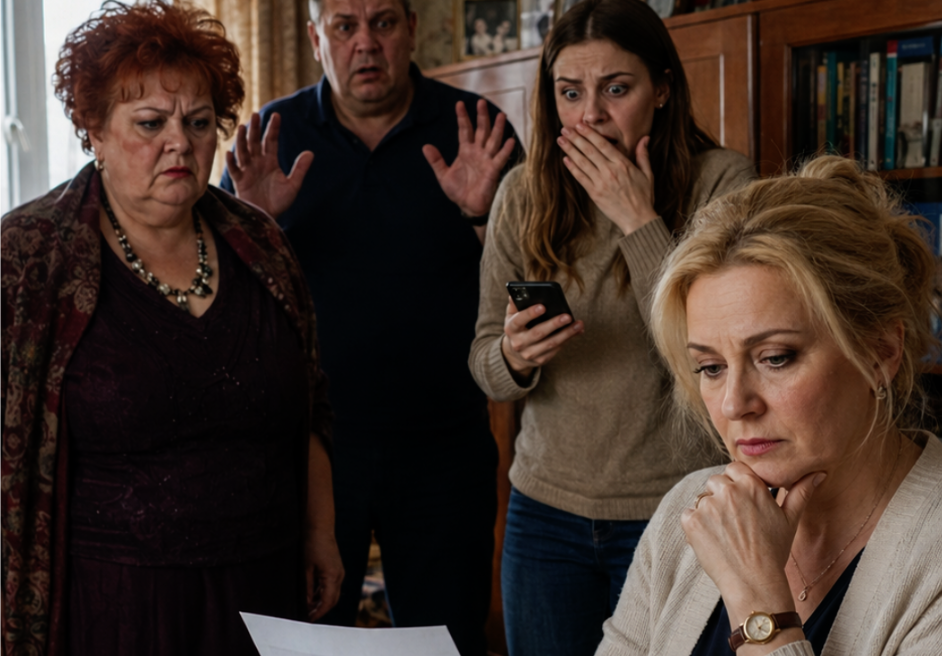
“Mom and my sister should have a share in your apartment — that’s only fair,” my husband declared. What kind of fairness was he talking about?
When my husband said those words to me — calmly, over dinner, while serving himself a second helping of borscht — at first I didn’t even understand that he wasn’t joking.
“Masha. I talked to Mom. And to Irka. Anyway, we came to the conclusion that you need to transfer shares of the apartment to them. One quarter each. To Mom and my sister. It’s only fair.”
I was holding the ladle in midair. Borscht dripped from it. Right onto the tablecloth.
“Seryozha. What are you talking about right now?”
“The apartment. Yours. Ours,” he emphasized the word “ours.” “Mom has nowhere to live — she has an old Khrushchevka with a leaking ceiling. Irka is squeezed in there with Mom and her two kids — it’s awful. And here we are, in a three-room apartment on Yugo-Zapadnaya, one hundred and ten square meters, living like royalty, just the two of us. It would be fair to give them shares. They’re like family to you.”
“Like family.”
A wonderful way to put it. Especially coming from the mouth of a man whose mother, at our wedding eight years ago, said to my mother in front of all the guests, “Well, it’s nothing that your daughter is simple and almost without an apartment — our Seryozhenka will lift her up.”
“Almost without an apartment” referred to the one-room flat in Biryulyovo that my parents had left me back then. My grandmother’s. After she died.
And the “three-room apartment on Yugo-Zapadnaya,” in which Seryozha was now suggesting that I “give his mother a share,” was a completely different story. A very interesting story.
I placed the ladle on a saucer. Wiped the tablecloth. And asked calmly:
“Seryozha. Where did this sudden urge come from? When was the last time you carefully looked into this apartment? Have you seen the documents?”
“Masha, don’t start. What documents? We’ve been married for eight years. Everything acquired during marriage is split in half. That’s the law. I’m not demanding — I’m suggesting it humanely: let’s give my family some shares. They’re struggling.”
“Struggling,” I repeated slowly. “Seryozha. Your mother went to Turkey twice last year. Your Irka bought a Kia Rio on credit the year before last — and by the way, your own mother is paying off that loan from her pension. I’d really love to see in what way they’re ‘struggling.’”
“You don’t understand! They’re family! Family needs help!”
“And what am I to you? A neighbor from the stairwell?”
He grimaced. As if from a toothache.
“Masha. I’m giving you until tomorrow. If you don’t agree, I’ll file for divorce. And then we’ll divide everything in half by law. I’ll transfer my half to my mother and Irka myself — that will be my choice. Think about it.”
And he left to watch football. Serving himself a third helping of borscht on the way.
I sat in the kitchen for another ten minutes. Completely calm. Because — let me explain, dear readers — in eight years of marriage, my husband had never bothered to read the documents for the apartment he lived in. That, of course, was his problem. But now it was becoming my problem too, since he had started throwing ultimatums around.
A small digression. My name is Maria Viktorovna. Thirty-six years old. I work as an editor at a publishing house. My salary is average, nothing special. But the apartment — three rooms, one hundred and ten square meters, in a brick building on Yugo-Zapadnaya — is not “jointly acquired property” at all. It is an inheritance. From my aunt, my mother’s sister, Vera Viktorovna, may she rest in peace. Aunt Vera had no children. She worked in a ministry all her life, earned that apartment, and left it to me in her will. She passed away exactly two years before my wedding to Seryozha.
So — pay attention — the apartment was registered in my name before marriage. By inheritance. According to Article 36 of the Family Code, it is my personal property. It is not subject to division. Never. Under any circumstances. Even if Seryozha and I had painted frescoes all over the walls together.
Seryozha, of course, knew this. At the beginning of our relationship. I told him right away: it was my aunt’s apartment, inherited, mine. Back then he lit up and said, “Masha, I don’t care, I love you, not the apartment.” I melted. I believed him. I married him.
And now, after eight years of married life, it turned out that Seryozha’s “I don’t care” was a very flexible concept. Especially when his mother and sister were feeding him ideas like sparrows scattering seeds.
I took my phone. Called Anna Lvovna. She is my notary — she once handled the inheritance documents for me, and we have maintained a good relationship since then. From time to time, I consult her on literary matters — she is writing her memoirs — and she consults me on legal ones.
“Anna Lvovna, good evening. I’m sorry for calling so late. My husband said something very interesting today. May I stop by tomorrow at lunchtime? For half an hour. With documents.”
“Mashen’ka, of course. I’ll be waiting at one.”
Next — another phone call. To my brother. My brother’s name is Andrey. And — pay attention — he works in a bar association. Family law, property disputes. Twenty years of experience.
“Andryush. Today Seryozha gave me an ultimatum. Shares for my mother-in-law and sister-in-law — or divorce.”
There was a pause on the line. Then quiet laughter.
“Masha. Are you kidding?”
“I’m serious.”
“Has he still not understood whose apartment it is?”
“Apparently not.”
“When should I come over?”
“Tomorrow. At seven in the evening. And Andryush, bring the full package with you — a copy of the inheritance certificate, an extract from the Unified State Register of Real Estate, the agreement. And, if possible, a draft notice terminating his right to use the residential premises. Just in case.”
“Masha. Are you sure right now that this is what you want?”
“Andryush. For eight years I ‘wasn’t sure.’ But today — I am sure. He told me over dinner, ‘It’s only fair.’ You know, after that phrase — I am very sure.”
In the morning, Seryozha came into the kitchen in a good mood. He sat down. Poured himself coffee. Looked at me slyly.
“Well, Masha? Have you thought about it?”
“I have, Seryozha. Let’s talk this evening. At seven. I’ll be back from work by then.”
“Deal!” he beamed. “I knew you were a smart girl.”
And he began writing a message to his mother. I could see from my corner of the kitchen. Something like: “Mom, everything’s okay, she agreed, we’ll arrange it this evening.”
I silently finished my tea.
At lunchtime, I stopped by Anna Lvovna’s office. She carefully looked over my documents, hummed, had tea and cookies with me, and said:
“Mashen’ka, I’ll explain in simple terms. This apartment is exclusively yours. Received by inheritance before marriage. You are not obligated to allocate any shares to anyone — not your husband, not his mother, not his sister, not even the Pope. If your husband wants a divorce — fine, that is his right. But he has no connection to this apartment whatsoever. Not a single square centimeter. Do you understand?”
“I understand.”
“Moreover, if you need to terminate his right to use the residential premises, it can be done within thirty days from the moment of notification. If he does not move out voluntarily, then through court. The court will side with you. Guaranteed.”
“Anna Lvovna, could you write me an opinion? A short one. For presentation. Today. On your letterhead.”
“Of course, Mashen’ka. I’ll say even more — I’ll immediately give you a notarized copy of the extract from the Unified State Register and a copy of the inheritance certificate. So that your husband has no questions left. None at all.”
I left Anna Lvovna’s office at two in the afternoon. With a full folder of documents.
And yes, I admit honestly, for the first time that day, I smiled.
At seven in the evening, Seryozha was sitting in the living room. On the sofa. Relaxed. Pleased. Beside him sat his mother, Zinaida Arkadyevna, who had come “to help arrange everything.” And his sister Irina, who had come “for company.”
A family council. Everyone dressed up. Zinaida Arkadyevna in a blue dress with lurex and amber beads. Irka in a pink velour tracksuit. Seryozha in a fresh shirt. An idyll.
The doorbell rang.
“Who is that?” Seryozha frowned.
“That’s my brother. Andrey. He will also be participating in our family council today.”
“Why?” Seryozha became wary.
“Well, why not? You invited your mother and sister. I’ll invite my brother too. Fair is fair.”
Seryozha grunted. But he didn’t object.
Andrey came in — solid, in a suit, with a briefcase. He greeted everyone dryly, businesslike. Sat down at the dining table. Put down his briefcase. Opened it. Took out a folder.
“All right. Dear attendees, My name is Andrey Viktorovich. I am Maria Viktorovna’s brother and her authorized representative in property matters. Before we move on to discussion, allow me to read several documents. This will take five minutes.”
Zinaida Arkadyevna frowned.
“What documents now? Seryozha, why are you silent? What kind of circus is this?”
“Mom, wait…” Seryozha said, confused.
Andrey put on his glasses. Took the first document.
“Document number one. Certificate of the right to inheritance by will. Issued to Maria Viktorovna by notary Anna Lvovna Belova on September tenth… that is, two years before her marriage to Sergey Igorevich. The object of inheritance is a three-room apartment with a total area of one hundred ten point four square meters, located at the following address: Moscow, such-and-such street, such-and-such building, such-and-such apartment. In other words, this very apartment in which we are now standing.”
Silence.
“Document number two. Extract from the Unified State Register of Real Estate. Owner — Maria Viktorovna. Sole owner. One hundred percent. No encumbrances. Date of property rights registration — also before the marriage.”
Seryozha turned pale.
“Document number three. Opinion of notary Anna Lvovna Belova, issued today at fourteen hundred hours. I quote: ‘The said residential premises are the personal property of Maria Viktorovna, acquired by way of inheritance before marriage, and in accordance with Article 36 of the Family Code are not subject to division upon divorce. Allocation of shares to third parties without the owner’s expression of will is impossible.’ End quote.”
Zinaida Arkadyevna opened her mouth. I closed it. I opened it again.
“What… what does this mean, Seryozha?”
“It means, Zinaida Arkadyevna,” Andrey explained gently, “that your son suggested my sister transfer one quarter to you and one quarter to your daughter — half of the apartment in total — even though this apartment is in no way his property. Not a single square centimeter of it. This is my sister’s personal property. And to put it mildly, I do not quite understand on what basis your son believed he had the right to dispose of it.”
Irka jumped up.
“This… this isn’t fair! For eight years we thought this apartment was shared! Seryozha lived here, he did repairs!”
“Repairs,” Andrey nodded. “Good that you remembered. Masha, did you pay for the repairs yourself?”
“Completely,” I said. “I still have all the receipts. And the contracts with the crew. I had received a large bonus for a book project at the time.”
“So the repairs were also paid for by the owner,” Andrey stated. “Wonderful. Let’s continue. Sergey, the floor is yours. You wanted a divorce?”
Seryozha looked at me. His face had become the color of my aunt’s burgundy wallpaper.
“Masha… Masha, wait… we were just having a conversation… I wasn’t serious…”
“Seryozha,” I said very calmly. “Yesterday you said, ‘I’m giving you until tomorrow.’ Those were your words. I remember them perfectly. By the way, I also have a recording — my phone was lying on the table yesterday, and I had turned on the voice recorder before dinner because you had been acting somewhat… nervous since morning. Just in case. Eighteen minutes and forty-two seconds. The full ultimatum, with swearing, threats, and mentions of your mother and sister. If you want, we can listen to it together. All four of us.”
Seryozha shook his head.
“Masha… Masha, don’t… don’t play it…”
“All right, I won’t. For now. Let’s continue with the matter. Andryush, go on.”
Andrey nodded and turned the page.
“All right. We continue. Sergey Igorevich, yesterday in the presence of your wife, you voiced a demand to allocate shares in her personal apartment to third parties — your mother Zinaida Arkadyevna and sister Irina Igorevna — under threat of divorce. That is an ultimatum. Recorded, by the way, on audio. As a lawyer, I am obliged to explain to you: such demands have no legal basis whatsoever. Zero. Empty space. It would be the same as if I were to demand a share in the Kremlin from you right now — in the name of fairness.”
Irka snorted. Zinaida Arkadyevna turned crimson.
“Young man! How… how dare you speak like that! We are parents! We are relatives! We raised our Seryozhenka!”
“Zinaida Arkadyevna,” Andrey gently interrupted her, “what does that have to do with my sister and her apartment? You raised Seryozhenka — that is undoubtedly your achievement. But my sister’s aunt left the apartment to her. Not you. Therefore, with all due respect, your claims are addressed to the wrong person.”
“This is outrageous!” Zinaida Arkadyevna jumped up from the sofa. The amber beads around her neck rattled like a war drum. “Seryozha! Seryozha, do you hear what they’re saying?! They are mocking us!”
“Mom,” Seryozha said quietly, “wait…”
“What do you mean, ‘wait’?! Are you a man or what?! You are her husband! You have rights!”
“Mom, I don’t…” Seryozha covered his face with his hands. “I don’t have any rights… It’s her apartment… Her aunt’s… I knew… I just… forgot…”
Silence. What rare, beautiful, ringing silence hung in our living room at that moment. I could even hear the wall clock with the pendulum ticking. Water dripping from the kitchen faucet. A neighbor’s dachshund barking somewhere in the courtyard.
“Forgot?!” Zinaida Arkadyevna squealed. “Seryozha! What nonsense are you talking about?! Yesterday you told me, ‘It’s our joint property, I’ll tear half of it away from her!’”
And here — pay attention — Seryozha did something I had never seen him do in eight years of marriage. He looked at his mother. And said, quietly but clearly:
“Mom. Be quiet. Please. I’m asking you.”
Zinaida Arkadyevna fell silent. Opened her mouth. Closed it. Sat back down on the sofa. Only the amber beads on her chest continued to sway, like small ripples after a disaster.
Andrey closed the folder. Took off his glasses. Placed them on the table beside him. And said:
“All right. Let’s summarize. Sergey Igorevich, my sister has two questions for you. First: what do you intend to do next? File for divorce, as you promised — or shall we consider this an emotional outburst under the influence of relatives? The second question — Masha, your second question?”
“My second question,” I said calmly, “is this. Seryozha, I want to understand at what exact point over these eight years you decided that my apartment was something that could be ‘fairly sliced into pieces.’ Who exactly put that into your head? When? And most importantly — why did you agree?”
Seryozha was silent. For a long time. About two minutes. During those two minutes, Irka managed to sigh demonstratively three times, Zinaida Arkadyevna muttered something about “ungrateful people,” and the clock struck half past seven.
Finally, Seryozha raised his head.
“Masha. I… I’m guilty. I really am guilty. Mom had been telling me all autumn… that Irka was struggling… that she and the kids had nowhere to live… that we had an ‘empty room’ here… that ‘your wife won’t become poor’… I… somehow got drawn into it. I thought, well, I’ll talk to you humanely, you’ll understand yourself, you’ll agree… And when you said ‘no’ yesterday, I… I lost it. I snapped. I wasn’t really going to divorce you. Forgive me.”
“Seryozha,” I said. “Do you understand that yesterday you basically offered me a choice: either I give half of my apartment to your mother and sister, or you leave me? Do you understand what exactly you offered me?”
“I understand… Masha, I understand… I’m an idiot…”
“Idiot is a mild diagnosis. I would choose a stronger wording. But all right. Listen, Seryozha. I’m going to tell you one thing now. And all of you, please listen — Zinaida Arkadyevna, Irina, you too.”
Everyone looked at me. Silently.
“This apartment is mine. And it will never belong to anyone but me. That’s the first thing. Seryozha lives here because I allowed him in as my husband. He lived here for eight years and, in principle, could have lived here for another eighty if he had behaved decently. That’s the second.”
Zinaida Arkadyevna was about to open her mouth again, but Andrey gently raised his hand, and she closed it again. A good woman. Trainable.
“Now the third. Seryozha, I am not throwing you out. Today. But I want you — and your mother, and your sister — to understand one thing very clearly. If I hear about ‘shares,’ ‘fairness,’ ‘family helps family,’ or any other pretty words directed at my apartment one more time — just once — I will file for divorce myself. That same day. And you will move out within thirty days. By the way, all of this is very simple to arrange legally — Andryusha has already prepared a draft notice for me, it’s in his folder. Would you like me to show you?”
“I don’t,” Seryozha said quickly. “Masha, no need. I understand.”
“And one more thing. Zinaida Arkadyevna. I’m addressing you separately. You are my husband’s mother. I respect you. I have come to your birthdays with cake, I call you on holidays, I have always been polite to you. But if I hear even one more time — from Seryozha, from a neighbor, from the saleswoman at the store — that you are discussing my apartment at home and who is ‘entitled to a share’ in it, I will stop being polite. And believe me, you do not want to see me in that form. I have a brother who is a lawyer. I have a notary who is a friend. My documents are in order. My patience is running out. Do you understand me?”
Zinaida Arkadyevna swallowed. Nodded.
“I understand, Mashen’ka…”
“Irina. This is for you. You have two children — that is your responsibility, not mine and not my husband’s. If you need help with housing, apply to a government program for families with many children. I’ll gladly help you gather the documents; I know someone at the MFC. But there is no ‘share’ for you in my apartment. And there never will be. Not a quarter, not one tenth, not a single square centimeter. Is that clear?”
“Clear…” Irka muttered, not lifting her eyes from her phone.
“Excellent. Then — would you like tea? I have an apple pie in the oven. I took it out half an hour ago.”
They did not stay for tea. Zinaida Arkadyevna and Irka gathered their things and left — Zinaida Arkadyevna silently, lips pressed tight, Irka slamming the door demonstratively. Seryozha tried to escort them downstairs, but I said, “No need. They’re grown women. They’ll manage on their own.”
Andrey put the documents back into the folder. The folder into the briefcase. Closed the briefcase. Looked at me. At Seryozha. And said:
“Masha, I’m leaving. Call me if anything happens.”
“Thank you, Andryush.”
He hugged me in the hallway. He did not shake Seryozha’s hand. He simply nodded — dryly, businesslike. And left.
Seryozha and I were left alone. In the kitchen. He sat with his head lowered. I poured tea — two glasses in brass holders. Took out the pie. Cut him a piece. Put it on a plate.
“Eat.”
“Masha…”
“Eat, I said. It’ll get cold.”
He began eating. Silently. I looked at him — at this grown, thirty-eight-year-old man who, eight years ago, had sworn to me at the altar “in joy and in sorrow,” and yesterday, over a bowl of borscht, had suggested that I give half of my apartment to his mother. And who was now sitting there eating my apple pie. And I understood that yes, I probably still loved him. I had gotten used to him, after all, over eight years. But something inside me had broken forever that evening. Some thin thread of trust. Snapped completely.
Whether it would be restored — I did not know.
“Masha,” he said after chewing. “I’ll talk to Mom. Seriously. She won’t do it again.”
“Seryozha. Don’t talk to your mother. Talk to yourself. Because your mother is what she is — she won’t change anymore. But you are a man. Thirty-eight years old. You should have your own head. Not your mother’s. And you need to put this into that head once and for all: my wife is my wife. Her property is her property. And no one — not Mom, not my sister, not the upstairs neighbor — has the right to poke around in it. Understood?”
“I understand, Masha…”
“And one more thing. The recording. I’m going to keep it. Not to blackmail you. But so that if you suddenly ‘forget’ something, I can play it for you and remind you. How we sat yesterday. And what you said. So that you can hear yourself from the outside. And understand what nasty things people sometimes say to those they supposedly love.”
“All right, Masha. Keep it. I don’t object.”
“Well, thank you for not ‘objecting.’ That, by the way, is progress.”
He smiled. Sadly. Crookedly. But he smiled.
Three months passed.
Seryozha changed. Not radically — people don’t radically change at thirty-eight — but noticeably. He became calmer. More attentive. He started visiting his mother less often — once every two weeks instead of every weekend. And, what makes me especially happy, he stopped chatting with her on the phone for an hour and a half every day. Now it’s fifteen minutes, all business.
Zinaida Arkadyevna communicates with me through clenched lips. Dryly. But she communicates. She calls on holidays. Congratulates me. This past New Year, she even gave me a box of Vdokhnovenie chocolates — not Assorti, of course, not Korkunov, but still. Progress.
Irka has almost completely disappeared from our lives. Apparently, she hasn’t forgiven us. Well, thank God. Less Irka in life means more joy in the house, as one wise proverb says — a proverb I just invented.
The apartment still stands. In my name. One hundred and ten square meters. The documents are in the safe. The recording from that dinner is in the cloud, and another copy is on a flash drive in a bank deposit box. Just in case. An accountant’s habit — copies of everything.
And by the way, I did one more thing that I haven’t told Seryozha about yet. I made a will. Very carefully. Simple. If something happens to me, the apartment goes to my mother — she is still alive, may God grant her health — and to my brother. Equally. Seryozha gets not a single square centimeter.
This is not revenge. This is fairness. Real fairness, not Seryozha’s version. The apartment belonged to my aunt. My aunt left it to me, not to Seryozha. And I, in turn, will pass it on to those who are truly related to me by blood. Not to those who lived beside me for eight years and one day decided that “a wife is a convenient way to get an apartment for his mother.”
Seryozha does not know about this will yet. Maybe he will find out someday. Or maybe never. If he behaves well.
P.S. Do you know what I realized over these three months? One simple thing. When a man says the word “fairness” to a woman, she needs to listen very carefully. And most importantly, she needs to quickly understand whose fairness he means exactly. His? Hers? His mother’s?
Because in nine cases out of ten, it is not her fairness. And it is certainly not real fairness. It is someone else’s. Used as a cover to take something away from her.
I now recognize my own fairness from the very first note. And I defend it from the very first second. Without hysterics, without tears, without scandals. I simply open the folder with the documents. And that is it.
My grandmother, may she rest in peace, always used to say, “Mashen’ka, in this world, people don’t respect those who shout loudly. They respect those whose papers are in order.”
Grandmother never spoke for nothing.