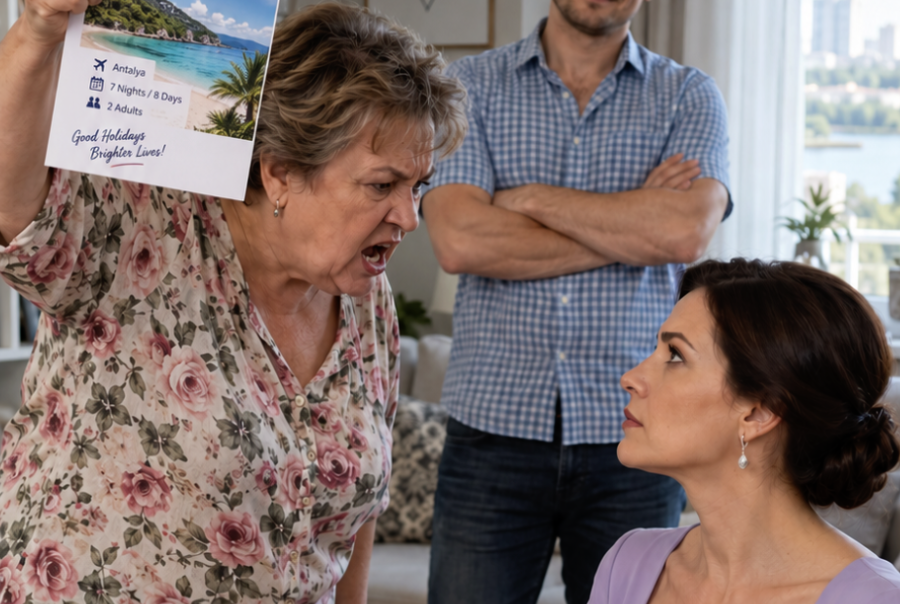
“What do you mean, treatment at a sanatorium? You’ll survive without it. I don’t even have wallpaper in my kitchen!” Inessa Pavlovna snapped.
Polina barely had time to react before her mother-in-law grabbed the printed voucher from the table.
Inessa Pavlovna had arrived without warning, carrying two large rolls of wallpaper and a bag of glue. Matvey had let her in, and within seconds she was standing in the kitchen as though she owned the place.
“A sanatorium!” she repeated with disgust. “You’re really going to waste ninety thousand rubles on that when my kitchen is falling apart?”
Polina sat silently.
Her back had been hurting since morning, the same dull ache she had lived with for months.
Six months earlier, she had undergone spinal surgery. The doctor had warned her clearly: rehabilitation could not be delayed. Without physiotherapy, mud treatments, and proper rest, she risked serious complications.
For eight months, Polina had saved for the trip herself. She skipped new clothes, cut back on lunches, and put aside part of every paycheck.
The specialized sanatorium in the Caucasus cost ninety thousand rubles.
She was supposed to leave in three days.
“I already promised Lyuba an advance,” Inessa Pavlovna continued. “She starts tomorrow. I need money for the renovation.”
“Mom—” Polina began.
“Don’t interrupt me. Matvey, explain it to her.”
Matvey sat beside Polina, staring at the table.
“Pol,” he said quietly. “Maybe Mom is right. You can return the voucher and go somewhere cheaper in autumn.”
Polina looked at her husband for a long moment.
Then Inessa Pavlovna slipped the voucher into her handbag.
“Her back is young. It’ll heal. But I can’t leave my kitchen like this forever.”
Polina felt something inside her change.
She did not shout.
She did not argue.
She simply stood up and left the apartment.
Outside, September was cold and damp. Polina walked slowly through wet streets, thinking.
The voucher was only paper.
The actual booking was electronic.
Inessa Pavlovna did not know that.
Polina stopped outside a pharmacy, looked at her pale reflection in the window, and made a decision.
Enough.
The next morning, she went to her doctor.
Dr. Serov examined her records and issued an official medical statement saying rehabilitation was necessary and should not be postponed.
Polina went home, packed a suitcase, and sent Matvey a message.
“I’m leaving this evening. The keys are on the hallway shelf.”
He called immediately.
“You’re serious?”
“Yes.”
“But Mom already promised Lyuba the money.”
“I’m going for treatment. The booking is electronic. Your mother can keep the paper.”
“Polina, wait. Let’s talk.”
“I need to be at the station by six.”
She ended the call.
That evening, she boarded the train.
For the first time in months, she felt that she had chosen herself.
The next morning, Lyuba arrived at Inessa Pavlovna’s apartment to begin the renovation.
By lunchtime, she had stripped all the old wallpaper from the kitchen walls.
Then she asked for the promised advance.
Inessa Pavlovna hesitated.
“My daughter-in-law is returning her sanatorium booking. I’m waiting for the money.”
Lyuba frowned.
“She’s returning it?”
“Of course. I explained that now isn’t the time for vacations.”
Lyuba took out her phone and called Polina.
Polina answered from the train.
“I’m already on my way. I didn’t cancel anything.”
Lyuba looked at Inessa Pavlovna.
Then she calmly packed her tools.
“I’m not working without an advance.”
“Lyuba, wait. Matvey will help.”
“When you have the money, call me.”
She left.
Inessa Pavlovna remained alone in a kitchen with bare walls.
That evening, Matvey came over after work.
His mother immediately began complaining.
“She did this deliberately! She wanted to humiliate me!”
Matvey looked at the stripped walls.
“Mom, do you actually have money for the renovation?”
“Polina was supposed to—”
“That’s not what I asked. Do you have the money?”
Silence.
“My pension is small. You know that.”
For the first time, Matvey understood that his mother had never had a real plan.
She had simply assumed Polina would surrender her money.
Now the kitchen was destroyed, Lyuba refused to return, and someone had to finish the work.
Matvey decided to do it himself.
For the next ten days, he went to his mother’s apartment after work.
He measured wallpaper, mixed glue, climbed onto stools, and tried to align patterns while Inessa Pavlovna sat in the living room criticizing him.
“That strip is crooked!”
“I know, Mom.”
“Then redo it!”
At eight in the evening, exhausted after a full workday, Matvey stood with glue on his hands and pain in his back.
And one thought slowly began forming in his mind.
Polina was receiving medical treatment.
He was hanging his mother’s wallpaper.
Meanwhile, Polina was surrounded by pine trees and mountains.
The sanatorium was peaceful.
She underwent mineral baths, physiotherapy, and mud treatments.
For the first time in half a year, the pain began to ease.
One evening, after realizing she could bend down and tie her shoes without wincing, she called a friend.
“How are you feeling?” her friend asked.
“Good,” Polina said. “For the first time in months, actually good.”
Matvey sent her a message three days later.
“How are you?”
She did not answer.
A week later, another message arrived.
“Mom is offended. You could at least apologize.”
Polina replied with one word.
“No.”
Two weeks later, she returned home.
Her back no longer hurt.
Matvey was sitting in the kitchen, looking exhausted. His hands still had traces of wallpaper paste.
“You’re back,” he said.
“I’m back.”
Polina glanced at the walls.
The wallpaper was slightly crooked.
She said nothing.
Matvey watched her carefully.
“I understand that I was wrong,” he finally said.
Polina sat opposite him.
“You weren’t just wrong. You sat there while your mother took my voucher. You asked me to cancel rehabilitation after spinal surgery. Then you told me I should apologize to her.”
Matvey lowered his eyes.
“I know.”
Polina went to the bedroom and returned with a beige folder.
She placed it on the table.
“What is that?” he asked.
“Documents.”
He opened the folder.
Divorce papers.
Matvey looked up.
“You’re serious?”
“Completely.”
“Polina, wait. I know I messed up, but divorce over wallpaper?”
“This isn’t about wallpaper.”
She spoke calmly.
“I spent eight months saving for treatment because my doctor told me my health depended on it. Your mother walked into our apartment, decided her kitchen was more important than my spine, and you supported her.”
He said nothing.
“My health is not something that gets negotiated. It is not something that gets compared with wallpaper.”
She paused.
“At the sanatorium, I realized that if I returned and pretended nothing happened, next time it would be something else. Different money. A different demand. But the same pattern.”
Matvey stared at the papers.
“I don’t think you’re a bad person,” Polina continued. “You’re just used to your mother always coming first. You’ve been taught that her comfort matters more than everyone else’s boundaries.”
She pushed the folder toward him.
“But I’m not living like that anymore.”
The apartment belonged to Polina. She had bought it before the marriage.
She gave Matvey two weeks to move out.
That evening, he called his mother.
Inessa Pavlovna immediately began shouting about ingratitude and how Polina had destroyed the family.
For once, Matvey did not listen endlessly.
“Mom, I’ll call you tomorrow.”
Then he hung up.
It was probably the first time in thirty-three years he had ended a conversation with her on his own terms.
Matvey moved out two weeks later.
The divorce was finalized quietly in January.
Inessa Pavlovna called Polina once several months later.
“You destroyed our family,” she said.
“Good evening, Inessa Pavlovna.”
“Did you hear me?”
“Yes. How’s the kitchen?”
Silence.
“What?”
“The wallpaper. Is it holding up?”
Inessa Pavlovna hung up.
Polina returned to her work.
In spring, she went back to the Caucasus for another course of rehabilitation.
The same pine trees surrounded the sanatorium.
The same river ran below.
But this time she felt lighter.
She walked through the grounds in the evenings and thought about everything that had happened.
Her doctor had been right about one thing beyond the medical advice.
She needed to protect herself.
Health was not selfishness.
It was not a whim.
It was not something to sacrifice because someone else wanted new wallpaper.
Without health, everything else eventually stopped mattering.
Polina looked toward the mountains and kept walking.
Her back did not hurt.